The best pearls for your mother are usually not the biggest, rarest, or most expensive ones. They are the pearls that fit the jewelry she already likes to wear.
If you know very little about her taste, a pair of medium-size white pearl studs or a simple pearl pendant is often the lowest-risk starting point. Freshwater pearls give you the most flexibility on budget and style. Akoya pearls suit a classic round white-pearl look. Tahitian pearls work better for someone who likes darker, more distinctive jewelry, while South Sea pearls make sense when larger size and luxury are deliberately part of the gift.
The most useful rule is this: choose the jewelry format first, the visual style second, and the pearl specification third. That order prevents you from buying an impressive pearl that does not fit the person receiving it.
Before Shopping, Spend 60 Seconds Looking at What She Already Wears
You can learn more from your mother's jewelry box than from most generic “pearls by age” charts.
Look for five clues:
- Format: Does she reach for studs, drop earrings, fine chains, pendants, bracelets, rings, or full necklaces?
- Scale: Are her pieces delicate, medium-sized, or visibly bold?
- Metal: Does she mostly wear yellow gold, white gold, silver, platinum, or rose gold?
- Color: Is her jewelry mostly white and neutral, warm-toned, dark, or colorful?
- Frequency: Does she wear jewelry every day or mainly for dinners, events, and formal occasions?
These clues tell you how the gift needs to behave in real life. A mother who wears tiny gold studs every day may get more use from a refined pair of pearls than from a dramatic strand. Someone who already collects statement jewelry may find 7 mm white studs too conservative even if a gift guide calls them “safe.”
This is why age should be a weak clue at most. There is no pearl diameter that automatically belongs to a 40-, 60-, or 80-year-old woman. Personal scale and style are much more useful.
Choose the Jewelry Format Before You Choose the Pearl Type
Gift buyers often start by asking “Freshwater or Akoya?” That question comes too early. First decide whether the gift should be earrings, a pendant, a strand, or something else.
| Jewelry format | Gift risk when you are unsure | Best clue that it will work |
|---|---|---|
| Pearl stud earrings | Low, if her ears are pierced | She already wears studs regularly |
| Single-pearl pendant | Low to medium | She wears fine chains or simple pendants |
| Drop earrings | Medium | She already wears movement or longer earrings |
| Pearl bracelet | Medium | She wears a watch, bangles, or bracelets often |
| Full pearl strand | Medium to high | You know she likes classic necklaces or already owns pearl strands |
| Pearl ring | High when taste is unknown | She already likes rings and will accept a more care-sensitive piece |
Why studs are often the easiest gift
Stud earrings remove several variables at once. You do not need to choose a necklace length, decide whether she layers chains, or guess whether a full strand feels too formal. For a first pearl gift, that simplicity is valuable.
Why a pendant is a strong second choice
A pendant gives the gift more visual presence than small studs while concentrating the budget on one main pearl. It also lets someone wear pearls without committing to the traditional look of a full strand.
When a full strand is the right answer
A pearl necklace can be the most memorable option when you already know she wants one. But a strand asks more questions: pearl size, length, matching, clasp, overall formality, and whether she prefers a uniform or more contemporary design. If you cannot answer those questions, earrings or a pendant are usually easier.
To compare finished formats rather than loose pearls or strands, browse the MJ Pearls jewelry collection.
Then Choose the Pearl “Character” That Fits Her Style
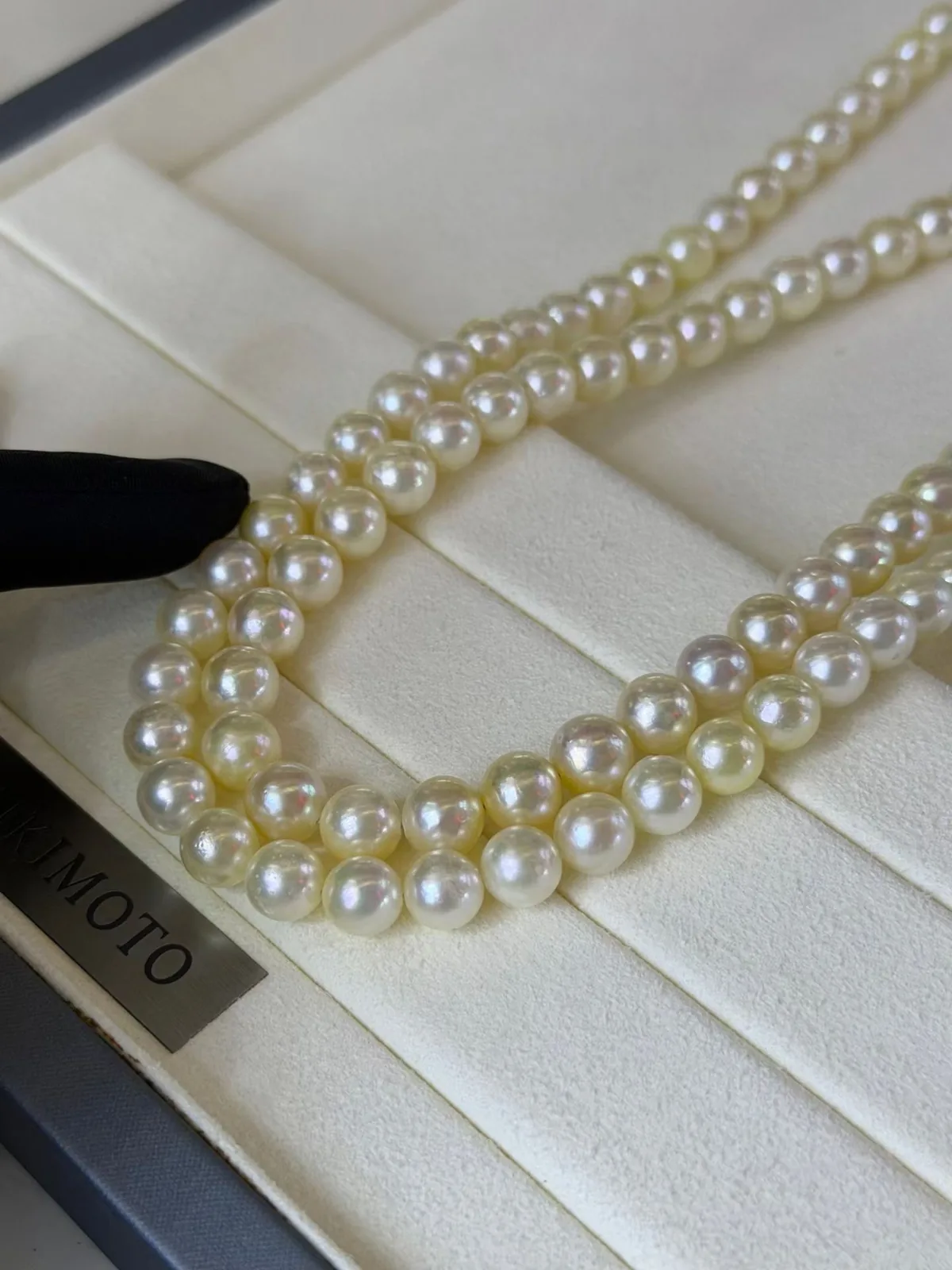
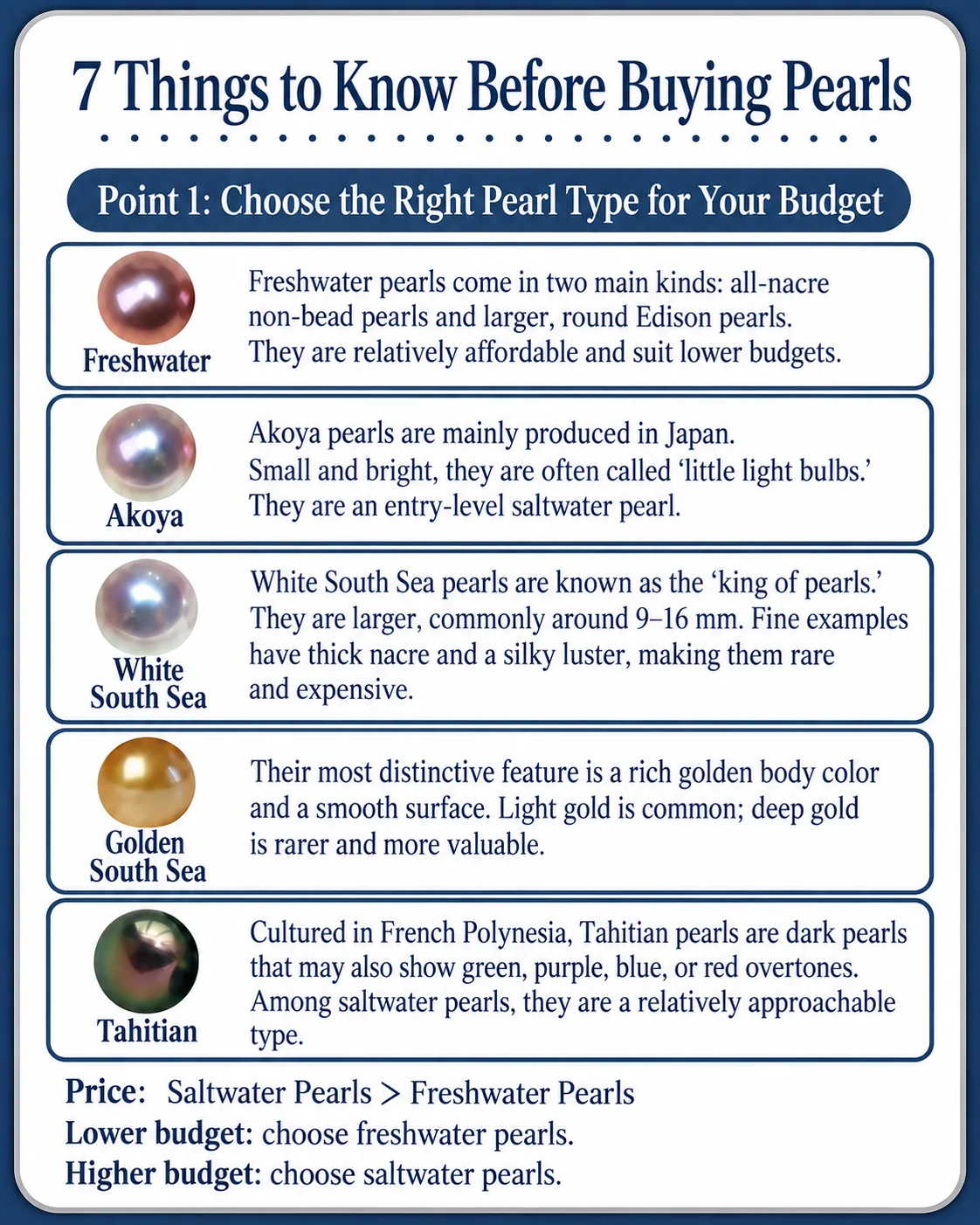
The major cultured pearl types are not simply four quality levels. They have different typical colors, sizes, luster character, rarity, and price structures. GIA's guide to freshwater, Akoya, Tahitian, and South Sea pearls is a useful technical reference.
| Pearl type | Visual character | Good fit for a mother who... | Main trade-off |
|---|---|---|---|
| Freshwater | Very broad range of white, pastel, round, near-round and baroque looks | Likes practical jewelry, variety, or good visible quality within a controlled budget | The category is very broad, so actual quality matters more than the name alone |
| Akoya | Classic round white look with bright, crisp luster | Wears polished, traditional, understated jewelry | You may pay more for the specific Akoya look and tighter roundness/matching |
| Tahitian | Gray, silver, green, brown and other naturally dark tones, often with colorful overtones | Likes modern, cool-toned, darker, or less conventional jewelry | The color is more distinctive, so personal preference matters more |
| South Sea | Large scale, white/silver or golden colors, often with a softer satiny luster | Likes larger jewelry and the gift is intentionally luxurious | Large high-quality pearls can carry a substantial price premium |
If you are still learning the categories, our Pearl Buying Guide explains the main differences without treating one type as universally superior.
Freshwater vs. Akoya is the most common gift decision. Choose Akoya when the specific goal is the traditional round white saltwater-pearl appearance. Choose freshwater when you want more freedom in size, color, shape, and budget. A high-luster freshwater pearl can be a better gift than a mediocre Akoya pearl if it suits her better.
Choose Pearl Size by Visual Presence, Not by Age
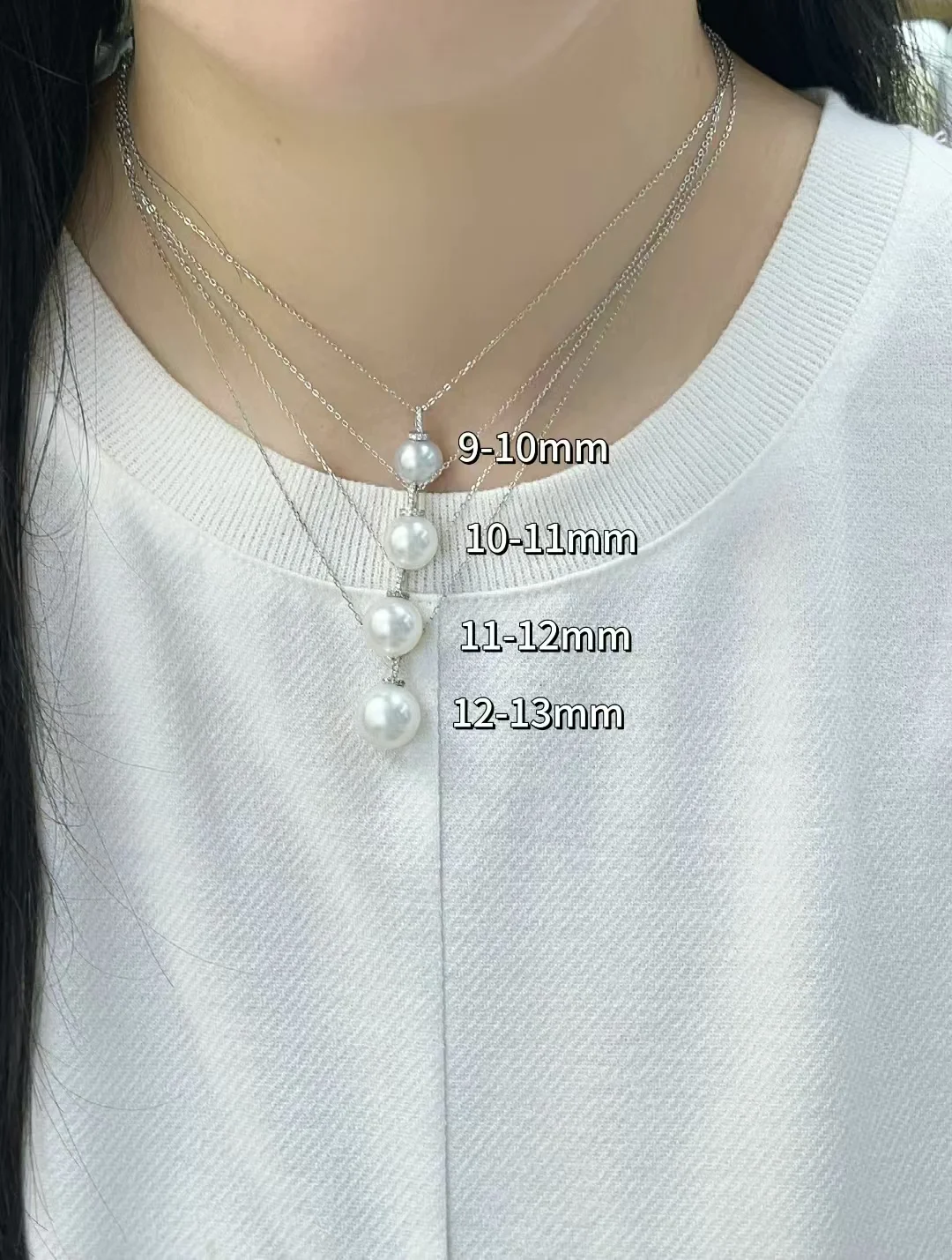
Pearl size is measured in millimeters. The numbers look close on paper, but even a one-millimeter change can be visually noticeable because the pearl increases in three dimensions.
Use size to answer one question: How noticeable should the pearl be when she wears it?
| Pearl size | Typical visual impression | Gift context |
|---|---|---|
| 5–6 mm | Delicate | Minimal jewelry, layering, understated studs |
| 6–7 mm | Refined and light | Everyday pieces for someone who dislikes bold jewelry |
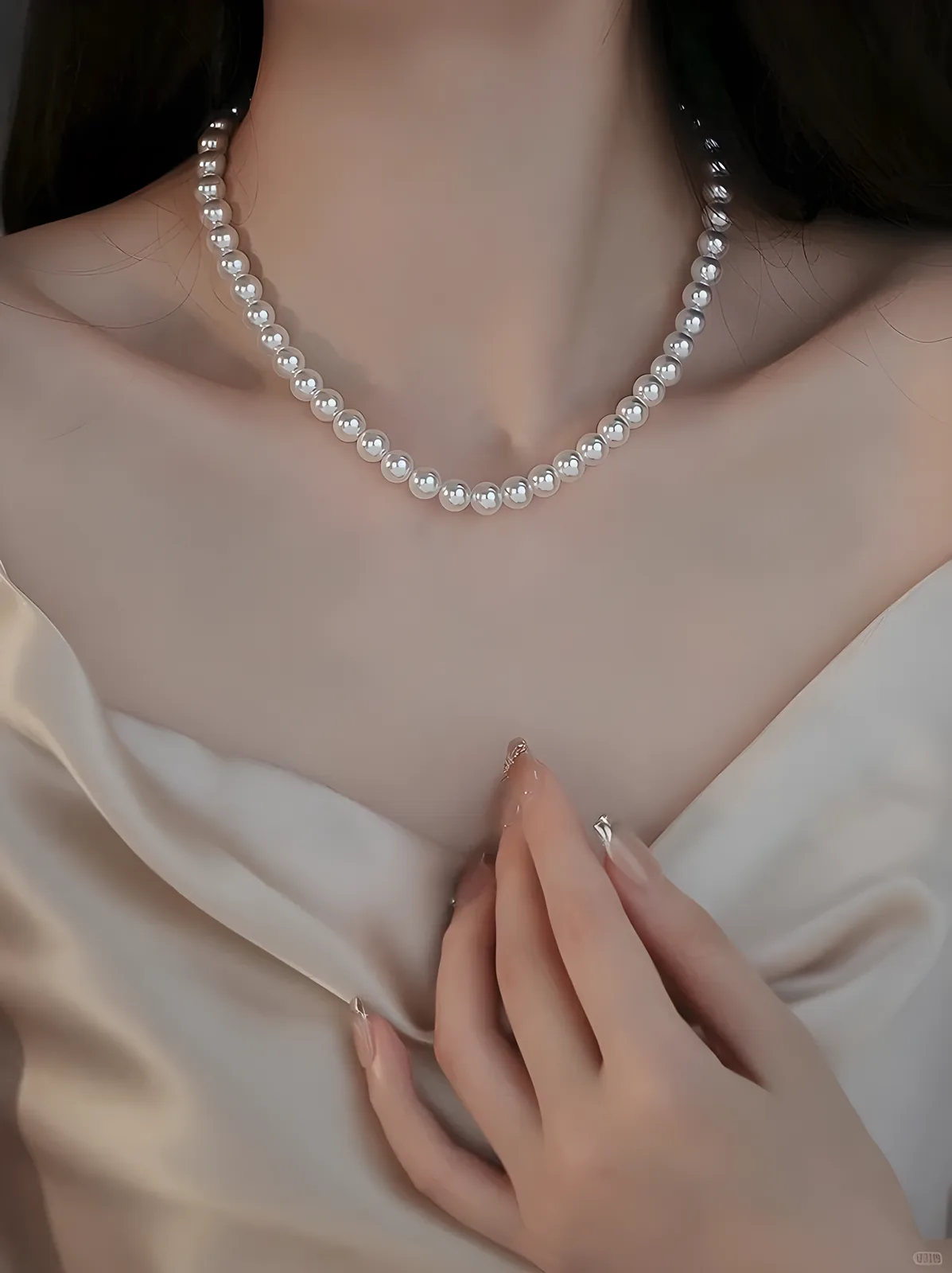
| 7–8 mm | Versatile medium scale | A practical default for classic white studs and necklaces |
| 8–9 mm | More visible | For someone who likes jewelry to register clearly |
| 9–10 mm | Substantial | Milestone gifts or stronger visual presence |
| 10 mm+ | Statement scale | Large freshwater, Tahitian, or South Sea pieces |
These are styling guides, not universal rules. Pearl type also changes the context: 8 mm is relatively substantial for Akoya, while it is near the smaller end of many Tahitian pieces.
If you are deciding between adjacent sizes, our Pearl Size Guide gives more visual context for earrings and necklaces.
How to Spend the Budget: Improve What She Will Actually Notice
There is no correct amount to spend on pearls for your mother. A better question is: What should the next dollar improve?
GIA describes pearl quality through seven value factors: size, shape, color, luster, surface, nacre, and matching. You can review the framework in GIA's Pearl Quality Factors guide.
For a gift, a practical spending order is often:
- Get the format right. A pair of earrings she wears weekly is more successful than a necklace she never reaches for.
- Protect luster. Bright, lively reflection has a major effect on how beautiful a pearl looks.
- Choose an appropriate size. Do not pay for diameter she would consider too large.
- Then improve surface quality and shape. Minor natural surface characteristics can be a rational compromise if they are not prominent.
- For pairs and strands, pay attention to matching. Similar size, color, luster, and overall appearance matter when pearls are viewed together.
- Only then decide how much the pearl type itself matters.
This leads to one useful gift strategy: reduce the number of pearls before reducing the quality of every pearl. If a fine necklace is beyond budget, a better pair of earrings or a well-selected pendant may feel more impressive than a lower-luster strand bought mainly because it contains more pearls.
Our Pearls by Budget guide explains these trade-offs in more detail.
Four Useful Starting Points When You Still Cannot Decide
These are not rigid formulas. They are starting configurations that reduce the number of decisions you need to make.
| Her style | Low-risk starting point | Why it works |
|---|---|---|
| Minimalist / everyday | 6–8 mm white freshwater studs or a small white pendant | Easy to wear and does not dominate an outfit |
| Classic / polished | 7–8 mm Akoya studs or a classic Akoya necklace if she already likes strands | Matches the traditional round white-pearl aesthetic |
| Modern / individual | Tahitian pendant or earrings | Dark natural bodycolors make the piece feel less conventional |
| Statement / luxury | 9 mm+ high-luster freshwater, Tahitian, or South Sea pendant/earrings | Larger scale creates presence without requiring a full strand |
If none of these descriptions fits her, go back to her actual jewelry. The existing collection should override the template.
Five Gift-Buying Mistakes That Matter More Than Pearl Trivia
1. Buying for her age instead of her taste
A larger pearl is not automatically more “mature,” and a smaller pearl is not automatically younger. Scale should follow the wearer.
2. Letting a grade label make the decision
Commercial labels such as AAA, AAAA, “top grade,” or “premium” are not reliably standardized across unrelated sellers. Compare the actual luster, surface, shape, color, size, and matching. Our Pearl Grading Guide explains why seller grades need definitions.
3. Spending the entire budget on size
A larger pearl can be valuable, but size does not compensate for dull luster or poor matching. If you must trade something away, maximum diameter is often easier to sacrifice than visible life and brightness.
4. Choosing a full set because it looks more generous
More pieces do not automatically make a better gift. If she mainly wears earrings, a strong pair may be more personal than a necklace-bracelet-earring set that does not fit her habits.
5. Ignoring the finished jewelry details
The pearl is only part of the gift. Check the metal, earring posts and backs, chain, clasp, setting, necklace length, and overall workmanship. A beautiful pearl in an inconvenient design can still go unworn.
Before You Buy, Check These Seven Details
- Pearl identity: freshwater, Akoya, Tahitian, South Sea, or another clearly disclosed category.
- Size: confirm the actual millimeter measurement or range.
- Luster: look for bright, lively reflections rather than relying only on a quality adjective.
- Surface and shape: judge what is visible at normal wearing distance and whether the shape suits the design.
- Color and treatment disclosure: especially when unusual color is an important part of the price or appeal.
- Metal and construction: verify the setting metal, posts, backs, chain, clasp, and workmanship.
- Return or exchange terms: particularly important for gifts, because the recipient may prefer another size or format.
When shopping remotely, side-by-side photos or video under similar lighting are more useful than comparing isolated product photos with different exposure, angles, or editing.
If You Know Almost Nothing About Her Taste, Use This Conservative Default
If her ears are pierced and she wears studs, start with 7–8 mm white freshwater or Akoya pearl studs. If she wears necklaces more often, choose a simple white pearl pendant.
Why this default? It keeps four variables moderate: color, size, design complexity, and styling commitment. White coordinates easily, medium sizes are neither tiny nor strongly statement-making, and simple earrings or pendants are easier to integrate into an existing wardrobe than a full strand.
But use this only when you truly lack better information. If her jewelry box clearly says “large, dark, sculptural, modern,” a conservative white stud is not the thoughtful choice. The evidence you have about her should always beat a generic rule.
The Best Pearl Gift Should Look Like You Paid Attention
Pearls can work for Mother's Day, birthdays, retirements, anniversaries, and major family milestones. The occasion explains why you are giving the gift; it does not tell you what she should wear.
Start with her habits. Choose the format she already likes, then decide how subtle or visible the piece should be. After that, choose the pearl type and quality level that fit both the look and the budget.
Freshwater pearls offer the most flexibility. Akoya pearls give you the classic bright white-pearl look. Tahitian pearls suit darker, more individual jewelry. South Sea pearls make sense when larger scale and luxury are intentional.
If the final choice is between a more expensive pearl that does not resemble anything she wears and a slightly simpler piece that fits her style perfectly, the simpler piece is often the better gift. The best pearl for your mother is the one that feels like it was chosen for her.
Frequently Asked Questions
What is the safest pearl gift for a mother?
If her ears are pierced and she already wears studs, medium white pearl stud earrings are one of the lowest-risk choices. A simple single-pearl pendant is another versatile option when you are unsure whether she wants a full strand.
Is 7–8 mm a good pearl size for a mother?
It is a versatile medium size for many white pearl earrings and necklaces, but it should not be chosen because of age. A mother who prefers delicate jewelry may want smaller pearls, while someone who likes bold jewelry may prefer 9–10 mm or larger.
Are freshwater pearls good enough for a gift?
Yes. Freshwater cultured pearls are real cultured pearls and can range from commercial to very high quality. Judge the actual luster, surface, shape, color, and matching instead of assuming freshwater automatically means low quality.
Should I buy Akoya or freshwater pearls for my mother?
Choose Akoya when the goal is the classic round white saltwater-pearl look with bright, crisp luster. Choose freshwater when you want more flexibility in size, shape, color, style, and budget. Compare actual quality rather than the type name alone.
Are pearl earrings or a pearl necklace a better gift for mom?
Earrings are usually easier when you do not know her preferences because you do not have to choose necklace length or strand style. A necklace can be a better gift when you already know she likes full pearl strands.
Should I spend more on larger pearls or better quality?
For most gifts, protect luster and overall appearance before chasing maximum size. A slightly smaller pearl with stronger luster and better matching can be more attractive and easier to wear than a larger but duller pearl.