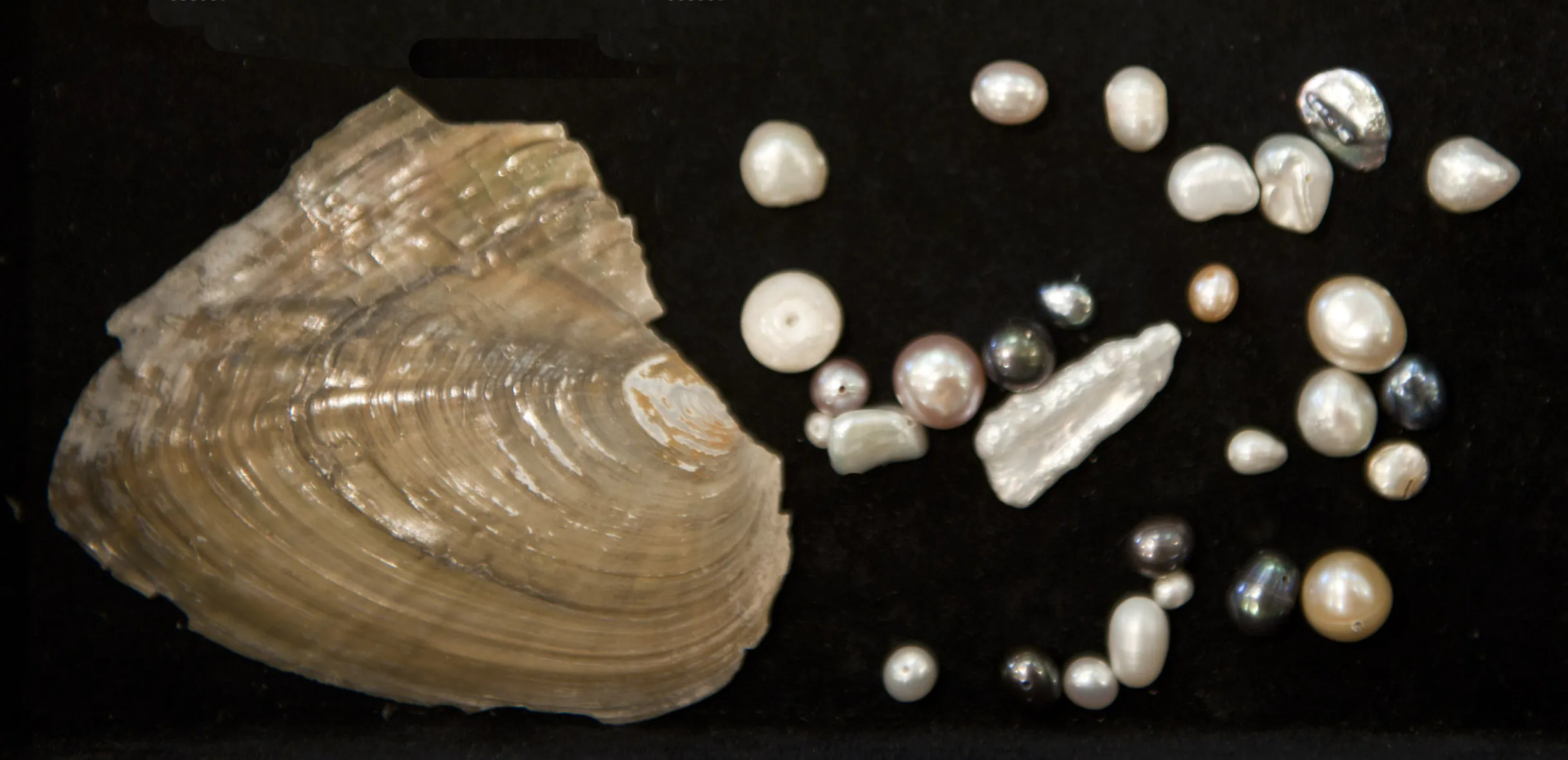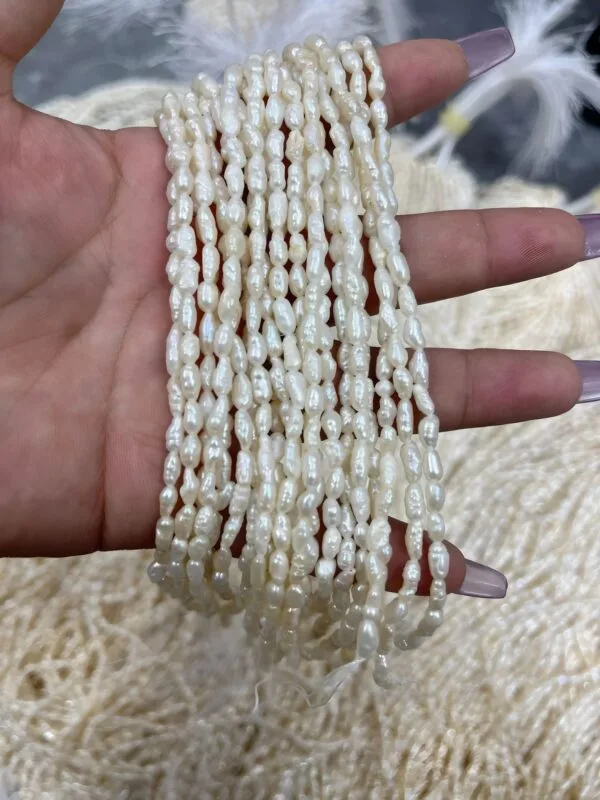
Keshi pearls are non-beaded pearls associated with cultured pearl production. Instead of growing around the solid shell bead used for a typical saltwater cultured pearl, they form without that bead at the center. This usually gives them a nacre-rich structure, free-form shapes, and—when quality is good—especially lively luster.
The important point is that Keshi describes formation, not simply appearance. An irregular pearl is not automatically Keshi, and a beadless pearl is not automatically a natural pearl. Understanding those distinctions makes it much easier to judge what a seller is actually offering and whether the price makes sense.
What exactly is a Keshi pearl?
In careful modern trade terminology, the clearest phrase is Keshi cultured pearl. The CIBJO Pearl Book defines it as a non-beaded cultured pearl formed in marine pearl oysters as a by-product of the culturing process. CIBJO also notes that the older word “Keshi” has been used more broadly, which is why using the term without qualification can create confusion.
That definition gives us three useful ideas:
- It is a real pearl. It is formed by a pearl-producing mollusk, not manufactured as an imitation bead.
- It is non-beaded. There is no conventional solid bead nucleus at its center at harvest.
- It is connected to cultivation. Human intervention created the pearl-culturing conditions in which it formed.
This is why a Keshi cultured pearl should not be described casually as a “natural pearl” just because it lacks a bead. If you want the broader biological background first, see our guide to how pearls form.
How do Keshi pearls form?
A standard bead-cultured saltwater pearl begins when a technician inserts a shell bead nucleus together with a small piece of donor mantle tissue. That tissue helps form a pearl sac, which deposits nacre around the bead.
Keshi formation happens when the process develops differently. The simplest and most familiar route is bead rejection: the bead is expelled or no longer remains in the pearl sac, but pearl-forming tissue stays active and continues depositing nacre. The result can be a non-beaded cultured pearl.
But bead rejection is not the only possible mechanism. CIBJO describes Keshi cultured pearls as potentially developing from part or all of inserted mantle tissue, from a pearl sac that continues after bead rejection, or from other cultivation-related tissue responses. GIA research on non-bead-cultured pearls from Pinctada margaritifera and Pinctada maxima likewise shows that several formation pathways are possible.
A simple way to picture the difference
| Pearl type | What happens during formation? | Solid bead at the center? |
|---|---|---|
| Typical saltwater bead-cultured pearl | A pearl sac deposits nacre around an inserted shell bead | Yes |
| Keshi cultured pearl | A non-beaded pearl develops in connection with the culturing operation | No conventional bead nucleus |
| Natural pearl | Pearl formation begins without deliberate human cultivation intervention | Not a cultured shell bead nucleus |
Are Keshi pearls really “all nacre”?
You will often see Keshi pearls marketed as “100% nacre.” The idea behind that phrase is reasonable: because a Keshi cultured pearl has no conventional shell bead at its center, most of its body is pearl material rather than a thin nacre coating over a large bead.
For technical accuracy, however, non-beaded or nacre-rich is usually safer wording than treating “100% nacre” as a guarantee about every microscopic internal feature. GIA describes many saltwater non-bead cultured pearls as mainly composed of solid nacre, while gemological imaging can also reveal organic features, cavities, or other internal structures.
This distinction matters because “all nacre” is sometimes used as a shortcut for “automatically superior.” It is not. A dull, heavily blemished Keshi pearl does not become fine quality simply because it lacks a bead nucleus.
Why are Keshi pearls usually irregular in shape?
A round shell bead gives a conventional cultured pearl a spherical framework to grow around. Keshi pearls do not have that rigid central guide, so their final form is more strongly influenced by the shape of the pearl sac, tissue growth, available space, and the way nacre is deposited.
The result can be highly variable. Keshi pearls may appear flattened, petal-like, elongated, button-like, folded, drop-shaped, or completely free-form. Trade descriptions such as “petal,” “flake,” or “wing” can be useful visually, but they are not universal gemological grades.
If you are comparing shapes, our pearl shape guide explains the broader vocabulary used for round, oval, drop, button, circled, and baroque pearls.
Keshi and baroque are not synonyms
This is one of the most common naming mistakes. Baroque describes shape. Keshi describes formation and structure. Many Keshi pearls are baroque because they are irregular, but a bead-cultured pearl can also be baroque while still containing a solid bead nucleus.
For a deeper comparison of irregular pearl forms, see what baroque pearls are and how their value is judged.
What types of Keshi cultured pearls are there?
Keshi cultured pearls are commonly named for the marine pearl oyster associated with their production.
Akoya Keshi
Akoya Keshi are associated with Pinctada fucata. The historical Japanese use of “keshi,” meaning poppy seed, reflected the very small pearls that could appear as by-products of Akoya cultivation. Modern Akoya Keshi can vary in size, but they are often admired for crisp luster and delicate scale.
Tahitian Keshi
Tahitian Keshi come from black-lipped pearl oysters, Pinctada margaritifera. They can display the dark gray-to-black bodycolors and green, blue, purple, or mixed overtones associated with Tahitian cultured pearls. Their free forms can make those colors appear especially dynamic as the pearl moves.
South Sea Keshi
South Sea Keshi are associated with Pinctada maxima. They may be silver-white, cream, or golden depending on the oyster and production context, and they can reach much larger, more sculptural forms than the tiny Keshi historically associated with Akoya production.
What about “freshwater Keshi pearls”?
You will see this phrase frequently in the market, especially for small, irregular freshwater cultured pearls. Visually, the label may seem intuitive because many freshwater pearls are non-beaded and can resemble the organic shapes buyers associate with Keshi.
Strict terminology is more cautious. CIBJO defines Keshi cultured pearl in connection with marine pearl oysters, while freshwater non-beaded cultured pearls are classified separately. In other words, “freshwater Keshi” is widely understood as a trade expression, but it does not carry the same precise formation meaning as saltwater Keshi cultured pearl.
If the distinction matters to you, ask the seller what they mean by the label. For the freshwater category itself, see our guide to freshwater non-nucleated cultured pearls.
Why can Keshi pearls have such strong luster?
Fine Keshi pearls are famous for lively reflections, orient, and a sense of depth. Their nacre-rich structure is part of the reason, but it is not the whole explanation. Luster depends on the quality, organization, and surface condition of the nacre—not merely on how much nacre exists.
A high-quality Keshi pearl can show sharp, bright reflections across an irregular surface. That combination produces the “liquid” or shifting look many buyers find attractive. But two Keshi pearls with similar shapes can still differ dramatically in luster.
So when comparing Keshi pearls, do not let the formation story replace visual judgment. Look at the pearl first; read the label second.
What determines the value of Keshi pearls?
There is no single “Keshi price.” GIA evaluates pearls through seven broad value factors: size, shape, color, luster, surface, nacre, and matching. The same framework is useful for Keshi, but some factors need to be interpreted differently because irregularity is part of the category’s appeal.
| Value factor | What matters for Keshi pearls |
|---|---|
| Luster | Usually the first thing to judge. Bright, sharp reflections and strong visual depth can separate an attractive Keshi from a dull one. |
| Shape | Roundness is not the only goal. In design-led Keshi jewelry, a balanced, expressive, or usable organic form may be more desirable than a random awkward shape. |
| Surface | Texture is common, but deep pits, cracks, thin fragile edges, or distracting damage can reduce beauty, durability, and value. |
| Color and orient | Attractive bodycolor, overtone, and orient can strongly affect desirability, especially in Tahitian and South Sea Keshi. |
| Size | Larger examples can be less common within the same pearl type, but size only adds value when the other quality factors remain strong. |
| Matching | For pairs and strands, matching means visual harmony rather than identical outlines. Similar luster, color, scale, and overall rhythm can be difficult to assemble. |
| Origin and disclosure | Knowing whether the pearl is Akoya, Tahitian, South Sea, or freshwater—and whether “Keshi” is being used precisely—helps buyers compare like with like. |
Our pearl grading guide gives a broader framework for judging luster, surface, shape, nacre, and matching across pearl types.
Are Keshi pearls automatically more valuable because they are non-beaded?
No. Their structure can contribute to strong luster and makes them interesting to collectors and designers, but value still depends on the individual pearl. A small dull Keshi with an unattractive surface can be inexpensive, while a large, highly lustrous, beautifully colored saltwater Keshi—or a difficult matched pair—can be much more valuable.
The word “Keshi” tells you what category of pearl you may be looking at. It does not tell you the grade.
Keshi pearls vs. similar pearl terms
| Term | What it primarily describes | Key distinction |
|---|---|---|
| Keshi cultured pearl | Formation / structure | Non-beaded cultured pearl associated with marine pearl cultivation |
| Baroque pearl | Shape | Irregular outline; may be bead-cultured, non-beaded cultured, or natural |
| Natural pearl | Origin of formation | Forms without deliberate human cultivation intervention |
| Freshwater non-beaded cultured pearl | Cultivation method / environment | Freshwater category that should not automatically be equated with strict marine Keshi terminology |
How should you evaluate Keshi pearls before buying?
Because Keshi pearls are irregular, a single front-facing photo often hides important information. A practical inspection should focus on both beauty and usability.
- Confirm what the seller means by “Keshi.” Ask whether the pearl is Akoya, Tahitian, South Sea, or freshwater, and whether it is being sold as a non-beaded cultured pearl or simply under a loose trade label.
- Check luster under neutral light. Brightness alone is not enough; look for sharp reflections and visual depth rather than a chalky surface shine.
- Ask for more than one view. Front, back, side, and a short video help reveal folds, thin edges, flat areas, drill placement, and overall balance.
- Use multiple measurements. For a free-form pearl, one diameter can be misleading. Length × width—and sometimes depth—better describes the true scale.
- Judge the shape for its intended use. A dramatic asymmetry may be ideal for a pendant but inconvenient for a matched stud earring.
- For pairs and strands, judge harmony rather than clones. Similar luster, color, visual weight, and scale often matter more than forcing two organic pearls to have identical outlines.
- Do not pay for the label alone. “Keshi,” “all nacre,” or “rare” should never replace a direct comparison of quality.
If you are buying pearls for jewelry making or production rather than a finished piece, browsing loose pearls for sourcing and matching can make it easier to compare individual shapes, drilling options, and lot consistency.
When does a laboratory report matter?
For ordinary commercial Keshi jewelry, a laboratory report is not always necessary. But the distinction becomes more important when a pearl is unusually valuable, is being represented as natural rather than cultured, or has an origin claim that materially affects price.
Natural and non-bead cultured pearls can sometimes share similar outward appearances and even some internal features. GIA research shows why gemological identification may require X-radiography and other laboratory methods rather than visual inspection alone. If the price depends heavily on the exact formation category, documentation can be worth the extra step.
Final takeaway
Keshi pearls are best understood as a formation category, not a shape nickname. In modern careful usage, a Keshi cultured pearl is a non-beaded pearl connected to marine pearl cultivation. It may form after bead rejection or through other cultivation-related pearl-sac processes, which is why not every Keshi pearl follows exactly the same formation story.
The absence of a bead helps explain their nacre-rich structure and often expressive shape, but it does not guarantee high quality or high value. The best Keshi pearls earn their value the same way other fine pearls do: through strong luster, attractive color, good surface quality, compelling form, useful size, and—when several pearls are used together—skillful matching.
If you remember one rule when shopping, make it this: buy the quality you can see and verify, not the romance of the word “Keshi.”
Frequently Asked Questions
Are Keshi pearls natural pearls?
Usually, no. Modern Keshi cultured pearls are connected to a cultured pearl operation even though they do not contain the conventional solid bead nucleus. CIBJO recommends qualifying the term rather than using “Keshi” alone when the natural-versus-cultured distinction matters.
Are Keshi pearls real pearls?
Yes. Keshi cultured pearls are real pearls produced by pearl-forming mollusks. They are not imitation pearl beads.
Are all Keshi pearls baroque?
Many are irregular or baroque, but the terms describe different things. Baroque is a shape description; Keshi refers to formation and structure.
Are Keshi pearls 100% nacre?
They are non-beaded and commonly described as all-nacre or nacre-rich. For precise gemological wording, it is safer to say they are mainly or essentially composed of nacre rather than assuming every specimen has a perfectly uniform solid-nacre interior.
Are “freshwater Keshi pearls” really Keshi?
The phrase is common in commercial use, but strict CIBJO terminology associates Keshi cultured pearls with marine pearl oysters. When buying freshwater material, ask how the pearl was cultured instead of relying on the Keshi label alone.
Why are some Keshi pearls expensive?
High prices usually reflect a combination of strong luster, attractive color, good surface quality, larger or desirable size, unusual but usable shape, species or origin, and difficult matching—not merely the fact that the pearl is Keshi.
References
- CIBJO Pearl Book 2024 — terminology for Keshi and Keshi cultured pearls.
- CIBJO Guide for Classifying Natural Pearls and Cultured Pearls — illustrated background on non-bead and Keshi cultured pearls.
- GIA: Non-Bead-Cultured Pearls from Pinctada margaritifera — formation routes and gemological observations for Tahitian-type non-bead cultured pearls.
- GIA: Internal Structures of Known Pinctada maxima Pearls — Cultured Pearls — research on non-bead cultured South Sea pearls.
- GIA Pearl Quality Factors — size, shape, color, luster, surface, nacre, and matching.