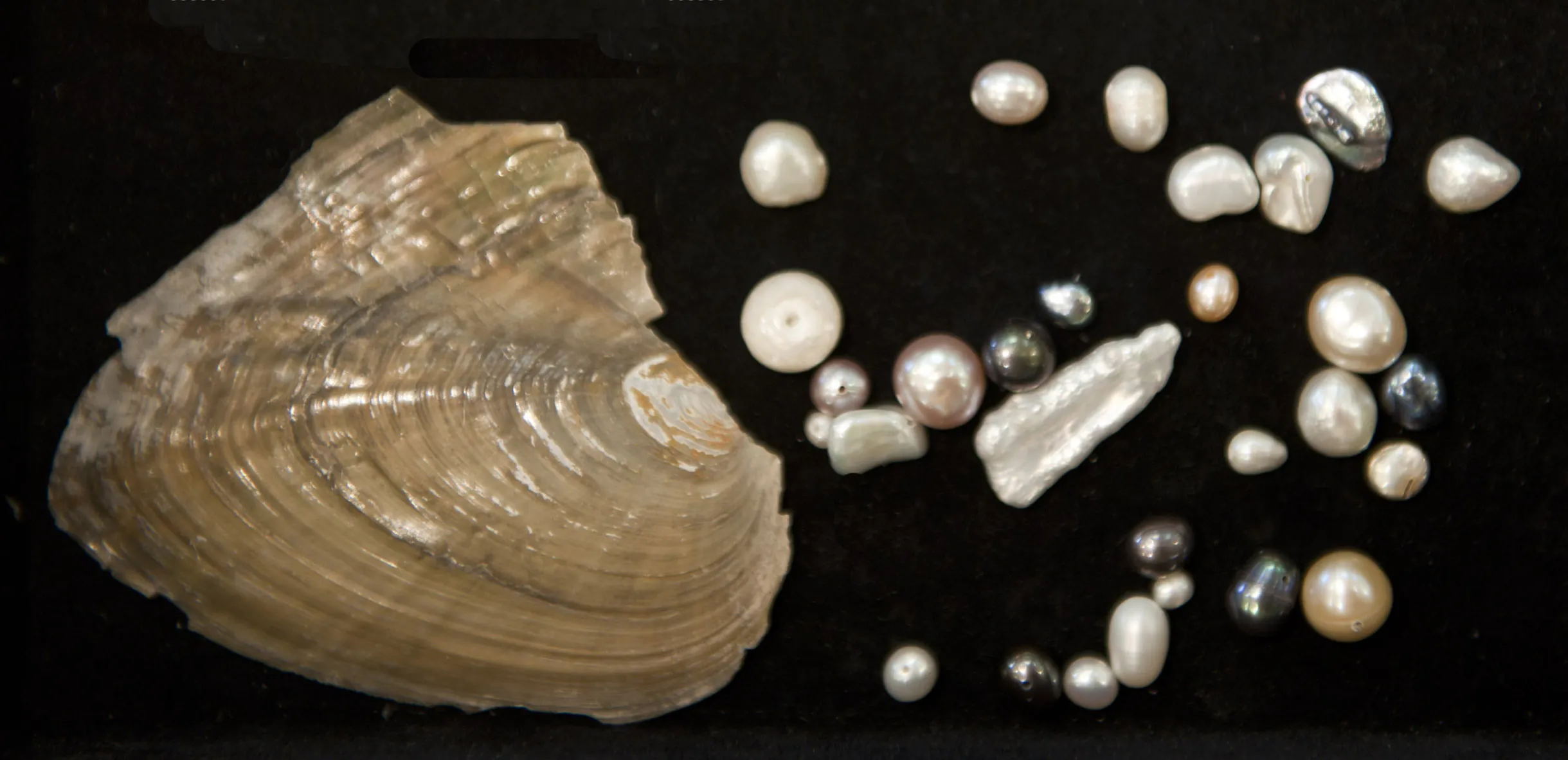
Pearls grow layer by layer because the living tissue around a developing pearl does not create the whole pearl at once. A structure called the pearl sac keeps depositing new mineral and organic material onto the pearl's existing surface. Earlier material becomes buried inside, while newer material is added outside it. Repeated over months or years, that incremental deposition makes the pearl larger.
In familiar nacreous pearls—such as Akoya, Tahitian, South Sea, and most freshwater pearls—the deposited material is nacre, or mother-of-pearl. Nacre is a highly organized biological composite made mostly of calcium carbonate, commonly in the form of aragonite, together with a small amount of organic matrix.
There is one useful correction to the common “onion layers” picture: under a microscope, nacre does not necessarily appear as a perfectly smooth coat that is completed around the whole pearl before the next coat begins. Growth occurs through many microscopic mineralization events. “Layer by layer” is correct at the larger scale, but the actual construction process is much more intricate.
The Short Answer: New Pearl Material Can Only Be Added at the Growth Surface
A finished pearl may look like one solid object, but biologically it is the accumulated result of repeated secretion and mineralization. The pearl sac surrounds the developing pearl. Its epithelial cells release the ingredients that form pearl material at the interface between the living tissue and the pearl.
Once one increment of material has hardened, it is no longer the active growth surface. The pearl sac continues working outside that older material and deposits the next increment over it. This naturally creates an inside-to-outside growth record:
- pearl-forming epithelial cells organize into a pearl sac;
- the sac deposits organic and mineral components onto the current surface;
- that deposit becomes part of the pearl;
- new material is deposited over the previous material;
- the cycle continues as the pearl enlarges.
If you want the complete biological sequence before focusing on the layers themselves, see our guide to how pearls form naturally and in culture.
What Is Actually Being Deposited in Each Nacre Layer?
Nacre is not simply calcium carbonate painted onto a pearl. It is a biologically organized composite. In many nacre-producing mollusks, thin aragonite structures are separated and controlled by extremely thin organic sheets containing proteins and polysaccharides.
This architecture is often compared with a brick wall:
- aragonite platelets or tablets act roughly like the mineral “bricks”;
- organic matrix acts roughly like the material organizing and separating those mineral units;
- many repeating mineral-organic units build a thicker nacreous structure.
The analogy is useful, but nacre is more sophisticated than ordinary masonry. Research on mollusk nacre shows that mineral growth can occur through nanoscale precursor particles, organic compartments, mineral bridges, and crystallization processes controlled by the biological matrix. The final structure is hierarchical rather than a stack of simple flat sheets.
For a broader explanation of what pearls are physically made of, see the physical and chemical properties of pearls.
Does a Mollusk Finish One Perfect Layer Before Starting the Next?
Not necessarily. This is where the phrase “layer by layer” can become too literal.
Modern studies of nacre growth show that a new nacre layer can begin at multiple microscopic growth centers. Mineralized regions then expand and fill space along the layer. In other words, the developing nacre can grow both outward to create new lamellae and sideways as individual mineral regions expand within a lamella.
A better mental model is therefore not “dip the pearl in one complete coat, dry it, then dip it again.” It is closer to a living construction surface where many tiny sections are being organized, mineralized, and joined as growth proceeds.
At the scale of the whole pearl, the result is still successive growth from the center outward. At the microscopic scale, however, each apparent layer is itself assembled from smaller structures and growth events.
Why Does the Pearl Sac Keep Making More Layers?
The pearl sac consists of living epithelial cells derived from shell-forming tissue. As long as those cells remain active and the mollusk remains healthy enough to sustain the process, the sac can continue secreting the materials involved in biomineralization.
That is why pearl growth is gradual rather than instantaneous. A cultured pearl farmer can start the process by grafting mantle tissue and, in many saltwater systems, inserting a bead nucleus. But after implantation, the actual pearl surface is produced by the mollusk over time.
The same logic applies to a natural pearl: once pearl-forming tissue has created a functioning sac, continued secretion adds material to the existing pearl. The beginning may be different, but the ongoing growth principle is similar.
How Does Layered Growth Make a Pearl Larger?
Each deposition event adds only a very small amount of thickness. But a pearl is growing over nearly its entire exposed surface inside the pearl sac. Repeated microscopic additions therefore increase the pearl's diameter little by little.
For a bead-nucleated cultured pearl, the bead establishes much of the starting diameter. Nacre then accumulates over the bead. For many non-bead freshwater cultured pearls, there is no large spherical bead at the center, so the pearl body is built predominantly from the material deposited by the pearl sac.
This distinction matters when people talk about “pearl size.” A 10 mm bead-nucleated pearl is not 10 mm of nacre from center to surface. Its final diameter includes the nucleus plus the nacre grown around it. A tissue-nucleated pearl can have a very different internal structure even when the outside diameter is similar.
Do More Layers Automatically Mean Better Luster?
No. More growth time can allow more pearl material to accumulate, but layer quantity alone does not guarantee better luster.
Pearl luster depends strongly on how light interacts with the surface and near-surface nacre. The smoothness of the surface, the organization and continuity of the nacre structure, and the quality of the mineral deposition all matter. A thick but poorly organized or damaged surface can look less attractive than a well-formed surface with excellent optical structure.
Layering does matter because nacre is not a single glossy film. Multiple organized mineral-organic interfaces help create the depth and optical effects associated with fine pearls. But it is more accurate to say good nacre architecture supports good luster than to say “the pearl with the most layers is automatically the most lustrous.”
For the visual side of this topic, see our Pearl Luster Guide.
Why Can Layered Growth Produce Rings, Ridges, or Baroque Shapes?
Layer-by-layer growth does not guarantee that every part of the pearl receives material at exactly the same rate or in exactly the same geometry.
If deposition remains very even around a stable, round center, the pearl has a better chance of staying round. If growth is uneven, if the pearl sac has an irregular shape, if the nucleus shifts, or if local conditions differ around the surface, the developing pearl can become oval, drop-shaped, circled, or baroque.
This is another reason to avoid imagining each “layer” as a perfectly uniform spherical shell. The living growth surface can vary from place to place. Small differences repeated over many growth increments can become visible differences in the final form.
Does a Longer Cultivation Period Always Create a Thicker, Better Pearl?
A longer healthy growth period generally gives the pearl sac more time to deposit material, so cultivation duration can influence nacre accumulation. But time is only one variable.
Growth rate and quality can also be affected by species, water temperature, food availability, seasonal conditions, mollusk health, pearl-sac stability, and farming practice. Extra time cannot correct every problem. If deposition is poor, the surface is damaged, or the mollusk is stressed, simply waiting longer does not guarantee a better result.
This is why nacre thickness and cultivation time should not be treated as interchangeable measures of quality. For a fuller explanation, see pearl cultivation time and maturity.
Are the Layers the Same in Natural and Cultured Pearls?
Natural and cultured nacreous pearls both rely on living pearl-forming tissue and incremental deposition, but their internal structures can differ because they start differently.
A bead-nucleated cultured pearl has a manufactured shell bead at its center, followed by nacre deposited around it. A natural pearl does not contain a deliberately inserted bead nucleus. Many tissue-nucleated freshwater cultured pearls also lack a large bead and may consist largely of nacreous material.
Those differences are important in gemological identification. The outside appearance alone may not reliably reveal how a pearl began, which is why laboratories use methods such as X-radiography to examine internal growth structures when origin determination matters.
Do All Pearls Have the Same Nacre Layer Structure?
No. The “aragonite-tablet nacre” explanation applies to familiar nacreous pearls, not to every biological pearl produced by every mollusk.
Conch pearls, Melo pearls, and some other non-nacreous pearls have different microscopic structures. They can still grow incrementally as the animal deposits material, but it is inaccurate to describe all of them as being made from classic mother-of-pearl nacre.
So when someone says “pearls grow in layers,” the safest interpretation is: pearl material is added progressively over time. For nacreous pearls, those additions create the characteristic layered nacre architecture. Other pearl types may use a different mineral microstructure.
What the Layered Structure Tells You About Pearl Care
A pearl's beauty depends on the condition of its outermost material. The oldest layers may be deep inside, but the layers you see are the newest ones at the surface. Scratching, abrasion, harsh chemicals, dehydration, or other damage affects that outer growth surface first.
This is one reason pearls should not be treated like harder crystalline gemstones. Their surface is a biological composite with a comparatively soft, delicate finish. Proper care helps preserve the smooth outer nacre that controls much of the visible reflection.
The Main Idea to Remember
A pearl grows layer by layer because living pearl-sac cells can only add new material at the current growth surface. Each new deposit covers older material, so the pearl records its growth from the inside outward.
In nacreous pearls, that process creates an exceptionally organized mineral-organic composite rather than a simple sequence of paint-like coatings. At the whole-pearl scale the growth looks concentric; at the microscopic scale it is a dynamic biomineralization process involving many small growth centers, mineral structures, organic interfaces, and crystallization events.
That distinction explains not only why pearls become larger, but also why growth conditions can influence their luster, surface, shape, and internal structure.
Frequently Asked Questions
Is a pearl one solid crystal?
No. A nacreous pearl is a biological composite rather than one single crystal. Its nacre contains many organized calcium-carbonate structures together with an organic matrix.
Can you see every nacre layer with the naked eye?
No. The structural units that make up nacre are microscopic. A pearl may show visible growth features such as rings, ridges, or surface lines, but those visible marks are not a one-to-one map of every microscopic nacre layer.
Does each new layer make a pearl rounder?
Not necessarily. If deposition is very even, a round shape can be maintained. If growth is uneven, repeated deposition can preserve or amplify irregularities, producing oval, circled, or baroque shapes.
Does thicker nacre always mean stronger luster?
No. Nacre accumulation matters, but luster also depends on surface smoothness and the organization and quality of the near-surface nacre. Thickness alone does not guarantee a more lustrous pearl.
Do non-nacreous pearls also grow layer by layer?
They also grow through progressive biological deposition, but their microstructure is not the same as classic nacre. It is better to say that they grow incrementally rather than describing all non-nacreous pearls as stacks of mother-of-pearl layers.
Sources and Further Reading
- FAO: Pearl Oyster Farming and Pearl Culture — Pearl Formation
- Nature Communications: Growth Dynamics and Amorphous-to-Crystalline Phase Transformation in Natural Nacre
- Nature Communications: Biomimetic Layer-by-Layer Assembly of Artificial Nacre
- Scientific Reports: Shell Matrix Proteins and Nacre Structure in the Pearl Oyster Pinctada fucata