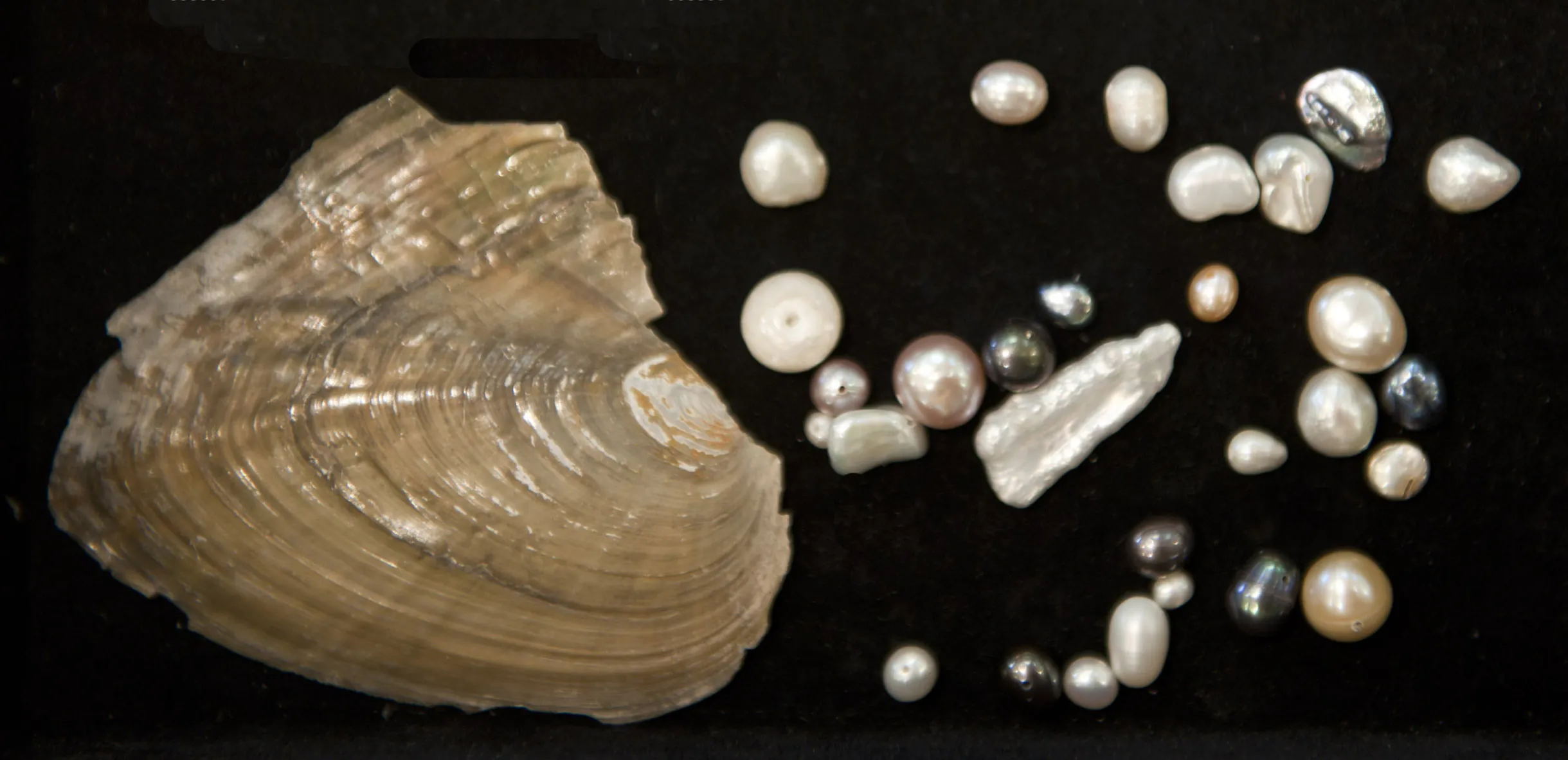
Half-round pearls are pearls with a rounded appearance that are not fully spherical, but the term is not used consistently across the pearl trade. In some listings, “half-round” means a slightly off-round whole pearl, close to what may be called semi-round or near-round. In others, it describes a more noticeably flattened, button-like pearl. It can even be confused with mabé pearls or flat-backed imitation “pearls,” which are structurally different products.
So the useful question is not only “What does half-round look like?” but also “What does this seller mean by half-round?” A front view, side view, dimensions, drilling information, and a clear statement of the pearl’s structure are usually more reliable than the label alone.
Is “Half-Round” an Official Pearl Shape?
Not in the sense of being one universally standardized category with one fixed boundary.
Modern pearl references use more specific shape terms. GIA, for example, describes common pearl shapes with terms such as round, near-round, oval, button, drop, semi-baroque, and baroque. The CIBJO Pearl Book likewise uses descriptors including round, near-round, oval, button, drop, and baroque.
By contrast, half-round is often a commercial or regional description. It can be useful, but it is not precise enough by itself to tell you the exact three-dimensional shape or construction of a pearl.
If you want a broader framework first, see our Pearl Shape Guide for round, near-round, button, oval, drop, ringed, baroque, and other common shapes.
What Does a Half-Round Pearl Usually Look Like?
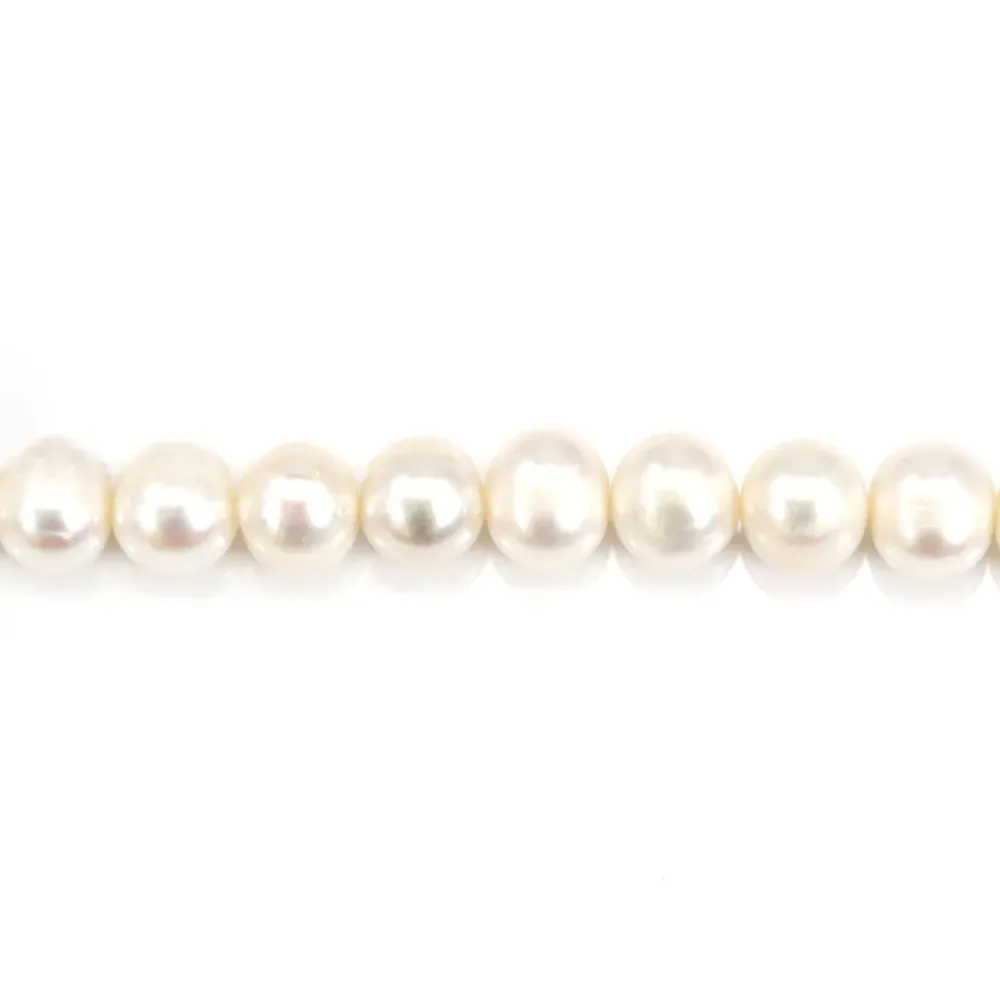
A typical half-round pearl still presents a rounded face, but its profile shows that it is not a complete sphere. Depending on the pearl and the seller’s terminology, the difference may be subtle or obvious.
A mildly flattened pearl may look almost round from one angle and show a slight reduction in depth from another. A more pronounced example may have a broad rounded dome and a flatter underside, approaching a high-button or button shape.
This is why one face-up photograph can be misleading. Two pearls can both look “8 mm and round” from the front while having very different side profiles. One may be close to 8 mm deep; another may be only 5–6 mm deep. Those proportions affect how the pearl looks in a strand, how it sits in a setting, and how it should be compared with other pearls.
Half-Round vs. Near-Round vs. Button vs. Mabé
The easiest way to understand half-round pearls is to compare the term with more specific descriptions.
| Term | Typical meaning | What to check |
|---|---|---|
| Round | A whole pearl that appears spherical when viewed and rotated | Whether the shape stays round from multiple directions |
| Near-round / semi-round | A whole pearl that is close to spherical but has slight flattening or elongation | How visible the deviation becomes when rotated |
| Half-round | An informal trade term that may overlap with near-round, semi-round, high-button, or other flattened rounded forms | Front view, side view, width × depth, and seller definition |
| Button | A symmetrical domed pearl with a noticeably flattened profile | Dome height, base shape, and front-view symmetry |
| Mabé | A cultured blister product grown against the shell and normally assembled after harvest | Construction, backing, edge condition, and whether it is sold as mabé |
The key distinction is that shape and structure are not the same thing. A button-shaped whole cultured pearl and a mabé can both look domed from the front, but they are not made in the same way.
Is a Half-Round Pearl the Same as a Mabé Pearl?
No. They may look similar in some jewelry, but the terms describe different things.
A conventional whole cultured pearl forms as a separate pearl body within the mollusk. It may end up round, near-round, button-shaped, or irregular depending on how it develops.
A mabé begins as a cultured blister attached to the inside of the shell. After harvest, the blister is cut from the shell and typically assembled into a flat-backed pearl product. That construction makes mabé especially suitable for earrings, rings, pendants, and brooches where the back is hidden.
Calling every flat or domed pearl a mabé would therefore be inaccurate. If a listing says “half-round” but does not explain whether the pearl is whole or assembled, ask before comparing prices or quality.
Is “Half-Round” the Same as “Half-Drilled”?
No. This is another common terminology mix-up.
Half-round describes shape. Half-drilled describes the drilling. A half-drilled pearl has a hole that enters only partway into the pearl instead of passing all the way through it. The pearl itself may be round, near-round, button, drop-shaped, or another form.
This distinction matters when buying loose pearls for jewelry making. A product described as “half-drilled round pearl” is usually talking about a round pearl with a partial drill hole—not a half-round pearl.
How Do Half-Round Pearls Form?
There is no single formation mechanism because “half-round” can refer to more than one shape category and more than one pearl type.
In a whole cultured pearl, slight asymmetry can develop as nacre is deposited. Growth conditions, the shape and position of the developing pearl, the pearl sac, and the type of cultivation can all influence the final form. In bead-nucleated pearls, a spherical nucleus can encourage roundness, but the finished pearl is not guaranteed to become perfectly spherical. In tissue-nucleated freshwater pearls, shape can vary even more because there may be no spherical bead dictating the internal geometry.
A button-like whole pearl therefore develops as a whole pearl with a flatter dimension. A mabé, by contrast, is intentionally cultured against the shell over a dome-shaped form. Similar-looking profiles can come from different structures.
Are Half-Round Pearls Real Pearls?
They can be, but the shape name alone does not prove authenticity.
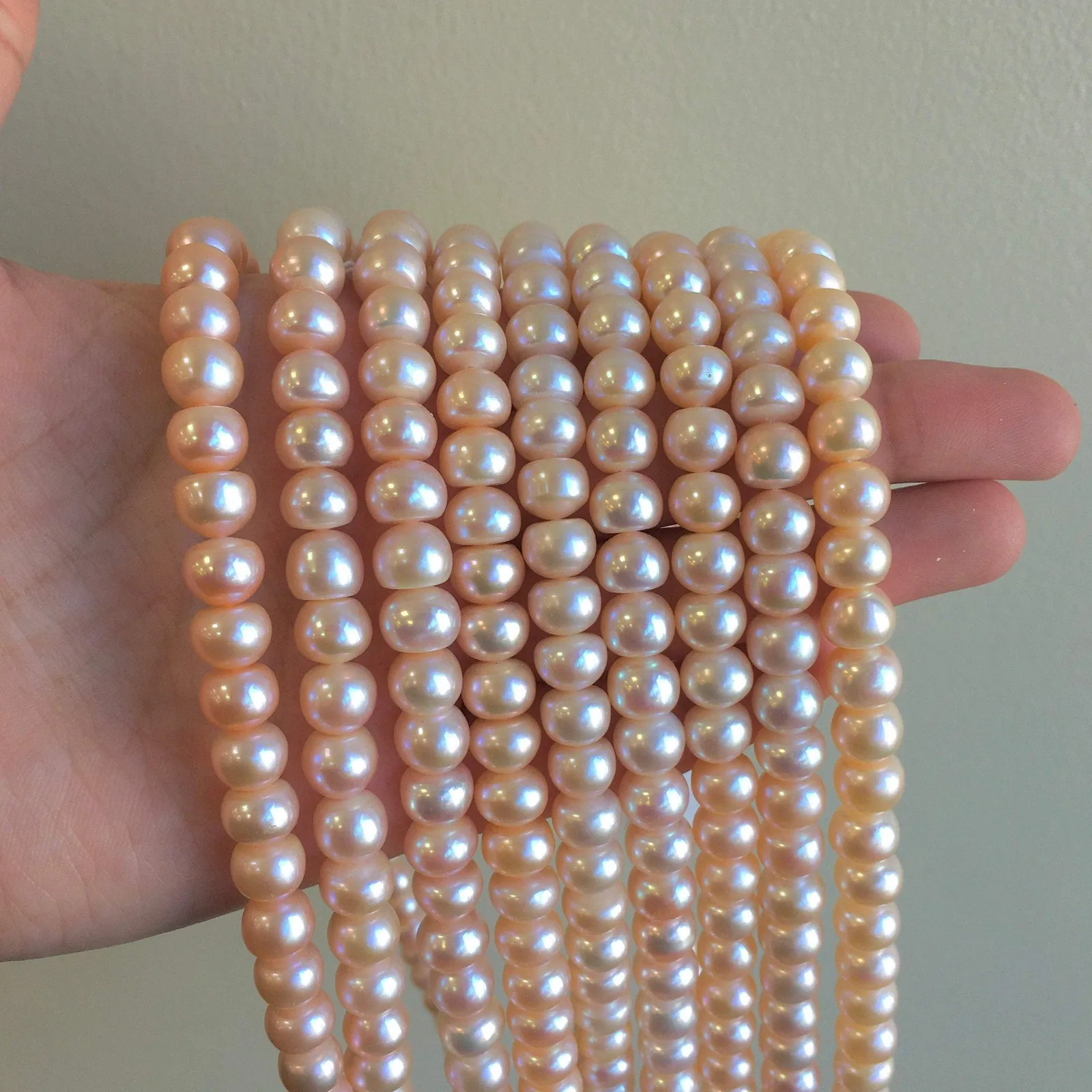
Real cultured pearls can be round, near-round, button-shaped, oval, drop-shaped, baroque, or many other forms. A half-round appearance is therefore completely compatible with a genuine cultured pearl.
However, online marketplaces also use phrases such as “half-round pearl” or “flat-back pearl” for imitation craft beads made from plastic, glass, resin, or coated materials. When authenticity matters, check the material description rather than assuming that “pearl” in a product title means a cultured pearl.
Does Half-Round Mean Low Quality?
No. Shape is only one part of pearl evaluation.
A half-round or button-like pearl can have strong luster, an attractive color, a clean surface, and excellent matching. A very round pearl can still have weak luster, poor surface condition, or other quality problems.
Roundness can affect rarity and price when other factors are comparable, but it should not be used as a substitute for evaluating the entire pearl. For a fuller discussion of this question, see Are Half-Round Pearls Low Quality? What Jewelry Are They Suitable For? and our Pearl Grading Guide.
How to Identify What a Seller Means by “Half-Round”
Because the label is flexible, use the listing as a starting point rather than the final definition. A simple inspection checklist is more reliable:
- Ask for a side view. A front-facing photo can make a flattened pearl look almost perfectly round.
- Ask for at least two dimensions. Width × depth is far more informative than one diameter for flattened shapes.
- Confirm whether it is a whole pearl or a mabé. Similar face-up shapes do not mean identical construction.
- Check the drilling. “Half-drilled” and “half-round” describe different features.
- Confirm the material. In craft listings, flat-backed imitation beads are often marketed with pearl-like terminology.
- Judge quality separately from shape. Look at luster, surface, color, nacre where relevant, and matching rather than treating roundness as the whole grade.
For makers or designers sourcing loose material, our wholesale pearl collection can also be compared by actual dimensions, shape, drilling, luster, and matching rather than relying only on a trade name.
A Simple Way to Remember the Term
Think of half-round as a visual trade description, not a complete gemological identity.
If the pearl looks broadly round from the front but not fully spherical from the side, the term may be reasonable. But before you decide what the pearl is—and whether it is fairly described—check which more precise category it resembles: near-round, button, or mabé.
That small step prevents most of the confusion around half-round pearls.
FAQ
Are half-round pearls the same as semi-round pearls?
Sometimes sellers use the terms interchangeably, especially for pearls that are close to round but slightly flattened or elongated. The terminology is not completely uniform, so photos and dimensions are more reliable than the name alone.
Are half-round pearls the same as button pearls?
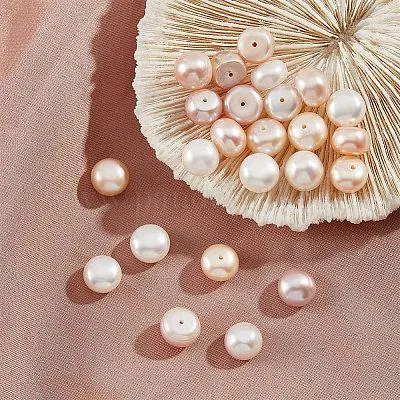
Not always. A button pearl has a more clearly flattened, domed profile. “Half-round” may refer to a mildly flattened near-round pearl or to a button-like pearl depending on the seller.
Are half-round pearls the same as mabé pearls?
No. A mabé is a cultured blister product grown against the shell and normally assembled after harvest. A conventional half-round or button-shaped whole pearl develops as a separate pearl body.
Are half-round pearls genuine cultured pearls?
They can be. Genuine cultured pearls occur in many shapes, including near-round and button-like forms. But “half-round pearl” is also used for imitation flat-backed craft beads, so the material description still needs to be checked.
Does half-round mean half-drilled?
No. Half-round refers to shape, while half-drilled means the drill hole goes only partway into the pearl.
Sources & Further Reading
- GIA: Different Pearl Types Explained — common pearl shape terminology and value factors.
- CIBJO Pearl Book — industry terminology and definitions for pearl shape and pearl products.