What Are Drop-Shaped Pearls? What Jewelry Are They Best Suited For?
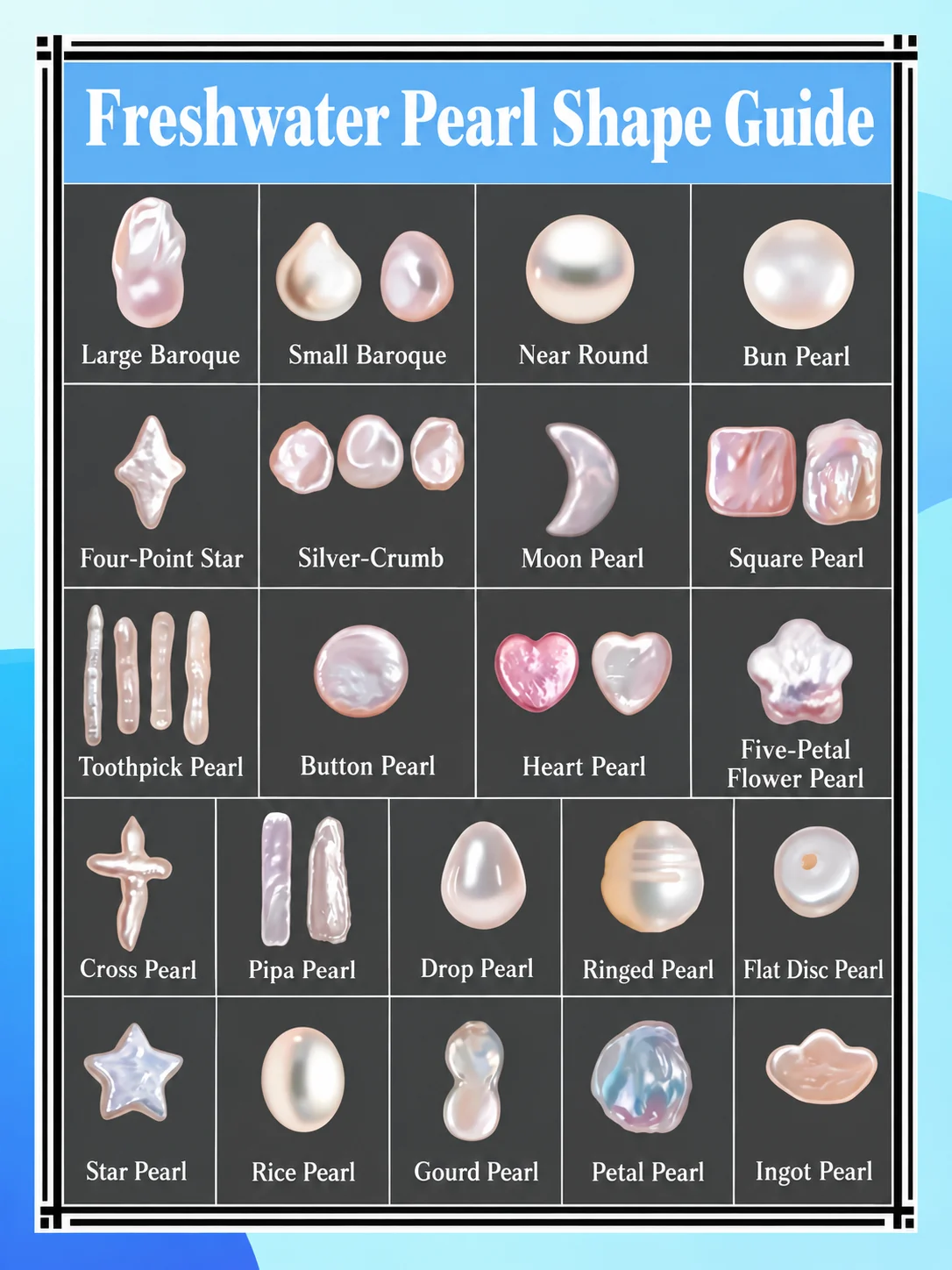
Drop-shaped pearls are elongated pearls that narrow toward one end and widen toward the other, creating a teardrop- or pear-like silhouette. A well-formed drop is usually balanced around its vertical axis rather than randomly irregular. Because this shape naturally looks best when it hangs vertically, drop pearls are especially well suited to pendants and dangle earrings. The important point is that “drop” describes shape—it does not by itself tell you whether a pearl is freshwater or saltwater, natural or cultured, high quality or low quality.
Quick Answer: What Is a Drop-Shaped Pearl?
| Feature | Drop-Shaped Pearl |
|---|---|
| Basic shape | Elongated with a narrower end and a fuller, rounded end |
| Typical symmetry | Usually symmetrical or close to symmetrical around a central axis |
| Common visual descriptions | Drop, teardrop, pear-shaped |
| Best jewelry uses | Pendants and dangle earrings |
| Also suitable for | Drop-style necklaces, designer strands, some bracelets and rings |
| Important buying detail | Check symmetry, taper, dimensions, orientation, luster and matching—not just the shape name |
Drop is a recognized pearl-shape description, but terminology is not perfectly uniform across every laboratory, seller and jewelry market. You may therefore see similar pearls described as drop, teardrop or pear-shaped.
What Does a Drop Pearl Actually Look Like?
The easiest way to recognize a classic drop pearl is to look for a gradual change in width. One end is narrower, the body becomes fuller toward the other end, and the outline should flow smoothly rather than changing direction abruptly.
In a classic hanging design, the narrower end is generally positioned near the finding or setting while the wider, heavier-looking portion hangs below it. This gives the pearl the familiar teardrop silhouette.
Not every drop pearl is long and sharply tapered. Some are short and plump, while others are slender and noticeably elongated. Both can belong to the same general shape family.
Short drops
A short drop has a compact body with only moderate elongation. From some angles it may look close to an oval or slightly pointed near-round pearl. These shapes can work well when the designer wants softness without a very dramatic hanging profile.
Long drops
A long drop has a more obvious vertical line and a stronger taper. This shape tends to make the pearl itself the main visual element, which is one reason long drops are so effective in simple pendants and earrings.
Partial or irregular drops
Some pearls have an obvious drop-like direction but are not perfectly balanced from side to side. Depending on the grading or trade terminology being used, these may be described as partial drops, irregular drops, semi-baroque drops or simply baroque pearls with a drop profile.
This distinction matters when buying loose pearls. If you want a clean, classical teardrop, look for strong axial symmetry. If the design is intentionally organic, slight asymmetry may add character rather than being a problem.
Are Drop, Teardrop and Pear-Shaped Pearls the Same?
In everyday jewelry language, these terms overlap heavily, but they are not used with perfect consistency.
“Drop” is the broadest and most useful term. “Teardrop” usually describes the visual resemblance to a falling drop of water, while “pear-shaped” may be used for a particularly well-defined shape with a narrow top and rounded lower body.
Some pearl references separate drop and pear into different shape labels, while others use pear or teardrop as ways of describing a drop pearl. For a shopper or jewelry maker, debating the label is usually less useful than inspecting the actual pearl.
Ask three questions instead:
- Is the pearl clearly tapered at one end?
- Is the outline balanced when viewed from the front and back?
- Does it hang in a visually straight, attractive orientation?
If those characteristics are right for your design, the exact commercial wording matters much less.
Drop Pearl vs. Oval, Baroque and Button Pearls
Drop pearls are easier to understand when compared with neighboring shapes.
| Shape | Typical profile | Main distinction | Especially suitable for |
|---|---|---|---|
| Drop | Elongated, narrower at one end and fuller at the other | Clear taper with generally balanced symmetry | Dangle earrings, pendants |
| Oval | Elongated with rounded ends | Usually lacks the pronounced one-ended taper of a drop | Strands, earrings, pendants |
| Baroque | Irregular or free-form | No requirement for symmetrical taper | Statement and artistic jewelry |
| Button | Rounded or domed face with a flatter profile | Flatter rather than vertically elongated | Stud earrings, rings, low-profile settings |
These shape words should also be kept separate from pearl origin. A shape name alone cannot establish whether a pearl is freshwater, Akoya, Tahitian or South Sea. Our guide to pearl classification explains why shape, origin and formation method need to be considered as different characteristics.
What Jewelry Are Drop-Shaped Pearls Best Suited For?
If the purpose of the design is to show the pearl's shape clearly, jewelry that allows the pearl to hang freely usually makes the most sense.
1. Pendants: probably the simplest use of a good drop pearl
A single drop pearl is particularly effective as a pendant because the design needs only one well-proportioned pearl. The chain and setting establish a clear vertical direction, allowing the taper to remain visible from a normal viewing distance.
This also means a pendant does not require the difficult matching needed for a pair of earrings. A pearl can have an attractive individual personality—a slightly longer body, unusually strong color or distinctive overtone—and still work beautifully on its own.
For minimalist designs, very little additional metalwork may be necessary. The pearl already provides both a rounded volume and an elegant directional shape.
2. Dangle earrings: one of the best ways to show a matched pair
Drop pearls are also naturally suited to hanging earrings. Movement makes the elongated silhouette visible, while the rounded lower portion gives the earring visual weight without requiring a large metal setting.
The challenge is matching. Two attractive individual drop pearls do not automatically make a good pair.
For earrings, compare:
- overall length
- maximum width
- degree of taper
- left-to-right symmetry
- bodycolor and overtone
- luster
- surface characteristics
- drilling or setting position
A small difference that goes unnoticed in two loose pearls can become obvious when the earrings hang side by side.
3. Drop-shaped pearl necklaces and strands
Drop pearls can also be used throughout a necklace rather than only as a single pendant. The result is very different from a classic round-pearl strand.
Depending on how the pearls are drilled and arranged, a drop strand may create a repeating pointed rhythm, a fringe-like effect or a graduated design in which longer drops are concentrated toward the center.
Matching becomes especially important because many pearls are seen together. Differences in length, direction or drilling can make an otherwise attractive strand look disorganized.
For this reason, necklace design requires more than simply collecting pearls that are all called “drop-shaped.” Their proportions and orientation need to work together as a group.
4. Bracelets: possible, but the silhouette is less controlled
Drop pearls can be used in bracelets, particularly in charm, fringe or clustered designs. However, a bracelet moves and rotates constantly, so the pearl is less likely to remain in one ideal viewing position.
If the main reason for choosing the pearl is its precise teardrop silhouette, a pendant or earring usually displays that shape more clearly. In a bracelet, slightly irregular drops may be equally effective because movement is already part of the design.
5. Rings: better for deliberate designer settings
There is nothing inherently wrong with using a drop pearl in a ring, but it is not usually the most obvious application.
A pearl projecting lengthwise across or away from the finger may be more exposed to knocks, and the setting has to make the orientation feel intentional. Rings therefore tend to work best when the drop is incorporated into a carefully planned asymmetrical or sculptural design.
For a simple, compact pearl ring, round, near-round or button-shaped pearls are often easier to mount.
What about stud earrings?
Drop pearls can technically be used in stud-style designs, but this often hides the feature that makes them interesting. A drop wants a visible vertical direction. Allowing it to hang below the ear generally shows that shape more effectively than attaching the body closely to the earlobe.
Which Drop Profile Works Best for Different Designs?
Instead of treating every drop pearl as interchangeable, match the proportions of the pearl to the jewelry.
| Drop profile | Visual effect | Good design choices |
|---|---|---|
| Short, rounded drop | Soft and compact | Small dangle earrings, delicate pendants, clusters |
| Classic teardrop | Balanced and elegant | Pendants, matched earrings, bridal jewelry |
| Long slender drop | Strong vertical line | Statement earrings, minimalist pendants |
| Soft drop approaching oval | Less dramatic taper | Strands, necklaces, softer everyday designs |
| Irregular or partial drop | Organic and individual | Contemporary and asymmetrical jewelry |
There is therefore no single “best” drop shape. A highly defined teardrop may be ideal for a formal pendant, while a group of slightly irregular drops may produce a much more interesting contemporary necklace.
Does a Drop Shape Make a Pearl More Valuable?
Not by itself. Shape is only one part of pearl evaluation.
When pearls are assessed, factors such as size, shape, color, luster, surface condition, nacre quality and—when several pearls are used together—matching can all affect desirability and value. A beautifully shaped drop with weak luster or poor surface quality is not automatically superior to a slightly less perfect drop with much stronger optical quality.
The same principle applies when comparing drop and round pearls. Roundness is often highly valued, but it does not make every round pearl better than every drop pearl. The individual pearl has to be judged as a combination of characteristics.
Our guide to evaluating pearl value explains these factors in more detail.
Why matched drop pairs deserve separate attention
With a pendant, you only need to evaluate one pearl. With earrings, the relationship between two pearls becomes part of the result.
Matching does not mean the pearls must be mathematically identical. Human eyes are surprisingly tolerant of tiny natural differences. But the pair should normally feel balanced in size, taper, color and overall visual weight when worn together.
For larger or more distinctive drop pearls, finding two pieces that work convincingly together can therefore become an important part of the selection process.
How to Choose Drop-Shaped Pearls for Jewelry Making
If you are buying loose drop pearls rather than finished jewelry, inspecting them as design components is more useful than judging them only as individual gems.
Check the pearl from more than one angle
A front-facing photograph can hide a bulge, flat area or sideways curve. Rotate the pearl or request video so you can see whether the shape remains attractive around the entire body.
Measure length and width separately
A single measurement such as “10 mm” is often not enough for an elongated pearl. A drop might be approximately 10 × 8 mm, 12 × 8 mm or 14 × 8 mm, and those pearls would create noticeably different jewelry even though their widths are similar.
Look at where the pearl will be attached
For drilled pearls, the location and direction of the hole can determine whether the pearl hangs correctly. For undrilled pearls, the jeweler has more flexibility, but the natural axis of the pearl should still be identified before drilling or setting.
Evaluate luster separately from shape
Do not let an attractive outline distract from the pearl's surface and reflection. Shape is easy to notice in a photograph, while differences in luster can be harder to capture accurately.
For pairs, compare them together
When selecting earrings, place the two pearls side by side in the orientation in which they will actually hang. This is far more useful than evaluating each pearl separately.
Does a Drop Shape Tell You What Type of Pearl It Is?
No. Drop describes geometry, not origin.
Drop-shaped pearls can occur in different pearl categories, including freshwater cultured pearls and saltwater cultured pearls. South Sea and Tahitian pearls, for example, are frequently seen in elongated and drop profiles, while freshwater cultured pearls are also available in a wide range of drop-like shapes.
The shape therefore cannot tell you by itself whether a pearl came from freshwater or saltwater, which mollusk produced it, whether it was cultured or natural, or whether it received any treatment.
This is the same distinction that applies to other shape terms such as round, oval, button and baroque. Shape should be recorded as one characteristic rather than treated as the identity of the pearl.
The Most Useful Way to Think About Drop Pearls
A drop pearl is valuable to a jewelry designer because its shape already creates direction. Round pearls are visually neutral and can be mounted almost anywhere; drop pearls naturally suggest movement from a narrow end toward a fuller end.
That is why their strongest applications are usually jewelry that allows this vertical silhouette to remain visible.
- For one exceptional pearl: choose a pendant.
- For a well-matched pair: choose dangle earrings.
- For many coordinated drops: consider a graduated or designer necklace.
- For irregular drops: use the variation intentionally in contemporary jewelry.
Rather than asking whether a drop pearl is universally better or worse than a round or oval pearl, ask whether its proportions, symmetry and orientation strengthen the piece of jewelry you want to create.
FAQ
Are drop-shaped pearls real pearls?
They can be. Drop only describes the pearl's shape. Genuine natural or cultured pearls can be drop-shaped, but imitation pearls can also be manufactured in similar shapes. Shape alone is not a test of authenticity.
Are drop pearls the same as teardrop pearls?
Usually, yes in everyday jewelry descriptions. Teardrop is a visual description commonly used for drop-shaped pearls. Some sellers and grading systems may distinguish more precisely between drop, pear and related shapes, so the actual profile is more useful than the label alone.
What is the difference between a drop pearl and an oval pearl?
An oval pearl is elongated but normally remains rounded at both ends, while a classic drop pearl becomes noticeably narrower toward one end. The two categories can overlap visually when the taper is subtle.
Are drop pearls best for earrings or necklaces?
They work especially well for both. A single drop is ideal for a pendant, while a well-matched pair is particularly effective in dangle earrings. Strands can also use drop pearls, but matching and drilling orientation become more important.
Are drop-shaped pearls more expensive than round pearls?
Not necessarily. Shape is only one value factor. Size, luster, surface quality, color, nacre quality and matching can all affect value. A fine drop pearl may be highly desirable, but the word “drop” does not automatically establish a higher or lower price.
Can freshwater pearls be drop-shaped?
Yes. Drop is not restricted to one pearl type. Freshwater cultured pearls can occur in drop and drop-like shapes, as can several saltwater cultured pearl categories.
Final Takeaway
Drop-shaped pearls are symmetrical or near-symmetrical elongated pearls with a visible taper toward one end. Their directional teardrop profile is displayed most effectively when the pearl is allowed to hang, making pendants and dangle earrings their most natural applications.
When choosing them, look beyond the word “drop.” Check the actual length-to-width proportions, taper, symmetry, orientation, luster and surface quality. For earrings, evaluate the two pearls as a pair. For a pendant, concentrate on finding one pearl whose individual shape looks balanced and attractive. That practical approach tells you far more than the shape name alone.