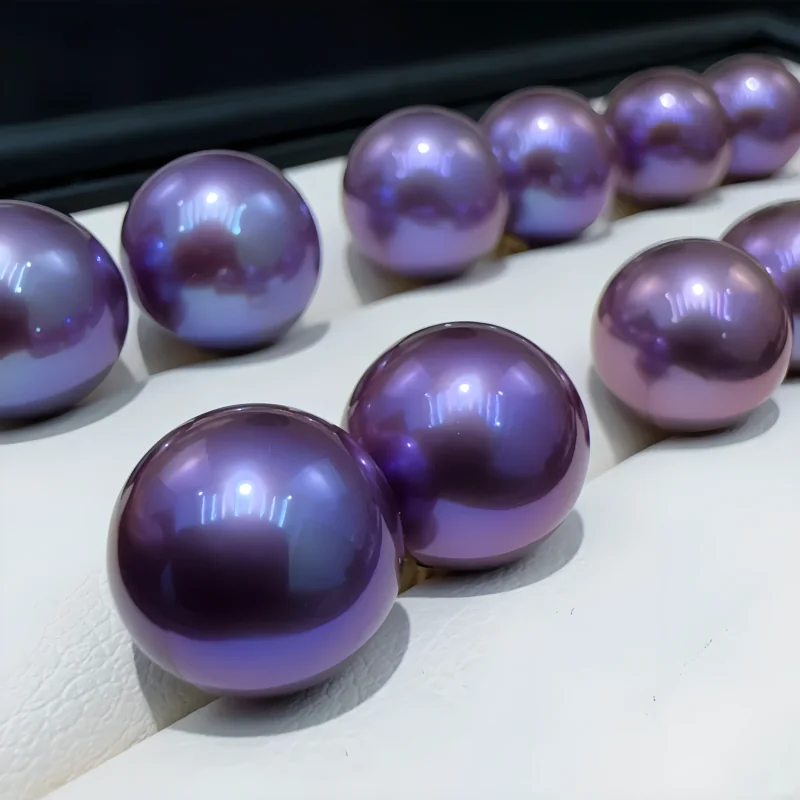
Two pearls can have the same general color, a similar size, and an almost identical shape in a product photo—yet one may cost much more than the other. That does not automatically mean the higher-priced pearl is overpriced, or that the lower-priced pearl is a bargain.
The reason is that the features we notice first are not always the features that separate one quality tier from another. Pearl value is built from several characteristics working together: pearl type, luster, surface quality, shape, size, color, nacre quality, and, for pairs or strands, matching. The GIA summarizes these as its seven pearl value factors.
There is also a second issue: photographs flatten differences. A bright studio image can make two pearls look similarly white and glossy even when their reflections, surface condition, roundness, overtone, or matching are noticeably different in person.
So the useful question is not simply, “Why is this pearl more expensive?” It is: what difference am I actually paying for, and can I see or verify it?
The Short Answer: Similar Appearance Does Not Mean Equivalent Quality
When two pearls look similar at first glance, the price gap often comes from details that become visible only under closer comparison. One pearl may have sharper luster. Another may have fewer or less distracting surface marks. One may be more precisely round, have better nacre quality, or belong to a pearl type with a different supply structure. A necklace may also require much more selective matching than a single loose pearl.
These differences are often incremental to the eye but not incremental in rarity. A pearl that is large, round, highly lustrous, clean on the surface, attractive in color, and well formed all at once is much harder to find than a pearl that meets only some of those conditions. That is why the price increase between quality tiers does not have to be linear.
Why Product Photos Can Make Different Pearls Look Almost the Same
Online pearl shopping is especially difficult because a photograph shows only a controlled moment. Lighting, exposure, camera angle, background color, image sharpening, and screen brightness can all influence how a pearl appears.
A front-facing image may also hide the side of a pearl with more visible surface characteristics. Diffused lighting can make luster look smooth without showing how sharp the reflections really are. A small product image may make near-round and very round pearls appear almost identical.
This does not mean product photography is misleading by definition. It means a photograph is incomplete evidence. When the price difference is substantial, compare specifications and quality descriptions rather than relying on the thumbnail alone.
What Can Be Different Even When Two Pearls Look Similar?
| What looks similar at first | What may actually be different | Why it can affect price |
|---|---|---|
| Both look bright | Sharp, mirror-like luster vs. softer or hazier reflection | Higher luster is generally more desirable within the same pearl type |
| Both look clean | Minor hidden marks vs. more visible pits, wrinkles, abrasions, or cracks | Surface condition affects beauty and, when severe, may affect durability |
| Both look round | Very round vs. slightly off-round when viewed from several angles | High roundness is generally rarer when other factors are comparable |
| Both are the same millimeter size | Different luster, surface, color, nacre, or pearl type | Size is only one value factor |
| Both look white or golden | Different bodycolor, overtone, saturation, treatment status, or uniformity | Color desirability and rarity vary by pearl type and market |
| Both necklaces look uniform | Different levels of matching across dozens of pearls | Tighter matching requires more sorting and a smaller usable pool |
1. Luster Can Create a Large Difference That a Small Photo Hides
Luster is one of the most important things to compare when two pearls otherwise appear similar. It is not simply “shine.” It describes the intensity and sharpness of the light reflected from the pearl’s surface and underlying nacre.
A high-luster pearl tends to show bright, crisp reflections and a stronger sense of depth. A lower-luster pearl may still look glossy under strong lighting, but its reflections can appear softer, hazier, or more diffuse.
This distinction is easier to see when two pearls are photographed under the same light. If you are comparing products from different sellers, image style can make direct comparison unreliable. Our pearl luster guide explains what to look for beyond the simple question of whether a pearl looks shiny.
2. Surface Quality Is About Severity and Location, Not Just the Number of Marks
Most cultured pearls are not perfectly clean. Small spots, wrinkles, pits, abrasions, or other surface characteristics can occur naturally during growth. The important question is how noticeable and how serious those features are.
Two pearls may both be described as having “minor blemishes,” but the visual result can be very different. A small mark near a drill hole may have little effect on appearance. A similar-sized mark on the face of an earring pearl may be much more obvious. Numerous or severe surface features can also reduce value more strongly than a few small, well-positioned marks.
If you want to judge this factor more carefully, see our guide to pearl surface quality and blemishes.
3. Roundness Can Be More Precise Than It Looks in a Front View
A single photo is not always enough to distinguish round from near-round pearls. A pearl that looks circular from the front may reveal a slight flattening, elongation, or asymmetry when rotated.
This matters because, when other quality factors are comparable, highly round cultured pearls are generally rarer than slightly off-round examples. GIA notes that round is the most difficult cultured pearl shape to produce consistently and is generally the most valuable when the other factors are equal.
That does not mean near-round pearls are poor quality. In fact, near-round pearls can offer excellent visual value because the difference in shape may be subtle once worn. The point is that “looks round in one image” and “meets a tighter roundness standard” are not necessarily the same thing.
4. Nacre Quality May Not Be Obvious in a Thumbnail
Nacre quality is closely connected with the pearl’s appearance and durability. In bead-nucleated cultured pearls, poor nacre quality may reveal itself through a dull or chalky look or, in more obvious cases, through visible signs of the bead beneath the nacre.
Good nacre and attractive luster often reinforce each other visually, which is one reason two pearls can look similar from a distance but perform differently when examined closely.
This is also a reason not to reduce pearl comparison to size and surface cleanliness alone. A clean-looking pearl is not automatically the better pearl if its luster and nacre quality are weaker.
5. Color Can Be Similar in Name but Different in Quality or Rarity
“White,” “golden,” “black,” and “pink” are broad color labels. Within each label, pearls can differ in bodycolor, overtone, saturation, orient, and overall visual balance.
Color value also depends on pearl type and market preference. A desirable natural color in one pearl category may be much less common than a superficially similar appearance created through treatment in another category. Treatments are not automatically a problem when they are clearly disclosed, but treatment status can affect how two otherwise similar-looking pearls should be compared.
For this reason, compare color only after confirming that the pearl type and treatment description are comparable.
6. Matching Makes a Pair or Strand Harder to Build Than a Single Pearl
A beautiful loose pearl is one thing. Finding two that work as an earring pair is harder. Building a necklace from many pearls that look harmonious in size, color, luster, shape, surface quality, and overall character is harder again.
Matching is therefore a separate value factor for jewelry containing more than one pearl. Two necklaces may look equally white and equally round in a small image, but one may hold a much tighter visual rhythm across the full strand.
Good matching does not always mean absolute uniformity. Multicolor and baroque strands can be intentionally varied and still be very well matched. What matters is whether the variation looks deliberate and balanced rather than random.
7. Pearl Type Sets the Baseline Before You Compare Quality
One of the easiest comparison mistakes is to judge pearls only by visible appearance while ignoring what kind of pearl they are.
Freshwater, Akoya, Tahitian, and South Sea cultured pearls come from different mollusks and production systems, and they have different typical size ranges, colors, nacre structures, supply conditions, and market positions. Two white round pearls of similar size can therefore belong to different categories even before their individual quality is evaluated.
If you want a broader framework for comparing quality within and across types, our pearl value evaluation guide explains how multiple factors work together.
8. A Higher Grade Label Does Not Always Make Cross-Seller Comparison Easier
Labels such as A, AA, AAA, or AAAA can be useful inside one seller’s own grading system, but they should not be treated as universally interchangeable across the entire market. Different companies can set different thresholds.
That is why two products can both be called “AAA” and still differ in luster, surface, shape, or matching. A grade becomes useful only when you know what the seller means by it and can connect the label to observable quality.
MJ Pearls explains its own A–AAAA ranges in our pearl grading guide. When comparing pearls from different sellers, compare the underlying characteristics—not just the letters.
Why the Price Difference Can Be Nonlinear
One of the most important ideas in pearl pricing is that rarity compounds. Suppose many pearls are available in a certain size. Fewer may also be very round. Fewer still may combine that roundness with strong luster. The pool becomes smaller again if you also require a clean surface, attractive color, good nacre, and close matching for a full strand.
In other words, premium pearl pricing often reflects an intersection of qualities rather than one spectacular feature. The price can rise sharply because the number of pearls that satisfy all the requirements at the same time becomes much smaller.
This is why a slightly cleaner surface or slightly sharper luster can appear to create a surprisingly large price jump at the top end of a category. You are not necessarily paying for one tiny visible improvement; you may be paying for the scarcity of the complete combination.
Finished Jewelry Adds Another Layer to the Price
Even when the pearls themselves are comparable, finished jewelry prices can differ because the pearl is only one part of the product.
The final price may also reflect the metal, clasp, findings, stone accents, design complexity, drilling and setting work, matching labor, quality control, certification, packaging, after-sales service, distribution costs, and brand positioning.
This is especially important when comparing a loose pearl with a finished pendant, or a simple strand with a necklace using a more complex clasp or precious-metal components. A fair comparison separates pearl quality from jewelry construction and retail positioning.
How to Compare Two Similar-Looking Pearls More Fairly
Before deciding that one product is overpriced—or that another is unusually cheap—compare them in the same order.
- Confirm the pearl type. Do not compare Freshwater, Akoya, Tahitian, and South Sea pearls as if they belong to one identical price structure.
- Match the size range. Compare pearls with genuinely similar millimeter measurements.
- Check shape from more than one angle. A front view alone may not show roundness accurately.
- Compare luster before surface perfection. Look for the sharpness and intensity of reflections, not just brightness from studio lighting.
- Inspect the surface in close-up. Consider the number, severity, and location of marks.
- Ask about nacre and treatment status when relevant. These details may not be obvious in a product image.
- For earrings and strands, judge matching. Consistency across multiple pearls can materially change value.
- Read what the seller’s grade actually means. Do not assume identical letters represent identical standards.
- Separate pearl value from jewelry value. Metal, craftsmanship, certification, service, and brand can all affect the final price.
If you are comparing your first few pearl purchases, our complete pearl buying guide gives a broader decision framework for type, size, quality, and budget.
What Should You Ask When the Price Gap Seems Too Large?
A large difference in price deserves a specific explanation. Useful questions include:
- Are these the same pearl type and the same approximate size?
- How does the luster differ?
- How clean is the surface, and where are the main marks?
- Is the shape round, near-round, or another category?
- Is the color natural, treated, or otherwise enhanced?
- How is the seller’s grade defined?
- For a pair or strand, how closely are the pearls matched?
- Does the price include different metal, clasp, certification, or craftsmanship?
A trustworthy answer should become more specific as the price rises. “Better quality” is less useful than an explanation such as “sharper luster, cleaner face-up surface, tighter roundness, and closer matching.”
Does a Higher Price Always Mean a Better Pearl?
No. Price and pearl quality are related, but they are not identical. A higher price can reflect genuinely better pearls, but it can also include design, precious-metal content, certification, retailer margins, service, or brand positioning. At the same time, a lower-priced pearl may offer very good visual value if you are willing to accept a slightly less round shape, a few minor surface marks, or a less selective match.
The goal is not to find the most expensive pearl. It is to understand which differences matter to you. Some buyers care most about mirror-like luster. Others prefer larger size, unusual color, or characterful baroque shapes. A more expensive pearl is only a better purchase when the premium is paying for qualities you actually value.
If you are deciding how much quality changes at different spending levels, see our guide to what changes when you increase your pearl budget.
Final Thoughts
Pearls that look similar can have very different prices because first impressions hide a great deal of information. Size and color may match, while luster, surface quality, roundness, nacre, treatment status, matching, or pearl type do not. Finished jewelry then adds its own costs for materials, craftsmanship, certification, service, and brand.
The most useful buying habit is therefore simple: compare like with like, then look beneath the headline description. Ask what specifically separates the two pearls and whether that difference is visible, documented, or meaningful for how you plan to wear them.
Once you learn to compare pearls this way, price gaps become easier to interpret—and it becomes much harder for a vague grade label or a flattering product photo to do all the selling.
FAQ
Why can two pearls of the same size have different prices?
Because size is only one value factor. Two pearls with the same diameter can differ in luster, surface quality, shape, color, nacre quality, pearl type, and treatment status. If they are part of a pair or strand, matching also affects value.
Can two pearls with the same grade still be different?
Yes. Seller grading systems are not always directly comparable. Two pearls labeled “AAA” by different sellers may have different standards for luster, surface, roundness, or matching. Compare the underlying quality description, not only the grade name.
Which quality factor should I compare first?
When the pearl type, size, and general shape are already comparable, luster is often a good place to start because it strongly affects how lively and attractive a pearl appears. Surface, shape precision, nacre, color, and matching should then be considered together.
Can online photos hide pearl quality differences?
They can make differences harder to judge. Lighting, angle, exposure, background, and image size can affect how luster, color, surface marks, and roundness appear. Close-ups, multiple angles, videos, and clear specifications make comparison more reliable.
Is the more expensive pearl always the better value?
No. A higher price may reflect better pearl quality, but it may also include precious-metal content, craftsmanship, certification, service, or brand positioning. The better value is the pearl or jewelry piece whose quality and features justify the premium for your priorities.