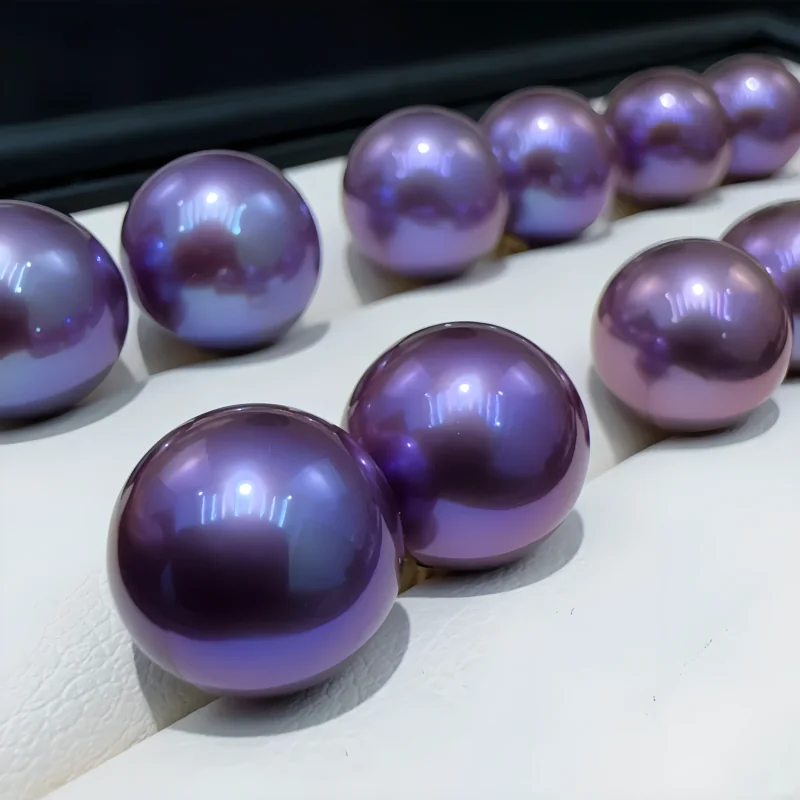
Akoya Madama pearls are expensive because the Madama category sits at the intersection of several uncommon conditions: naturally occurring blue-to-gray-blue Akoya color, high overall quality, strong luster, suitable nacre, good shape and surface, and—when used in a strand or pair—close matching. The price is not simply a surcharge for the word “Madama” or for a certificate.
The most important idea is compound rarity. Natural blue Akoya pearls already represent a narrower part of Akoya production. From that group, only some have the quality needed for a top designation. From those, fewer still can be assembled into a closely matched necklace, especially in larger sizes.
That is why two pearls that both look “blue-gray” in a photograph can have very different prices. One may be an ordinary blue Akoya, another may have treated color, and another may be a certified Aurora Madama with much stronger luster, roundness, surface quality, nacre, and matching.
If you first want to understand the terminology itself, see our guide to what Akoya Madama pearls are. Here, we will focus on why the price can rise so sharply.
The Short Version: You Are Paying for a Rare Combination, Not Just a Rare Color
A common explanation says Madama pearls are expensive because natural blue Akoya pearls are rare. That is true, but incomplete.
Color alone does not create a fine Madama pearl. A blue Akoya can still have weak luster, thin-looking nacre, distracting surface features, an irregular shape, or poor matching. The expensive material is the subset in which the unusual color occurs together with the quality expected from a premium Akoya pearl.
The Pearl Science Laboratory (PSL) currently places Aurora Madama in its highest-quality series for blue-body-color Akoya pearls. Its grading system states that the highest-quality mark is reserved for pearls whose five quality components all fall within the laboratory's highest evaluation range.
So Madama is not merely a marketing name for “blue Akoya.” It is a much narrower quality boundary.
Natural Blue Akoya Color Is Uncommon—and the Same Formation Process Can Work Against Perfect Quality
This is one of the most important reasons Madama pearls can become expensive.
PSL explains that the blue appearance associated with Madama can arise when organic material or other internal matter becomes incorporated within the pearl. That internal structure contributes to the blue visual effect. But PSL also points out the difficult part: the same kind of internal irregularity can contribute to blemishes or deformation.
In other words, the biological event that helps create the desirable blue color does not automatically create a perfectly round, clean pearl. In fact, it can make those additional qualities harder to achieve.
That creates a strong selection effect. A natural blue Akoya that also remains round, has only minor surface disturbance, shows strong luster, and meets the laboratory's broader quality requirements is inherently more selective than a pearl that only satisfies the color condition.
This is a better explanation of rarity than simply saying “blue is rare.” The premium comes from blue color surviving alongside the qualities buyers traditionally expect from fine Akoya.
Madama Certification Narrows the Pool Further
Certification does not magically make a pearl more beautiful, but it changes the buying proposition.
For a genuine Aurora Madama claim, the buyer is not being asked to rely only on a seller's description such as “rare blue,” “natural gray,” or “top AAA.” The pearls have been evaluated within a defined laboratory system and must fit the relevant Madama category.
This matters because pearl grading terminology is not universally standardized. Seller grades such as AAA or AAAA can mean different things from one business to another. A laboratory designation gives the buyer a more specific reference point.
However, the certificate itself is not the main reason a Madama strand is expensive. The testing and documentation add cost, but the larger economic effect is that only a limited portion of natural blue Akoya material can qualify in the first place.
Think of the report as evidence of a filter. The filter does not create the rarity; it identifies pearls that passed through it.
If you want a broader explanation of how pearl reports should be interpreted, see our pearl grading certificate guide.
Matching a Madama Necklace Can Be Much Harder Than Finding One Beautiful Pearl
The difference between a loose pearl and a necklace is easy to underestimate.
GIA notes that naturally colored gray Akoya pearls are often relatively light in color and can show uneven color distribution, which makes them difficult to match. That difficulty becomes especially important in Madama strands.
A necklace may require dozens of pearls that work together in:
- diameter and graduation;
- roundness;
- blue, gray, or silver bodycolor;
- overtone and orient;
- luster intensity;
- surface quality;
- nacre appearance; and
- overall visual balance.
Two individually attractive natural blue pearls may look mismatched when placed next to each other. One may lean silver, another gray-green, another violet-blue. One may reflect light sharply while another looks softer.
This means the value of a fine strand is not simply the arithmetic sum of many loose pearls. The seller or manufacturer needs access to enough suitable inventory to build a coherent set. As the target quality, size, and color consistency rise, the matching problem becomes increasingly difficult.
For this reason, matching is one of the hidden multipliers behind the price of fine Madama necklaces and pairs.
Luster Still Matters More Than a Dramatic Blue Color
Madama shoppers can easily become too focused on color.
A darker or more obviously blue pearl is not automatically a better pearl. GIA treats color as only one of seven major pearl value factors, alongside size, shape, luster, surface quality, nacre quality, and matching. Within the same pearl type, stronger luster generally increases value when other factors are comparable.
Fine Akoya pearls are especially prized for crisp, bright reflections. A Madama strand with lively mirror-like luster can look much more valuable in person than a darker strand with flatter reflections.
So when two Madama strands have different prices, do not assume the more expensive one must simply be “bluer.” The difference may come from luster, surface, nacre, matching, or size.
Our pearl grading guide explains why pearl quality should always be judged through multiple factors rather than a single grade label.
Large Madama Pearls Add Another Layer of Scarcity
Size can push the price upward quickly when the other quality factors remain strong.
Akoya oysters are relatively small compared with the mollusks that produce South Sea pearls, so large Akoya pearls are naturally a narrower part of production. GIA's general pearl-value framework also notes that, within the same pearl type and with other factors equal, larger pearls are usually rarer and more valuable.
Now add the Madama conditions. A large pearl must not only reach the desired diameter; it must also retain the natural blue-gray appearance, strong luster, suitable nacre, attractive shape, acceptable surface, and—if it belongs to a strand—compatibility with many other pearls.
This is why the jump from a smaller Madama piece to a large, highly matched necklace can be much steeper than the millimeter difference alone suggests.
If you want more context on normal Akoya characteristics and size ranges, see our Akoya pearl guide.
Natural-Color Documentation Matters Because Treated Blue Akoya Also Exists
Another reason documented natural blue Akoya can command a premium is that similar-looking blue or gray appearances can also be produced or modified through treatment.
GIA has documented irradiated and dyed Akoya pearls with gray, blue, and greenish appearances. Its laboratory research also notes that some grayish Akoya pearls are treated to imitate desirable natural colors because naturally colored material can command higher prices.
This does not mean treated blue Akoya is automatically bad. A disclosed treated pearl can still be attractive jewelry and may offer a lower-cost way to obtain a particular look.
The problem begins when a treated pearl is priced as though its blue color were naturally occurring, or when a generic “blue Akoya” description is presented as equivalent to Madama.
For a high-price purchase, documentation therefore has economic value because it helps answer a question that normal product photography may not reliably resolve: what exactly is the buyer paying a natural-color premium for?
For a deeper treatment-focused discussion, see our guide to blue Akoya pearl value factors and risks.
Why Can Two Certified Madama Strands Have Very Different Prices?
A certificate establishes a category or threshold; it does not make every pearl above that threshold identical.
Two certified Madama necklaces can still differ visibly and economically:
| Factor | Why it can raise the price | What not to assume |
|---|---|---|
| Luster | Sharper, brighter reflections generally create a stronger Akoya appearance. | A darker blue pearl is not automatically more lustrous. |
| Size | Larger fine Akoya pearls are less common. | More millimeters do not compensate for weak luster or poor matching. |
| Surface | Cleaner pearls are harder to obtain when other qualities are also high. | A tiny natural mark does not automatically make a fine pearl poor quality. |
| Shape | Round pearls are more selective and traditionally command a premium. | Roundness alone does not determine beauty or value. |
| Color character | Some silver-blue, gray-blue, or overtone combinations are especially desirable to buyers. | There is no universal rule that “darker blue = more valuable.” |
| Matching | A harmonious strand requires many compatible pearls from a limited pool. | Each pearl does not need to be visually identical under every light source. |
| Jewelry construction | Clasp metal, design, diamonds, workmanship, and strand length affect the final retail price. | The full jewelry price should not be attributed to pearl grade alone. |
| Brand and retail channel | Brand positioning, service, warranty, inventory depth, and distribution can affect retail pricing. | A higher retail price does not prove a higher pearl grade by itself. |
This explains why “What does a Madama necklace cost?” has no single useful answer without size and quality context.
Are Madama Pearls Always More Expensive Than Hanadama?
No. Madama and Hanadama should not be treated as two rungs on one universal price ladder.
Within PSL's system, Madama is associated with the highest-quality blue Akoya category, while Hanadama is associated with a highest-quality white Akoya category. Their actual market prices can overlap.
A large, exceptionally lustrous, tightly matched Hanadama strand may cost more than a smaller Madama strand. A particularly rare and beautifully matched Madama necklace may cost more than many Hanadama necklaces.
The useful comparison is therefore not “Which name is higher?” but:
- What is the size?
- How strong is the luster?
- How clean and well formed are the pearls?
- How convincing is the matching?
- What exactly does the certificate say?
- How much of the price comes from the pearls versus the finished jewelry?
Is the Madama Premium Worth Paying?
It depends on what you actually want.
If your priority is a documented natural blue-gray Akoya strand with high quality and a recognized laboratory designation, Madama gives you a much narrower and more verifiable target than a generic “blue Akoya” listing.
If your priority is simply the visual effect of cool gray or blue pearls, you may not need to pay for the Madama category. A good natural blue Akoya that does not carry the designation—or a properly disclosed treated blue Akoya—may fit your aesthetic and budget better.
Before paying a substantial premium, use this order:
- Confirm the exact report and designation. Make sure the certificate corresponds to the actual strand, pair, or pearl.
- Inspect luster first. Strong, sharp reflections should still be obvious.
- Judge the whole strand, not one close-up pearl. Matching is a major part of value.
- Check surface and shape in normal viewing conditions. Do not let a dramatic macro photograph exaggerate minor natural features.
- Compare size only after quality. A larger strand is not automatically the better purchase.
- Separate pearl value from jewelry value. Metal, clasp, design, diamonds, branding, and service can materially change the final price.
If you are comparing finished pieces, you can browse our Akoya pearl jewelry to see how pearl size and design change the overall look.
The Bottom Line
Akoya Madama pearls are expensive because several difficult conditions must occur at the same time.
The blue-gray color must be naturally associated with the Akoya pearl rather than merely imitated by a color treatment. The pearl must also reach a high quality level in the characteristics that make fine Akoya desirable. For necklaces and pairs, many qualifying pearls then have to match closely enough to work as one piece.
The most important insight is that Madama price is driven by compound rarity. Natural color narrows the pool. High quality narrows it again. Larger size narrows it further. Close matching can narrow it dramatically.
Certification helps document that narrow category, but the paper is not the source of the beauty or scarcity. The real premium is for the pearl material that can qualify—and for the difficulty of assembling enough of it into a convincing finished piece.
FAQ
Why are Madama pearls more expensive than ordinary blue Akoya pearls?
Madama is a narrower quality designation, not simply another name for blue Akoya. The premium reflects the combination of natural blue-series color with high overall quality and, for strands or pairs, close matching. An ordinary blue Akoya may be natural or treated and may fall across a much wider quality range.
Does a Madama certificate make the pearl expensive?
The report adds testing and documentation, but the main premium comes from the rarity and quality of pearls capable of meeting the designation. Certification is better understood as evidence of the category than as the cause of the pearl's value.
Are darker Madama pearls worth more?
Not automatically. Color character can affect demand, but luster, surface, nacre, size, shape, matching, and overall appearance also influence value. A lighter silver-blue strand with stronger luster and better matching may be more valuable than a darker but weaker-looking strand.
Why are Madama pearl necklaces so expensive?
A necklace requires many pearls that fit together in size, shape, natural blue-gray color, overtone, luster, surface, and overall quality. Natural gray and blue Akoya can be difficult to match, so a fine strand compounds the rarity of each individual pearl.
Are Madama pearls more expensive than Hanadama pearls?
Not in every case. Madama and Hanadama belong to different Akoya color categories within the PSL system, and their price ranges can overlap. Size, luster, surface, nacre, matching, jewelry construction, and brand can cause either one to cost more in a specific comparison.
Can treated blue Akoya pearls still be valuable?
Yes. A disclosed treated blue Akoya can still be attractive and well made. The key is accurate disclosure. It should not be priced or described as though a treated blue appearance were the same thing as a documented natural-color Madama designation.