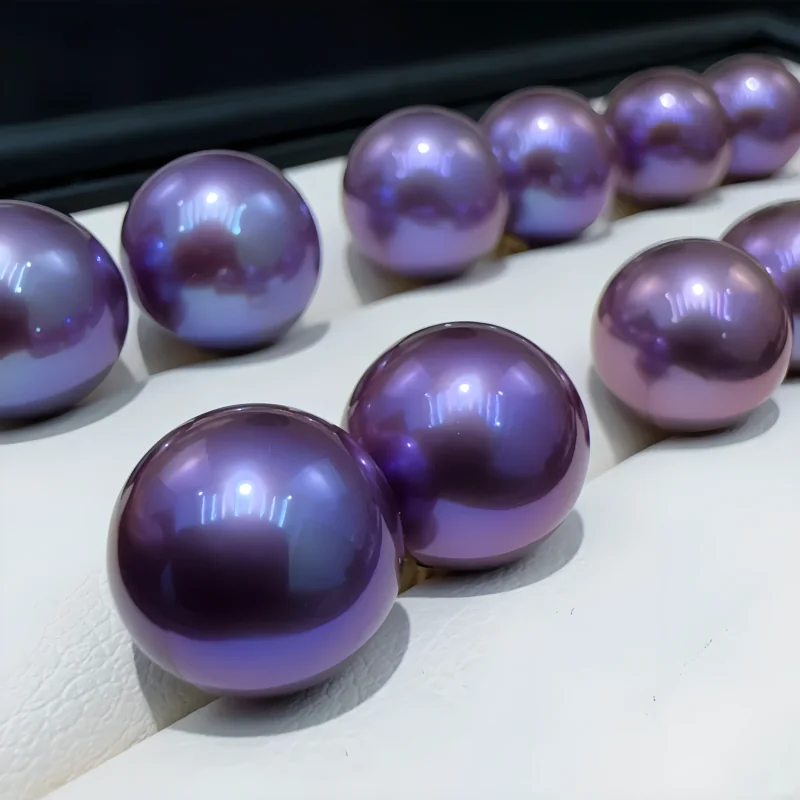
Tahitian pearls can be expensive because producing a fine one requires a long, low-output saltwater cultivation process, and only part of each harvest combines the qualities buyers pay the most for: strong luster, attractive natural color, a desirable shape, a clean surface, good nacre, and larger size. For necklaces and matched pairs, the price can climb further because many pearls must meet those standards at the same time.
But there is an important correction to the usual explanation: not every Tahitian pearl is rare, and not every Tahitian pearl is expensive. Circled, baroque, smaller, more heavily marked, or less vividly colored Tahitian pearls can be much more accessible. The steepest prices appear when several uncommon qualities occur together.
If you first want a broader introduction to the pearl type itself, see our Tahitian pearl guide.
1. Tahitian Pearls Have a Low-Output Cultivation Process
Tahitian cultured pearls are bead-nucleated saltwater pearls grown in Pinctada margaritifera, commonly called the black-lipped pearl oyster. According to the Gemological Institute of America (GIA), a Tahitian pearl oyster typically produces one pearl at a time, and cultivation commonly takes about 18 to 24 months.
That production model matters. The farmer must first raise suitable oysters, select healthy recipients and donor tissue, perform a skilled grafting operation, keep the oysters alive in lagoon conditions, clean and maintain them during the grow-out period, and then wait many months without knowing exactly what quality the finished pearl will have.
The operation also carries biological risk. Research on Pinctada margaritifera shows that some oysters reject the implanted nucleus or die after grafting, while surviving oysters can still produce pearls that differ substantially in shape and quality. In other words, the farmer is not simply manufacturing one predictable gem from each oyster.
This is one reason a Tahitian pearl should not be compared with a mass-produced object whose size, color, and surface can be specified in advance. A pearl farm can manage conditions and improve technique, but biology still determines part of the outcome.
2. The Expensive Part Is Not “A Tahitian Pearl” — It Is a Fine Tahitian Pearl
French Polynesia exports millions of Tahitian cultured pearls, so it is misleading to describe the entire category as extremely rare. The scarcity that matters most is quality-specific scarcity.
A harvest may contain round, near-round, drop, oval, circled, semi-baroque, and baroque pearls, with wide variation in luster, surface condition, color, and size. Only a fraction will satisfy several premium criteria simultaneously.
For example, imagine two 11 mm Tahitian pearls:
- one is heavily circled, moderately blemished, gray, and softly lustrous;
- the other is nearly round, clean, sharply lustrous, and displays a vivid green-pink overtone.
They are the same pearl type and nearly the same size, yet their market values can be very different. The second pearl represents a much narrower part of the harvest.
This is why it is more useful to learn how pearl quality is evaluated than to assume the word “Tahitian” automatically justifies a high price.
3. Larger Tahitian Pearls Become Progressively Harder to Find in Fine Quality
Tahitian pearls are naturally a relatively large pearl category. GIA and the French Polynesian Direction des Ressources Marines both describe a common size range of roughly 8 to 14 mm, while larger examples occur less frequently.
Size alone, however, is not the real reason large Tahitian pearls become costly. The important point is that the market wants size without losing other qualities.
A larger pearl that is dull, badly marked, or strongly misshapen may remain affordable. A large pearl that is also round, clean, well-nacred, and highly lustrous is much harder to obtain. Once several premium characteristics must coexist, supply becomes much thinner.
That is why pearl prices often rise non-linearly with size. Moving from one size range to the next is not simply paying for one extra millimeter of material; it can mean entering a much smaller pool of pearls that reached that size while preserving desirable quality.
For a broader comparison of how millimeter size changes appearance and buying decisions, see our pearl size guide.
4. Their Natural Dark Colors Add Rarity — But “Darker” Does Not Automatically Mean More Valuable
Tahitian pearls are famous for naturally dark colors produced by the black-lipped oyster. Despite the nickname “black pearls,” many are actually gray, charcoal, silver, green, blue-green, brownish gray, or other dark bodycolors, often with overtones such as green, pink, purple, blue, or bronze.
Color can strongly affect price because some combinations are more visually striking or more strongly demanded than others. Vivid green and so-called peacock combinations, for example, can command premiums in parts of the market.
But color should not be turned into a simple ranking chart. GIA notes that pearl color value is also influenced by supply and demand. A fashionable overtone does not rescue weak luster, poor surface quality, or an unattractive overall appearance.
Likewise, a pearl is not more valuable merely because it looks almost black. For a deeper explanation of bodycolor, overtone, orient, and the range of naturally dark shades, read the natural dark color range of Tahitian pearls.
5. Roundness, Luster and Surface Quality Create a Much Smaller Premium Pool
GIA evaluates pearls through seven value factors: size, shape, color, luster, surface, nacre, and matching. These factors are useful because Tahitian pearl price is rarely explained by one feature.
Round and near-round shapes
Perfectly round cultured pearls are difficult to produce. Tahitian harvests contain many attractive circled and baroque pearls, so a truly round pearl becomes more desirable when other qualities are also strong.
Luster
Luster is one of the most important visual qualities in any pearl. Strong luster creates bright, distinct reflections and gives Tahitian colors more depth and life. A pearl with weak luster can look flat even if its nominal color sounds impressive.
Surface quality
Pearls form inside living mollusks, so small pits, growth marks, ridges, or other surface characteristics are normal. Cleaner surfaces are less common, especially when the pearl is also large, round, and strongly lustrous.
This is where price begins to compound. A buyer is no longer paying for “round” or “large” in isolation. The premium is for a pearl that is large and round and lustrous and relatively clean and attractively colored.
6. Matching Is the Hidden Reason Tahitian Pearl Strands Can Become Very Expensive
A single fine Tahitian pearl is already selective. A necklace may require dozens of pearls that look harmonious together.
For a traditional matched strand, the sorter may need to coordinate:
- size progression;
- shape and roundness;
- bodycolor;
- overtone;
- luster intensity;
- surface quality;
- overall visual balance.
Tahitian pearls make this especially challenging because their natural colors vary so widely. Two individually beautiful pearls may look wrong next to each other if their tone, overtone, or luster differs too much.
This helps explain why a well-matched necklace can cost far more than the simple sum of a few comparable loose pearls. Matching requires a deep inventory and extensive sorting, and the rarest pearl in the matching equation can limit the entire strand.
Intentional multicolor strands are different: they do not need identical color, but they still need a deliberate rhythm of size, luster, quality, and color transition. Good “mismatching” is still a form of matching.
7. Why Can Some Tahitian Pearls Still Be Surprisingly Affordable?
Because the premium end of the market is selective, the rest of the harvest can offer excellent value.
If you are willing to choose a beautiful circled or baroque shape, accept a few visible surface features, select a smaller size, or choose a less fashionable color, you can often buy a genuine Tahitian pearl for much less than a top round gem-quality example.
This does not necessarily mean the pearl is “bad.” A strongly lustrous baroque Tahitian pearl with vivid color can be visually more exciting than a technically rounder pearl with duller luster. The lower price may simply reflect a characteristic that the traditional market values less.
This is also why broad statements such as “Tahitian pearls are expensive” need context. The category spans a wide range of commercial qualities and jewelry prices.
8. Are Tahitian Pearls More Expensive Than Akoya or Freshwater Pearls?
As a broad market tendency, Tahitian pearls often sit above typical freshwater pearls and many Akoya pearls because of their saltwater cultivation structure, larger common sizes, naturally dark colors, and lower output per oyster.
But pearl categories overlap. A top-quality Akoya strand can cost more than a commercial-grade Tahitian strand, and exceptional freshwater pearls can also reach substantial prices. Pearl type sets the context; it does not replace quality evaluation.
The safer comparison is always: what are the luster, surface, shape, size, nacre, color, and matching of the actual pearls in front of you?
9. How to Decide Whether a Tahitian Pearl Is Worth Its Price
When comparing Tahitian pearls, do not begin with the seller's grade or with size alone. A more practical order is:
- Look at luster first. Does the pearl look lively, with clear and strong reflections?
- Check the surface at normal viewing distance. Minor marks matter less if they disappear when the jewelry is worn.
- Evaluate shape. Decide whether you actually need perfect roundness or would enjoy a drop, circled, or baroque pearl.
- Judge color in neutral light. Look for a bodycolor and overtone you genuinely like rather than chasing a trade name.
- Then consider size. Pay for extra millimeters only if the rest of the quality supports the premium.
- For pairs and strands, inspect matching. Uneven luster or color can matter more than a small difference in size.
If you are buying your first piece, our pearl buying guide provides a broader framework. You can also browse Tahitian pearl jewelry to compare how size, shape, color, and design affect the final look.
The Bottom Line
Tahitian pearls are expensive at the fine end because the production process is slow and biologically uncertain, while the market pays heavily for uncommon combinations of quality.
The key distinction is this: the value does not come from the word “Tahitian” alone. It comes from how difficult it is to produce a Tahitian pearl—or enough Tahitian pearls for a matched piece—that combines strong luster, attractive natural color, desirable shape, clean surface, good nacre, and larger size.
Once you understand that, the price range makes more sense. A circled or baroque Tahitian pearl can be relatively affordable, while a large, round, vividly colored, clean and perfectly matched strand may require an exceptionally selective portion of many harvests.
FAQ
Why are black Tahitian pearls so expensive?
The most expensive Tahitian pearls combine costly saltwater cultivation with rare quality characteristics such as strong luster, large size, round shape, clean surface, attractive natural color, and close matching. The dark color alone does not make a pearl expensive.
Are all Tahitian pearls expensive?
No. Prices vary widely. Smaller, circled, baroque, more visibly marked, or less strongly demanded colors can be much more affordable than fine round Tahitian pearls.
Are bigger Tahitian pearls always more valuable?
No. When other quality factors are comparable, larger pearls are generally more valuable because they are less common. But a large pearl with weak luster or poor surface quality can be worth less than a smaller, finer pearl.
Is peacock the most expensive Tahitian pearl color?
Peacock is a popular trade color and fine examples can command a premium, but there is no universal rule that peacock is always the most valuable. Luster, saturation, surface, shape, size, matching, rarity, and current market demand all affect price.
Why are Tahitian pearl necklaces more expensive than single-pearl pendants?
A necklace requires many pearls that work together in size, shape, luster, surface quality, and color. Finding enough compatible pearls can be much harder than selecting one attractive pearl for a pendant, so matching adds significant value.