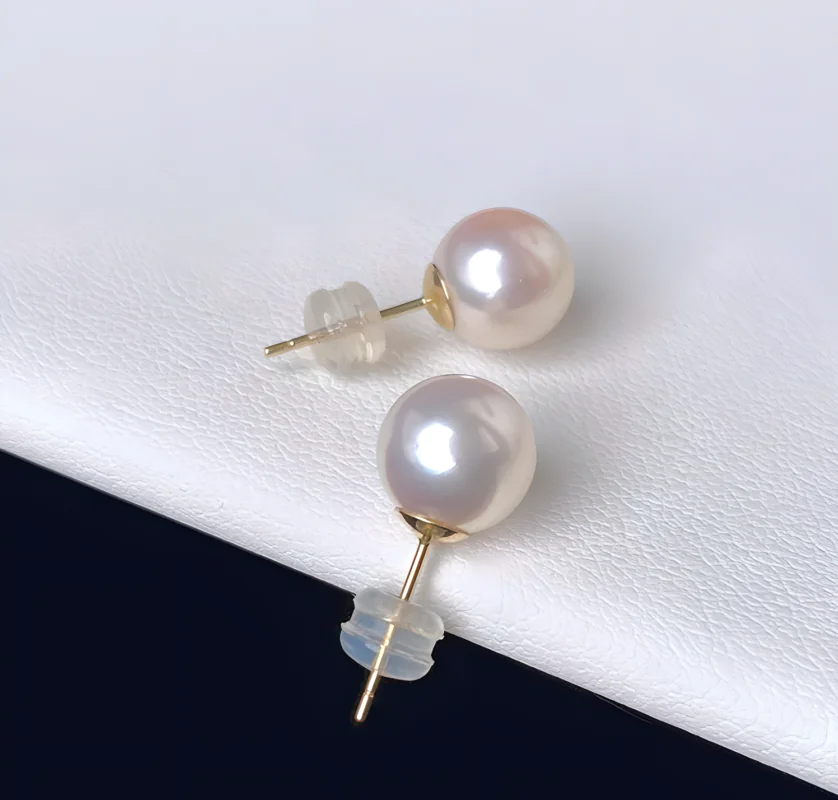
Why Do Akoya Pearls Often Have a Mirror-Like Luster?
High-quality Akoya pearls often look unusually bright because they can reflect light with very sharp, well-defined edges—sometimes clearly enough to resemble a tiny curved mirror. That appearance is not caused by one factor alone. It comes from the way nacre is deposited by the Akoya oyster, the smoothness and organization of that nacre, the conditions in which the pearl grows, and the quality of the finished surface. Cooler growing periods can encourage slower, tighter nacre deposition, which is one reason fine Akoya pearls are so strongly associated with crisp, mirror-like luster.
What Does “Mirror-Like Luster” Actually Mean?
Pearl luster is not simply another word for “shiny.” The important question is how strongly and how sharply light is reflected from the pearl. On a pearl with excellent luster, a window, lamp, or other bright object can appear as a small but recognizable reflection with relatively crisp boundaries. On a lower-luster pearl, the same reflection looks broad, hazy, or blurred.
This is why two white pearls can have similar color yet look completely different. One may seem bright, lively, and almost metallic, while the other looks soft or chalky. The difference is largely about the quality of reflected light rather than bodycolor alone.
Professional pearl-evaluation systems treat luster as a separate value factor from surface, color, shape, size, nacre, and matching. In practice, however, these factors interact: an uneven surface or poorly formed nacre can make reflected images less distinct even when the pearl has an attractive color.
The Main Reason: Akoya Nacre Can Form in Fine, Tightly Organized Layers
Akoya pearls are nacreous cultured pearls produced primarily by oysters in the Pinctada fucata complex. Their nacre is made of microscopic aragonite platelets separated by extremely thin organic layers. Rather than being a single smooth shell of mineral, nacre is a highly organized layered composite.
Those microscopic layers matter optically. Light interacts with the outer surface and with the stacked nacre beneath it. A smooth, well-organized surface can return a strong, concentrated reflection, while the layered structure also contributes to the characteristic depth, overtone, and subtle optical effects associated with fine pearls.
Scientific studies of pearl nacre describe a “brick-and-mortar” structure of aragonite tablets and organic material, with individual mineral layers on a scale comparable to wavelengths of visible light. Research on Akoya nacre also shows that variations in nacre-layer thickness influence structural color. In other words, the beauty of a pearl is partly the result of microscopic architecture rather than a simple glossy coating.
For more background on what nacre is made of, see our guide to the physical and chemical properties of pearls.
Why Cooler Water Can Improve the Sharpness of Akoya Luster
One of the most important characteristics of traditional Akoya cultivation is the role of cooler water, particularly toward the end of the growing cycle. When water temperatures fall, the oyster's biological activity slows. Nacre can then be deposited more slowly rather than building rapidly.
Gemological research associates this slower deposition under cooler conditions with finer nacre structure and the sharp luster for which high-quality Akoya pearls are known. Winter harvesting has traditionally been valued for a similar reason: the final nacre laid down during colder periods can be particularly fine and compact.
This does not mean that “colder is always better” or that temperature alone determines quality. Oyster health, water conditions, genetics, cultivation duration, farm management, and environmental stress all matter. The useful principle is narrower: slower, orderly nacre growth can favor the smooth optical surface needed for sharp reflections.
Surface Smoothness Matters as Much as Brightness
A mirror works because its surface sends reflected light back in an organized way. A pearl is much more complex than a mirror, but the same basic idea helps explain why surface condition matters.
If the outer nacre is smooth and evenly formed, reflected light remains comparatively concentrated. If the surface contains heavy wrinkles, pits, coarse growth texture, abrasion, or uneven crystal growth, the reflected light is scattered in more directions. The pearl may still glow, but the reflected image becomes softer.
This is also why luster and surface quality should not be treated as identical grading factors. A pearl can have one or two visible blemishes and still produce very sharp reflections over most of its surface. Conversely, a pearl may be relatively clean yet still look dull if its nacre does not reflect light strongly.
Does the Bead Nucleus Create Akoya's Mirror-Like Look?
Akoya cultured pearls are usually bead-nucleated. A round shell bead is inserted into the oyster together with mantle tissue, and nacre grows around that nucleus. The bead provides a regular underlying form, which helps explain why Akoya pearls are commonly round or near-round.
A round, regular shape can make a crisp reflection easier to see because the outer surface curves consistently. But the bead itself is not the source of luster. What the viewer sees is the nacre covering the nucleus. If that nacre is poorly formed, excessively thin, uneven, or dull, a perfectly round bead underneath will not create excellent luster.
This distinction has become increasingly important because some modern bead-nucleated freshwater pearls can also be very round and highly lustrous. Bead nucleation can contribute to shape regularity, but it does not make a pearl an Akoya and does not guarantee Akoya-style luster.
Why “Thicker Nacre = More Luster” Is Too Simple
Nacre thickness matters, especially for durability, and extremely thin nacre can reduce both appearance and long-term wear performance. But thickness by itself does not fully explain mirror-like luster.
Consider South Sea pearls. They generally develop much thicker nacre than typical Akoya pearls, yet fine South Sea pearls are often described as having a broad, satiny, luxurious glow rather than the extremely crisp reflection associated with top Akoya. Both can have excellent luster; the visual character is simply different.
The better rule is:
- Nacre thickness influences durability and the amount of well-formed nacre available to create optical effects.
- Nacre structure and organization influence how light travels through and returns from the layered material.
- Surface smoothness strongly influences whether reflections appear sharp or diffused.
- Pearl type and growth conditions influence the overall character of the luster.
So a thicker pearl is not automatically a more mirror-like pearl. When evaluating real jewelry, the reflection you can actually see is more useful than assuming quality from nacre thickness alone.
Mirror-Like Luster Is Not the Same as Orient
Another common source of confusion is the difference between luster and orient. They are related to the way light interacts with nacre, but they describe different visual effects.
Luster describes the intensity and sharpness of reflected light. Orient refers to iridescent, shifting colors that appear to float over or within the pearl, often showing pink, green, blue, or other hues as the viewing angle changes.
An Akoya pearl can therefore have extremely sharp luster without displaying dramatic orient. Another pearl may show beautiful color play but a softer reflection. When shoppers say an Akoya looks “like a tiny mirror,” they are usually describing luster rather than orient.
Why Some Akoya Pearls Still Look Dull or Chalky
Akoya is a pearl type, not a guarantee of quality. Commercial Akoya pearls span a broad range of luster. Some are intensely reflective; others appear moderately bright, soft, milky, or chalky.
Weak luster can be associated with several conditions, including poorly developed nacre, irregular outer nacre growth, surface texture that scatters light, environmental stress during cultivation, or simply lower-quality material being accepted into the finished pearl. Extremely thin nacre can also be a concern because the underlying bead may influence appearance and durability.
This is why “Akoya” should not be used as a substitute for an actual quality evaluation. If you want a broader framework for comparing luster with surface, shape, color, nacre, and matching, see our guide to evaluating pearl value.
How to Judge Mirror-Like Akoya Luster in Practice
You do not need laboratory equipment to make a useful visual comparison. What matters most is using the same light and comparing reflection quality rather than raw brightness.
- Use a broad, recognizable light source. A nearby window or rectangular soft light is easier to judge than multiple sparkling spotlights.
- Look for edge definition. On a high-luster pearl, the reflected window frame, lamp edge, or dark-and-light boundary should look comparatively crisp.
- Check more than one area. Rotate the pearl slowly. Strong luster should not exist only in one tiny highlight while the rest of the surface looks hazy.
- Compare pearls side by side. Luster differences become much easier to see when two pearls are under exactly the same lighting.
- Ignore brightness alone. A powerful jewelry spotlight can make almost any smooth object flash. Reflection sharpness is the more useful clue.
A practical test is to look for a dark object or the outline of your own face reflected in the pearl. You are not judging whether the reflection is perfectly mirror-clear; pearls are curved biological materials. You are comparing how focused or blurred the reflected image appears.
How Akoya Luster Usually Compares with Other Cultured Pearls
These descriptions are tendencies rather than fixed rules. Exceptional pearls exist in every major cultured-pearl category.
| Pearl type | Typical high-quality luster character | What the eye often notices first |
|---|---|---|
| Akoya | Sharp, crisp, mirror-like | Well-defined reflections and bright white highlights |
| South Sea | Broad, satiny, deep | A softer-looking glow across a larger pearl |
| Tahitian | Deep, sometimes metallic | Dark bodycolor combined with green, blue, silver, or peacock overtones |
| Freshwater | Highly variable, from soft to very metallic | A wide range of reflection styles depending on pearl type, structure, and quality |
Akoya's reputation is therefore not that it is the only pearl capable of strong luster. Its distinction is that the best examples combine a classic round form with unusually crisp reflected images. For a fuller introduction to the type, see our Akoya pearl guide.
FAQ
Do all Akoya pearls have mirror-like luster?
No. Akoya pearls are known for the potential to develop very sharp luster, but quality varies. Lower-quality Akoya pearls can look soft, hazy, or chalky. Judge the actual pearl rather than assuming that the Akoya name guarantees excellent luster.
Does thicker nacre always make an Akoya pearl more lustrous?
No. Adequate, well-formed nacre is important, and very thin nacre can cause quality and durability concerns. However, reflection sharpness also depends on nacre organization and surface smoothness. Thickness is one part of the picture, not a complete luster grade.
Can freshwater pearls also have mirror-like luster?
Yes. Some high-quality freshwater pearls, including modern bead-nucleated varieties, can show extremely sharp or metallic luster. A mirror-like reflection is therefore not proof that a pearl is Akoya.
Is mirror-like luster the same thing as a pearl's overtone?
No. Luster describes the strength and sharpness of reflected light. Overtone is a secondary color visible over the pearl's bodycolor. A pearl can have strong luster with a subtle overtone, or a noticeable overtone with softer luster.
What is the easiest way to compare Akoya luster when buying?
Compare two or more pearls under the same neutral light and focus on the sharpness of a recognizable reflected object. A more focused reflection usually indicates stronger luster than a broad, blurred highlight.
What to Remember
Akoya pearls often show mirror-like luster because fine Akoya nacre can develop as smooth, tightly organized microscopic layers, especially when growth slows during cooler periods. The resulting surface can return light with unusually sharp definition. But there is no single “mirror layer” inside an Akoya pearl, and thicker nacre alone does not guarantee the effect.
The most useful way to judge Akoya luster is visual: look for crisp reflections, not just brightness. Then consider luster together with surface quality, nacre condition, shape, color, and matching. That gives a much more accurate picture of pearl quality than simply asking whether a pearl is Akoya.