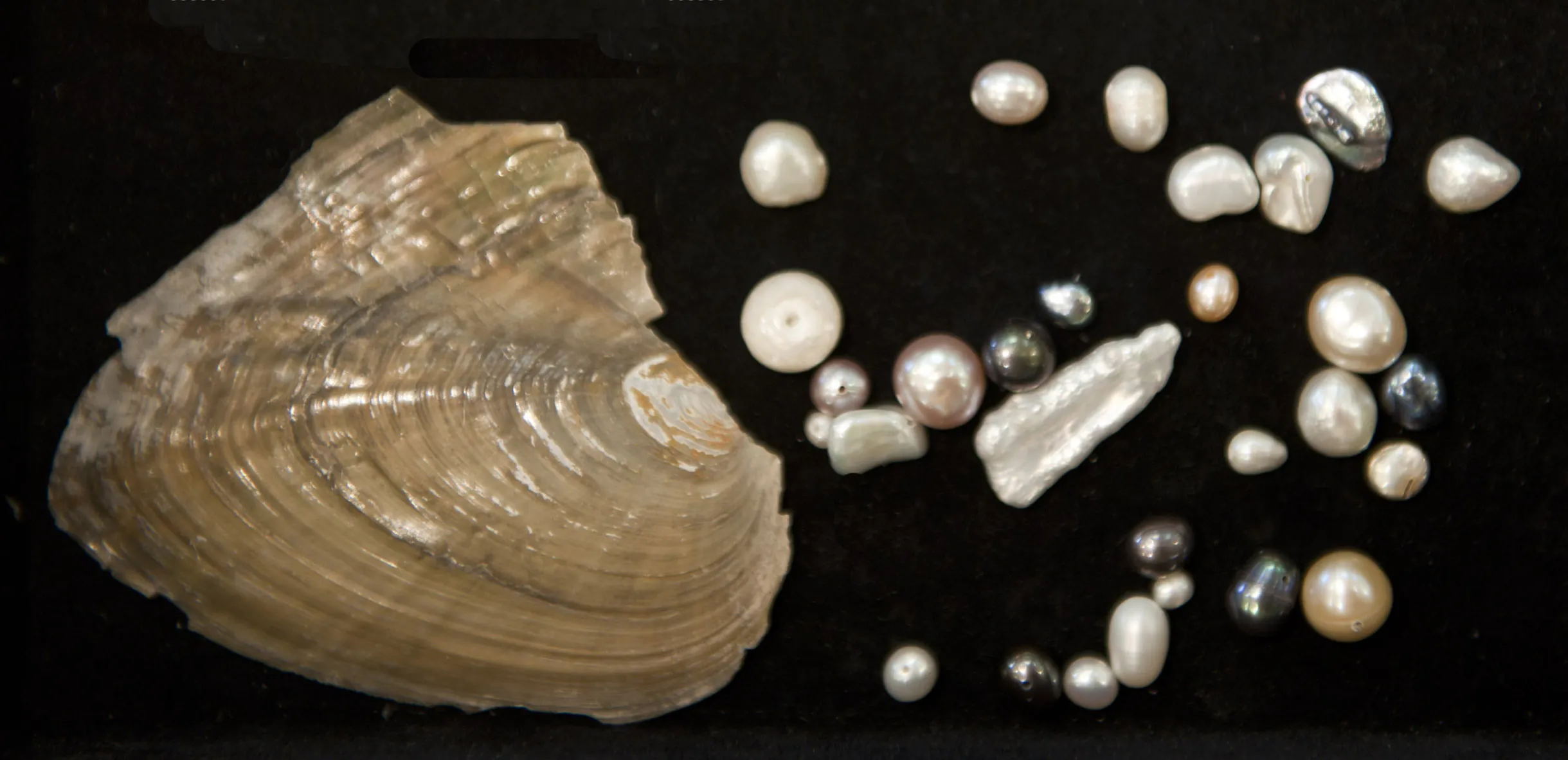
Tahitian pearls are called “black pearls,” but most are not a flat, ink-like black. Their natural colors usually sit somewhere between silver-gray and very dark charcoal, often modified by green, blue, purple, rose, bronze, or other secondary colors.
That is not a defect. It is a normal result of how color forms in the black-lipped pearl oyster and how light interacts with layers of nacre. A Tahitian pearl can look nearly black from one angle, greenish gray from another, and show pink or blue flashes when it moves.
The simplest way to understand the effect is to stop treating “black” as one exact color. In Tahitian pearls, what you see is a combination of bodycolor, overtone, orient, tone, and luster.
“Black Pearl” Is a Category Name, Not a Literal Color Requirement
Tahitian cultured pearls are associated with the black-lipped pearl oyster, Pinctada margaritifera, and are best known for naturally dark colors. Compared with white Akoya or white South Sea pearls, they can look dramatically darker, so the nickname “black pearl” is easy to understand.
But gemological references describe a much broader range. GIA notes that Tahitian cultured pearls may be gray, black, or brown, with blue, green, purple, or pink overtones. Its research on Pinctada margaritifera also documents colors ranging from light tones through dark gray and black, along with strong secondary hues.
So when a seller calls a pearl “black Tahitian,” the word black often means that it belongs to the naturally dark Tahitian color family. It does not mean every pearl should resemble polished black glass.
For a broader introduction to the pearl type, see our Tahitian pearl guide.
Reason 1: The Oyster Produces a Range of Dark Pigments, Not One Uniform Black
The characteristic color of Tahitian pearls begins with the black-lipped oyster. Its mantle tissue can produce darkly colored nacre, but biological coloration is not a simple on-or-off switch.
GIA spectroscopy research on natural-color cultured pearls from Pinctada margaritifera found that individual colors are associated with a mixture of pigments rather than one single pigment. That helps explain why two genuine Tahitian pearls can emerge with noticeably different dominant colors even though both come from the same pearl-producing species.
One pearl may be silvery gray. Another may be charcoal with a green cast. Another may be brownish gray, blue-green, or so dark that it reads as almost black in ordinary light.
This natural variation is part of the identity of the pearl type. A perfectly uniform jet-black appearance is not the standard that genuine Tahitian pearls are supposed to meet.
Reason 2: Nacre Adds Overtone and Orient on Top of the Bodycolor
Pigment explains only part of what the eye sees. Tahitian pearls are nacreous gems made from many extremely thin layers. Light does not simply hit a black surface and bounce straight back. It interacts with those layers.
This creates two important color effects:
- Overtone is a translucent secondary color visible over the pearl's main bodycolor. Common Tahitian overtones include green, blue, pink, purple, and bronze.
- Orient is an iridescent, shifting play of two or more colors that appears on or just beneath the surface of some pearls.
GIA explains that overtone and orient are related to light interference within the pearl's layered nacre. As the pearl or light source moves, those colors can become stronger, weaker, or appear to shift.
This is one reason a naturally dark pearl often looks more complex than a piece of black enamel. Its surface is optically active rather than visually flat.
Bodycolor, Overtone, and Orient: A Better Way to Describe What You See
If you want to understand Tahitian pearl color accurately, separate the visible effect into layers instead of asking only whether the pearl is black.
| Color component | What it means | Example in a Tahitian pearl |
|---|---|---|
| Bodycolor | The dominant overall color of the pearl | Silver-gray, charcoal, greenish gray, brownish gray, near-black |
| Overtone | A translucent secondary color seen over the bodycolor | Green over gray, rose over green, blue over charcoal |
| Orient | A shifting iridescent play of multiple colors | Green, pink, blue, or purple flashes that move with the viewing angle |
This distinction also explains famous trade descriptions such as peacock. In 2023, GIA formalized a “Peacock” color-range comment for certain Pinctada margaritifera pearls, describing a green-containing bodycolor with sufficient saturation and tone plus noticeable overtone or orient. In other words, one of the best-known Tahitian color descriptions is valuable precisely because it is not simply black.
If you want to compare individual color families in more detail, see our guide to the natural dark color range of Tahitian pearls.
Why Can the Same Tahitian Pearl Look Black in One Photo and Green in Another?
Dark pearls are particularly sensitive to lighting and background. The pearl itself has not changed, but the way its bodycolor and surface effects are perceived can change substantially.
Several things matter:
- Light direction: direct reflections can emphasize luster and secondary colors, while softer light may make the pearl look darker and more neutral.
- Color temperature: warm indoor light can make gray-green pearls appear more bronze or olive, while cooler light can emphasize blue and silver.
- Background: black backgrounds often make bright reflections and overtones stand out, while white or neutral gray backgrounds make overall tone easier to compare.
- Camera processing: automatic white balance, contrast, and saturation can strengthen or suppress colors.
For color-sensitive purchases, it is useful to see the exact pearl under neutral white light and, ideally, against more than one neutral background. A short video can also reveal color movement that a single still image hides.
Does a Tahitian Pearl Need to Be Very Dark to Be Valuable?
No. Darkness by itself is not a quality grade.
GIA evaluates pearl quality using several value factors, including size, shape, color, luster, surface quality, nacre quality, and matching for multi-pearl jewelry. A pearl can be unusually dark yet have weak luster or distracting surface characteristics. Another can be lighter silver-green but have sharp reflections, attractive color, and a cleaner surface.
This is why “the blackest pearl is the best pearl” is a poor buying rule.
A more useful comparison order is:
- Check luster. Are reflections bright and well defined, or dull and hazy?
- Look at the surface. Decide whether marks are minor or visually dominant.
- Identify the bodycolor. Is it silver, gray, charcoal, greenish gray, brownish gray, or near-black?
- Look for overtone and orient. Do they add depth and attractive color movement?
- For a pair or strand, judge matching. Similar color labels do not guarantee that pearls look harmonious together.
For the broader quality framework, use our pearl grading guide.
If It Is Not Pure Black, Does That Mean the Color Is Natural?
Not necessarily. A complex gray, green, blue, or purple appearance is consistent with natural-color Tahitian pearls, but appearance alone cannot prove color origin.
Pearls can be dyed or otherwise treated to alter color. Dark-colored freshwater and Akoya cultured pearls, for example, may be treated and can sometimes imitate colors associated with Tahitian pearls. Conversely, a genuine Tahitian pearl can naturally be silver, gray, green, brownish, or nearly black.
The important distinction is therefore not “pure black versus not pure black.” It is pearl type and color origin.
For ordinary jewelry, clear seller disclosure is often the practical starting point. For a high-value purchase where origin or treatment materially affects the decision, an independent gemological report can provide stronger evidence than visual inspection alone. Our guide to pearl treatments explains common enhancement methods and why disclosure matters.
What Does a “Nearly Black” Tahitian Pearl Actually Look Like?
A very dark Tahitian pearl can certainly appear black at first glance, especially from a distance or in low light. But when examined closely under neutral illumination, it often reveals something more specific: charcoal gray, deep green, blue-gray, brown-black, or another dark bodycolor with a visible overtone.
The closer the tone gets to black, the easier it is for subtle colors to disappear in a photograph. That does not mean the pearl lacks color. It means the human eye is seeing a very dark base while reflections and secondary hues occupy a narrower visible range.
This is also why color names should be treated as descriptive tools rather than exact scientific boxes. Two sellers may use slightly different trade names for pearls that sit close together visually.
How to Judge Tahitian Pearl Color in Practice
If color is important to you, use a simple viewing routine instead of relying on the word “black” in a listing.
- Start with neutral light. Daylight-balanced or neutral white light makes color comparison easier.
- Use a white or neutral gray background. It helps you see whether the pearl is truly near-black, charcoal, silver, greenish, or brownish.
- Rotate the pearl. Overtone and orient may appear only from certain angles.
- Compare pearls side by side. A pearl described as “dark green” may look much more gray next to a vivid green example.
- Judge luster together with color. Strong luster can make a color feel deeper and more vivid; weak luster can make even an unusual color look flat.
- Ask whether the image shows the exact pearl. This matters for one-of-a-kind loose pearls, pairs, and strands where color variation is expected.
If you are choosing a finished piece rather than loose material, you can compare how these colors look in actual designs in our Tahitian pearl jewelry collection.
The Main Point: Tahitian “Black” Is Supposed to Have Depth
Tahitian pearls are not usually pure black because their color is produced by a naturally variable biological system and then modified visually by the layered optical structure of nacre.
The black-lipped oyster can produce naturally dark bodycolors, but those colors vary in tone and hue. On top of that base, nacre can create green, blue, pink, purple, bronze, and other overtones and iridescent effects. The result is a pearl that may look dark without ever looking flat.
So the absence of a uniform jet-black color is not something that needs to be corrected. In many Tahitian pearls, the gray, green, blue, purple, or multicolored character is exactly what gives the pearl its identity.
FAQ
Are Tahitian pearls naturally black?
Tahitian cultured pearls can be naturally very dark, but most are better described as gray, silver, charcoal, greenish gray, brownish gray, or near-black. They may also show green, blue, pink, purple, or bronze overtones.
Can a genuine Tahitian pearl be silver or green?
Yes. Genuine Tahitian pearls have a broad natural color range. Silver-gray and green-containing colors are both well documented in pearls from the black-lipped oyster.
What is a peacock Tahitian pearl?
“Peacock” is a trade color description generally associated with a green-containing bodycolor plus noticeable overtone or orient, often including pink or other hues. It describes a layered color effect rather than a single flat shade.
Are the darkest Tahitian pearls the most expensive?
Not automatically. Color is only one pearl value factor. Luster, surface, size, shape, nacre quality, matching, rarity, and overall visual appeal also influence desirability and price.
Are all black pearls Tahitian pearls?
No. Some freshwater and Akoya cultured pearls are treated to produce dark colors, and other naturally dark saltwater pearls also exist. A dark appearance alone does not identify a pearl as Tahitian.
Sources and Further Reading
- GIA: Non-Bead-Cultured Pearls from Pinctada margaritifera — color range, secondary hues, pigmentation, and identification characteristics.
- GIA Gems & Gemology: UV-Vis-NIR Reflectance Spectroscopy of Natural-Color Saltwater Cultured Pearls from Pinctada margaritifera — evidence that individual colors arise from mixtures of pigments.
- GIA: Pearl Description — bodycolor, overtone, orient, and the color range of Tahitian cultured pearls.
- GIA: Guide to Phenomenal Gems — explanation of overtone and orient as optical effects associated with layered nacre.
- GIA: “Peacock” Color Range Comment for Pearl Reports — trade-color definition for qualifying Pinctada margaritifera pearls.