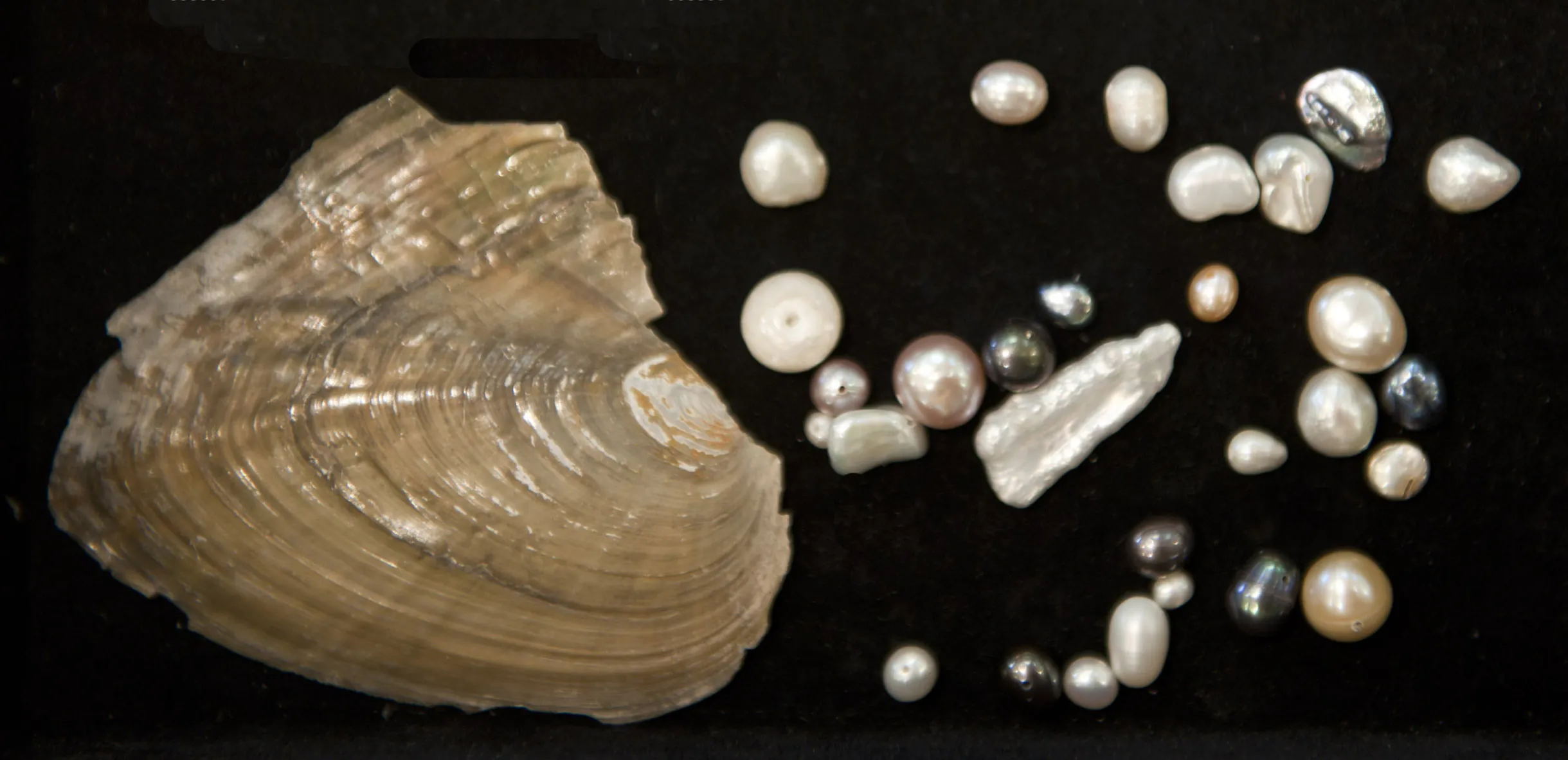
South Sea pearls are usually larger because they are cultured in Pinctada maxima, the largest pearl oyster used for major commercial pearl production. Its larger body can accommodate a larger bead nucleus, giving the pearl a much bigger starting point than an Akoya pearl. A relatively long cultivation period then allows the oyster to add substantial layers of nacre around that nucleus.
So the simple answer is not just “South Sea pearls grow for longer.” Their size comes from a chain of factors: a large host oyster, a large nucleus, enough time for nacre deposition, and successful management of the oyster throughout cultivation.
How Large Are South Sea Pearls?
South Sea cultured pearls occupy a noticeably larger size range than classic Akoya pearls. Gemological references commonly place South Sea pearls at roughly 8–18 mm or 8–20 mm, depending on the source and how the market range is described. GIA has also cited an average of about 13 mm for Pinctada maxima cultured pearls.
That does not mean every South Sea pearl is huge. An 8–10 mm South Sea pearl can still occur, while pearls above the mid-teens become progressively less common. Exceptional specimens can exceed 20 mm, but they should not be treated as the normal commercial range.
If you want to compare how millimeter measurements look in jewelry, see our Pearl Size Guide. A difference of only 1–2 mm can be visually significant because diameter increases in every direction.
The Main Reason: Pinctada maxima Is a Much Larger Pearl Oyster
The biological starting point is the oyster itself. South Sea pearls are bead-cultured in Pinctada maxima, the silver-lipped or gold-lipped pearl oyster. It is the largest species in the Pinctada genus used for commercial pearl culture. GIA notes that shells can grow beyond 30 cm, although pearl farms use oysters at practical culture sizes rather than simply waiting for the largest possible shell.
A larger animal gives pearl technicians more physical room to work with. Most importantly, it can accommodate a larger spherical bead nucleus than the much smaller Akoya oyster can usually support.
This is why oyster species sets a kind of biological size envelope. The pearl does not become large because the oyster is literally “filling up” with pearl material. Rather, the host's size and physiology make a larger nucleation strategy possible.
For a broader introduction to the species, colors, and producing regions, see our South Sea Pearls guide.
A Large Bead Nucleus Gives the Pearl a Head Start
Most round South Sea cultured pearls are produced by bead nucleation. During the operation, a technician inserts a spherical bead nucleus into the host oyster together with a small piece of donor mantle tissue. That tissue develops into the pearl sac, which then deposits nacre around the bead.
This point is essential for understanding size: the finished pearl does not grow from zero. Much of its initial diameter is already established by the nucleus.
A simplified way to think about the final diameter is:
finished pearl diameter ≈ nucleus diameter + nacre added around the nucleus
The exact result is biological rather than perfectly mathematical, but the principle is useful. If a South Sea oyster begins with a substantially larger nucleus than an Akoya oyster, it begins the pearl-growing stage much closer to the large sizes seen at harvest.
This is why saying that South Sea pearls are large “because they have thick nacre” is incomplete. Thick nacre matters, but the larger starting nucleus is a major part of the size advantage.
Longer Cultivation Adds Nacre—but Time Is Not the Whole Explanation
After nucleation, the oyster needs time to form the pearl sac and deposit successive nacre layers. South Sea pearl culture commonly continues for around two years after seeding in many farming systems, and some production may run longer depending on farm practice, oyster condition, environment, and the quality target.
Longer time can contribute to a larger final diameter because additional nacre is deposited over the nucleus. It also helps explain why South Sea pearls are known for substantial nacre and a broad, satiny glow.
But the relationship is not simply “twice the time equals twice the size.” Nacre deposition rate varies, and the oyster remains a living animal exposed to changes in food availability, temperature, disease pressure, fouling, storms, and other environmental conditions. A farmer therefore has to balance additional growth against the risk of keeping the pearl in the water longer.
Our guide to pearl cultivation time and maturity explains this trade-off in more detail. Longer cultivation can be useful, but it is not automatically better in every case.
Why South Sea Pearls Are Larger Than Akoya and Usually Larger Than Tahitian Pearls
The clearest comparison is between the three major saltwater bead-cultured pearl oysters.
| Pearl type | Main oyster | Typical commercial size tendency | Why the range differs |
|---|---|---|---|
| Akoya | Pinctada fucata / related Akoya oyster | Often about 6–9 mm | Smaller host oyster generally uses smaller nuclei |
| Tahitian | Pinctada margaritifera | Often about 8–14 mm | Larger host than Akoya, with larger bead-culture capacity |
| South Sea | Pinctada maxima | Often about 8–18/20 mm | Largest host oyster, larger nuclei, substantial nacre growth |
These ranges overlap. A 9 mm South Sea pearl and a 9 mm Akoya pearl can both exist, so pearl type cannot be identified by size alone. The important point is that the distribution of sizes is different: 9 mm is relatively large for classic Akoya production but modest for South Sea pearls.
Re-Seeding Can Produce Even Larger South Sea Pearls
South Sea cultivation has another size-related advantage: a successful oyster may sometimes be used again after harvest. Western Australia's Department of Primary Industries and Regional Development notes that the best oysters may be seeded several times, with each resulting pearl larger than the one before.
The logic is straightforward. Once a pearl sac has successfully produced a pearl, a technician may place a new, larger nucleus into the existing pearl sac. Because the next operation starts with a larger bead, the next pearl can reach a larger final diameter.
This does not mean every large South Sea pearl is a second- or third-operation pearl, nor that every oyster is suitable for repeated seeding. It simply shows how cultivation method can extend the size potential already provided by Pinctada maxima.
Oyster Health and Farm Conditions Still Matter
Species and nucleus size create the opportunity for a large pearl, but they do not guarantee one. The host oyster has to remain healthy enough to retain the nucleus and continue depositing nacre. Farm conditions also affect growth and pearl formation.
Research on Pinctada maxima has found relationships between host characteristics and pearl traits including size, luster, and defects. In practical terms, pearl production is not an assembly line where identical nuclei produce identical pearls. Two oysters seeded at the same time can still produce different results.
Important variables can include:
- the size and condition of the host oyster;
- the nucleus selected for that oyster;
- the health of the host after the operation;
- food availability and water conditions;
- the length of the culture period;
- farm cleaning, handling, and husbandry;
- whether the oyster is undergoing a first or later seeding operation.
That variability is one reason a harvest contains a range of sizes, shapes, surface conditions, and luster rather than a set of identical pearls.
Does Warm Water Make South Sea Pearls Large?
Warm tropical and subtropical waters are part of the natural farming environment for Pinctada maxima, and temperature, food, and water quality can influence oyster metabolism and nacre deposition. But “warm water makes big pearls” is too simple.
The strongest explanation for South Sea pearl size remains the combination of species + nucleus size + cultivation time. Environmental conditions determine whether the oyster can perform well within that system. Poor conditions can reduce survival or pearl quality rather than simply speeding up growth.
In other words, environment is an enabling factor, not a magic size switch.
Does a Larger South Sea Pearl Automatically Mean a Better Pearl?
No. Size is important because larger South Sea pearls are generally harder to produce and become scarcer as diameter increases, but size is only one quality and value factor.
A large pearl may still have weak luster, heavy surface blemishing, an irregular shape, or poor matching in a strand. A slightly smaller pearl with stronger luster and a cleaner surface can be the more attractive choice.
When comparing South Sea pearls, judge size together with luster, surface, shape, color, nacre, and matching. Our Pearl Grading Guide explains how these characteristics work together.
What Really Makes South Sea Pearls Large?
The best way to remember the answer is as a sequence:
- Pinctada maxima is a very large pearl oyster.
- Its size allows technicians to use a relatively large bead nucleus.
- The pearl then remains in culture long enough to build substantial nacre around that nucleus.
- Healthy oysters and suitable farm conditions determine how successfully that potential is realized.
- In selected oysters, later re-seeding operations can begin with even larger nuclei.
That is why South Sea pearls occupy a larger size category than classic Akoya pearls. The difference begins with biology, but cultivation technique determines how farmers use that biological capacity.
If you are choosing pearls for jewelry or sourcing larger pearls for making, compare the millimeter measurement with luster and surface quality rather than treating diameter as a quality grade by itself. You can also browse our wholesale pearl selection for material sourcing.
FAQ
Why are South Sea pearls bigger than Akoya pearls?
South Sea pearls are cultured in the much larger Pinctada maxima oyster. This allows farmers to use larger bead nuclei, and the pearls are then given substantial time to build nacre. Akoya oysters are smaller and are generally cultured with smaller nuclei.
What is the normal size of a South Sea pearl?
South Sea cultured pearls are commonly found from roughly 8 mm into the high teens, with gemological references often giving an upper typical range around 18–20 mm. Around 13 mm is a frequently cited average, while pearls above the mid-teens become increasingly uncommon.
Do South Sea pearls get larger the longer they stay in the oyster?
They can gain diameter as additional nacre is deposited, but growth is not unlimited or perfectly linear. The starting nucleus, oyster health, nacre deposition rate, environment, and harvest timing all affect the finished pearl.
Are very large South Sea pearls always more valuable?
Not automatically. Large size can add rarity and value, but luster, surface condition, shape, color, nacre, and matching also matter. A larger pearl with weak visible quality may be less desirable than a smaller but finer pearl.
Can the same South Sea oyster produce more than one pearl over its lifetime?
Yes, selected oysters may be re-seeded after a successful harvest. In some South Sea farming systems, later operations can use larger nuclei and produce progressively larger pearls.
Sources and Further Reading
- Gemological Institute of America (GIA): Different Pearl Types Explained
- GIA Gems & Gemology: A Look Inside a Remarkably Large Beaded South Sea Cultured Pearl
- Western Australia DPIRD: Pearl Oyster Fishery in Western Australia
- Aquaculture: Host and Donor Influence on Pearls Produced by the Silver-Lip Pearl Oyster, Pinctada maxima