When Is a Full Pearl Necklace Appropriate? Choosing Length, Pearl Size, and Style
A full pearl necklace is appropriate far more often than formal tradition suggests. A single strand can work with a T-shirt, office tailoring, a wedding-guest dress, or evening wear. What changes the impression is not simply that the necklace is made entirely of pearls, but its visual weight: the strand length, pearl diameter, shape, color, matching, and how it relates to the neckline. If you want one versatile first strand, a collarbone-length necklace with medium-size pearls is usually the easiest place to start.
What Counts as a Full Pearl Necklace?
In this guide, a “full pearl necklace” means a necklace in which pearls form most or all of the visible strand, rather than a single pearl pendant hanging from a metal chain. It may be made with round, near-round, oval, baroque, or mixed-shape pearls, and it may be uniform or graduated in size.
That distinction matters because a full strand creates a continuous band of color and luster around the neck. It therefore has more visual presence than a pendant, even when the individual pearls are small. But “more visible” does not automatically mean “more formal.” A short strand of small baroque freshwater pearls can look relaxed and contemporary, while a perfectly matched strand of larger round pearls can look much more ceremonial.
When Is a Full Pearl Necklace Appropriate?
The most useful rule is to match the necklace’s visual formality to the setting. Smaller pearls, irregular shapes, mixed materials, and relaxed styling usually make a full strand feel more casual. Larger round pearls, highly uniform matching, multiple strands, and dressier clasps increase its formality and presence.
| Occasion | Easy starting point | Why it works |
|---|---|---|
| Casual / everyday | 4–7 mm, short to princess length, round or baroque | Enough luster to add polish without dominating simple clothes |
| Work / business | 6–8 mm, usually 16–20 in (41–51 cm), clean single strand | Reads as refined and controlled with shirts, knitwear, and tailoring |
| Dinner / date / social event | 6–9 mm, choker to matinee; classic or slightly irregular | Can shift from understated to expressive depending on clothing |
| Wedding guest | 6–9 mm, princess or matinee, usually one clear focal strand | Elegant without requiring a heavily jeweled look |
| Bridal / formal evening | 7–10 mm or larger, highly matched or intentionally designed strand | Greater scale and uniformity create a more formal visual effect |
| Memorial / restrained ceremony | Small-to-medium single strand in a subdued color | Can look dignified and quiet where local dress customs consider pearls suitable |
These are styling guidelines, not etiquette laws. Workplace dress codes, wedding traditions, cultural customs, and personal style can all change what feels appropriate. When in doubt, choose a simpler single strand and let the clothing set the level of formality.
Choose Length First: It Determines Where the Strand Lives on the Outfit
Length is usually the first practical decision because it determines whether the pearls frame bare skin, sit at the collarbone, or lie over clothing. Necklace names vary slightly among jewelers, so use the actual measurement as well as the label.
| Common name | Typical length | How it usually reads | Useful with |
|---|---|---|---|
| Collar | About 12–13 in (30–33 cm) | Fashion-forward, close-fitting, noticeable | Open shoulders, deep necklines, deliberate styling |
| Choker | About 14–16 in (36–41 cm) | Defined and youthful to classic | Open collars, scoop necks, strapless or off-shoulder looks |
| Princess | About 17–19 in (43–48 cm) | Classic and highly versatile | Most dresses, shirts, V-necks, crew necks, gifting |
| Matinee | About 20–24 in (51–61 cm) | Relaxed, polished, slightly more elongated | Blazers, high necklines, knitwear, business dressing |
| Opera | Roughly 28–36 in (71–91 cm) | Dramatic when worn long; versatile when doubled | Evening looks, layering, simple dresses or tops |
| Rope | About 36 in (91 cm) and longer | Statement-oriented and highly style-dependent | Layering, knotting, doubling, editorial styling |
Why 17–19 Inches Is the Safest First Strand
A princess-length strand sits near the collarbone on many adults, so it can remain visible with a wide range of necklines without feeling as close-fitting as a choker or as directional as a long strand. That makes it a useful default for someone who wants one necklace to move between everyday clothing and more formal outfits.
Still, do not buy by the word “princess” alone. Neck circumference, shoulder width, pearl diameter, clasp length, and the thickness of the clothing underneath all affect where the strand actually falls. If fit matters, measure an existing necklace you like or use a soft tape to mark the point where you want the lower edge of the pearls to sit.
Then Choose Pearl Size: A Few Millimeters Change the Whole Mood
Pearl diameter changes a full strand more dramatically than it changes a single pendant because the size is repeated across the entire necklace. A move from 6 mm to 9 mm does not sound large on paper, but around a whole neckline it creates much greater surface area, luster, and visual weight.
| Pearl size | Typical visual effect in a full strand | Good starting use |
|---|---|---|
| 3–5 mm | Fine, delicate, light | Layering, youthful styling, subtle everyday wear |
| 5–7 mm | Understated but clearly pearl | Daily wear, casual-smart outfits, smaller-scale looks |
| 7–8 mm | Balanced, recognizably classic | First strand, office, gifting, broad versatility |
| 8–9 mm | More substantial and polished | Confident everyday wear, events, milestone gifts |
| 9–10 mm+ | Strong presence and increasing statement effect | Formal looks, luxury styling, buyers who prefer visible scale |
These ranges describe appearance, not quality grades. A larger pearl is not automatically a better pearl. The Gemological Institute of America treats size as one of several pearl value factors, alongside shape, color, luster, surface, nacre, and matching. When comparing two strands, strong luster and thoughtful matching can matter more visually than simply adding another millimeter.
If you want to understand those quality trade-offs before buying, see our guide to evaluating pearl value.
Round, Baroque, or Graduated? Style Changes Formality as Much as Size
Uniform Round Pearls: The Classic Full-Strand Look
A well-matched strand of round or near-round pearls creates rhythm and symmetry. In white or cream, it is the version most strongly associated with traditional pearl jewelry. With medium pearls and simple clothing, it can still look modern and restrained; with larger pearls, a formal dress, and matching pearl earrings, it becomes much more ceremonial.
Akoya pearls are frequently used for this crisp, classic strand aesthetic. If you are comparing pearl types rather than only styling, our Akoya pearl guide explains their typical characteristics in more detail.
Baroque and Irregular Pearls: More Texture, Less Strict Formality
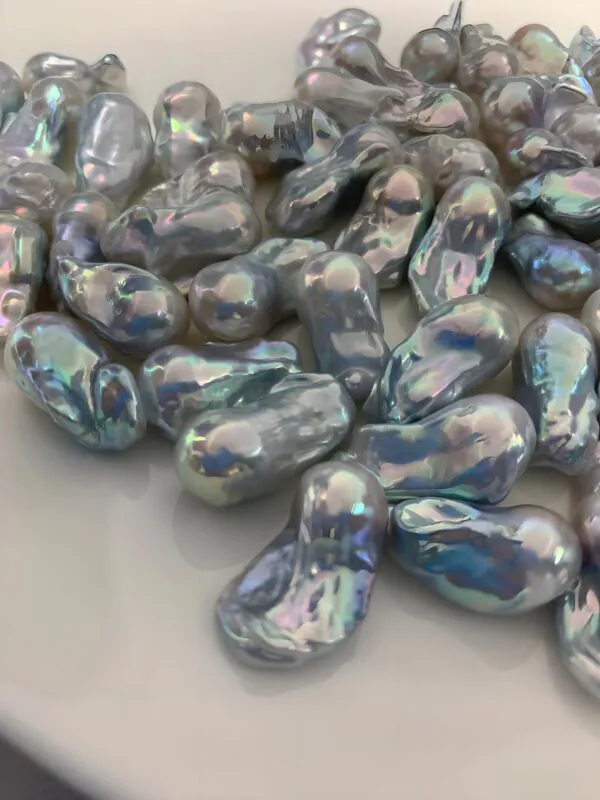
Baroque pearls interrupt the perfect repeated circle, so the eye reads shape and individuality as well as luster. That often makes a full strand easier to pair with linen, denim, knitwear, relaxed tailoring, or mixed metal jewelry. Large baroque pearls can still be dramatic, but they usually feel more design-led than conventionally formal.
Graduated Strands: Classic Structure with a Focal Center
In a graduated necklace, pearls become larger toward the center. The eye is naturally drawn to the front of the neckline, which can give the necklace a composed, vintage, or dressier character without making every pearl large. This is useful if you want presence at the center but less bulk around the sides and back of the neck.
Multicolor or Mixed-Material Strands: Styling Becomes the Main Message
Mixed-color pearls, pearl-and-chain combinations, visible metal spacers, or intentionally varied shapes move the necklace away from the traditional “perfect white strand” formula. These designs can be easier to wear casually because they read first as a jewelry design and second as a formal pearl convention.
Match the Strand to the Neckline, Not Just the Occasion
A necklace can be appropriate for an event and still fight with the clothing. The goal is to give the strand a clear visual zone.
- Open, scoop, square, strapless, or off-shoulder necklines: chokers and princess lengths can sit cleanly against skin and frame the neckline.
- V-necks: a short full strand creates contrast with the V; if you want the necklace to echo the neckline instead, a pendant may be the easier choice.
- Crew necks: either keep the pearls clearly above the collar edge or choose a longer strand that falls clearly below it. A necklace that lands exactly on the fabric edge may look crowded.
- Turtlenecks and high knits: matinee, opera, or rope lengths often work better because the pearls can sit visibly over the fabric.
- Detailed lace, sequins, beading, or embellished collars: simplify the pearl necklace or skip it in favor of pearl earrings. Two competing focal points can make even beautiful pieces feel busy.
A Practical Four-Step Way to Choose One Strand
- Decide where you will wear it most. If the answer is “everywhere,” prioritize versatility over maximum impact.
- Choose where it should sit. For a first strand, test approximately 17–19 inches; go shorter for a neck-focused look or longer if you often wear high necklines.
- Choose the visual weight. Around 5–7 mm is subtle, 7–8 mm is classic, and 8–10 mm or larger becomes progressively more noticeable.
- Choose the personality. Uniform round pearls look more traditional; baroque, mixed-color, graduated, or mixed-material strands can feel more contemporary or expressive.
For many shoppers, the most adaptable answer is not the biggest or longest strand. It is the one that sits clearly with their usual necklines and has enough presence to look intentional without forcing the rest of the outfit to become formal.
If you are ready to compare actual designs, browsing different pearl necklace styles side by side is useful because length, pearl diameter, shape, and clasp design are easier to judge as a complete piece than as isolated specifications.
Do Not Forget Comfort and Construction
A full pearl necklace carries more material around the neck than a pendant, and larger pearls increase that effect. If you are sensitive to weight or pressure at the throat, a slightly longer strand or smaller pearl size may be more wearable than a tight choker with large pearls.
Also inspect how the strand is assembled. On many traditional pearl necklaces, knots between pearls help keep the strand flexible and can limit how many pearls are lost if the string breaks. Over time, the string itself may stretch or wear even when the pearls remain in good condition. For cleaning, storage, cosmetics, and restringing considerations, see our guide on how to care for pearls.
FAQ
Can You Wear a Full Pearl Necklace Every Day?
Yes. A full strand can be everyday jewelry when its scale and styling suit your wardrobe. Smaller or medium pearls, baroque shapes, simple clasps, and short-to-princess lengths are especially easy to dress down.
What Is the Most Versatile Pearl Necklace Length?
For many adults, about 17–19 inches is the most versatile starting range because it sits near the collarbone and works with many common necklines. The exact fit still depends on neck circumference, pearl size, and clothing.
What Pearl Size Is Best for a First Full Necklace?
About 7–8 mm is a useful classic starting point, while 5–7 mm looks more delicate and 8–9 mm has more presence. The best size is the one that matches the wearer’s preferred visual scale rather than an age rule.
Do Larger Pearls Make a Necklace More Formal?
Often, but not by themselves. Larger pearls increase visual weight, yet shape, matching, color, length, clasp design, and the outfit all affect formality. A large baroque strand can look artistic and casual, while a smaller perfectly matched round strand may look very traditional.
Should a Pearl Necklace Match Pearl Earrings Exactly?
Not necessarily. Close harmony in color and overall scale can look polished, but exact matching is a style choice. For a more relaxed look, you can wear a full strand with simple metal earrings or with pearls that coordinate without being identical.
Final Takeaway
A full pearl necklace is not reserved for weddings or black-tie events. Its appropriateness depends on how much visual weight the strand carries and how it interacts with the outfit. Start with the occasion you wear most, choose a length that sits cleanly with your usual necklines, then select a pearl size and strand style that matches the amount of presence you want. For maximum versatility, a medium-size single strand around the collarbone is hard to beat; for a more distinctive look, change the shape, scale, length, or matching rather than assuming you need to abandon the full strand altogether.