What Is the Difference Between Mother of Pearl and Pearls?
Mother of pearl and pearls are closely related, but they are not the same thing. Mother of pearl is the nacreous inner layer of certain mollusk shells, while a pearl is a separate formation produced within a mollusk. In nacreous pearl species, both can be built from the same basic material—nacre—but they grow in different places, in different structures, and are used differently in jewelry.
Mother of Pearl vs. Pearls at a Glance
| Feature | Mother of Pearl | Pearl |
|---|---|---|
| What it is | The nacreous inner lining of certain mollusk shells | A separate organic gem formation produced by a mollusk |
| Where it forms | As part of the shell | Usually within the mollusk's soft tissue; some pearl forms can become attached to the shell |
| Typical form | Flat, curved, carved, or cut shell pieces | Round, near-round, oval, drop, button, baroque, or other three-dimensional forms |
| Jewelry use | Inlays, pendants, watch dials, carved elements, decorative panels | Strands, earrings, rings, pendants, bracelets, and focal gems |
| Typical market positioning | Usually valued as decorative shell material plus craftsmanship | Often valued pearl by pearl according to type and quality factors |
| Is it a pearl? | No | Yes, if it is a genuine natural or cultured pearl rather than an imitation |
What Is Mother of Pearl?
Mother of pearl is another name for nacre when it forms the lustrous inner layer of a mollusk shell. Nacre is a layered biological material made mainly from microscopic calcium-carbonate structures held together with organic material. The arrangement of these very thin layers helps create the soft iridescence associated with mother-of-pearl surfaces.
Importantly, not every mollusk shell contains a nacreous inner layer. Mother of pearl is associated with nacre-producing mollusks such as many pearl oysters, freshwater pearl mussels, and abalone. The Natural History Museum explains that nacre, also known as mother of pearl, is produced from shell-forming materials and can coat an irritant during pearl formation; importantly, not all mollusks produce nacreous pearls.
If you want to go deeper into why nacre looks and behaves the way it does, see our guide to the physical and chemical properties of pearls.
What Is a Pearl?
A pearl is a distinct formation made by a mollusk. Natural pearls develop without deliberate human initiation, while cultured pearls form after a farmer intentionally begins the process by introducing mantle tissue, a bead nucleus, or both, depending on the pearl type and cultivation method.
In a nacreous pearl, the pearl sac deposits material around the developing pearl in successive layers. That layered growth produces the three-dimensional object we recognize as a pearl. This is fundamentally different from mother of pearl, which remains part of the shell itself.
Cultured pearls are still real pearls; “cultured” describes how pearl formation was initiated, not an imitation material. For a fuller explanation of the biological process, read our pearl formation guide.
If Both Can Contain Nacre, Why Do They Look So Different?
The easiest way to understand the relationship is to think about structure rather than ingredients. Mother of pearl grows as layered shell material along a surface. A nacreous pearl grows as a compact three-dimensional formation, with material deposited around the pearl as it develops.
That difference changes how light interacts with the material. A mother-of-pearl panel may show broad flashes of shifting color across a flat or curved surface, while a pearl is judged for features such as luster, orient, bodycolor, overtone, shape, surface, and—when multiple pearls are used—matching.
There is also an important technical exception to the common statement that “pearls are made of mother of pearl.” GIA classifies pearls as nacreous or non-nacreous. Most familiar commercial pearls, including Akoya, Tahitian, South Sea, and many freshwater pearls, are nacreous. Other pearls, such as conch and melo pearls, do not have the classic layered nacre structure. That is why “mother of pearl and pearls are made of exactly the same material” is useful shorthand, but not a universal gemological rule. You can explore the broader distinctions in our pearl classification guide.
How Can You Tell Mother of Pearl from a Pearl in Jewelry?
In many finished pieces, the form gives you the fastest clue.
- Mother of pearl is commonly cut from shell into flat or gently curved pieces. It may appear as a disc, carved flower, geometric insert, watch dial, mosaic, cabochon-like panel, or inlay.
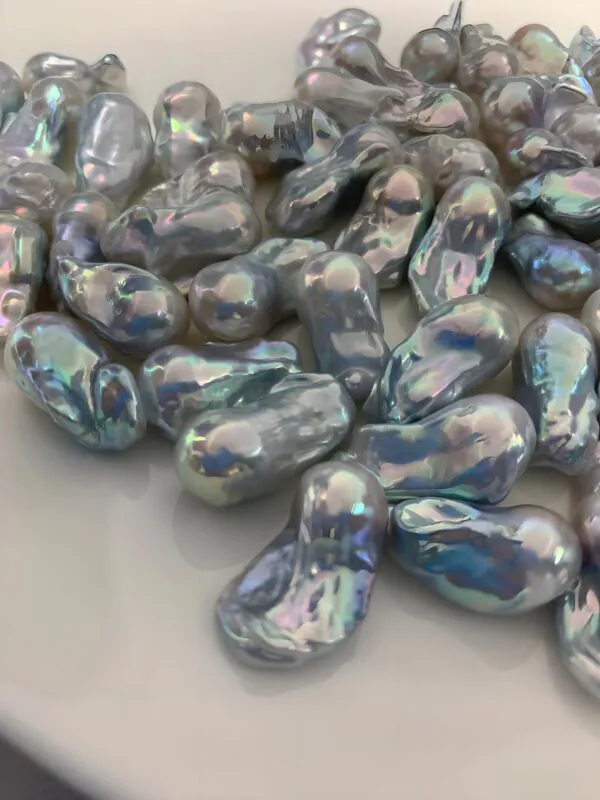
- Pearls are separate three-dimensional objects. They may be round, oval, drop-shaped, button-shaped, circled, or strongly baroque.
- Mother-of-pearl surfaces often display broad areas of iridescence that shift across the plane of the shell.
- Pearls usually show luster across a curved surface, so reflections move differently as the pearl turns.
These are practical visual clues, not laboratory identification tests. Dyed shell, coated materials, imitation pearls, reconstructed products, and assembled jewelry can complicate identification. If a material's identity materially affects price or authenticity, visual appearance alone may not be enough. Our pearl identification guide explains why professional testing may sometimes be necessary.
Is Mother of Pearl a “Real Pearl”?
No. Mother of pearl is a genuine natural shell material, but it is not itself a whole pearl. A listing can truthfully describe an item as “mother-of-pearl jewelry,” “mother-of-pearl inlay,” or “nacre shell,” but that is different from describing the material as a pearl.
This distinction matters when shopping online because product titles sometimes use “pearl,” “pearl shell,” and “mother of pearl” loosely. If you are buying a piece specifically because you want genuine pearls, look for wording that identifies the actual pearl type—such as freshwater cultured pearl, Akoya cultured pearl, Tahitian cultured pearl, or South Sea cultured pearl—rather than relying on the word “pearl” appearing somewhere in the design description.
Which Is More Valuable: Mother of Pearl or Pearls?
There is no single price rule for finished jewelry, but pearls generally have a stronger individual gem-value framework. Pearl value can depend on type, size, shape, color, luster, surface quality, nacre quality, matching, whether the pearl is natural or cultured, and other market factors.
Mother-of-pearl material is usually more abundant because a nacreous shell provides a much larger workable surface than an individual pearl. As a result, ordinary mother-of-pearl components are often less expensive than fine pearls. However, the finished price of mother-of-pearl jewelry can still be high when craftsmanship, precious metal, brand, age, provenance, carving, design complexity, or a particular shell material contributes significantly to value.
So the useful rule is not “mother of pearl is cheap and pearls are expensive.” It is: they are valued in different ways. A pearl is commonly evaluated as an individual organic gem, while mother of pearl is often evaluated as a decorative natural material within the construction of an object.
What About Mabe and Blister Pearls?
This is where the simple “shell versus pearl” distinction becomes more interesting. Some pearl products develop in contact with the shell rather than remaining as completely separate whole pearls.
A blister pearl becomes attached to the shell during growth. A mabe is an assembled cultured blister-pearl product: the nacreous dome is cut from the shell, processed, filled, and backed, commonly with a piece of shell. GIA has documented this composite construction in laboratory examinations.
That means a domed piece with a pearl-like face is not automatically ordinary mother-of-pearl inlay, but it may also not have the same structure as a whole round pearl. If you are comparing these products, our dedicated Mabe pearl guide is the more useful next step.
Do Mother of Pearl and Pearls Need the Same Care?
Both are organic, calcium-carbonate-based materials that benefit from gentle handling, but the construction of the jewelry also matters. Pearls are relatively soft and can be scratched, and GIA advises keeping them away from harsh chemicals, acids, perfume, hairspray, cosmetics, steam cleaners, and ultrasonic cleaners.
For mother-of-pearl jewelry, a similarly conservative approach is sensible: avoid harsh chemicals and abrasion, wipe the surface gently, and consider the metal, adhesive, backing, or inlay structure before using water or any cleaner. A thin mother-of-pearl inlay set with adhesive should not automatically be treated the same way as a loose pearl strand.
For routine pearl maintenance, see our full guide on how to care for pearls.
FAQ
Is mother of pearl made from real pearls?
No. Mother of pearl is not made by grinding or processing finished pearls. It is the nacreous inner layer of certain mollusk shells. Nacreous pearls and mother of pearl can share the same basic biological material, but they form in different structures.
Is nacre the same as mother of pearl?
In common jewelry and gemological usage, mother of pearl refers to nacre forming the iridescent inner layer of a shell. Nacre also forms the layered material of nacreous pearls.
Are all pearls made of nacre?
No. Many familiar commercial pearls are nacreous, but some genuine pearls are non-nacreous. Conch and melo pearls are well-known examples with different surface structures.
Can mother of pearl be called a pearl?
It should be described separately. Mother of pearl is genuine shell material, but it is not a whole pearl. Clear product labeling should distinguish mother-of-pearl components from genuine natural or cultured pearls.
Why is mother of pearl often flatter than a pearl?
Because it begins as a layer lining the shell. Jewelers usually cut that shell material into flat, curved, or carved pieces. A pearl, by contrast, develops as a separate three-dimensional formation, so it can be round, oval, drop-shaped, button-shaped, or baroque.
The Bottom Line
Mother of pearl is the nacreous inner shell layer; a pearl is a separate gem formation produced by a mollusk. They are closely related because nacre forms both mother of pearl and most familiar commercial pearls, but their structure, form, use, labeling, and valuation are different. Remembering “shell lining versus separate pearl” will answer most everyday comparisons—while nacreous versus non-nacreous pearls and mabe or blister pearls explain the important exceptions.