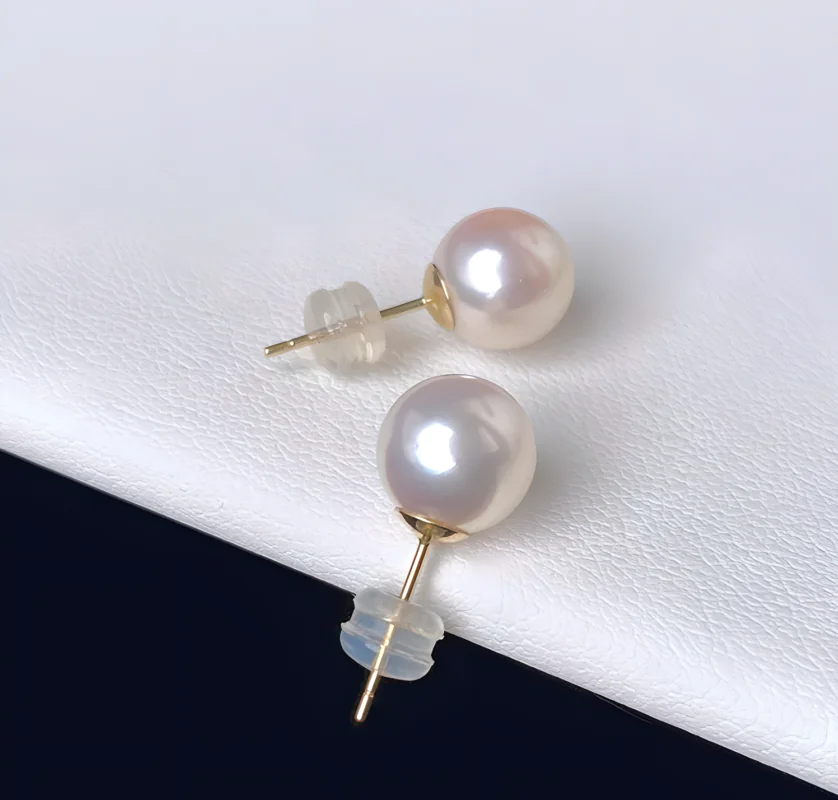
To evaluate the color of a Golden South Sea pearl, compare it under consistent neutral lighting and judge five things separately: its dominant bodycolor, the depth and saturation of that gold, any overtone or orient, the evenness of color around the pearl, and—if you are buying a pair or strand—how closely the pearls match.
Then make one more separation that buyers often miss: color beauty is not the same question as color origin. A pearl can have an attractive deep-golden appearance and still require separate treatment disclosure or laboratory testing if natural color materially affects the transaction.
The most important rule is simple: do not grade Golden South Sea color from a name alone. “Champagne,” “deep gold,” and “24K gold” can be useful trade descriptions, but there is no single universal color scale that every farm, dealer, laboratory, and retailer uses in exactly the same way.
Quick Answer: What Should You Check?
| Color factor | What to look for | Common mistake |
|---|---|---|
| Bodycolor | The dominant overall golden color | Assuming a trade name is a standardized grade |
| Tone and saturation | How light or deep the color appears and how strongly golden it reads | Reducing everything to “darker is better” |
| Overtone / orient | Secondary translucent color and any iridescent play | Confusing reflected surroundings with a true secondary color effect |
| Evenness | Whether the color remains visually coherent as the pearl rotates | Judging from one face or one still photo |
| Luster interaction | Whether the golden color still looks lively, deep, and reflective | Paying for deep color while accepting weak luster |
| Matching | Consistency of color, overtone, and visual intensity across a pair or strand | Matching only diameter |
| Color origin | Whether natural color, treatment, or uncertainty is properly disclosed | Trying to prove natural color by eye alone |
1. Standardize the Viewing Conditions Before You Judge the Pearl
Golden South Sea pearls are highly reflective objects. They do not only show their own bodycolor; they also reflect the light source, the room, the photographer, nearby clothing, and the background. That means the same pearl can look warmer, darker, more orange, or more yellow depending on where and how it is viewed.
For a meaningful comparison, place the pearls side by side under the same neutral or daylight-equivalent light. Use the same background, the same camera exposure, and the same viewing distance. A neutral white or gray background is usually more useful for color comparison than wood, yellow fabric, skin, or a strongly colored jewelry tray.
Do not compare one pearl photographed under warm indoor bulbs with another photographed in cool window light and then conclude that the second pearl has a “better” color. You are partly comparing lighting systems, not pearls.
This matters even more online. Phone cameras and product-editing software can automatically change white balance, contrast, saturation, and highlight recovery. A single polished product photo can therefore be attractive but weak evidence for precise color comparison.
A better online request is:
- one frame showing all candidate pearls together;
- a neutral background;
- the same lighting and exposure for every pearl;
- a short video while the pearls are slowly rotated;
- minimal color editing.
If you are comparing pearl quality more broadly, the same principle applies to pearl grading: direct side-by-side comparison is much more useful than relying on a seller's letter grade or descriptive adjective alone.
2. Identify the Bodycolor First
GIA describes bodycolor as the pearl's dominant overall color. For Golden South Sea pearls, the commercial spectrum can run from pale cream or champagne through light yellow-gold, medium gold, rich gold, and strongly saturated deep gold.
Those terms are practical, but they are not universal laboratory grades. One dealer's “medium gold” may overlap another dealer's “deep gold.” Labels such as “18K,” “22K,” or “24K” are also commonly used as visual marketing shorthand; they do not mean the pearl contains that purity of metallic gold, and they should not be treated as standardized gemological categories.
Therefore, use the label only as a starting point. The real question is:
What dominant color does this pearl actually show when compared with other Golden South Sea pearls under the same conditions?
The broader biological context is explained in our South Sea pearl guide. Golden South Sea cultured pearls are associated with the gold-lipped form of Pinctada maxima, but being a Golden South Sea pearl does not force every pearl into one identical shade.
3. Separate Tone from Saturation
Two pearls may both look “deep gold” at first glance but create very different impressions. To compare them more carefully, separate two ideas:
- Tone: how light or dark the overall color appears.
- Saturation: how strong, concentrated, or clearly golden the color appears rather than washed out or grayish.
This distinction is useful because a darker pearl is not automatically a more attractive pearl. A pearl can become visually dark without showing the clean, rich golden saturation a buyer actually wants. Conversely, a somewhat lighter pearl can have a very clear, vivid golden bodycolor and excellent visual life.
GIA notes that more saturated Golden South Sea colors typically command more in the market than paler champagne colors. The critical qualification is all else being reasonably comparable. Saturation is important, but it does not cancel the other pearl value factors.
When comparing two pearls, ask:
- Which pearl is darker?
- Which pearl looks more strongly and clearly golden?
- Are those actually the same pearl?
They do not have to be.
4. Do Not Reward Deep Gold Before You Check Luster
This is one of the most important practical checks.
A highly saturated Golden South Sea pearl can be rare and desirable, but color does not replace luster. A deep-gold pearl with soft, weak, or dull reflections may be less compelling than a slightly lighter pearl with bright, lively luster and much stronger visual depth.
Luster also changes how color is perceived. Strong reflections create highlights, contrast, and depth across the curved surface. That can make a medium-gold pearl look more vivid and three-dimensional. Weak luster can make an otherwise attractive color look flat.
So when two pearls are close in size and shape, compare them in this order:
- look at the golden bodycolor and saturation;
- check how bright and clear the reflections are;
- rotate the pearls and see whether they remain lively from multiple angles;
- only then decide which color-quality combination you prefer.
For the broader relationship between color, luster, surface, size, shape, nacre, and matching, see our guide to evaluating pearl value.
5. Look for Overtone and Orient Without Confusing Them with Reflections
GIA separates pearl color into three possible components:
- bodycolor — the dominant overall color;
- overtone — one or more translucent secondary colors lying over the bodycolor;
- orient — an iridescent, shifting play of colors at or just below the surface.
All pearls have bodycolor, but not every pearl shows an obvious overtone or strong orient. That is important because buyers sometimes feel pressured to “find” an overtone simply because a product description names one.
Golden South Sea pearls may show subtle secondary nuances that change the impression of the gold. One pearl may feel cleaner and more yellow; another may lean warmer, slightly greenish, pinkish, silvery, orangey, or bronze-like depending on its actual color effects and the light.
There is no universal rule that one overtone is always superior. Some secondary colors may be rarer or more desirable in a particular market, but personal preference matters. The correct evaluation question is not “Does this pearl have the fashionable overtone?” but:
Does the secondary color make the bodycolor look richer and more attractive, and is the effect genuinely visible under neutral comparison conditions?
Rotate the pearl. A true overtone or orient should behave like part of the pearl's optical appearance. A yellow wall or red shirt reflected in the pearl can also create a temporary color cast, which is why a neutral environment is essential.
6. Check Color Evenness by Rotating the Pearl
A Golden South Sea pearl should not be judged from only its “best face.” Hold or roll the pearl so you can see the full visible surface.
You are looking for visual coherence, not machine-made uniformity. Natural cultured pearls can show subtle variation because the surface is curved, reflective, and organically formed. Highlights, shadows, overtones, orient, surface features, and viewing angle can all change what you see.
What deserves attention is a color change that appears localized and persistent rather than simply moving with the reflections. Examples include an isolated darker patch, a noticeably different zone around a surface feature, or color concentrated around a drill opening.
Even then, do not jump directly to “treated.” Localized color can have more than one cause. Visual clues are useful for deciding whether to ask more questions; they are not a substitute for gemological testing.
If you want a broader visual checklist for suspicious color concentration, see our guide to common visual clues of dyed pearls.
7. For Pairs and Strands, Evaluate Matching as a Separate Color Factor
A beautiful loose pearl does not automatically create a beautiful pair or necklace.
GIA treats matching as a separate value factor when two or more pearls are used together. For Golden South Sea pearls, matching can be especially demanding because the color spectrum is broad and small changes in gold depth become obvious when pearls are placed beside one another.
For earrings, compare:
- bodycolor;
- gold depth and saturation;
- overtone;
- luster intensity;
- size and shape;
- the overall impression when the pair is viewed together.
For a strand, do not require every pearl to be microscopically identical. The goal is a visually intentional sequence. A uniform strand should not contain one unexpectedly pale or orangey pearl that repeatedly catches the eye for the wrong reason. A graduated or deliberately mixed-color strand may use controlled variation, but that variation should still look designed rather than accidental.
Matching is one reason saturated deep-golden pairs and strands can become much more expensive than a single pearl. The challenge is not only finding deep gold; it is finding enough pearls with compatible color, luster, size, shape, and surface quality at the same time.
8. Separate “Beautiful Color” from “Natural Color”
Golden South Sea pearls can naturally show yellow-to-golden colors, and high-quality untreated golden Pinctada maxima pearls are well documented by gemological laboratories. But color modification also exists.
GIA research has documented natural-color and heat-treated golden South Sea cultured pearls, and GIA's broader pearl-research program also discusses dyeing and other color modifications used on pearls. SSEF likewise notes that treatments intended to attain or imitate desirable golden colors remain relevant to laboratory testing and disclosure.
This creates a practical rule:
You can judge whether a color looks attractive by eye. You usually cannot prove every case of natural versus treated color by eye.
Visual clues such as color concentration around drill holes or surface features can raise suspicion, but sophisticated treatments may not produce an obvious consumer-visible sign. Laboratory identification can use techniques such as spectroscopy and fluorescence analysis that are not available from ordinary photographs.
If natural color materially affects the price, ask the seller to state the treatment status clearly. For a high-value loose pearl, pair, or strand where color origin is commercially important, consider an independent gemological report that addresses the relevant identification question.
For a broader explanation of post-harvest color modification, read our guide to pearl color enhancement treatments.
9. Do Not Use Country of Origin as a Shortcut for Color Quality
The Philippines has a strong trade reputation for richly saturated Golden South Sea pearls, while Indonesia produces a very broad commercial spectrum that includes cream, champagne, medium gold, and deep gold. Those tendencies can be useful when describing industries or large harvests.
They are much less useful when judging one pearl.
A Philippine pearl can be pale. An Indonesian pearl can be richly saturated. Two pearls from different countries can look almost identical once sorted into the same color group.
Therefore, “Philippine” is not a color grade, and “Indonesian” is not a lower color category. If provenance matters, ask for traceability. If color quality matters, evaluate the actual pearl.
Our comparison of Philippine and Indonesian Golden South Sea pearls explains this distinction in more detail.
10. A Better Way to Compare Two Golden South Sea Pearls
Imagine two round pearls of similar size:
| Factor | Pearl A | Pearl B |
|---|---|---|
| Bodycolor | Deep gold | Medium gold |
| Saturation | Strong | Strong |
| Luster | Moderate | Excellent |
| Surface | Several visible marks | Cleaner |
| Color evenness | Good | Good |
| Overall impression | Richer color, softer visual life | Lighter color, brighter and livelier |
Which is better?
There is no responsible answer based on color depth alone. Pearl A may command a color premium because deeply saturated gold is desirable, but Pearl B may be the more beautiful or higher-quality pearl overall because its luster and surface are stronger.
This is the central point of Golden South Sea color evaluation: judge color precisely, but do not let color erase the rest of the pearl.
11. What Can You Reliably Evaluate from Online Photos?
You can make a useful preliminary assessment online, but only when the seller gives you comparable evidence.
Ask for:
- A group photo under one light. This is better for comparing relative color than separately edited product photos.
- A neutral-background image. It reduces obvious color contamination from surroundings.
- A short rotation video. This helps you separate fixed bodycolor from highlights and reflected colors.
- Close-ups at realistic exposure. Overexposed images can erase saturation; underexposed images can exaggerate depth.
- Written treatment disclosure. Do not use photography as the only evidence for natural color.
- Pair or strand photos as a complete group. Matching cannot be judged from isolated single-pearl images.
If two sellers photograph pearls in completely different environments, treat color comparisons as approximate. The most trustworthy comparison is often not “Which seller's image looks darker?” but “Can each seller show the alternatives together under one controlled setup?”
12. Be Careful with “24K,” Color Numbers, and Seller-Specific Grades
The current market uses many convenient color descriptions. Some sellers compare pearl color with gold-karat language; others use numbered intensity scales; some fold color into an A/AA/AAA-style quality grade.
These systems can be useful inside one seller's inventory if that seller applies them consistently. The problem begins when buyers assume the labels are universal.
They are not.
A “24K deep gold” pearl from one company is not automatically identical to a “24K” pearl from another. Likewise, an “AAA” Golden South Sea pearl does not tell you exactly how deep the color is unless the seller explains what AAA means in that system.
For cross-seller comparison, ignore the label for a moment and return to observable characteristics:
- bodycolor;
- tone and saturation;
- overtone / orient;
- color evenness;
- luster;
- surface;
- size and shape;
- matching;
- treatment disclosure.
This is more transferable than memorizing one retailer's vocabulary.
A Practical 7-Step Golden South Sea Color Evaluation
- Put comparable pearls under the same neutral light. Do not mix different photos or lighting environments.
- Identify the dominant bodycolor. Use champagne, light gold, medium gold, or deep gold only as practical descriptions, not absolute grades.
- Separate tone from saturation. Ask how dark the pearl is and how strongly golden it looks.
- Check luster before paying for deeper color. The pearl should still look lively, reflective, and dimensional.
- Rotate the pearl. Evaluate overtone, orient, and color evenness around the full visible surface.
- For pairs and strands, judge matching separately. Similar diameter does not guarantee similar color.
- Confirm treatment disclosure. If natural color materially changes value, use appropriate documentation rather than relying on appearance alone.
If you follow this sequence, color becomes much easier to evaluate because you stop asking one vague question—“Is this a good gold?”—and replace it with several specific ones.
The Bottom Line
The best Golden South Sea color is not simply the darkest pearl on the tray.
Fine color evaluation starts with controlled viewing conditions, then separates bodycolor, tone, saturation, overtone, orient, evenness, luster interaction, and matching. Deeper and more saturated gold can carry a real market premium, but that premium makes sense only when the pearl still performs well in the other quality factors that create beauty and rarity.
And if the transaction depends on the color being natural, treat that as a separate identification question. Attractive color can be judged visually; natural-versus-treated color may require disclosure and gemological testing.
In practice, the strongest Golden South Sea pearl is the one whose gold is convincing, lively, coherent, well matched for its intended use, and accurately represented—not merely the one with the most dramatic color name.
Frequently Asked Questions
Is deep gold always the best Golden South Sea pearl color?
No. Deep, strongly saturated gold can be rare and valuable, but it should still be judged together with luster, surface quality, shape, size, nacre quality, and matching. A slightly lighter pearl with much stronger luster can be more attractive overall.
What does “24K Golden South Sea pearl” mean?
It is generally a trade or marketing description for a very rich golden appearance. It is not a universal laboratory color grade, and it does not mean the pearl contains 24-karat metallic gold.
How can I compare Golden South Sea pearl colors online?
Ask for the candidate pearls in the same frame, under the same neutral lighting and background, plus a short rotation video. Separately edited photos are much less reliable for fine color comparison.
Do Golden South Sea pearls have overtones?
They can. A pearl may show subtle secondary colors over its main golden bodycolor, and some pearls may also show orient. Not every pearl displays a strong overtone or orient, so these effects should be judged from the actual pearl rather than assumed from a product label.
Can I tell whether a golden pearl is naturally colored by looking at the drill hole?
Sometimes a drill hole or surface feature can show suspicious color concentration, but visual inspection is not conclusive for every treatment. If natural color is important to value, laboratory testing and clear treatment disclosure are more reliable.
Are Philippine Golden South Sea pearls always deeper in color than Indonesian pearls?
No. Philippine production has a strong reputation for saturated gold, but the color ranges overlap. Both origins can produce lighter and deeper golden pearls, so country of culture should not replace direct color evaluation.
References & Further Reading
- GIA — Pearl Quality Factors
- GIA — Different Pearl Types Explained: Akoya, South Sea, Tahitian & Freshwater Pearls
- GIA Gems & Gemology — Natural-Color and Heat-Treated “Golden” South Sea Cultured Pearls
- GIA Gems & Gemology — Application of UV-Vis-NIR Spectroscopy to Gemology
- SSEF — Research on Golden Cultured Pearls