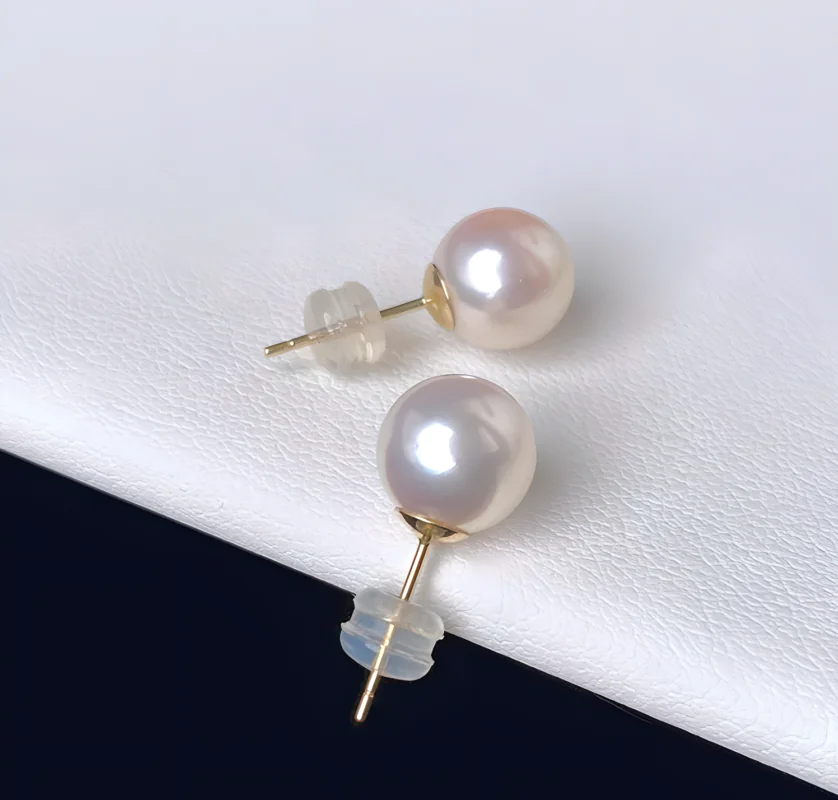
Australian White South Sea Pearls: Color, Luster, and Nacre Characteristics
Australian White South Sea pearls are best understood through three separate characteristics: color, luster, and nacre. They are typically produced by the silver-lipped Pinctada maxima oyster and are known for white-to-silver bodycolors, subtle overtones, a deep satiny glow, and unusually substantial nacre for bead-cultured pearls. The important point is that these traits are related but not interchangeable. A pearl can have attractive color yet mediocre luster, thick nacre yet imperfect nacre structure, or a soft South Sea glow while still showing bright, sharp reflections.
Quick Reference: What Defines the Look?
| Characteristic | Typical Australian White South Sea Appearance | What to Remember |
|---|---|---|
| Bodycolor | White, silver-white, silver, or creamy white | “White” is a color family, not necessarily paper-white |
| Overtone / orient | Rose, pink, greenish, bluish, silvery, or mixed iridescent effects may appear | Secondary color should be judged separately from bodycolor |
| Luster | Deep, satiny, dimensional glow | Fine examples can still show bright and relatively sharp reflections |
| Nacre | Generally thick and substantial around a bead nucleus | Thickness matters, but layering and surface structure also affect appearance |
| Overall visual character | Large-scale, luminous, softer in optical character than classic Akoya | Do not judge South Sea pearls by Akoya standards alone |
What Does “Australian White South Sea Pearl” Mean?
South Sea cultured pearls are produced by Pinctada maxima, the largest of the major commercially farmed pearl oysters. The species occurs in silver-lipped and gold-lipped forms. The silver-lipped form is strongly associated with white and silver South Sea pearls, and Australia is a major source of this white P. maxima production.
These pearls are bead cultured: a shell bead nucleus and donor mantle tissue are introduced into the oyster, after which a pearl sac forms and deposits layer after layer of nacre around the nucleus. South Sea cultivation normally allows a comparatively long period for nacre deposition, which is one reason the finished pearls can combine large size with substantial nacre. For the broader process behind pearl-sac formation and nacre deposition, see our pearl cultivation guide.
For a broader overview of the species, production regions, and major South Sea color families, see our South Sea pearl guide.
Color: White Does Not Mean One Single Shade
One of the easiest mistakes is to imagine that Australian White South Sea pearls should all look like the same neutral white sphere. In practice, the category contains a range of closely related bodycolors. A pearl may read as bright white, cool silver-white, soft silver, or warmer creamy white depending on the pearl, the light source, and what is reflected around it.
It helps to separate three color concepts:
- Bodycolor is the dominant overall color of the pearl.
- Overtone is a translucent secondary hue seen over the bodycolor.
- Orient is a more complex, iridescent play of colors that appears on or just below the surface.
Australian White South Sea pearls may show delicate rose or pink overtones, cool silver or blue impressions, greenish flashes, or more complex combinations. These effects can make two nominally “white” pearls look noticeably different when placed side by side.
Color preference is not the same as quality
A cooler silver-white pearl is not automatically better than a warmer white pearl, and a pink overtone does not automatically make a pearl superior. Color preference is partly aesthetic and can change with skin tone, jewelry metal, matching requirements, and market taste. A beautiful color can add desirability, but it does not replace luster, surface, shape, nacre, or matching as quality considerations.
Do not use color alone to prove origin or treatment status
The white-to-silver palette is characteristic of silver-lipped Pinctada maxima, but appearance alone is not sufficient proof that a particular pearl came from Australia. The same caution applies to treatment status. Naturally occurring white, silver, and overtone effects are normal for this pearl type, but a buyer should not treat a photograph or a color description as laboratory proof that an individual pearl has never been processed or enhanced.
Luster: “Satiny” Does Not Mean Dull
South Sea pearls are often described as having soft, satiny, or deep luster. That description is useful, but it is sometimes misunderstood. It does not mean that a good South Sea pearl should have fuzzy, weak, or chalky reflections.
Luster is judged by the intensity and sharpness of reflected light. A fine Australian White South Sea pearl can show a bright highlight, recognizable reflected shapes, and strong visual depth at the same time. What differs from classic Akoya is the overall optical character: South Sea pearls often appear broader, softer, and more dimensional rather than giving only the tight, glassy, mirror-like flash associated with very fine Akoya.
This is an important evaluation rule: “satiny” describes the style of the glow, not permission for poor luster. If the reflection is dim, flat, or chalky, the pearl should not be upgraded simply because South Sea pearls are known for softer luster.
Why does the glow look deeper?
Nacre is built from microscopic calcium-carbonate platelets and an organic matrix arranged in many layers. Light interacts with these layers rather than bouncing only from a simple outer coating. In a well-formed pearl, the combination of substantial nacre and orderly nacre structure helps create the depth, translucence, and internal-looking glow for which South Sea pearls are known.
For this reason, luster and nacre quality are closely connected, but they should still be evaluated as separate observations. Our guide to evaluating pearl value explains how luster fits alongside color, surface, size, shape, nacre, and matching.
Nacre: Thick Is Important, but Thickness Is Not the Whole Story
Australian White South Sea pearls are famous for substantial nacre. Gemological research on Pinctada maxima describes these oysters as producing some of the thickest nacre layers among bead-cultured pearl types, typically after a long growth period compared with many Akoya pearls.
That matters for two reasons. First, adequate nacre contributes to durability by providing a meaningful pearl layer above the bead nucleus. Second, nacre strongly affects optical appearance: poorly formed, very thin, or damaged nacre can produce weak luster, chalkiness, or other undesirable visual effects.
However, a common shortcut is misleading:
Thicker nacre does not automatically guarantee better luster.
Luster also depends on how the nacre has formed. The size, orientation, continuity, and arrangement of microscopic nacre platelets affect how light travels through and returns from the pearl. Two pearls can both have substantial nacre yet show different levels of brightness, sharpness, smoothness, and visual depth.
If you want to understand the material itself in more detail, see the physical and chemical properties of pearls.
What Is “Nacre Movement” in Australian South Sea Pearls?
A less commonly explained characteristic of Australian South Sea pearls is the visible effect sometimes described in the trade as nacre movement. When certain pearls are rolled or viewed from changing angles, the nacre can appear to shift, ripple, or show a subtle textured movement rather than presenting a perfectly uniform silky surface.
Some Australian grading systems describe nacre from very smooth or “tight” through progressively more visible movement. At stronger levels, the surface may develop a texture sometimes compared with sharkskin. This is not exactly the same thing as a simple surface blemish. It relates to how the nacre structure presents visually across the pearl.
Whether movement is attractive depends partly on shape and intended use. A classic round strand usually benefits from smoother, more uniform nacre, because the eye expects consistency across many pearls. In a baroque or artistic pearl, more visible nacre movement can become part of the individual character rather than an automatic reason to reject the pearl.
How to Judge Color, Luster, and Nacre in Practice
You do not need to collapse everything into one grade. A better method is to evaluate the pearl in separate passes.
1. Judge bodycolor first
Use neutral daylight or a consistent neutral light source. Decide whether the pearl reads as white, silver-white, silver, or cream-white before paying attention to secondary hues. Compare several pearls together if matching matters.
2. Look for overtone and orient
Rotate the pearl slowly. Observe whether rose, green, blue, silver, or mixed iridescent effects appear over the bodycolor. Do not let warm room lighting, colored clothing, skin reflection, or camera white balance masquerade as a true pearl color characteristic.
3. Judge luster independently
Look at how bright and defined reflected light appears. A fine South Sea pearl can have a soft overall glow while still returning clear, lively reflections. Compare pearls under the same lighting rather than relying on isolated product photographs.
4. Inspect the nacre surface
Look for a healthy, coherent nacre appearance rather than a flat or chalky surface. Also note whether the nacre appears smooth and tight or shows visible movement. What is desirable can depend on whether the pearl is round, drop-shaped, circled, or baroque.
5. Do not try to measure nacre thickness by eye
Visual clues can warn you about poor nacre, but the naked eye cannot reliably tell you the exact nacre thickness around a bead nucleus. If a precise structural claim matters, gemological examination and radiography are stronger evidence than a visual estimate.
Australian White South Sea vs. Akoya: Why the Luster Feels Different
| Trait | Australian White South Sea | Akoya |
|---|---|---|
| Typical visual scale | Larger and more substantial | Usually smaller and more delicate |
| Characteristic luster | Deep, satiny, dimensional | Bright, crisp, mirror-like |
| Nacre character | Generally much more substantial in bead-cultured production | Typically thinner around the bead nucleus |
| White color family | White, silver-white, silver, cream with subtle overtones | White to cream, often with rose or silver overtones |
The practical lesson is not that one pearl type has “better” luster. They create different optical impressions. The fairest comparison is within the pearl type first: compare one Australian White South Sea pearl with other South Sea pearls of similar size and color before using Akoya as the benchmark.
The Most Important Distinction to Remember
When judging Australian White South Sea pearls, avoid reducing everything to one phrase such as “thick nacre and soft glow.” Use three separate questions:
- Color: What is the bodycolor, and what overtone or orient is visible?
- Luster: How bright, sharp, and lively are the reflections?
- Nacre: Does the nacre appear healthy and coherent, and what kind of surface structure or movement is visible?
That framework explains why two Australian White South Sea pearls of the same size can look dramatically different. Their beauty comes from the interaction of color, optical performance, and nacre structure—not from any single characteristic in isolation.
FAQ
Are Australian White South Sea pearls always pure white?
No. “White” covers a family of light bodycolors. Australian White South Sea pearls can appear bright white, silver-white, silver, or creamy white, and they may show rose, green, blue, silver, or mixed overtones.
Does satiny luster mean South Sea pearls are less lustrous than Akoya pearls?
No. South Sea and Akoya pearls have different characteristic optical appearances. Fine South Sea pearls can show bright, sharp reflections together with a broader, deeper glow, while fine Akoya is especially known for a crisp mirror-like look.
Does thick nacre automatically mean a South Sea pearl has excellent luster?
No. Adequate nacre thickness is important, but luster also depends on nacre quality, layering, surface condition, and the way the microscopic structure interacts with light.
Can you identify Australian origin from color and luster alone?
No. White-to-silver color, large size, and satiny luster are consistent with Australian White South Sea pearls, but appearance alone does not prove geographic origin. Provenance or appropriate gemological documentation is stronger evidence when origin matters.
Can pink or blue overtones occur naturally in White South Sea pearls?
Yes. White and silver Pinctada maxima pearls can naturally show subtle secondary hues, including pink, green, or blue effects. However, visible color alone should not be treated as conclusive proof of treatment history.