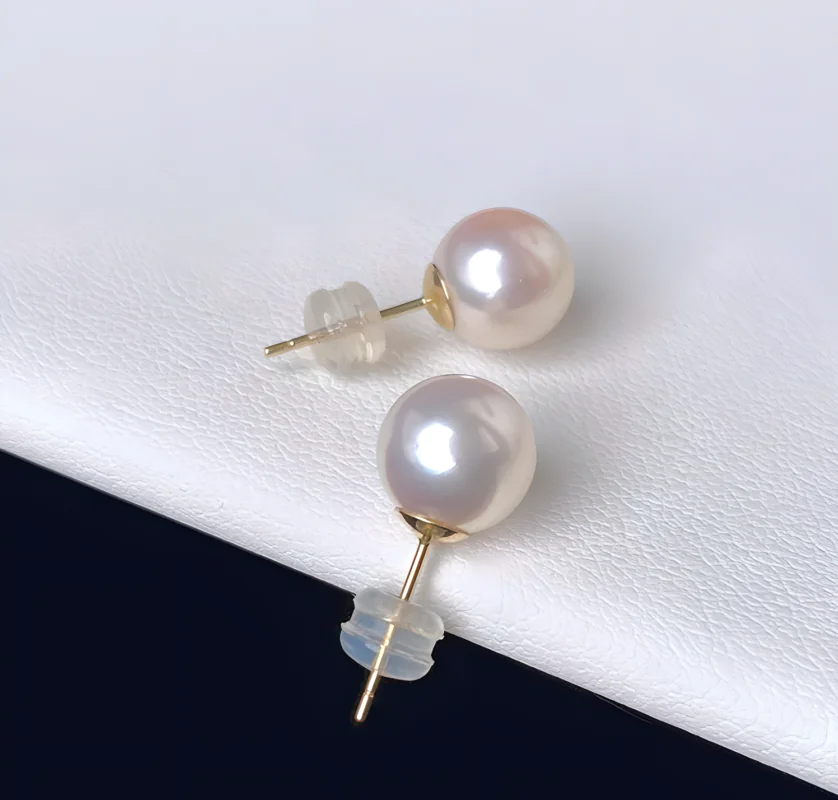
No. Swarovski Crystal Pearls are not real pearls in the gemological sense. They are simulated pearls made with a Swarovski crystal core and a specially engineered pearl-like coating. They do not grow inside an oyster or mussel, so they are neither natural pearls nor cultured pearls.
That distinction is easy to miss because Swarovski pearls can look remarkably pearl-like. They can also be genuine Swarovski products. But “genuine Swarovski” and “genuine pearl” describe two different things.
What Are Swarovski Crystal Pearls Made Of?
Swarovski describes its Crystal Pearls as having a compact crystal core covered by a complex pearl coating. The surface is designed to reproduce the smooth appearance and soft glow associated with pearls while keeping size, shape, and color highly consistent.
The wording matters here. Swarovski describes the finish as a special pearl coating and, in some of its materials, as creating mother-of-pearl-like layers. That should not automatically be interpreted as a layer of genuine nacre grown by a mollusk. A real pearl forms through a biological process inside a mollusk; a Swarovski Crystal Pearl is manufactured.
If you want a broader overview of other man-made pearl products, see our guide to artificial and imitation pearls.
Are Cultured Pearls Real Pearls?
Yes. This is the most important comparison to understand.
Cultured pearls are real pearls. They form inside living mollusks after people deliberately start the pearl-growing process. Natural pearls also form inside mollusks, but without deliberate human culturing.
Imitation or simulated pearls are different. Their pearl-like appearance is created from manufactured materials rather than from pearl formation inside a mollusk.
| Type | How it is made | Real pearl? |
|---|---|---|
| Swarovski Crystal Pearl | Crystal core with a manufactured pearl-like coating | No — simulated pearl |
| Cultured pearl | Grown inside a mollusk with human intervention | Yes |
| Natural pearl | Forms inside a mollusk without deliberate culturing | Yes |
Why Do Swarovski Pearls Look So Much Like Real Pearls?
The resemblance is intentional. Swarovski controls the core, coating, shape, and surface during manufacturing, so the finished beads can be very round, smooth, evenly colored, and closely matched.
The crystal core also gives them more substance than many lightweight plastic imitation pearls. This helps explain why a Swarovski pearl can feel more convincing in the hand even though it is still a simulated pearl.
Real pearls are usually less perfectly uniform. Even well-matched cultured pearl strands often show tiny differences in surface, shape, color, or luster because each pearl grew biologically rather than being manufactured to an identical specification.
Does “Fake Pearl” Mean Swarovski Pearls Are Low Quality?
Not necessarily. “Fake” is often used casually, but simulated pearl or imitation pearl is more precise.
There are two separate questions:
- Is it a real pearl? Swarovski Crystal Pearls are not.
- Is it a well-made manufactured jewelry component? It can be.
A high-quality imitation pearl can have excellent consistency, a polished finish, and useful design properties. None of that turns it into a cultured or natural pearl. In the same way, a genuine Swarovski-branded Crystal Pearl can be authentic Swarovski while still being an imitation pearl.
This distinction also matters in jewelry descriptions. In the United States, Federal Trade Commission guidance says sellers should disclose when pearls are cultured or imitation rather than simply using the word “pearl” in a way that could mislead buyers.
Swarovski Pearls vs. Real Cultured Pearls
The better choice depends on what you want from the jewelry.
| Feature | Swarovski Crystal Pearls | Real Cultured Pearls |
|---|---|---|
| Origin | Manufactured | Grown inside a mollusk |
| Surface | Engineered pearl-like coating | Biologically formed pearl material |
| Uniformity | Usually very consistent | Natural variation is common |
| Color options | Highly controllable during manufacturing | Limited by pearl type, growth, and any disclosed treatment |
| What gives it value | Brand, design, finish, condition, and craftsmanship | Pearl type, size, luster, surface, shape, color, matching, rarity, and craftsmanship |
If your priority is a perfectly matched fashion look, unusual colors, or repeatable design components, simulated crystal pearls can make sense. If your priority is owning genuine pearl material formed by a mollusk, choose cultured freshwater, Akoya, Tahitian, or South Sea pearls instead.
For a broader framework on choosing real pearls, our Pearl Buying Guide explains the quality factors that matter before purchase.
How Can You Tell Swarovski Pearls from Real Pearls?
No single home test is perfect, especially with better-quality imitation pearls. Instead, look at several clues together.
1. Check for extreme uniformity
A strand in which every bead has nearly identical roundness, color, and surface can be a clue that you are looking at manufactured pearls. High-quality cultured pearls can be very well matched, so uniformity alone is not proof.
2. Examine the drill holes
On coated imitation pearls, wear or chipping around a drill hole may reveal a boundary between the outer finish and the inner core. Real pearls do not have a crystal core beneath an applied pearl-like coating.
3. Look closely at the surface
Real pearl surfaces often show subtle growth features and tiny irregularities. A manufactured coating can appear unusually smooth or consistent. Again, this is a clue rather than a stand-alone test.
4. Do not rely on one “trick”
Touch, weight, visual inspection, and surface feel can all help, but high-quality imitations can be convincing. If authenticity has significant financial importance, professional testing is more reliable than a single at-home test.
For a practical checklist, read How to Tell If Pearls Are Real or Fake.
Are Swarovski Pearls Worth Buying?
They can be — as long as you are buying them for what they actually are.
Swarovski Crystal Pearls make sense when you want a polished, highly consistent pearl look in fashion jewelry or design work. They are less suitable if your goal is to own genuine cultured pearls, compare pearl grades, or buy jewelry for the intrinsic characteristics associated with pearl growth and nacre.
The key is accurate labeling. A product described clearly as a Swarovski Crystal Pearl or simulated pearl can be judged on its design and manufacturing quality. A product presented in a way that makes buyers think it is a cultured or natural pearl is a different issue.
Frequently Asked Questions
Are Swarovski pearls cultured pearls?
No. Cultured pearls grow inside mollusks. Swarovski Crystal Pearls are manufactured simulated pearls with a crystal core and pearl-like coating.
Are Swarovski pearls made from real mother-of-pearl?
Swarovski’s current descriptions refer to a special pearl coating and mother-of-pearl-like layers around a crystal core. That wording should not be treated as evidence that the surface is genuine mollusk-grown nacre.
Are Swarovski pearls “fake”?
They are imitation or simulated pearls, which is the more accurate terminology. A bead can be an authentic Swarovski product while not being a real pearl.
Can Swarovski pearls pass for real pearls?
They can look very convincing, especially at normal viewing distance. Close inspection of uniformity, surface character, drill holes, and coating wear may reveal that they are manufactured, but professional testing is preferable when certainty matters.
Which is better: Swarovski pearls or cultured pearls?
Neither is universally better. Swarovski pearls favor consistency and controlled design. Cultured pearls offer genuine pearl material, natural variation, and the optical character produced by biological pearl growth. Choose according to what you value.
The Bottom Line
Swarovski pearls are not real pearls; they are high-quality simulated pearls. Their crystal core and engineered coating are designed to recreate the appearance and feel of pearl jewelry, but they are manufactured rather than grown inside a mollusk.
If a seller describes them clearly as Swarovski Crystal Pearls or simulated pearls, there is nothing inherently misleading about the product. The important thing is not to confuse a genuine Swarovski component with a genuine natural or cultured pearl.