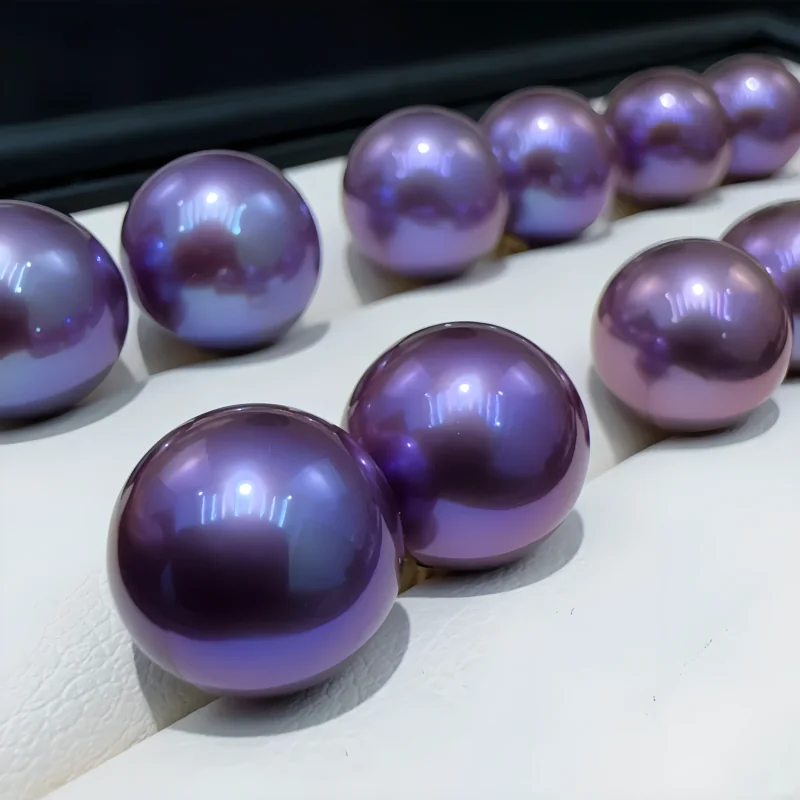
Farmed pearls—more accurately called cultured pearls—are usually less valuable than comparable natural pearls, mainly because natural pearls are dramatically rarer. That does not mean cultured pearls are low-value, artificial, or poor quality.
A cultured pearl is a genuine pearl formed inside a living mollusk. Pearl farming simply means that people deliberately start the pearl-forming process rather than waiting for it to happen by chance in the wild. The mollusk then produces the pearl material biologically.
The important distinction is therefore between rarity and quality. Natural origin can add substantial rarity value, while the value of an individual cultured pearl still depends on characteristics such as luster, size, shape, surface quality, color, nacre, and matching.
Quick Answer: Does Pearl Farming Reduce Value?
| Question | Short answer | Why |
|---|---|---|
| Are cultured pearls usually cheaper than natural pearls? | Yes | Natural pearls are much rarer and cannot be produced on demand. |
| Does cultured mean fake? | No | The pearl grows inside a living mollusk; people only initiate the process. |
| Are all cultured pearls inexpensive? | No | Fine Akoya, Tahitian, South Sea, and exceptional freshwater cultured pearls can have substantial value. |
| Does natural automatically mean high quality? | No | Natural origin adds rarity, but individual pearls can still differ greatly in size, shape, luster, surface, and condition. |
| Should jewelry buyers avoid farmed pearls? | No | Cultured pearls make fine pearl jewelry accessible while offering a very wide range of quality levels. |
First, “Farmed Pearl” Usually Means “Cultured Pearl”
In everyday language, people sometimes call pearls produced on pearl farms “farmed pearls.” In gemology and the jewelry trade, the standard term is cultured pearl.
A natural pearl forms inside a mollusk without deliberate human intervention. A cultured pearl forms after people deliberately intervene to begin pearl formation—for example, by introducing mantle tissue and, in many types of pearl culture, a bead nucleus.
After that intervention, living pearl-forming tissue creates the pearl. A cultured pearl is therefore fundamentally different from an imitation pearl made from glass, shell, plastic, or another manufactured material.
If you are comparing pearl listings, this terminology matters. Natural, cultured, and imitation describe three very different categories.
Why Are Natural Pearls Usually More Valuable?
The main reason is scarcity.
Natural pearls have to form without a farmer deliberately starting the process. Historically, enormous numbers of mollusks could be opened without finding a fine natural pearl. Finding one with attractive size, shape, luster, and condition was rarer still.
Pearl culture changed that supply problem. By deliberately creating the biological conditions for pearl formation, farms can produce pearls much more consistently and in much larger quantities.
That does not make cultured pearls worthless. It means that the extreme scarcity premium attached to natural pearls is greatly reduced.
For this reason, a laboratory-confirmed natural pearl—particularly a large, attractive, well-matched, historically important, or unusually rare example—can command a price far beyond that of an ordinary cultured pearl.
But “Cultured” Is Not a Pearl Quality Grade
This is the most important point for ordinary jewelry buyers.
Cultured tells you how pearl formation began. It does not tell you whether the finished pearl is beautiful.
A cultured pearl can have:
- strong or weak luster;
- a clean or heavily marked surface;
- a round, near-round, oval, drop, button, circled, or baroque shape;
- thick, healthy-looking pearl material or weaker nacre quality;
- a common or unusually desirable color;
- excellent or poor matching in a strand or pair.
That creates an enormous value range within cultured pearls themselves. A mass-produced, dull freshwater pearl and a large, beautifully lustrous South Sea cultured pearl may both be “farmed,” but they occupy completely different parts of the market.
This is why cultured pearl value should be evaluated through actual pearl characteristics rather than by treating the word cultured as a grade.
What Actually Determines the Value of a Cultured Pearl?
GIA describes seven major pearl value factors: size, shape, color, luster, surface quality, nacre quality, and matching for pieces containing multiple pearls.
If you are comparing cultured pearls, these factors are much more useful than simply asking whether the pearls came from a farm.
Luster
Luster is one of the most visually important differences between pearls. A fine pearl reflects light brightly and clearly, giving the surface a lively, almost luminous appearance. A dull pearl can look flat even if it is large and round.
When comparing two cultured pearls of the same general type, stronger luster can make a major difference in desirability and value.
Surface quality
Pearls naturally develop surface characteristics. A few small marks do not necessarily make a pearl unattractive, but heavy pitting, cracking, peeling, deep blemishes, or widespread irregularities can reduce value.
Size
Within comparable pearl types and quality levels, larger pearls are generally rarer and more valuable. Size should not be judged by itself, however. A large dull pearl is not automatically more desirable than a smaller pearl with exceptional luster.
Shape
Round pearls are difficult to produce consistently and usually receive a premium when other qualities are comparable. But attractive drops, ovals, buttons, circled pearls, and baroque pearls can also be valuable.
Color
Value depends not merely on whether a pearl is white, pink, silver, green, gray, or golden. Saturation, overtone, rarity within a particular pearl type, fashion preferences, and how attractive the color appears all matter.
Nacre quality
Nacre and surface structure strongly affect a pearl's appearance and, in some cultured pearl types, durability. A pearl with weak-looking or poorly developed nacre should not be valued the same way as a comparable pearl with attractive, healthy pearl material.
Matching
A single fine pearl can be difficult to produce. Finding dozens of fine pearls that also match closely in size, color, shape, luster, and surface can be considerably harder.
That is one reason a well-matched necklace can cost disproportionately more than simply multiplying the price of one loose pearl.
For a broader explanation of these criteria, see our Pearl Grading Guide.
Why Can Some Farmed Pearls Still Be Expensive?
Pearl farming improves the probability of producing pearls. It does not make every desired result easy to produce.
A farmer may successfully produce thousands of pearls while only a small percentage combine all the characteristics required for the highest-quality selection.
For example, finding a cultured pearl that is simultaneously:
- large;
- strongly lustrous;
- very round;
- clean on the surface;
- attractive in color;
- well formed;
- and suitable for matching with other equally fine pearls
can still be difficult.
Pearl cultivation controls the starting process much better than nature does, but it does not completely control the finished pearl. Biological variation remains an important part of pearl production.
This is especially relevant when comparing premium Akoya pearls, Tahitian pearls, and South Sea pearls. All are normally cultured in today's jewelry market, yet fine examples can still command substantial prices.
Why Are Freshwater Cultured Pearls Often Less Expensive?
This is another area where “farmed” and “cheap” can become incorrectly mixed together.
Freshwater cultured pearls are often more affordable because their production system can generate a much larger supply than some saltwater pearl cultures. Certain freshwater mussels can produce multiple pearls during a production cycle, which helps increase availability.
But freshwater cultured pearls themselves span a wide quality range.
You can find inexpensive commercial freshwater pearls with irregular shapes, moderate luster, and visible surface characteristics. You can also find large, round or near-round freshwater pearls with strong luster, attractive colors, and excellent surfaces.
The lower average price of the category therefore reflects supply and production economics, not a rule that freshwater pearls are inherently bad pearls.
Natural vs. Cultured vs. Imitation: Which Is More Valuable?
| Category | How it forms | Is it a real pearl? | Typical value context |
|---|---|---|---|
| Natural pearl | Forms without deliberate human initiation | Yes | Usually receives the strongest rarity premium, especially with laboratory confirmation and fine quality |
| Cultured / farmed pearl | Formation is deliberately initiated inside a living mollusk | Yes | Ranges from inexpensive commercial pearls to high-value fine pearls |
| Imitation pearl | Manufactured outside a mollusk | No | Generally valued as costume jewelry or manufactured material rather than as a pearl gem |
Can a Cultured Pearl Be Better Quality Than a Natural Pearl?
Yes, if you are talking about visible quality rather than rarity of origin.
A natural pearl can be small, irregular, dull, heavily marked, or otherwise visually modest. Its natural origin may still make it interesting or rare, but natural formation does not guarantee a perfectly round, highly lustrous gem.
Meanwhile, pearl farmers can sort very large harvests and select cultured pearls with exceptional luster, clean surfaces, attractive colors, and desirable shapes.
A fine cultured pearl may therefore look considerably more attractive than an ordinary natural pearl.
That does not erase the natural pearl's rarity premium. It simply demonstrates why origin and quality should be evaluated separately.
Does Farming Make Pearls Artificial?
No.
Human involvement does not mean the finished pearl is manufactured in a factory. Pearl farmers perform operations that initiate pearl formation and manage the mollusks during cultivation, but biological tissue inside the mollusk produces the actual pearl material.
This distinction is similar to many other agricultural processes: human management affects when and where production occurs, but the biological organism still creates the product.
The correct opposite of a cultured pearl is therefore not necessarily a “real pearl.” Both natural and cultured pearls are genuine pearls. The relevant contrast is natural versus cultured, while manufactured look-alikes are described as imitation pearls.
Should You Pay More for a Natural Pearl?
That depends on why you are buying it.
If you are buying primarily for rarity, collecting, history, provenance, or gemological significance, natural origin can be extremely important. In that market, laboratory verification becomes particularly important because the difference between natural and cultured formation can have a major effect on value.
If you are buying primarily to wear beautiful pearl jewelry, cultured pearls usually make much more practical sense. They allow you to choose among different sizes, colors, shapes, pearl types, and quality levels without paying the extreme scarcity premium associated with natural pearls.
For most jewelry purchases, the more useful question is therefore not:
“Was this pearl farmed?”
It is:
“How good is this cultured pearl compared with other cultured pearls of the same type and price?”
Our Pearl Buying Guide explains how to make that comparison more systematically.
How Should You Compare the Value of Farmed Pearls?
If two sellers offer cultured pearls at very different prices, compare them in this order:
- Confirm what type of pearl you are comparing. Freshwater, Akoya, Tahitian, and South Sea pearls have different supply structures and typical size ranges.
- Compare luster. Bright, sharp reflections usually matter more visually than a small difference in diameter.
- Check the surface. Look at both the number and severity of visible characteristics.
- Check shape honestly. Do not pay a round-pearl premium for pearls that are clearly near-round unless the price reflects that distinction.
- Evaluate size within the same pearl type. A 10 mm freshwater pearl and a 10 mm South Sea pearl do not have the same supply context.
- Consider color and treatments. Natural color and treated color should not automatically be valued the same way.
- For pairs and strands, examine matching. Tight matching may add significant value.
- Separate pearl value from jewelry value. Precious metal, craftsmanship, design, brand, and retail service can all affect the final price.
The same reasoning explains why pearl prices can vary dramatically even when two products appear similar in a listing. The article Why Do Pearl Prices Vary So Much? looks at those pricing differences in more detail.
The Main Idea to Remember
Farmed pearls are generally less rare than natural pearls, but they are not inherently low-value pearls.
Pearl farming made genuine pearls available to far more people by replacing an extremely unpredictable natural supply with managed cultivation. That lowered the scarcity premium, not the biological authenticity of the pearl.
Once you are comparing cultured pearls with other cultured pearls, the word farmed tells you very little about quality. Look instead at pearl type, luster, surface, shape, size, color, nacre, matching, rarity within the category, and the quality of the finished jewelry.
A better rule is:
Natural origin can make a pearl rarer. Fine quality makes a pearl better within its category. Those are related questions, but they are not the same question.
Frequently Asked Questions
Are farmed pearls real pearls?
Yes. Farmed pearls are normally cultured pearls, which grow inside living mollusks after people deliberately initiate the pearl-forming process. They are different from imitation pearls manufactured from glass, plastic, shell, or other materials.
Are cultured pearls worth money?
Yes. Cultured pearls range from inexpensive commercial material to valuable fine pearls. Their value depends on pearl type, size, luster, surface quality, shape, color, nacre, matching, rarity, and market demand.
Why are natural pearls more expensive?
Natural pearls are much rarer because they form without deliberate human intervention. Fine natural pearls are rarer still, so confirmed natural origin can add a major scarcity premium.
Are freshwater farmed pearls cheap because they are fake?
No. Freshwater cultured pearls are genuine pearls. They are often more affordable because production volumes can be large and one freshwater mollusk may produce multiple pearls, increasing supply.
Are South Sea and Tahitian pearls farmed?
Nearly all South Sea and Tahitian pearls encountered in the modern jewelry trade are cultured pearls. Their cultured origin does not prevent fine examples from being rare, desirable, and expensive.
Is a natural pearl always worth more than a cultured pearl?
Not automatically in every individual comparison. Natural origin usually carries a strong rarity premium, but size, condition, quality, provenance, laboratory identification, jewelry design, and market demand all influence actual value.
Can you tell whether a pearl is natural or cultured just by looking at it?
Not reliably. Natural and cultured pearls can appear very similar externally. When origin has a major effect on value, gemological laboratories can examine internal structures using methods such as X-radiography.
Sources and Further Reading
- Gemological Institute of America (GIA): Pearl Quality Factors.
- Gemological Institute of America (GIA): What Is the Difference Between Natural and Cultured Pearls?
- Gemological Institute of America (GIA): Different Pearl Types Explained.
- CIBJO: Pearl Blue Book — classification and terminology for natural and cultured pearls.