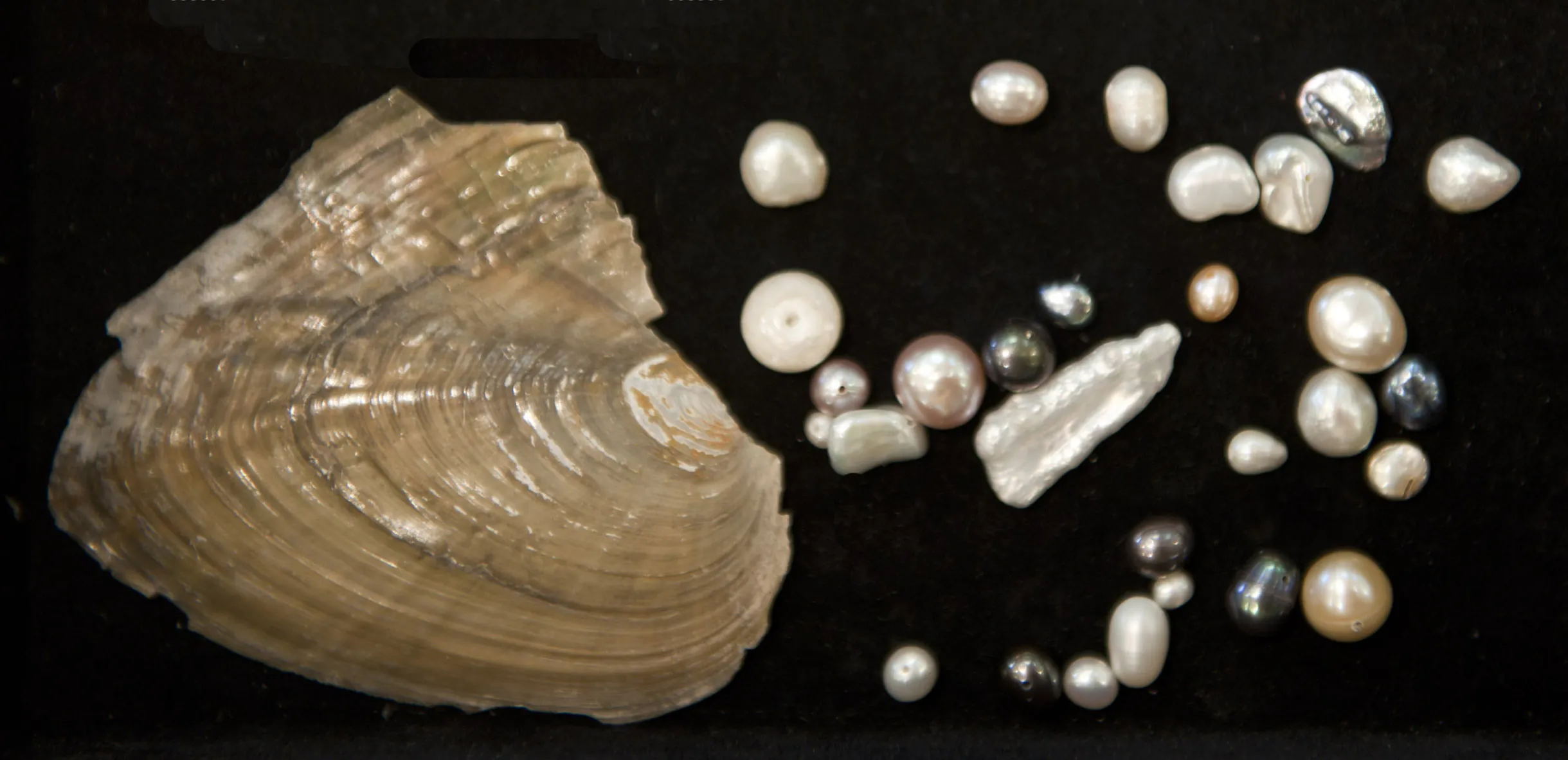
Most Akoya pearls seen in jewelry are about 6–9 mm, with 6–8 mm forming the classic center of the market. Smaller pearls exist, while 9–10 mm Akoya pearls are distinctly large and sizes above 10 mm are uncommon.
The Short Answer: Most Akoya Pearls Are About 6–9 mm
If you want one practical range to remember, use 6–9 mm. That is where most shoppers encounter Akoya pearls in classic necklaces, bracelets, pendants, and stud earrings.
Within that range, 6–8 mm is especially common. A 6–7 mm Akoya looks delicate and refined, 7–8 mm is a classic balanced size, and 8–9 mm has noticeably more presence. Once Akoya pearls reach about 9–10 mm, they sit near the large end of ordinary commercial production and become harder to source in fine quality.
The full biological and gemological range is wider than the everyday jewelry range. GIA has documented bead-cultured Akoya pearls from roughly 2 mm to 11 mm, while more recent GIA guidance describes 6–9 mm as the typical size range. Exceptional pearls can exceed 10 mm, but they should not be treated as routine Akoya sizes.
A Practical Akoya Pearl Size Chart
| Akoya size | How it usually looks | Typical market context |
|---|---|---|
| About 2–5 mm | Very small and delicate | Specialty or “baby” Akoya sizes; less typical for a classic full strand |
| 5–6 mm | Small, light and refined | Delicate jewelry, small studs, fine designs |
| 6–7 mm | Classic-small | Common Akoya size with an understated look |
| 7–8 mm | Balanced and recognizably classic | One of the most versatile Akoya size bands |
| 8–9 mm | More substantial | Upper-mainstream Akoya size with stronger visual presence |
| 9–10 mm | Large for Akoya | Increasingly scarce, especially when luster, surface and matching are also strong |
| 10 mm+ | Very large for the pearl type | Uncommon; fine round pearls and well-matched strands become much harder to assemble |
These are practical buying descriptions, not universal grading categories. Farms, harvests, producing regions, and sellers may divide size bands differently. For a broader comparison across pearl types and jewelry styles, see our pearl size guide.
Why Are Akoya Pearls Usually Smaller Than South Sea Pearls?
Akoya cultured pearls are produced by relatively small pearl oysters in the Pinctada fucata complex. Their smaller host oyster naturally limits how large a bead nucleus can be inserted and successfully cultured. This is one reason Akoya pearls occupy a smaller size range than pearls produced by much larger South Sea pearl oysters.
Akoya pearls are also bead cultured. A shell bead forms most of the pearl’s internal volume, while the oyster deposits nacre around it. Farmers must balance the desired finished diameter against oyster health, survival, nacre development, and the risk of losing the pearl during cultivation.
That is why simply inserting a much larger bead is not a reliable shortcut to producing a large, beautiful Akoya pearl. As size rises, it becomes harder to obtain the complete combination buyers actually want: roundness, strong luster, an attractive surface, suitable nacre, and close matching.
For more background on the pearl type itself, see our Akoya pearl guide. If you want to understand why fine Akoya can look unusually bright even at modest sizes, read why Akoya pearls can show mirror-like luster.
Is 7 mm or 8 mm a “Normal” Akoya Size?
Yes. Both are firmly inside the classic Akoya range.
Around 7 mm, Akoya pearls look refined and clearly visible without dominating the design. Around 8 mm, the same pearl type begins to feel more substantial while still keeping the traditional Akoya character.
The difference sounds small on paper, but it is visible because a pearl is a three-dimensional sphere. An extra half millimeter or one millimeter changes not only the width but also the overall visual mass. In a full strand, that difference repeats dozens of times, so an 8–8.5 mm necklace can look noticeably more substantial than a 7–7.5 mm necklace.
When Does an Akoya Pearl Count as Large?
There is no official line where “normal” suddenly becomes “large,” but the market changes noticeably as Akoya approaches 9 mm.
8–9 mm is already a more substantial Akoya size. 9–10 mm is distinctly large for the type. At 10 mm and above, size becomes unusual enough that buyers should pay closer attention to identification, quality, and how the seller measured the pearl.
Importantly, 10 mm is not an absolute biological ceiling. In 2024, GIA reported unusually large Japanese Akoya strands containing pearls around 11.0–12.2 mm. GIA described these sizes as extraordinary. That is the right way to interpret such pearls: possible, but not representative of normal Akoya production.
Does a Larger Akoya Pearl Automatically Mean Better Quality?
No. Size is only one pearl value factor.
If two Akoya pearls are comparable in every other respect, the larger one will generally be rarer and more valuable. Real pearls, however, are rarely identical in every other respect. A smaller Akoya with sharper luster, a cleaner surface, better roundness, and stronger nacre can be more beautiful than a larger pearl with weaker visible quality.
This matters especially when a buyer has a fixed budget. Moving from 7–8 mm to 8–9 mm or 9–10 mm can consume a meaningful part of that budget. If the size upgrade forces a major drop in luster or surface quality, the larger pearl may not be the better purchase.
Our pearl grading guide explains how size interacts with luster, surface, shape, nacre, color, and matching. For a closer look at the most visually important factor, see the pearl luster guide.
How Are Akoya Pearl Sizes Listed?
Pearl diameter is normally stated in millimeters. For round and near-round pearls, sellers often list a range such as 7.0–7.5 mm or 8.0–8.5 mm rather than claiming that every pearl is exactly the same diameter.
That range matters when comparing products. A 7.0–7.5 mm strand and a 7.5–8.0 mm strand are neighboring sizes, but the second will usually look more substantial. When comparing prices, make sure the ranges actually overlap before assuming one seller is charging more for the same size.
Also distinguish a uniform strand from a deliberately graduated strand. A graduated necklace may contain smaller pearls near the clasp and larger pearls at the center, so one single number may not describe the whole piece accurately.
Which Akoya Pearl Size Should You Choose?
Choose by the look you want, not by an age rule.
- 5–6 mm: very delicate, light, and understated.
- 6–7 mm: refined and subtle; clearly pearl jewelry without much visual weight.
- 7–8 mm: the classic middle ground and an easy all-purpose Akoya size.
- 8–9 mm: more visible and polished, with stronger presence in studs and strands.
- 9–10 mm: large for Akoya and more dependent on limited large-size production.
- 10 mm+: unusual for Akoya; buy for the rarity and look only after checking the rest of the quality carefully.
If you are buying your first pearl jewelry and deciding where to spend your budget, our pearl buying guide gives a broader framework. In most cases, it is better to choose the size you genuinely like while protecting luster and overall condition rather than chasing the largest millimeter number available.
What Sizes Are Akoya Pearls Usually? The Practical Takeaway
For everyday buying, think of Akoya pearls as a 6–9 mm pearl type, with 6–8 mm representing the most familiar classic scale. Pearls around 9–10 mm are large for Akoya, and pearls above 10 mm are uncommon even though exceptional larger examples do exist.
The most useful question is therefore not “What is the biggest Akoya pearl?” but “What size gives me the look I want without sacrificing luster, surface, nacre, shape, or matching?” That approach leads to a better pearl than size alone.
FAQ
What is the most common size for Akoya pearls?
Akoya pearls are commonly encountered around 6–9 mm, with 6–8 mm especially typical in classic jewelry.
Are 9 mm Akoya pearls large?
Yes. Around 9 mm, Akoya pearls are moving into the larger end of their normal commercial range. Fine pearls become progressively scarcer as size increases.
Are 10 mm Akoya pearls rare?
They are uncommon compared with 6–9 mm Akoya pearls. A fine 10 mm Akoya with strong luster, good surface quality, roundness, suitable nacre, and close matching is much harder to assemble than a typical 7–8 mm pearl.
Can Akoya pearls be 11 or 12 mm?
Yes, exceptional examples exist. GIA reported unusually large Japanese Akoya pearls measuring roughly 11.0–12.2 mm in 2024, but described these sizes as extraordinary rather than normal production.
Are small Akoya pearls lower quality?
No. Size and quality are separate questions. A small Akoya pearl can have excellent luster, surface, shape, nacre, and color, while a larger pearl can be lower quality.
Is 7–8 mm a good Akoya pearl size?
Yes. It sits near the classic center of the Akoya market and works well for both strands and stud earrings because it has visible presence without looking oversized.
Selected References
- GIA, “Different Pearl Types Explained: Akoya, South Sea, Tahitian & Freshwater Pearls” — https://www.gia.edu/gia-news-research/differences-between-pearl-types
- GIA, “Very Small Akoya Cultured Pearls,” Gems & Gemology, Spring 2018 — https://www.gia.edu/gems-gemology/spring-2018-gemnews-very-small-akoya-cultured-pearls
- GIA, “Remarkably Large Akoya Bead Cultured Pearls,” Gems & Gemology, Summer 2024 — https://www.gia.edu/gia-website/gems-gemology/summer-2024-gemnews-large-akoya-bead-cultured-pearls
- GIA, “What are the main types of cultured pearls and what are their distinctive characteristics?” — https://www.gia.edu/FAQ/gia-faq-about-gemstones-cultured-pearl-types-characteristics