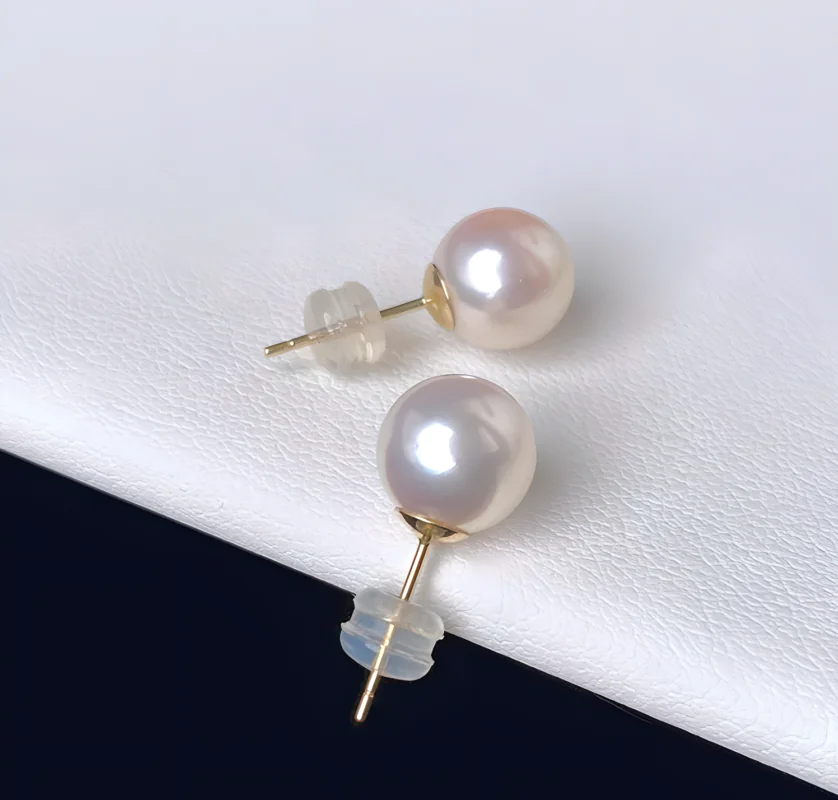
Yes, extreme uniformity can be a warning sign—but it is not proof that pearls are fake. Genuine cultured pearls can be carefully matched for size, shape, color, luster, and surface quality. What becomes suspicious is not simply that a strand looks neat, but that many pearls seem mechanically identical in several ways at once, especially when that sameness appears together with coating, drill-hole, or surface clues associated with imitation beads.
Why Do Real Pearls Usually Show Some Variation?
Real pearls grow inside living mollusks. Even when farmers use controlled culturing methods, the final appearance of each pearl is influenced by biological growth rather than by a machine reproducing the same bead again and again.
That is why genuine pearls often show small pearl-to-pearl differences. One pearl may be fractionally less round. Another may have a tiny surface feature. Two pearls that appear the same white at first glance may show slightly different overtones when they are rotated under light. Reflections may also vary subtly because the nacre surface and structure are not perfectly identical from one pearl to the next.
These differences can be extremely small in fine-quality pearls. The point is not that every real pearl must look obviously irregular. The point is that biological formation usually leaves some individual variation when the pearls are examined carefully enough.
Why Can Imitation Pearls Look More Perfectly Repeated?
Many imitation pearls begin as manufactured beads made from glass, plastic, shell, or another material. A pearlescent coating can then be applied to imitate the appearance of nacre. Because bead size, shape, surface preparation, and coating conditions can be controlled industrially, large numbers of imitation pearls can be produced with highly repetitive geometry and finish.
GIA laboratory reports have documented imitation pearls made from coated shell, glass, plastic, and other manufactured materials. Under magnification, some show artificial coating features rather than the overlapping nacre structures expected in nacreous pearls. Damage around a drill hole may also reveal a different material beneath the pearly outer layer.
This is why a necklace can start to look suspicious when every bead repeats the same combination: the same perfect sphere, the same flawless surface, the same color response, the same type of shine, and the same manufactured-looking edge around the drill hole.
Uniformity becomes more useful as a clue when it looks like repetition from manufacturing, not simply careful matching.
But Well-Matched Real Pearl Strands Can Also Look Extremely Uniform
This is the most important exception.
A genuine pearl strand is not assembled randomly from whatever pearls were harvested together. Pearls are sorted after harvest, and a strand maker may select from many pearls to create a necklace that looks consistent from end to end.
Matching is not a defect in genuine pearls. It is a recognized quality factor. GIA evaluates multi-pearl jewelry for matching across characteristics such as size, shape, color, luster, surface, and nacre. A fine cultured-pearl strand may therefore look remarkably uniform because someone deliberately selected pearls that work together visually.
If you are evaluating quality rather than authenticity alone, our pearl grading guide explains why matching should be considered alongside luster, surface quality, shape, and other factors.
So the useful question is not:
“Are these pearls very uniform?”
It is:
“Do these pearls look carefully matched, or mechanically repeated?”
What Kind of Uniformity Is Actually More Suspicious?
Look for uniformity across several independent characteristics rather than focusing on only one.
| What you notice | What it may mean |
|---|---|
| Very similar diameter | Normal in a well-matched genuine strand; weak evidence by itself |
| Very round pearls | Can occur in fine cultured pearls, especially carefully selected strands |
| Similar bodycolor | Expected in many matched strands; not proof of imitation |
| Same size, same perfect sphere, same flawless surface, same shine, and almost no individual variation | More suspicious and worth closer inspection |
| Repeated coating texture or glittery surface appearance | Stronger reason to suspect an artificial surface |
| Peeling, chipping, coating buildup, or exposed base material at several drill holes | Much stronger evidence of imitation construction |
The pattern matters. A single clean, round pearl proves very little. Dozens of beads showing the same manufactured-looking behavior deserve much more scrutiny.
High-Quality Akoya Pearls Are a Good Example of Why “Too Perfect” Can Mislead
Akoya cultured pearls are often selected for roundness, bright luster, clean surfaces, and close matching. A fine Akoya necklace can therefore look much more uniform than someone expects from a natural material.
If you apply the rule “perfect-looking means fake,” you could incorrectly reject a high-quality genuine strand.
The better approach is to inspect whether tiny natural differences remain when the pearls are viewed closely and rotated under light. High matching creates harmony. It does not necessarily erase every individual surface, overtone, or reflection difference.
What Should You Check Besides Uniformity?
Uniformity is best used as a reason to inspect more carefully, not as a final verdict. A practical sequence is:
- Compare several pearls, not just one. Look for repeated manufacturing features across the strand.
- Rotate the pearls under neutral light. Genuine pearls may show subtle variation in overtone and reflection behavior even when they are well matched.
- Inspect the surfaces with magnification. Look for natural individual surface characteristics versus repeated coating-like texture.
- Check drill holes and worn edges. Peeling film, chipped coating, pooled material, or an exposed non-pearl core is more informative than roundness alone.
- Use several clues together. Weight, temperature, friction, price, and seller claims are supporting context, not standalone proof.
For a broader at-home screening framework, see our guide on how to tell if pearls are real or fake.
Can Irregularity Prove That Pearls Are Real?
No. The logic does not work in reverse.
An imitation manufacturer can deliberately produce off-round beads, textured surfaces, varied colors, or other irregularities. Some modern imitations are convincing enough that appearance alone cannot provide certainty.
That means:
- extreme sameness can be suspicious, but it does not prove imitation;
- visible irregularity can support a natural-looking appearance, but it does not prove authenticity;
- surface and drill-hole construction clues are often more useful than simple roundness;
- high-value or uncertain pieces may require professional gemological testing.
For a more detailed discussion of the difference between legitimate high matching and factory-like sameness, read our guide to overly uniform pearl strands and imitation-pearl risk.
When Is Professional Testing Worth Considering?
If the pearls are valuable, antique, inherited, unusually expensive, or being sold with an important claim about their identity, home inspection should be treated only as screening.
Professional pearl laboratories can use magnification, X-ray imaging, spectroscopy, fluorescence, and other methods to examine structures that cannot be judged reliably from normal appearance alone. This is particularly important when the question is not merely “real or imitation,” but whether a pearl is natural or cultured, what type it is, or whether a treatment is present.
Bottom Line
Pearls that look too perfectly uniform can be suspicious because manufactured imitation beads can repeat the same size, shape, coating, color, and surface appearance much more easily than biological pearl growth does.
But uniformity is only a screening clue. Genuine cultured pearls can be extremely well matched, and matching is itself a recognized pearl quality factor.
The most useful distinction is therefore not “uniform versus non-uniform.” It is careful matching versus mechanical repetition. If extreme sameness appears together with repeated coating texture, peeling around drill holes, exposed base material, or other manufacturing clues, the suspicion becomes much stronger.
FAQ
Can real pearls be perfectly round?
Yes. Some cultured pearls can be very round, and fine strands may be assembled from carefully selected round pearls. Perfect roundness alone does not prove a pearl is imitation.
Are flawless-looking pearls always fake?
No. High-quality cultured pearls can have very clean surfaces. A flawless-looking surface becomes more suspicious when many beads also share identical shape, color, shine, and repeated manufacturing features.
Why do genuine pearl necklaces often look so well matched?
Because pearls are sorted after harvest. Strand makers select pearls with similar size, shape, color, luster, and surface appearance so the finished necklace looks balanced and consistent.
What is a stronger warning sign than uniform size?
Repeated evidence of an artificial outer layer is much more useful. Examples include coating buildup, peeling, chipping, or exposed base material around several drill holes.
Can imitation pearls be made to look irregular?
Yes. Imitation beads can be manufactured with deliberate variations in shape, texture, or color. That is why neither perfect uniformity nor visible irregularity should be used as a one-step authenticity test.