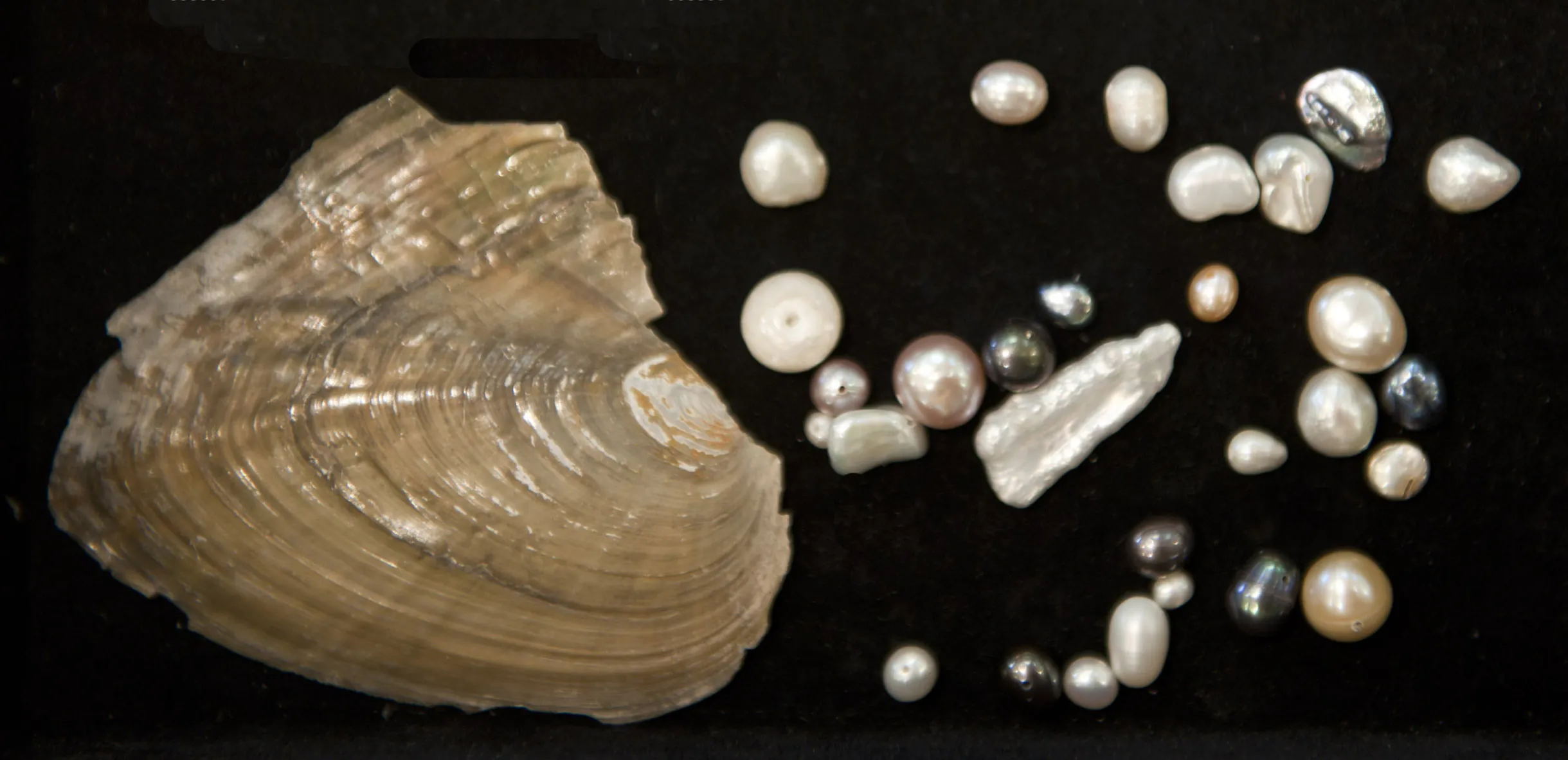
White South Sea pearls and Akoya pearls are both saltwater cultured pearls, but they are not simply larger and smaller versions of the same thing. They come from different oyster species, usually grow in different regions, and tend to show different combinations of size, luster, nacre thickness, color, shape, rarity, and price.
In practical terms, Akoya pearls are usually chosen for a smaller, crisp, highly reflective and precisely matched classic look. White South Sea pearls are usually chosen for larger size, thicker nacre, a softer dimensional glow, and a more substantial presence.
Neither type is automatically “better.” The better choice depends on the visual effect you want, the size you are comfortable wearing, the quality of the actual pearls in front of you, and your budget.
White South Sea vs. Akoya Pearls at a Glance
| Factor | White South Sea Pearls | Akoya Pearls |
|---|---|---|
| Host oyster | Pinctada maxima, especially the silver-lipped form | Pinctada fucata |
| Typical size | Usually larger; commonly around 9–16 mm, with a broader type range possible | Usually smaller; commonly around 6–9 mm, although larger Akoya exist |
| Luster character | Often broad, satiny, soft and dimensional | Often bright, crisp and mirror-like |
| Nacre | Typically much thicker around the bead nucleus | Typically thinner, but good nacre quality can still produce excellent pearls |
| Common white color direction | White, silver-white, creamy white, sometimes with subtle overtones | White to cream, often with rose, silver or other subtle overtones |
| Overall visual effect | Large, luminous, substantial, luxurious | Refined, bright, precise, classic |
| Typical price position | Usually higher, especially for large, round, clean and well-matched pearls | Generally more accessible at common sizes, although exceptional Akoya can still be expensive |
The First Difference Is the Oyster, Not the Marketing Name
Akoya cultured pearls are produced by Pinctada fucata, a relatively small saltwater pearl oyster. White South Sea cultured pearls are produced by Pinctada maxima, one of the largest pearl oysters used commercially.
That biological difference matters because the oyster helps set the practical range of what can be produced. Pinctada maxima can accommodate a larger bead nucleus and deposit substantial nacre over it, which is one reason South Sea pearls reach sizes that are unusual for Akoya.
If you want a broader introduction to the two pearl families, see our guides to Akoya pearls and South Sea pearls.
White South Sea Does Not Automatically Mean Australian
This distinction is easy to miss.
White South Sea pearl is the broader pearl-type description. These pearls are cultured from Pinctada maxima and are produced in several South Sea farming regions, with major production associated with Australia, Indonesia, and the Philippines.
Australian White South Sea pearl adds a geographic claim. It refers to a White South Sea pearl cultured in Australia. In other words, Australian White South Sea pearls belong within the broader White South Sea category, but not every White South Sea pearl is Australian.
If origin is specifically part of your buying decision, our separate comparison of Australian White South Sea pearls vs. Akoya pearls goes further into that narrower question.
Size Is Usually the Most Obvious Difference on the Body
For most buyers, size creates the fastest visual separation between these pearl types.
Akoya pearls are commonly encountered around 6–9 mm. Larger Akoya pearls do exist, and exceptional examples above the usual commercial range can be desirable, but the category is naturally associated with a more restrained scale.
White South Sea pearls are typically much larger. GIA describes South Sea pearls as the largest of the major cultured pearl types, with a broad range that can extend from roughly 8 mm to 18 mm and beyond. In ordinary jewelry shopping, sizes around 9–16 mm are especially familiar.
This difference changes more than the number on a caliper. A 7.5 mm Akoya stud can look bright and polished without dominating the face. A 12 mm White South Sea stud has far more physical presence even before color or luster is considered.
If you are choosing between the two types, decide how much visual scale you want before comparing grades or prices. A technically beautiful pearl can still feel wrong if its size does not suit the wearer.
Akoya Luster Is Usually Sharper; South Sea Luster Is Usually Broader
The common shorthand is that Akoya pearls are “mirror-like” while South Sea pearls are “satiny.” That is useful, but it should not be treated as an absolute ranking.
Fine Akoya pearls can show very crisp reflected edges. Under a window or a large soft light source, the reflection may look bright, sharp and almost glassy. This high-contrast luster is a major part of the classic Akoya aesthetic.
Fine White South Sea pearls often return light more broadly. The surface can appear softer while still being bright, with a deeper glow that seems to come from within the nacre rather than only from the outermost surface.
That does not mean Akoya always has “better” luster. A fine White South Sea pearl can be far more lively than a mediocre Akoya pearl. It also does not mean every South Sea pearl must look soft. High-quality South Sea pearls can still show strong, relatively sharp reflections.
The practical rule is simple: compare luster within the context of the pearl type, then compare the actual pearls under the same lighting.
Nacre Thickness Is a Real Structural Difference
Both Akoya and White South Sea cultured pearls are normally bead-nucleated. A shell bead forms the core, and the oyster deposits nacre around it.
South Sea cultured pearls generally develop substantially thicker nacre than Akoya pearls. Their longer growth period and the biology of Pinctada maxima help produce the deep, layered appearance associated with the category.
Akoya pearls normally have thinner nacre over the bead nucleus. That is not a defect by itself. Akoya is a different pearl type with its own normal structure, and well-cultured Akoya pearls with good nacre quality can be beautiful and durable when handled properly.
The mistake is to reduce quality to nacre thickness alone. Thick nacre cannot compensate for dull luster, severe surface problems, poor matching or an unattractive shape. Likewise, a fine Akoya should not be dismissed simply because its nacre is naturally thinner than that of a South Sea pearl.
Both Can Be White, but They Rarely Look Identical
“White” is not one exact pearl color.
White South Sea pearls commonly appear white, silver-white or creamy white. Some lean cool and silvery; others show warmer or subtle rose effects. Because the pearls are large and their nacre is thick, color and orient can feel broad and layered across the surface.
Akoya pearls are also commonly white to cream, often with rose, silver or other subtle overtones. Their sharper reflection can make these overtones appear more concentrated or high-contrast.
For a buyer, the useful question is not “Which type is whiter?” but rather:
- Do you prefer a cool silver-white or a warmer creamy white?
- Do you want a visible rose overtone?
- Will the pearl be worn next to yellow gold, white gold, platinum, or another metal?
- Does the color still look attractive in daylight as well as indoor lighting?
Akoya Is Closely Associated with Precision Matching
Akoya pearls are strongly associated with traditional round strands and carefully matched pairs. Their smaller size and long-established grading and matching culture make highly uniform necklaces a defining part of the market.
White South Sea pearls can also be beautifully round and precisely matched, but building a large strand requires matching pearls across several difficult variables at once: size, shape, bodycolor, overtone, luster, surface and nacre appearance.
As size increases, that matching challenge becomes more significant. This is one reason a large, round, clean, high-luster White South Sea strand can become extremely expensive.
Do not assume, however, that round is the only desirable South Sea shape. Drop, button, oval, circled and baroque South Sea pearls can be intentionally chosen for design rather than treated as failed versions of round pearls.
Why Are White South Sea Pearls Usually More Expensive?
At comparable quality levels, White South Sea pearls usually occupy a higher price tier than Akoya pearls. Several factors work together:
- they are usually much larger;
- their cultivation period is generally longer;
- the host oyster is large and valuable to farm;
- high-quality round pearls with clean surfaces are limited in supply;
- matching a full strand of large pearls is difficult;
- larger size magnifies visual differences that would be less obvious in smaller pearls.
But pearl type alone does not determine value. A top-quality Akoya pearl can be more desirable—and more expensive—than a low-quality White South Sea pearl. The actual quality still depends on factors such as luster, surface, shape, color, nacre and matching.
For a more systematic way to evaluate those factors, see our pearl grading guide.
Which One Should You Choose?
Choose Akoya if you want a bright, classic and precise look
Akoya is often the stronger fit when you want:
- a traditional white pearl necklace;
- sharp, mirror-like reflections;
- smaller or medium pearl sizes;
- high visual uniformity in a strand or pair;
- a polished piece that works easily for office, bridal and everyday formal wear;
- a fine saltwater pearl look at a more accessible size and price point than comparable South Sea jewelry.
You can browse Akoya pearl jewelry if this is the direction you prefer.
Choose White South Sea if you want size, depth and presence
White South Sea is often the stronger fit when you want:
- larger pearls that are visibly substantial;
- a softer, broader and more dimensional glow;
- thicker nacre as a normal structural feature of the pearl type;
- a luxury statement piece rather than a restrained classic scale;
- large studs, pendants or strands where the pearl itself is the main visual focus;
- white-to-silver colors associated with Pinctada maxima.
You can browse South Sea pearl jewelry for examples of that larger-scale look.
The Best Comparison Is Not “Which Pearl Type Is Better?”
The two categories solve different aesthetic problems.
Akoya excels when the goal is a refined, bright, highly controlled classic pearl look. White South Sea excels when the goal is scale, depth and a more substantial visual presence.
Once you know which look you prefer, compare quality within that type. A smaller pearl with excellent luster and clean nacre may be a better purchase than a larger pearl that looks flat. A beautifully matched Akoya strand may suit you better than a more expensive South Sea strand—and the reverse can also be true.
So the most useful buying sequence is:
- Choose the pearl type whose visual character you actually prefer.
- Choose the size range that suits the wearer and jewelry style.
- Compare luster first, then surface, shape, color, nacre and matching.
- Judge price only after you know the quality you are comparing.
That approach is more reliable than buying South Sea simply because it is larger or buying Akoya simply because its reflections look sharper.
Frequently Asked Questions
Are White South Sea pearls always from Australia?
No. Australia is an important producer, but White South Sea pearls are also cultured in other South Sea regions, including Indonesia and the Philippines. “Australian White South Sea” is a more specific origin description within the broader White South Sea category.
Which has better luster: Akoya or White South Sea?
Neither type automatically has better luster. Akoya is known for crisp, mirror-like reflections, while White South Sea pearls often show a broader, satiny glow. Quality should be judged within the pearl type and by comparing the actual pearls under consistent lighting.
Are White South Sea pearls more durable than Akoya pearls?
White South Sea pearls typically have much thicker nacre, but durability is not determined by pearl type alone. Nacre quality, surface condition, setting, wear habits and care all matter. Pearls of either type can be damaged by abrasion, chemicals and poor storage.
Why are White South Sea pearls usually more expensive than Akoya?
They are generally larger, take longer to grow, are produced in lower volumes, and become increasingly difficult to find in round, clean, high-luster, well-matched groups as size rises. Exceptional Akoya pearls can still be expensive, so price should always be compared together with quality.
Can Akoya pearls be as large as South Sea pearls?
Large Akoya pearls do exist, including examples above the traditional 6–9 mm range, but they become increasingly uncommon. South Sea pearls naturally occupy a much larger size range, so sizes above 10 mm are far more characteristic of that category.
Sources and Further Reading
- GIA: Different Pearl Types Explained — pearl type, host mollusks, typical size ranges, color, luster, growth and origin.
- GIA: The 7 Pearl Value Factors — framework for evaluating size, shape, color, luster, surface, nacre and matching.