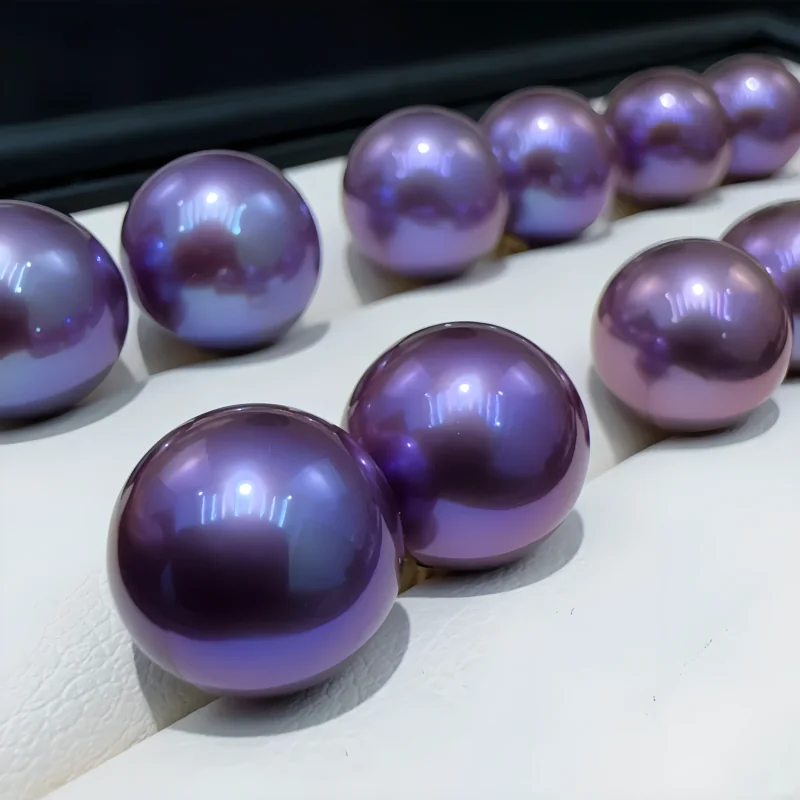
Pearl gift guide
The most elegant pearl gift for an older family member is usually the one that looks intentional on her—not simply the largest, whitest, or most traditional pearl you can afford. If you are unsure, start with strong luster, a clean and simple setting, a size that has some presence without overwhelming her usual jewelry, and a format she already wears.
For many recipients, that means refined white pearl studs, a single-pearl pendant, or a well-matched strand in a moderate size. But an older relative who wears bold jewelry may look far more natural in a large South Sea pearl, a dark Tahitian pendant, or an organic baroque design.
The useful rule is simple: choose for her taste first and her age second. Age can matter for practical details such as earring weight, clasp size, chain length, or how easy a piece is to put on. It should not be used as a shortcut for deciding that she must want conservative jewelry.
The safest answer: prioritize luster, proportion, and simplicity
If you need to choose without asking the recipient directly, elegance is easier to achieve by controlling a few visible factors than by chasing a particular pearl type or grade name.
| What to prioritize | Why it matters visually | A practical gift rule |
|---|---|---|
| Luster | Bright, clear reflections make pearls look lively and refined rather than flat or chalky. | Prefer better luster over simply moving up to a larger pearl. |
| Proportion | The pearl should have enough presence for the wearer's face, neckline, and usual jewelry scale. | If she normally wears small jewelry, do not assume a milestone gift needs oversized pearls. |
| Color harmony | White, cream, silver, golden, gray, green, and other pearl colors create very different moods. | Look at the metals, clothing colors, and jewelry she already chooses. |
| Setting | A simple, well-proportioned setting can make a pearl look more sophisticated than an over-decorated design. | When unsure, keep the metalwork restrained and let the pearl carry the design. |
| Ease of wear | A beautiful gift is less successful if it feels heavy, difficult to fasten, or unlike anything she wears. | Choose a familiar jewelry format and check weight, backs, clasp, and length. |
GIA evaluates pearls using seven value factors: size, shape, color, luster, surface, nacre quality, and matching. It describes luster as one of the most important contributors to a pearl's beauty. That is useful for gift buying because a smaller, brighter pearl can look more elegant than a larger but duller one. You can compare these factors in more detail in our pearl luster guide, while GIA's pearl quality factors provide an independent technical overview.
Do not choose pearls by age alone
Gift guides sometimes recommend one pearl size for women in their 40s, another for women in their 60s, and still larger pearls for women in their 70s or 80s. That can be a convenient selling formula, but it is not a reliable style rule.
An elegant 75-year-old who wears fine gold chains and small earrings may prefer a crisp 7–8 mm pair of pearls to 11 mm studs. Another relative of the same age may wear sculptural jewelry every day and find 7 mm pearls almost invisible. The difference is personal style, not the birth year.
Instead, look for evidence:
- Does she usually wear studs, drops, pendants, strands, or bracelets?
- Are her existing pieces delicate, medium-scale, or bold?
- Does she favor yellow gold, white metals, rose gold, or mixed metals?
- Does her wardrobe lean toward light neutrals, warm colors, dark colors, or saturated colors?
- Does she wear jewelry every day, mainly for social occasions, or only for important events?
Those observations tell you much more than age. If you want a broader framework for comparing pearl types and quality before buying, use our pearl buying guide.
Which pearl colors usually look most elegant?
There is no universally “mature” pearl color. The most elegant color is the one that looks deliberate with the recipient's wardrobe and metal preferences.
White or silver-white: the safest classic direction
White pearls are the easiest choice when you want something polished, recognizable, and versatile. Bright white or silver-white Akoya, freshwater, or South Sea pearls can work with both cool and warm wardrobes depending on their overtone and setting.
If the recipient already wears traditional jewelry, white pearls are usually the lowest-risk option. The key is to avoid buying a dull white pearl merely because “white is classic.” Strong luster is what gives the classic look its life.
Cream and warm white: softer, not automatically “more age-appropriate”
Creamier pearls can look beautifully warm with yellow gold, beige, camel, brown, ivory, and other warm wardrobe colors. But do not choose cream only because someone is older. Color should still be matched to her taste rather than to an assumption about age or complexion.
Golden pearls: elegant when she already likes warm, visible jewelry
Golden South Sea pearls can create a rich and celebratory look, especially for someone who wears yellow gold or warm-colored clothing. Because the color itself has presence, even a simple pair of studs or a single pendant can feel substantial without extra decoration.
Tahitian pearls: refined for someone who dislikes conventional white pearls
Tahitian cultured pearls can show gray, green, blue, purple, bronze, and other dark overtones. They often suit people who wear charcoal, black, navy, forest green, silver, or contemporary jewelry. A dark pearl does not look less formal or less appropriate for an older relative; it simply creates a different visual language.
If she has a strong personal style, a Tahitian pendant or earrings may feel more elegant than a white strand chosen only because it seems “safe.”
What pearl size looks elegant on an older relative?
For gifts, it is more useful to think in terms of visual presence than age. The ranges below are styling guides, not rules.
| Approximate pearl size | How it tends to read visually | When it can work well as a gift |
|---|---|---|
| 5–6 mm | Delicate and quiet | For someone who consistently wears very small jewelry |
| 6–7 mm | Refined and understated | Everyday studs, light necklaces, minimal style |
| 7–8 mm | Classic medium presence | A safe starting point for traditional white studs or strands |
| 8–9 mm | Noticeably more substantial | Milestone gifts, polished everyday jewelry, more visible studs |
| 9–11 mm | Luxurious or statement-oriented | Large freshwater pearls, pendants, bolder earrings, some South Sea and Tahitian styles |
| 11 mm+ | Strong visual presence | For someone who already enjoys large jewelry or when a single pearl is the focal point |
The pearl type matters. An 8–9 mm Akoya pearl is visually substantial within the Akoya category, while South Sea and Tahitian pearls commonly extend into larger size ranges. A millimeter also looks more significant in real life than it may sound on paper because a pearl grows in three dimensions.
If size is the main uncertainty, our pearl size guide gives a more detailed comparison.
Which pearl shape looks most elegant?
Round pearls are the traditional answer, but they are not the only elegant option.
- Round and near-round pearls read as balanced, polished, and classic. They are the safest choice for conventional studs and strands.
- Drop pearls create a graceful vertical line and work especially well in pendants and earrings.
- Oval pearls are slightly softer and less formal than perfectly round pearls while still looking orderly.
- Baroque pearls can look highly sophisticated when the recipient likes artistic, modern, or organic jewelry.
Do not reject baroque pearls because they are irregular. An older relative with contemporary taste may find a sculptural baroque pendant much more elegant than a perfectly matched strand. Shape should support the design language she already wears.
Stud earrings, pendant, or pearl necklace: which gift is safest?
Pearl studs: usually the lowest-risk choice
If her ears are pierced and she regularly wears studs, pearl earrings are difficult to overcomplicate. A matched pair has no necklace-length problem, can be worn with casual or formal clothing, and lets the pearls themselves provide most of the visual effect.
For a classic gift, 7–9 mm white pearls are a practical range to compare. If she likes stronger jewelry, larger golden, Tahitian, or South Sea studs may be appropriate—but check weight and the security of the earring backs. You can browse pearl earrings to compare different proportions and styles.
A single-pearl pendant: elegant when you are unsure about a full strand
A pendant gives one good pearl room to be noticed without making the entire outfit revolve around pearls. It also lets you spend more of the budget on the quality and character of one pearl rather than on matching dozens of pearls in a strand.
This makes pendants especially useful when you want a gift that feels special but do not know whether the recipient would wear a traditional pearl necklace. Compare pearl pendants if you want to see how white, dark, and golden pearls change the overall look.
A pearl strand: elegant when you know she will wear it
A full strand can be the most iconic pearl gift, but it is also the easiest format to misjudge. Length, pearl size, matching, clasp design, and the recipient's comfort with a more visibly “pearl” look all matter.
If she already owns and wears strands, a new necklace can be a natural upgrade. If she never wears them, a strand purchased because it seems appropriate for her age may spend most of its life in the box.
Drop earrings: beautiful, but check movement and weight
Drop earrings can look especially graceful for dinners, celebrations, and formal events. They are a good choice when she already wears moving or dangling earrings. For someone who mostly wears small studs, however, a long drop design may feel less natural even if it looks elegant in a product photograph.
What makes a pearl gift look expensive without making it oversized?
If the goal is refinement rather than maximum visual impact, spend attention on the details that are visible at normal wearing distance.
- Choose lively luster. A bright pearl generally reads as more polished than a larger pearl with weak reflections.
- Keep the setting proportionate. The metal should support the pearl rather than compete with it unless the recipient already likes ornate jewelry.
- Check matching in pairs and strands. Earrings should look like they belong together; strands should feel intentionally coordinated in size, color, luster, and shape.
- Accept minor natural surface features when they are not distracting. Perfect-looking surfaces are not the only route to beauty, especially in larger pearls and baroque designs.
- Choose the right scale, not the largest scale. A pearl that looks proportional to the wearer will usually appear more sophisticated than one chosen mainly to impress on a specification sheet.
For an older family member, practical elegance matters too
A gift can be visually perfect and still be inconvenient. Instead of assuming age-related limitations, look at what the person already finds comfortable.
Before buying, check:
- whether she normally wears pierced earrings and what kind of backs she prefers;
- whether large earrings tend to tilt or feel heavy on her;
- which necklace lengths she already wears most often;
- whether the clasp is large enough to operate comfortably;
- whether a bracelet would require help to fasten;
- whether you know her ring size well enough to make a ring a sensible gift;
- which metal color appears most often in her jewelry box.
These details are not glamorous, but they determine whether the gift becomes part of her regular wardrobe or remains a special-occasion object.
A simple decision guide
| If she is... | A strong starting point | Why it tends to work |
|---|---|---|
| Classic and understated | 7–8 mm or 8–9 mm white Akoya or high-luster freshwater studs | Clean, familiar, and easy to wear without looking overly decorative |
| Polished and formal | Well-matched white pearl strand or refined drop earrings | Creates a more complete, dressed look |
| Minimal but luxurious | Single white South Sea pearl pendant | One larger pearl provides presence without visual clutter |
| Warm-toned and gold-loving | Golden pearl studs or pendant in yellow gold | Color and metal reinforce the same warm direction |
| Modern or distinctive | Tahitian pendant, earrings, or dark pearl strand | Dark natural colors feel individual without requiring an elaborate design |
| Artistic and unconventional | Baroque pearl pendant or earrings | Organic shape can look more personal than a conventional round pearl |
If you still cannot decide, use this three-question test
Before placing the order, ask yourself:
- Would she choose this jewelry format for herself? If she never wears necklaces, do not start with a full strand just because pearls feel traditional.
- Does the piece look like her normal scale of jewelry? Move only one step larger or more luxurious if you want the gift to feel special without becoming unfamiliar.
- What is the first thing I notice—the pearl or the specification? If you are mainly impressed by “12 mm,” “AAA,” or a high price but the pearl itself looks dull or the design feels wrong for her, keep looking.
The best gift usually feels recognizable as her, only a little more special.
FAQ
Are pearls a good gift for a grandmother or older relative?
Yes, especially when the design matches jewelry she already enjoys. Pearls can range from traditional white strands to minimalist pendants, dark Tahitian earrings, and contemporary baroque pieces, so the category is much broader than a single “grandmother style.”
What pearl size looks most elegant on an older woman?
There is no age-based ideal size. Around 7–9 mm is a useful range to compare for classic white studs or necklaces, while larger pearls can work beautifully for someone who already wears substantial jewelry. Proportion and personal style matter more than age.
Are pearl studs or a necklace a safer gift?
If she has pierced ears and regularly wears studs, earrings are usually the lower-risk choice because you do not need to guess necklace length or whether she likes full strands. A single-pearl pendant is another flexible option.
Do white pearls look more elegant than Tahitian or golden pearls?
Not inherently. White pearls create the most traditional look, golden pearls create a warmer and more luxurious effect, and Tahitian pearls can look modern and sophisticated. The best color is the one that fits the recipient's wardrobe and metal preferences.
Should I buy larger pearls for a milestone birthday?
Only if larger jewelry suits the recipient. A milestone gift can feel more special through better luster, a finer setting, a more distinctive pearl color, or a higher-quality matched pair—not only through size.