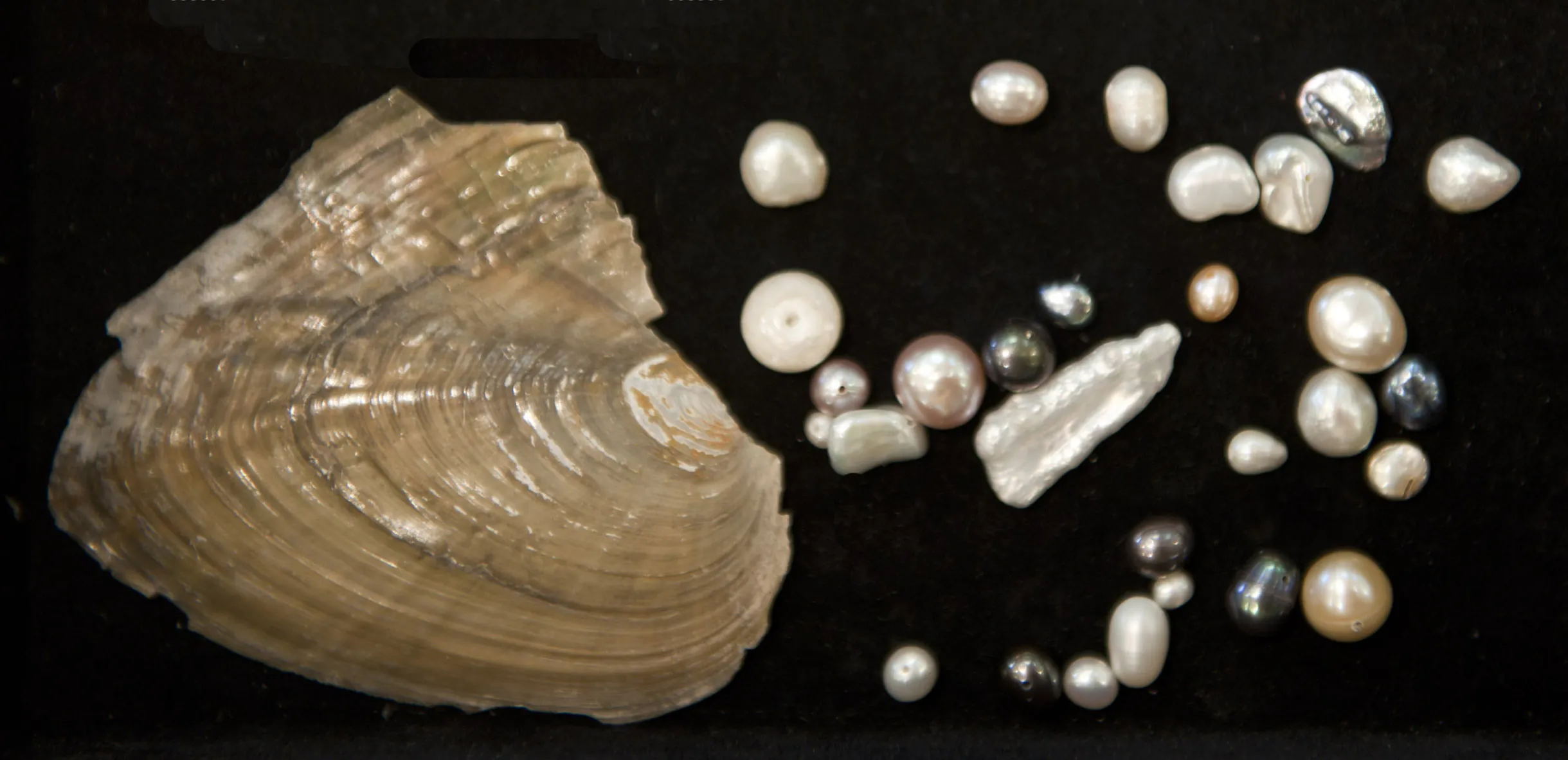
The simplest difference is that “Keshi” primarily describes how a pearl formed, while “baroque” describes its shape. A Keshi cultured pearl forms without the usual solid bead nucleus during cultured-pearl production. A baroque pearl is simply an irregularly shaped pearl.
That means the two terms can overlap, but they are not interchangeable. A Keshi pearl may have a baroque shape, while a baroque pearl may be bead-cultured and therefore not Keshi at all. Understanding that distinction is more useful than trying to identify either category from appearance alone.
The Short Answer: Keshi Is About Formation; Baroque Is About Shape
The easiest way to avoid confusion is to stop treating Keshi and baroque as two competing pearl varieties.
| Question | Keshi cultured pearl | Baroque pearl |
|---|---|---|
| What does the term mainly describe? | Formation and internal structure | External shape |
| Does it have the normal solid bead nucleus? | No | It may or may not |
| Must it be irregular? | Often irregular, but the term is not fundamentally a shape grade | Yes; irregularity is what makes it baroque |
| Can it be cultured? | Yes; “Keshi cultured pearl” is the precise modern trade term | Yes, and natural pearls can also be baroque |
| Does the term tell you quality? | No | No |
In other words, Keshi answers “How did this pearl form?” while baroque answers “What shape does this pearl have?”
This distinction is similar to saying that “South Sea” and “round” are not opposing categories. One describes a pearl type and production context; the other describes shape. The same pearl can carry both descriptions.
What Exactly Is a Keshi Cultured Pearl?
In precise modern terminology, Keshi cultured pearl refers to a non-beaded cultured pearl associated with marine cultured-pearl production.
During normal bead culturing of Akoya, Tahitian, or South Sea pearls, a technician introduces a bead and pearl-forming tissue. Sometimes a non-bead pearl develops instead. This can happen after the bead is rejected, through separated graft tissue, or through other tissue responses related to the culturing operation.
The important point is that the resulting pearl develops without the standard solid shell bead at its center.
CIBJO's pearl terminology treats these as non-beaded cultured pearls created in connection with human-operated marine pearl culture. GIA laboratory publications likewise commonly use “keshi” as a trade term for saltwater non-bead cultured pearls.
If you want the broader formation, luster, value, and buying background, see our guide to Keshi pearls. Here, the important point is simply that Keshi is not a synonym for “odd-shaped pearl.”
What Exactly Is a Baroque Pearl?
Baroque is a shape description. CIBJO defines baroque pearls as irregularly shaped natural or cultured pearls, while GIA similarly places baroque among its standard pearl shape categories.
A baroque pearl may be lumpy, sculptural, curved, pinched, elongated, asymmetrical, or otherwise irregular enough that it does not fit a more regular shape category such as round, oval, button, or drop.
The word tells you very little about what is inside the pearl. A baroque pearl might be:
- a bead-cultured South Sea pearl with an irregular contour;
- a bead-cultured Tahitian pearl with an asymmetric shape;
- a non-bead freshwater cultured pearl;
- a Keshi cultured pearl;
- or even a natural pearl that happens to be irregular.
So “baroque” does not tell you whether a pearl contains a bead nucleus, where it was cultured, whether it is freshwater or saltwater, or whether it is high or low quality.
For a broader look at how irregular pearls are judged, see What Are Baroque Pearls? and our Pearl Shape Guide.
Can a Pearl Be Both Keshi and Baroque?
Yes. In fact, this overlap is one reason the terminology becomes confusing.
Many Keshi cultured pearls have highly irregular shapes. If a non-bead cultured Keshi pearl is irregular enough to fall into the baroque shape category, then describing it as a baroque Keshi cultured pearl can communicate both its formation and its shape.
But the reverse does not work. Seeing a baroque outline does not prove that the pearl is Keshi.
Consider three examples:
- Irregular South Sea bead-cultured pearl: baroque, but not Keshi because it still contains its bead nucleus.
- Irregular South Sea non-bead cultured pearl: potentially both Keshi and baroque.
- Irregular natural pearl: baroque, but not a Keshi cultured pearl.
The categories therefore cross each other rather than replacing each other.
Are All Keshi Pearls Baroque?
It is safer not to turn that into an absolute rule.
Keshi cultured pearls are strongly associated with irregular and free-form shapes because there is no spherical bead controlling their growth. Historical pearl terminology also closely associates Keshi with baroque forms.
However, modern gemological research uses the trade term “keshi” for non-bead cultured formation, and individual non-bead cultured pearls can show shapes such as button, drop, or other forms in addition to obviously baroque examples.
That is why defining Keshi as “a type of baroque pearl” is less precise than saying:
Keshi identifies a non-bead cultured formation; baroque identifies an irregular shape. Many pearls satisfy both descriptions.
This distinction also prevents a common circular argument in online listings, where an irregular shape is used as proof that a pearl must be Keshi.
Does “Keshi” Mean the Pearl Is 100% Solid Nacre?
You will often see Keshi marketed as “100% nacre” or “solid nacre.” That wording is trying to distinguish them from ordinary saltwater bead-cultured pearls, which contain a relatively large solid bead surrounded by nacre.
For general buying purposes, it is reasonable to describe Keshi cultured pearls as non-beaded and nacre-rich. But “100% solid nacre with absolutely nothing else internally” can be too simplistic.
GIA's 2026 research on South Sea non-bead cultured “keshi” pearls documented specimens with organic-rich internal cores. Earlier laboratory work has also shown cavities, organic structures, and other internal features in non-bead cultured pearls.
So the important structural distinction is not that every Keshi is a perfectly homogeneous ball of nacre. It is that it does not contain the normal solid bead nucleus used to produce a conventional bead-cultured pearl.
This is another reason formation terminology should not be reduced to advertising shorthand.
What About “Freshwater Keshi”?
This term deserves extra caution.
CIBJO's specific definition of a Keshi cultured pearl is tied to non-bead cultured pearls produced in marine pearl oysters. Freshwater pearl culture follows different production systems, and many freshwater cultured pearls are already produced without a large spherical bead nucleus.
Nevertheless, “freshwater Keshi” appears frequently in commercial listings. Depending on the seller, it may be used for very small non-bead freshwater pearls, extremely irregular freshwater pearls, petal-like pearls, or other specialty material.
That does not automatically mean a product sold under that name is fake. It means the terminology may be looser than the formal saltwater definition.
If the distinction matters, ask what the seller actually means:
- Is the pearl freshwater or saltwater?
- Was a solid bead nucleus used?
- Which mollusk produced it?
- Is “Keshi” being used as a formation term or mainly as a commercial shape name?
Our Pearl Classification guide explains why separating pearl type, formation, shape, and trade terminology prevents many of these misunderstandings.
Can You Tell Keshi and Baroque Pearls Apart by Looking at Them?
Not reliably.
An unusually flat, petal-shaped, or highly irregular pearl may look typical of material sold as Keshi, but shape alone cannot prove its internal structure.
A bead-cultured pearl can also become dramatically baroque. Conversely, a non-bead cultured pearl does not have to display the most extreme free-form silhouette imaginable.
Professional pearl laboratories distinguish natural, bead-cultured, and non-bead cultured structures using techniques such as X-radiography and, when necessary, more advanced imaging. The important internal clues are therefore not always visible from an ordinary product photograph.
For normal jewelry shopping, laboratory testing is rarely necessary for every inexpensive pearl. But for an unusually valuable item, a natural-pearl claim, or a Keshi description that materially affects the price, documentation may be worth requesting.
Is Keshi Automatically More Lustrous Than Baroque?
No. The terms themselves do not establish luster quality.
Fine Keshi cultured pearls are famous for lively reflections, and their nacre-rich non-beaded structure can produce beautiful optical effects. But that does not mean every Keshi pearl has excellent luster.
Likewise, a baroque bead-cultured Tahitian or South Sea pearl can have exceptional luster even though it contains a bead nucleus.
Luster should therefore be evaluated directly. The same principle applies to surface quality, color, size, and matching. GIA treats these as separate pearl value factors rather than allowing one label—Keshi, baroque, round, Akoya, or South Sea—to stand in for overall quality.
Is Keshi Automatically More Valuable Than Baroque?
No. This comparison mixes two different classification dimensions, so there is no universal price hierarchy.
A fine South Sea Keshi cultured pearl may be rare and valuable. A large, beautifully formed baroque South Sea bead-cultured pearl may also be valuable. At the other end of the market, ordinary small Keshi material and mass-produced freshwater baroque pearls can both be relatively accessible.
Value still depends on factors such as:
- pearl type and mollusk;
- size;
- luster;
- surface quality;
- color;
- shape and visual appeal;
- matching for pairs or strands;
- treatment and disclosure;
- rarity within the specific pearl category.
So neither “Keshi” nor “baroque” should be treated as a grade.
What Should You Check When a Seller Uses Either Term?
Start by separating the description into layers.
First ask what kind of pearl it is. Is it freshwater, Akoya, Tahitian, South Sea, or something else?
Then ask about formation. Is it bead-cultured or non-bead cultured? If it is being sold as Keshi, what does the seller mean by that term?
Then evaluate shape. Is it baroque, button, drop, oval, circled, or another form?
Finally judge quality independently. Look at luster, surface, color, size, and matching instead of assuming that the category name guarantees quality.
If you are sourcing loose pearls or strands, this framework is especially useful because two suppliers may use similar marketing names for materially different products. Our wholesale pearl selection is organized around pearl characteristics rather than treating one descriptive word as a complete specification.
The Key Difference to Remember
If you remember only one sentence, make it this:
Keshi tells you primarily about formation; baroque tells you about shape.
A non-bead cultured pearl formed during marine pearl cultivation may be described as a Keshi cultured pearl. If that pearl also has an irregular shape, it can be baroque as well.
But an irregular pearl is not automatically Keshi. Baroque pearls can be bead-cultured, non-bead cultured, freshwater, saltwater, cultured, or natural.
Once you separate formation from shape, the terminology becomes much easier to understand—and product descriptions become much easier to evaluate critically.
FAQ
Are Keshi pearls the same as baroque pearls?
No. Keshi primarily describes non-bead cultured formation, while baroque describes irregular shape. A pearl can be both, but the terms are not synonyms.
Are all baroque pearls Keshi?
No. Many baroque cultured pearls contain a solid bead nucleus. Their irregular shape makes them baroque, but their bead-cultured structure means they are not Keshi cultured pearls.
Are all Keshi pearls irregular?
Keshi cultured pearls are commonly irregular, but Keshi should not be treated purely as a shape term. Modern laboratory usage focuses on their non-bead cultured formation, and non-bead cultured pearls can occur in several shapes.
Do Keshi pearls have a nucleus?
They do not contain the normal solid bead nucleus used in conventional saltwater bead-cultured pearls. However, non-bead cultured pearls can still contain organic material, cavities, or other internal structures.
Are Keshi pearls natural pearls?
Keshi cultured pearls are cultured pearls because their formation is connected with human pearl-culturing operations. The absence of a bead nucleus does not automatically make a pearl natural.
Are baroque pearls cultured pearls?
Many are, but baroque describes shape rather than origin. Both cultured pearls and natural pearls can have baroque shapes.
Can you identify a Keshi pearl from its shape alone?
No. An irregular appearance may be consistent with Keshi material, but external shape does not prove whether a pearl is bead-cultured, non-bead cultured, or natural. Internal testing is needed when a definitive identification matters.
Sources & Further Reading
- CIBJO Pearl Book — terminology for baroque pearls, Keshi, Keshi cultured pearls, bead-cultured pearls, and non-beaded cultured pearls.
- GIA, Diverse Range of Organic-Rich Cores in South Sea Non-Bead Cultured “Keshi” Pearls, Gems & Gemology, Spring 2026.
- GIA, Fine Linear Structures in Non-Bead Cultured Pearls, Gems & Gemology.
- GIA, Different Pearl Types Explained — pearl shape terminology including baroque.
- GIA Pearl Buyer’s Guide — pearl value factors including shape, luster, surface, color, size, nacre, and matching.