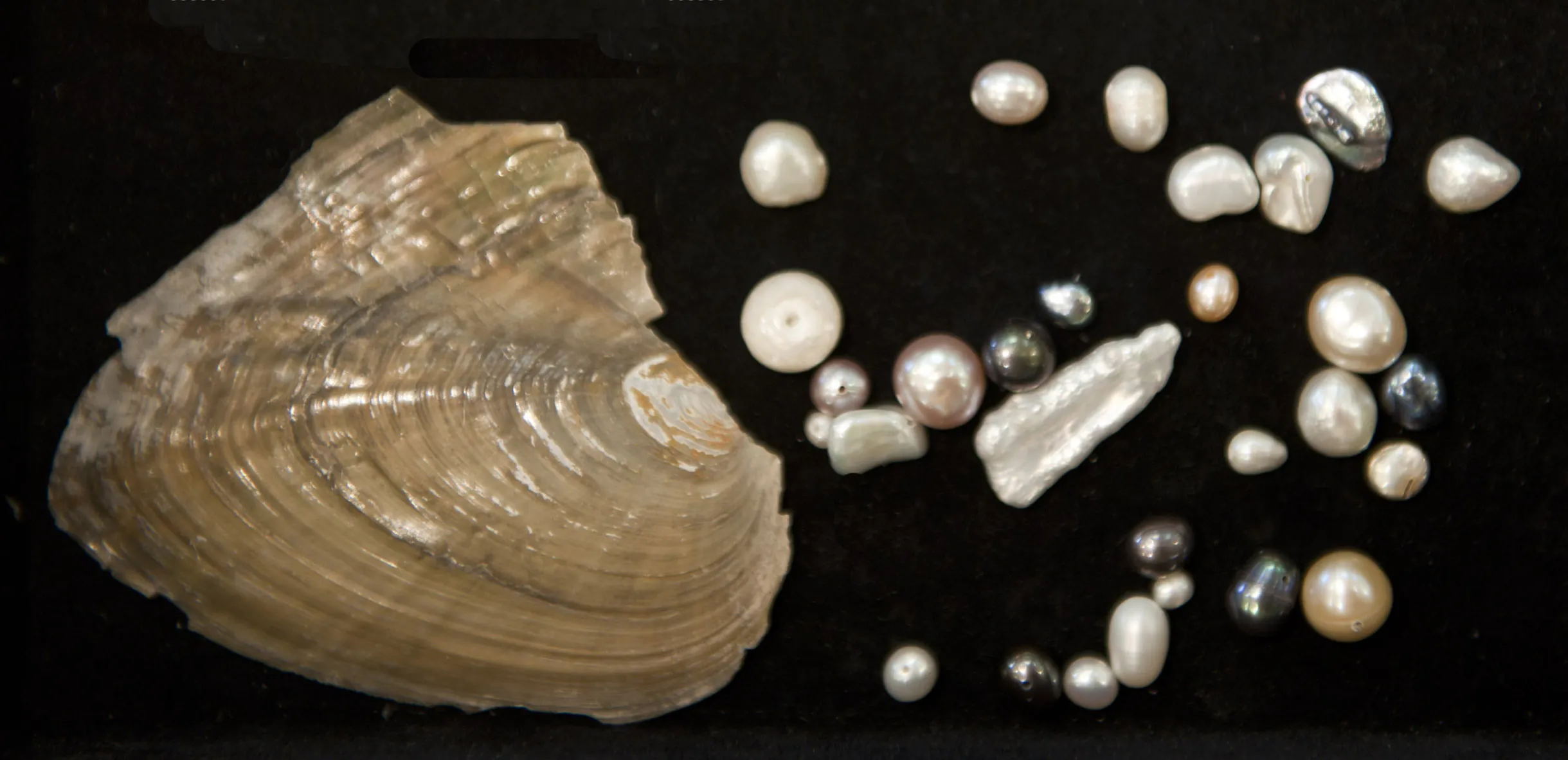
Pearls form inside certain mollusks when pearl-forming cells create a small sac and begin depositing mineral and organic material in layers. In familiar nacreous pearls, those layers are nacre—the same type of material that lines the inside of many pearl-producing shells.
The basic idea is simple, but the familiar “a grain of sand gets into an oyster” story leaves out the most important part: the pearl is made by living mantle-derived cells. Natural pearls begin without human intervention, while cultured pearls begin after a pearl farmer deliberately introduces mantle tissue, often with a bead nucleus. After that, the mollusk does the biological work of building the pearl.
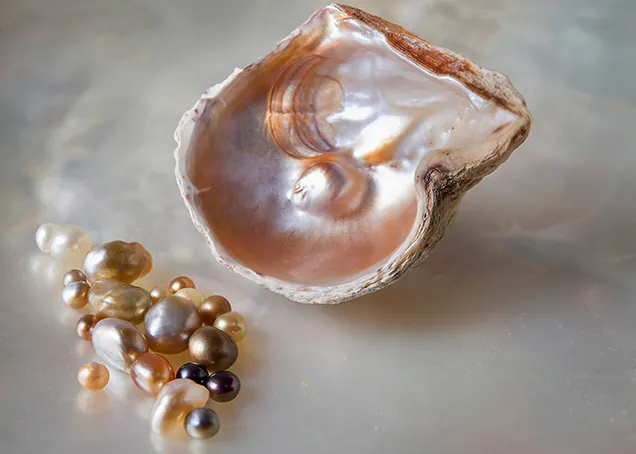
The Short Answer: How Does a Pearl Form?
For a typical nacreous pearl, the process can be reduced to four biological steps:
- Pearl-forming epithelial cells become established inside the mollusk. In a natural pearl this can follow injury or another natural event. In cultured pearl production, farmers deliberately introduce mantle tissue.
- Those cells form a pearl sac. The sac surrounds the developing pearl and acts as the pearl-producing tissue.
- The pearl sac secretes mineral and organic material. In nacreous pearls, this material builds into nacre, largely made of calcium carbonate crystals organized with an organic matrix.
- Layer after layer accumulates. Over time, the growing structure becomes a pearl.
This layered biological mineralization is closely related to the way a mollusk builds the inner surface of its shell. If you want to go deeper into what pearls are physically made of, see our guide to the physical and chemical properties of pearls.
The Important Part Is the Pearl Sac, Not Just the “Irritant”
Many simplified explanations say that an irritant enters an oyster and the animal coats it until a pearl appears. That description is useful as a first approximation, but it can give the wrong impression that any trapped object automatically becomes a pearl.
The more important event is the presence of pearl-forming epithelial cells. These cells originate from the mantle—the tissue that normally helps produce the shell. When they become enclosed within the animal’s soft tissue, they can develop into a pearl sac. That sac then secretes the material that builds the pearl.
In other words, the center of a natural pearl does not always need to contain a neat, visible grain or parasite. Natural pearl formation can begin after tissue injury or intrusion, and the exact original trigger may no longer be obvious when the finished pearl is examined.
Are Pearls Really Formed from Grains of Sand?
Usually, that is an oversimplification. Sand is the classic story because it is easy to picture, but natural pearl formation is more complicated. Parasites, tiny bits of organic material, tissue damage, or other disturbances may be involved. The critical step is that mantle-derived epithelial cells become positioned where they can form a pearl sac and begin secreting pearl material.
This also explains why simply putting a grain of sand into an oyster would not reliably produce a gem-quality pearl. Modern pearl culture depends on carefully handled mantle tissue because those living cells are essential to the process.
How Do Natural Pearls Form?
A natural pearl forms without deliberate human intervention. A biological event inside a suitable mollusk leads to the formation of a pearl sac, and that sac deposits successive layers around a small central area.
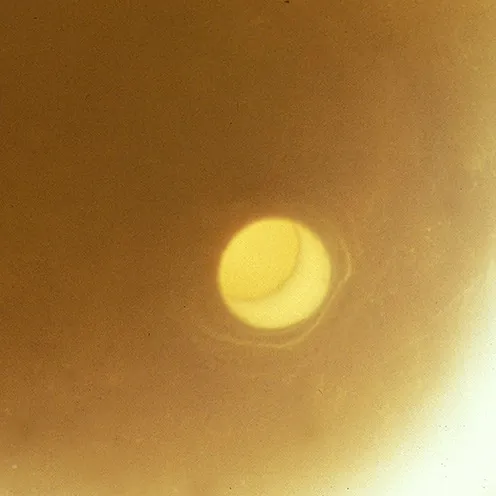
In many natural nacreous pearls, X-radiography can reveal internal growth structures that look like concentric arcs or “onion-ring” patterns. These structures reflect growth from the center outward, but natural pearls are not all internally identical. Their formation can be irregular and the original cause is not always recoverable from the finished gem.
Natural pearls are rare because the right sequence of events has to occur spontaneously. That is very different from pearl farming, where people deliberately create the conditions for pearl formation in large numbers of mollusks.
How Do Cultured Pearls Form?
A cultured pearl is also formed by a living mollusk. The difference is that humans intentionally start the process.
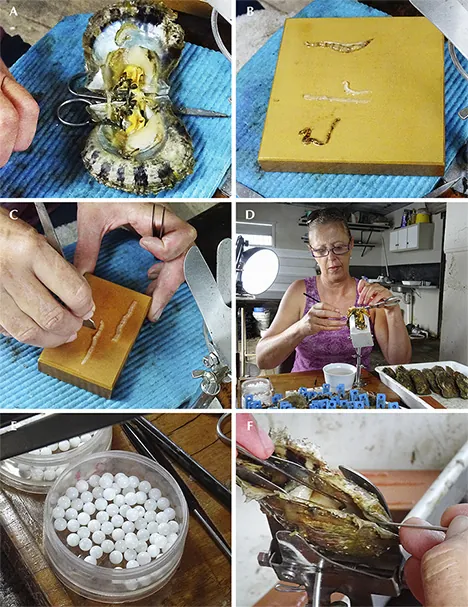
In pearl farming, a technician introduces mantle tissue from a donor mollusk into a host. Depending on the pearl type, the operation may also include a round shell bead that acts as a nucleus. The transplanted mantle cells proliferate, form a pearl sac, and begin depositing nacre or other pearl material around the center.
So cultured pearls are not “fake pearls.” The farmer initiates the process, but the pearl itself grows biologically inside the mollusk. For a fuller look at the farming process, see how pearl cultivation works.
Bead-nucleated cultured pearls
Most familiar saltwater cultured pearls—such as Akoya, Tahitian, and South Sea pearls—are commonly produced with a shell bead plus a small piece of mantle tissue. The tissue forms a pearl sac around the bead, and nacre is deposited onto the bead’s surface.
The bead helps establish the central shape, but it does not guarantee a perfectly round pearl. The position of the nucleus, the behavior of the pearl sac, the mollusk’s health, and the consistency of deposition can all affect the result.
Tissue-nucleated cultured pearls
Many freshwater cultured pearls are produced by inserting pieces of mantle tissue without a round bead. The grafted tissue forms pearl sacs, and pearl material develops around the tissue-associated center. These pearls can be composed mostly or almost entirely of nacre rather than having a large shell bead inside.
Freshwater production techniques are diverse, and bead-nucleated freshwater pearls are also widely produced today. If you want to understand the traditional non-bead process in more detail, read our guide to freshwater non-nucleated pearls.
What Is Nacre, and Why Does It Create Pearl Luster?
Nacre, often called mother-of-pearl, is a highly organized composite material. It contains calcium carbonate crystals—commonly aragonite in nacreous pearls—arranged with a small proportion of organic material.
Its beauty does not come from a single glossy coating. Light interacts with many extremely fine layers and structures near the surface. Their organization, smoothness, thickness, and continuity help produce the reflections and subtle color effects we recognize as pearl luster and orient.
This is one reason pearl quality cannot be explained by size alone. The way the pearl sac deposits material matters throughout the growth period.
Do All Pearls Have Nacre?
No. The best-known cultured jewelry pearls—Akoya, Tahitian, South Sea, and most freshwater pearls—are nacreous. But some gem pearls produced by other mollusks, such as conch and Melo pearls, do not have the same layered nacre structure.
That distinction is useful because “pearl” describes a broader biological gem category, not one single internal structure. Our pearl classification guide explains the major families and terminology in more detail.
How Long Does It Take a Pearl to Form?
There is no single growth time for every pearl. Cultivation periods vary with the mollusk species, pearl type, farming method, water conditions, target size, and the producer’s quality goals. Depending on the pearl and production system, growth can take many months or several years.
A longer period gives the mollusk more time to deposit material, but more time does not automatically guarantee a better pearl. Surface quality, luster, shape, health of the mollusk, and environmental conditions all matter. For a more detailed explanation, see pearl cultivation time and maturity.
Why Are Some Pearls Round While Others Are Baroque?
Pearl shape develops from the interaction between the pearl’s center, the pearl sac, and the way material is deposited over time.
In a bead-nucleated pearl, a round nucleus gives the pearl a strong starting template, which is one reason saltwater cultured pearls are often more consistently round. But if the pearl sac forms unevenly, the nucleus shifts, or deposition becomes irregular, the finished pearl may be near-round, oval, drop-shaped, circled, or baroque.
In non-bead cultured pearls, there is no large round bead forcing the center into a sphere, so shape can be less predictable. That variation is not automatically a defect; baroque pearls are valued for their individual forms.
Natural, Cultured, and Imitation Pearls Are Not the Same Thing
The easiest way to remember the difference is to ask who—or what—made the pearl?
- Natural pearl: formed inside a mollusk without deliberate human initiation.
- Cultured pearl: formed inside a mollusk after people intentionally start the pearl-forming process.
- Imitation pearl: manufactured to look like a pearl but does not grow inside a mollusk.
Both natural and cultured pearls are genuine biological pearls. “Natural” is not a synonym for “real”; it is a specific origin category. Cultured pearls should therefore be described as cultured rather than marketed as natural pearls.
What Actually Controls the Final Pearl?
Pearl farmers can influence the starting conditions, but they cannot completely dictate the finished result. Several factors interact during growth:
- the species and genetics of the mollusk;
- the donor mantle tissue;
- the size and placement of a bead nucleus, if one is used;
- how successfully the pearl sac forms;
- water temperature, food availability, and other environmental conditions;
- the length and stability of the cultivation period;
- the pattern and quality of mineral deposition.
That is why two pearls grown on the same farm—or even in the same production cycle—can differ in luster, shape, color, surface, and size.
The Main Idea to Remember
A pearl is not simply a foreign object coated by an oyster. It is the result of a living biomineralization process. Mantle-derived epithelial cells form a pearl sac, and that sac deposits the material that gradually becomes a pearl.
Natural and cultured pearls use the same basic biological ability. The crucial difference is how the process starts: spontaneously in a natural pearl, or with deliberate human intervention in a cultured pearl.
Frequently Asked Questions
Do pearls really start from a grain of sand?
Not usually in the simple way the popular story suggests. Natural pearl formation can be associated with parasites, tissue injury, organic debris, or other disturbances. The key biological event is the formation of a pearl sac by mantle-derived epithelial cells.
Are cultured pearls real pearls?
Yes. Cultured pearls are real pearls grown by mollusks. Human intervention starts the process, but the mollusk forms the pearl. Imitation pearls are the manufactured substitutes.
Do only oysters make pearls?
No. Saltwater pearl oysters are famous pearl producers, but freshwater mussels and several other mollusks can also produce pearls. Different mollusk species produce different pearl structures, colors, and appearances.
Can you tell how a pearl formed just by looking at the outside?
Not reliably. Natural and cultured pearls can look very similar externally. Gemological laboratories use methods such as X-radiography to examine internal growth structures when origin determination is needed.
How long does it take to grow a cultured pearl?
It depends on the species and production method. Cultivation may last from many months to several years. More time can allow additional material to be deposited, but cultivation time alone does not determine quality.