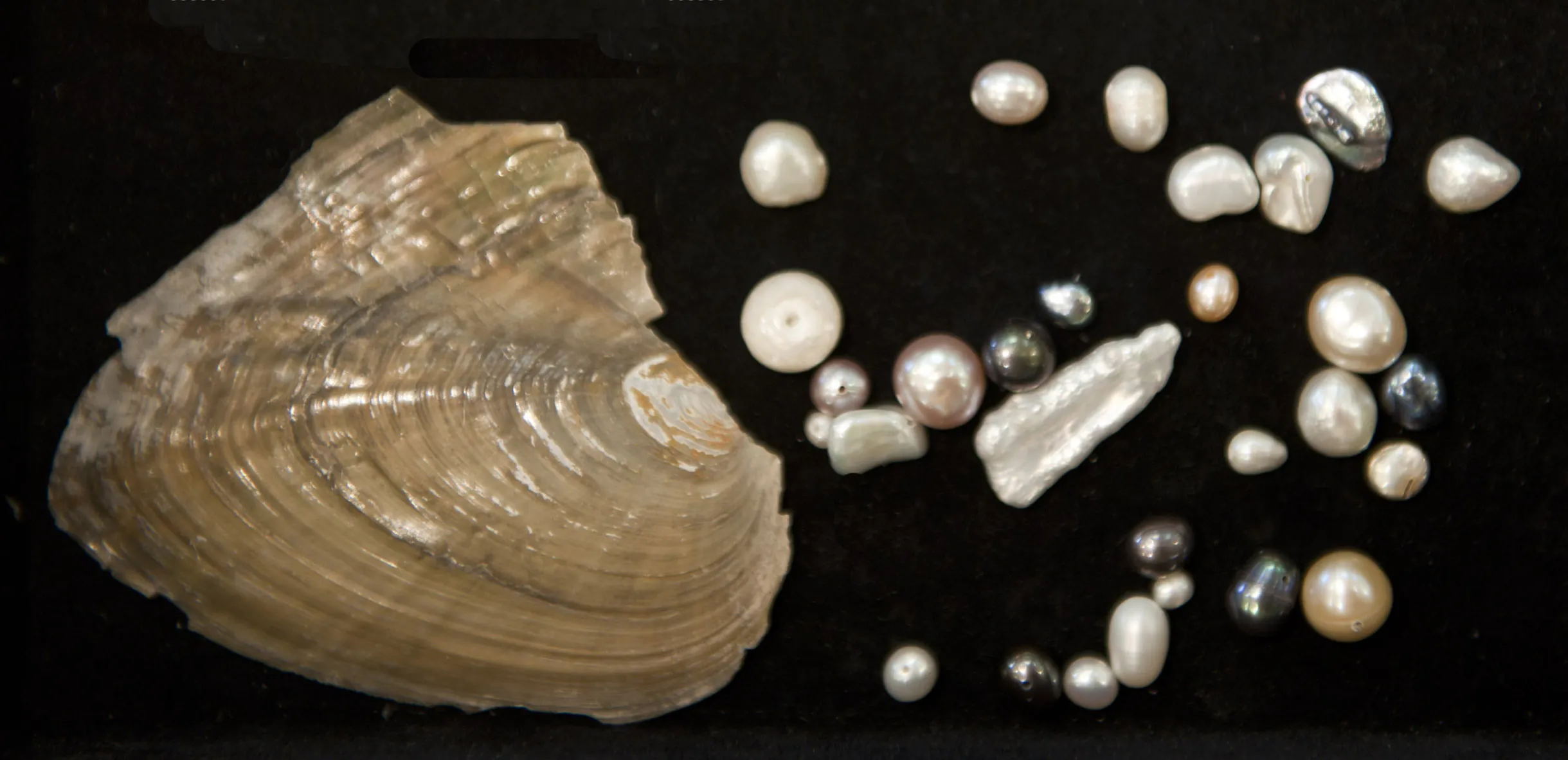
Akoya pearls have a very recognizable profile: they are saltwater cultured pearls known for bright, mirror-like luster, round to near-round shapes, relatively small sizes, and a refined white-to-cream color range. High-quality examples often show delicate rosé, pink, silver, or green overtones.
Those traits describe the Akoya family, but they do not mean every Akoya pearl is automatically high grade. An Akoya can be dull, blemished, off-round, poorly matched, or thin in nacre. The useful distinction is between what makes a pearl characteristically Akoya and what makes an individual Akoya pearl good.
| Characteristic | Typical Akoya Profile | Important Caveat |
|---|---|---|
| Luster | Bright, crisp, mirror-like reflections | Luster still varies greatly by quality |
| Shape | Often round or near-round | Baroque and less-round Akoya pearls also exist |
| Size | Most commonly around 6–9 mm | Smaller sizes exist, and exceptional pearls can exceed 10 mm |
| Color | White to cream, often with pink, rosé, silver, or green overtones | Blue-gray and other less common colors also occur; processing can affect appearance |
| Nacre | Nacre deposited around a bead nucleus | Thickness, continuity, and condition affect appearance and durability |
| Overall look | Refined, symmetrical, classic, highly matched | This look is strongest in better-quality strands and pairs |
What Makes a Pearl an Akoya Pearl?
Akoya pearls are bead-cultured saltwater pearls produced by the Akoya pearl oyster, commonly identified as Pinctada fucata. They are historically and commercially associated most strongly with Japan, although Akoya production also exists in countries including China and Vietnam.
This matters because “Akoya” is a pearl type, not simply another word for “Japanese pearl.” The Japan Pearl Promotion Society lists Akoya production mainly in the 2–11 mm range and notes production in Japan as well as smaller output from other countries. GIA likewise describes Akoya as a saltwater cultured pearl type rather than a country-of-origin label.
For a broader look at cultivation, origin, and trade terminology, see our full Akoya pearl guide.
1. Mirror-Like Luster Is the Most Recognizable Akoya Trait
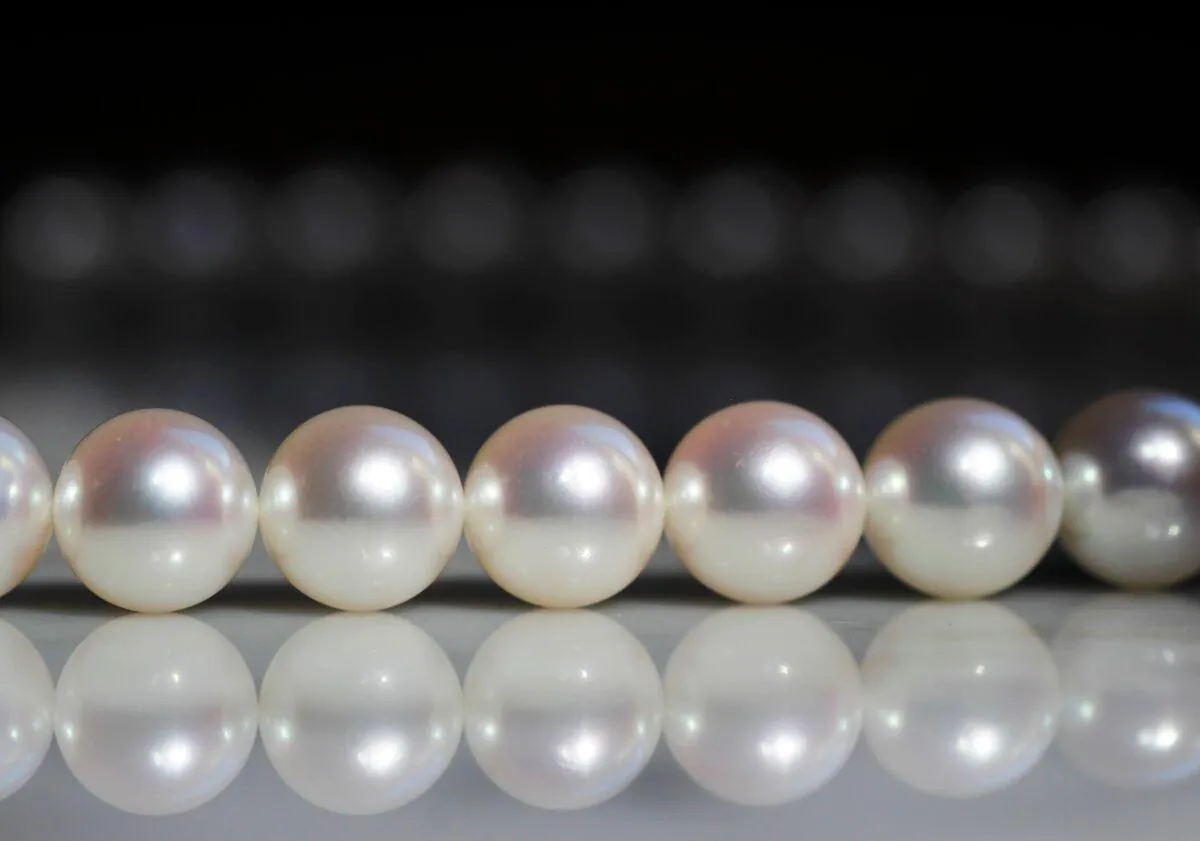
The feature people notice first is usually luster. Fine Akoya pearls can reflect light with unusually sharp edges, giving the surface a crisp, almost mirror-like appearance. This is different from simply being shiny: the key is the intensity and definition of the reflection.
GIA describes Akoya pearls as especially known for sharp, mirror-like luster. In practical sorting, this is one of the fastest ways to separate a lively pearl from one that looks flat or chalky. Look at a bright window, lamp, or dark object reflected on the pearl. The clearer the reflected shape appears, the stronger the luster usually is.
Still, “Akoya” does not guarantee excellent luster. Lower-quality Akoya pearls can show soft, blurred reflections. If you want to compare this factor more carefully, our pearl luster guide explains what to look for under normal lighting.
2. Akoya Pearls Are Strongly Associated with Roundness
Akoya culture uses a round bead nucleus, so round and near-round pearls are a major part of the market. This makes Akoya especially well suited to classic necklaces and matched stud earrings, where small differences in shape become easy to notice.
But the phrase “Akoya pearls are round” should be treated as a tendency, not a rule. Akoya oysters can also produce semi-baroque and baroque pearls. Even within a strand sold as round, tiny variations become visible when the pearls are rolled on a flat surface or viewed in a straight line.
Roundness is also a quality factor. Two genuine Akoya pearls can belong to the same pearl type while differing greatly in symmetry and therefore in value.
3. Akoya Has a Refined, Smaller Size Profile
Akoya pearls are generally smaller than Tahitian and South Sea pearls. GIA commonly places the most familiar Akoya sizes around 6–9 mm, while the Japan Pearl Promotion Society gives a broader production range of roughly 2–11 mm. These figures are not contradictory: one describes the typical jewelry-market profile, while the other captures a wider production range.
Pearls above 9 mm become less common, and Akoya pearls over 10 mm are unusual, although exceptionally large examples do exist. Size therefore helps create the visual identity of Akoya: it tends to look precise and refined rather than oversized or dramatic.
Size alone is not a quality grade. A smaller pearl with excellent luster and strong nacre can be more attractive than a larger pearl with dull reflections. For proportions and jewelry use, see our pearl size guide.
4. White and Cream Are Classic, but Overtone Creates the Personality
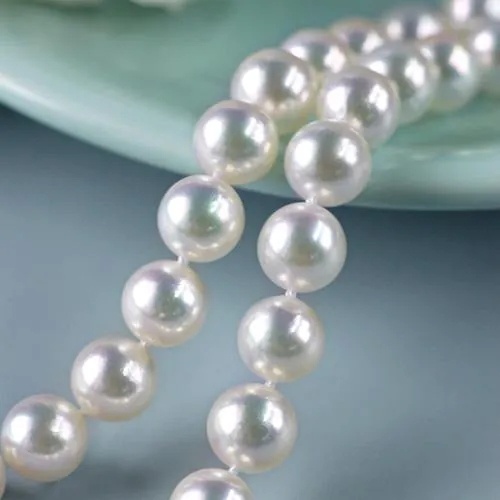
The classic Akoya image is white or cream. What often makes a strand look warmer, cooler, or more vivid is the overtone: a translucent secondary color seen over the bodycolor. Rosé or pink overtones are especially familiar, while silver and green overtones can produce a cooler look.
Not every Akoya pearl fits the classic white-and-pink picture. Blue-gray Akoya pearls exist, and the Japanese industry recognizes a broader range of colors than many retail summaries suggest. This is one reason color should not be used by itself to identify pearl type.
There is another important nuance: post-harvest processing is common in the Akoya trade. Some commercial white or rosé appearances may be influenced by accepted processing practices. A pink overtone therefore should not automatically be interpreted as proof of completely untreated natural color.
5. Nacre Quality Matters More Than the Bead Inside
Akoya pearls are bead-cultured. A round nucleus is inserted into the oyster, and the oyster deposits nacre around it. Because much of the pearl's internal volume comes from the nucleus, buyers sometimes focus only on how thick the nacre is. Thickness matters, but it is not the whole story.
GIA evaluates nacre quality by considering factors such as thickness, continuity, and condition. In practical terms, good nacre supports stronger visual depth and durability, while very thin or poor nacre can create a dull, chalky appearance or make the underlying bead easier to detect.
This is why a pearl that is perfectly round and clean can still be disappointing if its nacre and luster are weak. In Akoya pearls, the surface appearance is the result of several factors working together rather than one specification in isolation.
6. A Clean Surface Is Desirable, but Small Growth Marks Are Normal
Pearls are organic gems formed inside living mollusks, so small pits, bumps, wrinkles, or other growth features are normal. A completely clean surface is relatively uncommon.
For Akoya pearls, surface quality should be judged together with luster. Strong luster can visually soften the effect of minor blemishes, while a very clean pearl with weak luster may still look lifeless. The location of a mark also matters: a small feature near a drill hole can be much less noticeable than the same mark on the front of a stud earring.
7. Matching Is Part of the Classic Akoya Look
A single Akoya pearl can be beautiful on its own, but many of the most recognizable Akoya pieces are pairs and strands. In those pieces, matching becomes a major part of the visual quality.
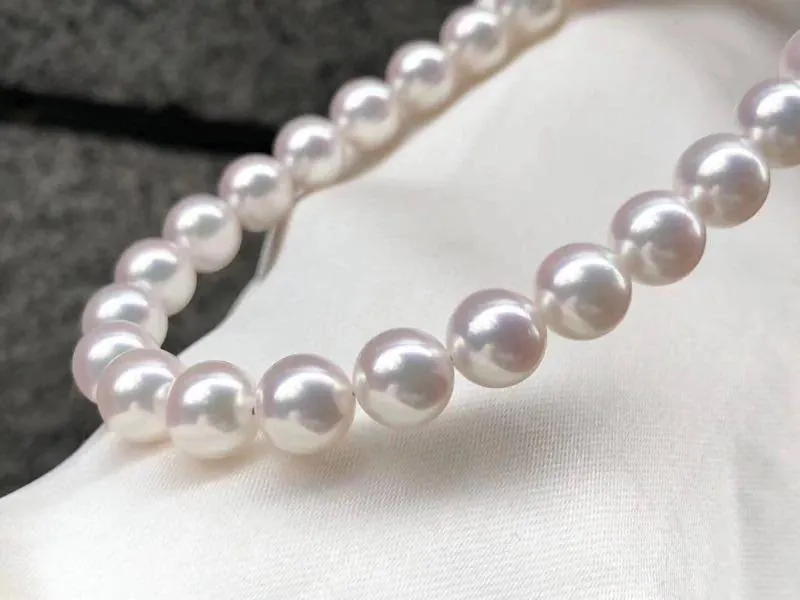
Good matching means the pearls look deliberately consistent in size, shape, color, overtone, luster, and surface quality. A strand can contain individually good pearls yet still look uneven if some are warmer, duller, or less round than their neighbors.
This is one reason the classic Akoya necklace looks so orderly: its identity comes not only from the pearl type but from the labor required to assemble many pearls with a coherent appearance.
Akoya Characteristics and Akoya Quality Are Not the Same Thing
This is the most useful idea to remember. A pearl can be genuinely Akoya and still be low quality. Conversely, a modern freshwater cultured pearl can be round, white, and highly lustrous without becoming an Akoya pearl.
| Question | What It Tells You |
|---|---|
| Is it a saltwater Akoya pearl? | Pearl type / identity |
| Is the luster sharp? | Quality |
| Is it round or near-round? | Typical Akoya appearance plus a shape-quality factor |
| Is the surface clean? | Quality |
| Is the nacre strong and well formed? | Quality and durability |
| Is it Japanese? | Origin, not proof of top grade |
| Is it Hanadama? | A high-quality designation under specific reporting/certification criteria, not a separate pearl species |
Four Common Misunderstandings About Akoya Pearls
“All Akoya pearls are Japanese.” Japan is the most famous source and remains central to the Akoya trade, but Akoya pearls are also cultured elsewhere, including China and Vietnam.
“All Akoya pearls are perfectly round.” Roundness is characteristic, not guaranteed. Near-round and baroque Akoya pearls also exist.
“Hanadama is a different type of pearl.” It is not. Hanadama is used for qualifying high-quality Akoya pearls under defined grading or reporting criteria.
“A pearl that looks like Akoya must be Akoya.” Not necessarily. Modern bead-nucleated freshwater pearls can also be small, white, round, and highly lustrous. GIA has specifically warned that terms such as “freshwater Akoya” can be misleading because freshwater pearls are not genuine Akoya pearls.
A Practical Way to Read an Akoya Listing
When you see the word “Akoya,” do not stop at the name. Read the listing in this order:
- Confirm pearl type and stated origin. Akoya tells you the pearl family; “Japanese Akoya” adds an origin claim.
- Check luster first. Look for crisp, bright reflections rather than general shine.
- Check shape and matching. Especially important for strands and pairs.
- Read the size in millimeters. Do not assume a larger pearl is automatically better.
- Separate bodycolor from overtone. White, cream, rosé, silver, green, and blue-gray descriptions can refer to different visual components.
- Check surface and nacre information. A high-grade claim should make sense when all the visible quality factors are considered together.
If you are comparing seller grades such as AA, AAA, or other proprietary labels, remember that these systems are not universally standardized. Compare the actual characteristics, photos, and specifications rather than relying on the letters alone.
Who Usually Likes the Akoya Look?
Akoya pearls are a strong fit for buyers who want a bright, orderly, classic pearl appearance rather than the larger scale of South Sea pearls, the dark natural colors of Tahitian pearls, or the broader variety of freshwater pearls.
For finished pieces, you can browse Akoya pearl jewelry. Jewelers and designers looking for strands or loose material can instead explore wholesale Akoya pearls.
Frequently Asked Questions
What are the main characteristics of Akoya pearls?
Akoya pearls are saltwater cultured pearls typically associated with sharp mirror-like luster, round to near-round shapes, relatively small sizes, and white-to-cream bodycolors with subtle overtones. Better-quality pearls also show strong nacre, cleaner surfaces, and good matching.
What size are Akoya pearls usually?
The most familiar jewelry sizes are around 6–9 mm. Smaller pearls are also produced, while pearls above 9 mm become less common and examples above 10 mm are unusual.
Are Akoya pearls always white?
No. White and cream are the classic market colors, often with rosé, pink, silver, or green overtones, but blue-gray and other less common colors also occur. Processing can also influence the finished appearance of some Akoya pearls.
Are all Akoya pearls perfectly round?
No. Round and near-round shapes are characteristic of Akoya production, but semi-baroque and baroque Akoya pearls also exist.
Are all Akoya pearls from Japan?
No. Japan is the country most closely associated with Akoya pearls, but Akoya cultivation also takes place in other countries, including China and Vietnam.
Is Hanadama a separate type of Akoya pearl?
No. Hanadama is a quality designation used for Akoya pearls that meet specific grading or reporting requirements. It does not refer to a different oyster species or a separate pearl family.
What to Remember
The Akoya identity is best understood as a combination of traits: saltwater bead culture, a refined size range, strong roundness, light bodycolors, and especially crisp luster. But these traits describe a pearl type, not a guaranteed grade.
When judging an individual Akoya pearl, look beyond the name. Luster, nacre, surface, shape, color, and matching determine whether that particular pearl lives up to the classic Akoya ideal.