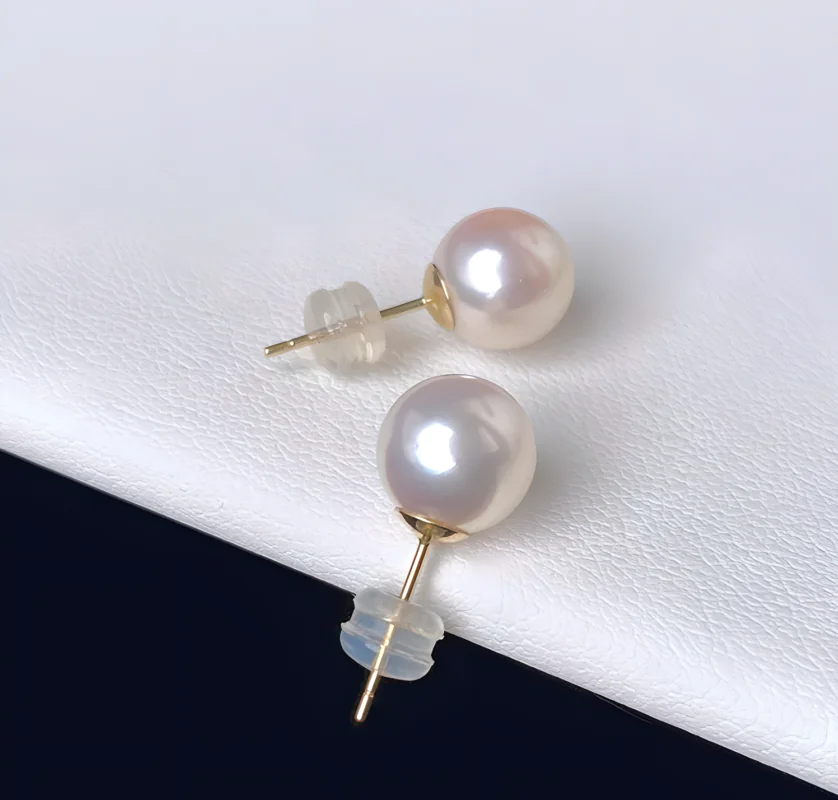
Fake pearls—more accurately called imitation or simulated pearls—do not have one universal appearance. Some are lightweight plastic beads, while others use glass, shell, crystal, fiber, resin, or multilayer coatings. Because their construction varies, no single characteristic identifies every imitation.
The most useful characteristics are signs that the object was manufactured as a coated or molded bead rather than grown as a pearl inside a mollusk. These can include a visible surface film, chipped or peeling coating, a different material exposed beneath the surface, repeated molded texture, or drill holes that reveal a separate core.
Other familiar signs—such as perfect roundness, very uniform color, smoothness, light weight, or a flat shine—can raise suspicion, but they are weaker clues when used alone. Fine cultured pearls can be round and closely matched, while high-quality imitations can be heavy, cool, irregular, and visually convincing.
Quick Answer: Which Fake-Pearl Characteristics Matter Most?
| Characteristic | What it can suggest | How useful is it? |
|---|---|---|
| Peeling, chipping, or exposed core material | A separate coating over a manufactured bead | Strong warning sign |
| Visible coating boundary at a drill hole | Layered artificial construction rather than continuous pearl material | Strong warning sign |
| Repeated molded texture or identical surface features | Mechanical reproduction across multiple beads | Moderate to strong clue |
| Glittery, paint-like, oily, or rubbery surface | An artificial finish rather than typical nacre structure | Moderate clue |
| Extreme uniformity in shape and color | Possible mass-manufactured matching | Supporting clue only |
| Very smooth feel | Possible glass, plastic, or coated surface | Supporting clue only |
| Very light weight | Possible plastic or fiber core | Useful only for some imitations |
| Warm or room-temperature feel | Sometimes associated with plastic | Weak clue |
1. The Strongest Characteristic Is Evidence of a Manufactured Coating
The clearest everyday sign of an imitation pearl is not simply that it looks “too perfect.” It is that the surface behaves like a coating applied over a different material.
Look closely at worn areas, scratches, chips, and especially the edges of drill holes. An imitation may show a thin pearlescent layer lifting away from a glass, plastic, shell, crystal, or composite core. You may see a sharp boundary between the outer finish and the material underneath, or small flakes that look more like paint or lacquer than pearl nacre.
GIA has documented shell-based imitation pearls in which a thin glittery coating chipped near drill holes and exposed white shell bead material underneath. It has also documented glass-based imitations with visibly different surface coatings and ragged coating edges around drill holes.
This kind of evidence is much stronger than a general impression such as “the pearl feels light” because it reveals how the object is constructed.
2. Fake Pearls May Have a Surface That Looks Too Flat, Glittery, or Artificial
Many imitation pearls get their pearl-like appearance from an artificial surface layer. Under normal room light, that finish may look convincing. Under stronger light or magnification, however, the optical character can be different from nacre.
Typical warning signs include a shine that looks as though it sits only on the surface, obvious glitter-like particles, a hazy or rubbery finish, small dimples or pits, or an oily-looking iridescence. GIA studies of imitation pearls have documented several of these textures, including glittery coatings, pitted surfaces, and finishes that differ from the overlapping microscopic structure found in nacreous pearls.
Do not reduce this to “real pearls glow and fake pearls shine.” High-quality imitation coatings can produce attractive iridescence, and lower-quality genuine pearls can have weak luster. Luster is most useful when combined with construction and surface evidence.
3. Repeated Surface Features Can Be More Suspicious Than Simple Perfection
A strand of imitation pearls may be manufactured to extremely tight tolerances, so the beads can look almost identical in diameter, color, roundness, and surface finish. That can be a clue—but it is not proof.
Fine cultured pearl strands are also carefully matched. A high-quality Akoya strand, for example, may contain pearls that are very round and closely matched in color and size. The more useful question is whether the strand shows mechanical repetition: identical dimples, repeated molded marks, the same coating behavior, or nearly identical surface texture from bead to bead.
Biological pearls can be highly matched without being literally duplicated. Repeated manufactured features are therefore more suspicious than simple visual consistency.
For a broader visual-identification framework, see what appearance alone can and cannot tell you about pearl authenticity.
4. Drill Holes Often Reveal What the Front Surface Hides
Drill holes are one of the most useful places to inspect because drilling cuts through the outer surface. On some imitation pearls, this exposes the construction clearly.
Possible warning signs include chipped coating, peeling film, pooled finish around the opening, ragged coating edges, a noticeably different core, or a hole that looks molded rather than cleanly drilled. A very large or unusually shaped opening can also deserve closer attention.
But a clean drill hole does not prove that a pearl is genuine. Sophisticated imitations can be well finished, and genuine cultured pearls can have damaged, chipped, filled, or otherwise altered drill holes. The important point is to look for a mismatch between the outer pearl-like surface and the material beneath it.
5. Weight Can Help—but Only If You Know What the Imitation Is Made From
The claim that “fake pearls are always light” is incorrect.
Plastic and cotton-fiber imitations can be much lighter than genuine cultured pearls of similar size, so unusually low weight can be a useful clue in those cases. Glass, crystal, and shell-based imitations can feel substantial and may even seem more convincing because of their heft.
This is why weight should be interpreted as a material clue, not an authenticity verdict. A light bead may suggest plastic or fiber construction; a heavy bead does not automatically prove that it is a pearl.
If you want to understand why imitation pearls can behave so differently, see our guide to the main types of fake pearls and their base materials.
6. Temperature Is Even Less Reliable Than Weight
Real pearls often feel cool when first touched and then warm gradually against the skin. That observation is sometimes useful, but it is easy to overstate.
Glass and shell-based imitations can also feel cool. Plastic often feels warmer more quickly, but room temperature, bead size, jewelry setting, handling, and the core material all change the result.
Temperature is therefore a weak supporting characteristic. It should never override stronger evidence such as coating failure, exposed core material, or repeated manufactured texture.
7. Many Fake Pearls Feel Smooth—but the Tooth Test Is Not Proof
Many common plastic and glass imitations have smoother surfaces than nacreous cultured pearls. This is the basis of the traditional tooth-rub test: many nacreous pearls feel faintly gritty against the edge of a tooth, while many imitations feel smoother.
However, GIA has noted that imitation surfaces can be engineered, and a gritty texture does not exclude every imitation. Surface wear, polishing, coatings, and the type of pearl also affect what you feel.
There is also a practical problem: repeated rubbing can abrade a pearl surface. Treat texture as one clue, not as a pass/fail test. Our dedicated guide explains how reliable the pearl tooth test actually is.
8. Wear Can Expose Fake-Pearl Construction Over Time
Because many imitation pearls depend on a surface coating, wear can eventually make their construction easier to see. Friction at drill holes, clasp contact points, bead-to-bead contact areas, or exposed edges may cause the finish to chip, peel, scratch, or thin.
The important clue is not simply that the surface is damaged. Genuine pearls can also scratch, abrade, crack, or lose surface quality. What matters is what the damage reveals. If a pearlescent outer skin gives way to obviously different material underneath, that is much more characteristic of a coated imitation.
Which Characteristics Are Strong Evidence, and Which Are Just Clues?
A practical way to evaluate a suspected imitation is to separate construction evidence from general appearance clues.
| Evidence level | Examples | How to interpret it |
|---|---|---|
| Stronger | Peeling film, chipped coating, exposed different core, visible coating boundary, repeated molded structure | Direct evidence that the object may be manufactured as a bead-and-coating system |
| Moderate | Glittery or rubbery finish, unusual pitting, mechanically repeated surface texture, suspicious drill-hole behavior | Raises suspicion and deserves comparison with other clues |
| Weak alone | Perfect roundness, uniform color, smooth feel, light weight, cool or warm touch, simple tooth-test result | Can occur in either real pearls or certain imitations; never use as proof by itself |
Characteristics That Do Not Automatically Mean a Pearl Is Fake
Several popular “rules” cause genuine pearls to be misidentified.
Perfect roundness is not proof of imitation. Cultured pearls can be very round. Excellent matching is not proof either. Fine strands are deliberately assembled for consistency. A smooth-looking surface is not proof. High-quality cultured pearls can be visually clean, and some non-nacreous genuine pearls do not show the same surface structure as familiar nacreous pearls.
Likewise, a treated pearl is not automatically a fake pearl. A cultured pearl may be dyed, bleached, polished, coated, irradiated, or otherwise treated and still remain a cultured pearl. Treatment disclosure and pearl authenticity are related but separate identification questions.
This is why the best consumer approach is to ask: Do I see evidence that this object is a manufactured imitation, or am I relying on a stereotype about how real pearls are supposed to look?
How to Inspect a Suspected Fake Pearl Without Damaging It
Start with bright, neutral light and a clean surface. Compare several pearls rather than judging only one bead. A 10× loupe is especially useful around drill holes, worn edges, scratches, and areas where the finish changes.
Look first for direct construction evidence: coating edges, exposed core material, peeling, repeated molded features, bubbles, glittery particles, or a clear difference between the outer finish and the interior. Then use weight, temperature, smoothness, color uniformity, and matching only as supporting observations.
Avoid aggressive rubbing, scraping, cutting, burning, solvents, or other destructive “home tests.” If the jewelry is valuable, antique, represented as natural pearl, or financially important, professional gemological testing is more appropriate than trying to force a conclusion from surface clues.
For a complete identification sequence, see our real vs. fake pearl identification guide.
Why No Single Fake-Pearl Characteristic Works Every Time
The category “fake pearl” includes many different manufactured products. A plastic imitation, a solid-glass imitation, a shell-based imitation, a crystal-core imitation, and a cotton-fiber imitation do not have the same weight, temperature behavior, surface texture, or durability.
GIA has even documented very small imitation beads mixed among genuine pearls in strands, showing why visual similarity can sometimes be convincing enough that laboratory methods are needed.
The safest principle is therefore simple: judge patterns of evidence, and give more weight to visible construction than to one sensory trick.
Frequently Asked Questions
Do fake pearls always look perfectly round?
No. Many manufactured pearls are very round because that shape is easy to reproduce, but imitations can also be intentionally irregular. Genuine cultured pearls can also be extremely round, so shape alone does not establish authenticity.
Are fake pearls always lightweight?
No. Plastic and fiber imitations can be very light, but glass, crystal, and shell-based imitations can feel substantial. Weight is useful only when interpreted together with the likely construction material.
Do fake pearls always feel smooth?
No. Many common imitations feel smoother than nacreous pearls, but surface finishes vary and can be engineered. Smoothness is a clue, not proof.
What is the strongest visible sign of a fake pearl?
One of the strongest visible warning signs is a pearlescent coating that chips or peels and exposes a clearly different core material underneath. A visible coating boundary at a drill hole can be similarly useful.
Can fake pearls be made from real shell?
Yes. A bead can be cut or formed from genuine shell and then coated or finished to imitate a pearl. Using real shell material does not make the manufactured bead a natural or cultured pearl.
Can a high-quality fake pearl be difficult to identify?
Yes. Sophisticated imitations can imitate weight, iridescence, color, and surface appearance surprisingly well. When identity materially affects price or provenance, professional testing is more reliable than appearance alone.
The Bottom Line
The most important characteristics of fake pearls are signs of manufactured construction, not simply signs of visual perfection. Peeling or chipped coatings, exposed core material, coating boundaries around drill holes, repeated molded features, and artificial-looking surface textures are more informative than roundness, weight, temperature, or smoothness alone.
Think in terms of evidence strength. A lightweight, perfectly round, smooth bead may be suspicious, but it is not proven fake. A bead whose pearlescent skin is visibly separating from a different core tells you much more.
When the answer matters financially, use these characteristics to decide whether closer examination is needed—not as a substitute for gemological identification.
Sources
- Gemological Institute of America (GIA): Imitation Seed Pearl with Blue X-Ray Fluorescence
- Gemological Institute of America (GIA): Shell Pearl as a Pearl Imitation
- Gems & Gemology: Majorica Imitation Pearls
- Gems & Gemology: “Cotton Pearl” Imitations
- CIBJO Pearl Commission: The Pearl Book (2024)
- Federal Trade Commission: In the Loupe—Advertising Diamonds, Gemstones and Pearls