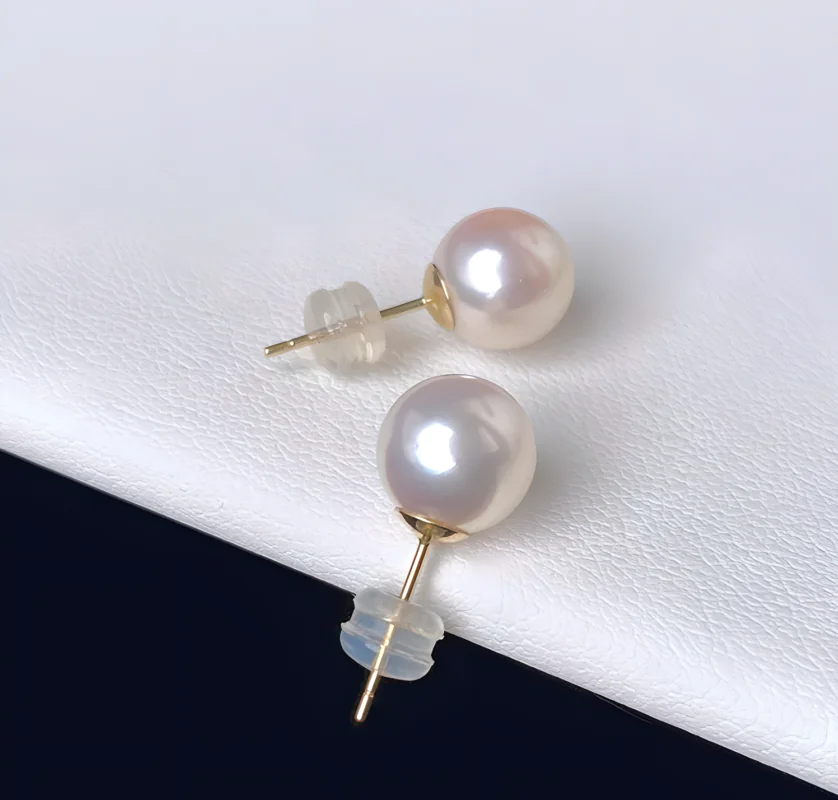
Yes. Many line-like marks on pearls are normal features of pearl growth. Fine growth lines, wrinkles, ridges, grooves, and even ring-like furrows can form as nacre develops inside the mollusk. Their presence does not automatically mean a pearl is damaged or poor quality.
But “surface line” is a loose description, not a precise diagnosis. A natural growth line is very different from a scratch, crack, or area where nacre is beginning to peel. The useful question is therefore not simply “Does this pearl have lines?” but “What kind of line is it, and what effect does it have on appearance, value, or durability?”
What does “surface line” mean on a pearl?
There is no single pearl-quality category called a “surface line.” Buyers and sellers may use the phrase for several different appearances, including:
- very fine nacre growth or suture lines;
- shallow wrinkles, creases, ridges, or grooves;
- ring-like furrows that partially or completely circle a pearl;
- scratches or abrasions caused by contact and wear; or
- deeper cracks or separations in the nacre.
Those features should not be treated as interchangeable. Some are simply part of how a pearl formed. Others lower surface quality without threatening durability. A smaller group may indicate actual damage.
For a broader overview of pits, bumps, wrinkles, cracks, and other marks, see our Pearl Surface & Blemishes Guide.
Four different kinds of line-like marks you may see
1. Fine growth or suture lines
Under magnification, nacreous pearls can show extremely fine linear or overlapping textures. Gemological literature often refers to these as suture lines. GIA laboratory notes have described such fine lines as a characteristic growth feature in the nacre of both natural and cultured pearls.
These lines may be difficult or impossible to notice at normal viewing distance. They are part of the microscopic structure and growth texture of the pearl, not automatically a defect in the ordinary consumer sense.
If you are interested in the gemological example, GIA's laboratory notes show suture lines visible under magnification and reflected light.
2. Wrinkles, creases, ridges, and shallow grooves
Some lines are visible without magnification because the surface itself is slightly uneven. A wrinkle may look like a soft crease; a ridge may stand slightly above the surrounding nacre; a groove may appear as a shallow channel.
These are common types of pearl surface characteristics. GIA notes that pearls can show irregular ridges that resemble creases or wrinkles, and that most pearls are not perfectly free of surface features. You can review the broader framework in GIA's Pearl Quality Factors.
They are therefore normal in the sense that they can occur naturally during pearl formation. However, “normal” does not mean “irrelevant to quality.” A pearl with a smooth, clean surface will generally grade better than a comparable pearl with many obvious wrinkles or grooves.
3. Rings or circles around the pearl
Some pearls develop one or more furrows that wrap around the body of the pearl. On strongly ringed pearls, these can become a defining visual feature rather than a small blemish.
GIA has described rings on Polynesian black pearls as parallel furrows encircling the pearl. Depending on the pearl and the design, these rings can be viewed as an attractive natural character feature rather than something that must be hidden.
This is one reason shape and surface cannot always be judged in isolation. A ringed or circled pearl may not compete with a perfectly smooth round pearl on surface cleanliness, but a buyer may deliberately choose it for its organic appearance.
4. Scratches, cracks, and peeling lines
These deserve a different level of attention. A scratch is an abrasion on the surface. A crack is a fracture or separation that may extend more deeply. Peeling or flaking means part of the nacre layer is lifting or missing.
A superficial scratch may mainly affect appearance. A deeper crack or peeling nacre can be more serious because severe surface characteristics may also affect durability. If a line looks sharp, broken, branching, or associated with lifted or missing nacre, do not dismiss it as a harmless “growth line.”
Our guide to pearl surface cracks and nacre peeling covers those warning signs in more detail.
Are visible growth lines considered flaws?
They can count against surface cleanliness without making the entire pearl poor quality.
Pearl surface evaluation considers the size, number, type, location, and visibility of surface characteristics. A few subtle lines on the side or back of a pearl may have little visual impact. Deep or numerous grooves across the most visible face of a pearl will matter more.
This creates an important distinction:
- Natural describes how a feature formed.
- Clean describes how free the surface appears from visible irregularities.
A wrinkle can be completely natural and still lower the surface grade. Conversely, a pearl does not need to be absolutely flawless to be beautiful or worth buying.
How can you tell a growth line from a scratch or crack?
You cannot always determine the exact origin of a line from one photo, but several practical checks can help.
Look at the shape of the line
Natural growth texture often blends into the surrounding surface as a soft ridge, wrinkle, shallow groove, or repeating pattern. A scratch may look more like a directional cut across the surface. A crack may appear sharper, darker, more irregular, or deeper.
Rotate the pearl under changing light
Do not judge the line from a single fixed angle. Rotate the pearl slowly under soft, directional light. A shallow growth feature often reveals itself as a smooth change in reflection. A scratch or crack may catch light along a sharper edge.
Check whether the nacre is continuous
Ask whether the surface around the line still looks intact. If the nacre remains continuous and lustrous, the line may simply be part of the pearl's texture. If the line is accompanied by flaking, a chip, missing material, or an exposed underlying layer, it is more concerning.
Compare macro and normal-distance views
Macro photographs can make a tiny growth line look dramatic. A mark that fills half the screen in a close-up may be nearly invisible when the pearl is worn. Use close-ups to inspect condition, but also judge the pearl from normal viewing distance.
Do not expect a consumer photo to prove everything
Lighting, reflections, image sharpening, and the curvature of the pearl can make shallow texture look deeper than it is. For an expensive pearl, request a rotating video or multiple angles. If there is a genuine concern about cracking, nacre condition, or authenticity, professional examination is more reliable than guessing from one image.
Do surface lines lower pearl value?
Sometimes, but the effect depends on the line. When other factors are equal, a cleaner surface generally supports higher value. But value is not determined by surface alone.
A useful way to judge line-like marks is to ask five questions:
- How visible is it? A microscopic line is different from a deep groove visible across the room.
- How much surface does it affect? One short wrinkle matters less than repeated heavy lines across the pearl.
- Where is it? A line near a drill hole or on the back of an earring may have little practical effect.
- Does it interrupt luster? A pearl can still look vivid if minor surface texture does not break up its reflections significantly.
- Is it merely textural or structurally concerning? A shallow ridge and a crack should not be valued the same way.
This is also why seller grade labels should not be read as universal standards. Surface is one quality factor among several, and grading language can vary between sellers. For a broader framework, see our Pearl Grading Guide.
When are surface lines an acceptable trade-off?
Minor growth lines can be a sensible compromise when the pearl otherwise has qualities you value more, such as strong luster, appealing color, a larger size, or an attractive shape.
For example:
- a high-luster pearl with one shallow low-visibility wrinkle may look better than a cleaner but duller pearl;
- a ringed Tahitian pearl may be chosen specifically for its organic character;
- a line near a drill hole may become almost invisible after setting or stringing; and
- a baroque pearl may look more coherent with natural ridges and grooves than with a perfectly smooth but less interesting surface.
The right trade-off depends on the intended use. For stud earrings, the front-facing surface matters most. For pendants, the visible face matters. For strands, overall luster and matching can matter more than a small line on one pearl.
If you are comparing several quality factors at once, our Pearl Buying Guide provides a broader decision process.
When should a line make you cautious?
Take a closer look when the mark is:
- deep enough to look like a fracture rather than a shallow groove;
- branching or irregular in a way that resembles cracking;
- surrounded by chipped, flaking, or peeling nacre;
- associated with a rough, chalky, or damaged-looking area;
- located across the most visible face of an expensive pearl; or
- described vaguely by the seller even though it is clearly prominent.
In those cases, ask for closer images, a rotating video, or a clearer description of the condition. If the pearl is valuable enough that the distinction matters financially, professional gemological evaluation may be worthwhile.
Do growth lines prove that a pearl is real?
No. Fine nacre structures and growth textures can be characteristic of genuine pearls under appropriate examination, but a consumer should not use a visible line as a stand-alone authenticity test.
Real pearls can have very clean surfaces. Imitation pearls can be textured deliberately, and they can also acquire scratches through wear. Authenticity depends on a combination of observations and, when necessary, gemological testing.
So avoid the shortcut “lines mean real.” If identification is your main concern, start with our guide on how to tell if pearls are real or fake.
A quick checklist before buying a pearl with surface lines
- Name the feature as precisely as possible. Is it a fine growth line, wrinkle, groove, ring, scratch, or crack?
- Rotate the pearl. Check how the line behaves under changing light.
- Look at the surrounding nacre. It should not be peeling, flaking, or missing.
- Judge normal viewing distance. Decide whether the line is actually noticeable when the pearl is worn.
- Check its location. A hidden side or drill area is different from the front of a stud or pendant.
- Protect the important qualities. Strong luster, sound nacre, attractive color, shape, and good matching can matter more than one minor line.
- Make sure the price reflects the surface. Natural growth does not mean the seller should price a heavily marked pearl as if it were exceptionally clean.
So, are surface lines on pearls normal?
Yes—many are. Fine suture or growth lines, shallow wrinkles, ridges, grooves, and ring-like furrows can all occur naturally as pearls form. Their presence alone does not mean the pearl is defective.
The important distinction is between natural surface texture and actual damage. A subtle growth line may only reduce surface cleanliness slightly. A deep crack, peeling nacre, or severe abrasion can have a much greater effect on value and durability.
When buying, do not demand absolute smoothness without considering the rest of the pearl. Judge how visible the line is, whether the nacre remains sound, how much it affects luster, and whether the price makes sense for the overall quality.
If you are ready to compare finished pieces, you can browse our pearl jewelry collection with this surface-quality framework in mind.
FAQ
Are growth lines on pearls a defect?
Not automatically. Growth lines can be a natural result of nacre formation. If they are visible, they may lower surface cleanliness to some degree, but their effect depends on number, depth, location, and visibility.
Are wrinkles on pearls normal?
Yes. Wrinkles and irregular ridges are recognized pearl surface characteristics and can occur naturally. A few minor wrinkles are different from widespread deep grooves or structural damage.
What are the rings around some pearls?
Some pearls develop parallel furrows that partially or completely encircle the pearl. These ringed or circled features can be a natural part of the pearl's formation and may be valued for their organic appearance, although they affect surface and shape classification.
How can I tell a pearl growth line from a crack?
A shallow growth line usually blends into the surrounding surface, while a crack may look sharper, deeper, irregular, or associated with chipped or peeling nacre. Photos alone are not always conclusive, so inspect multiple angles or seek professional evaluation when the distinction matters.
Do surface lines mean a pearl is real?
No. Genuine pearls can show growth texture, but visible lines are not proof of authenticity. Imitation pearls can be textured or scratched as well. Authenticity should be judged from multiple characteristics and, when appropriate, gemological testing.
Should I avoid pearls with visible lines?
Not necessarily. A minor line can be an acceptable trade-off if the pearl has strong luster, sound nacre, attractive color and shape, and the mark is not distracting when worn. Deep cracks, peeling, or heavy damage deserve more caution.