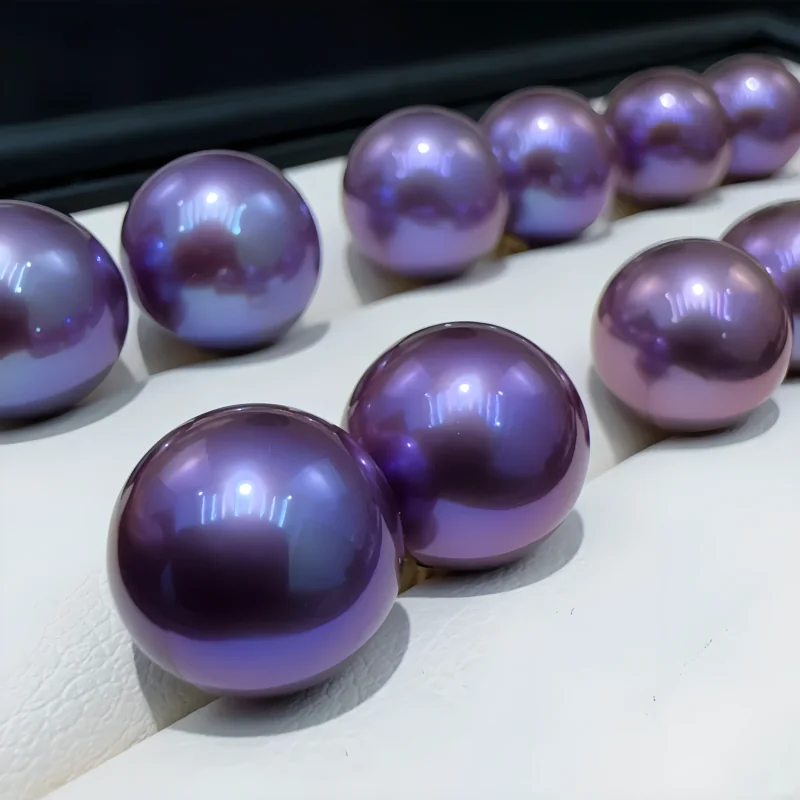
Yes—Freshwater AK pearls can be worth buying when you want a bright, round, refined pearl look at a more accessible price and you do not specifically need genuine saltwater Akoya pearls. The best examples can be very attractive: small to medium in size, round or near-round, bright in luster, and well suited to classic earrings, necklaces, bracelets, and everyday jewelry.
But the letters “AK” do not guarantee quality. “Freshwater AK” is a market term, not a formal pearl type or standardized grade. Two strands sold under the same name can differ substantially in luster, roundness, surface quality, color, matching, and price.
So the useful question is not simply, “Are Freshwater AK pearls good?” It is: Does this particular lot give you enough visible quality for the price, and is it being described honestly as a freshwater cultured pearl?
Quick Answer: When Are Freshwater AK Pearls a Good Buy?
| If you care most about... | Are Freshwater AK pearls a good fit? | Why |
|---|---|---|
| Strong visual value for the budget | Often yes | Good examples can deliver high luster, roundness, and a classic white-pearl look without the usual Akoya price premium. |
| Everyday pearl jewelry | Yes | They can work especially well for studs, pendants, bracelets, and wearable strands where appearance matters more than pearl-category prestige. |
| Genuine Akoya identity | No | If the pearl was cultured in freshwater, it is not an Akoya pearl even if it looks similar. |
| A standardized “AK” grade | No | “AK” has no universal grading definition. You still have to inspect the actual pearl quality. |
| Maximum resale or category prestige | Usually not the main reason to buy | Freshwater AK is better understood as a value-and-appearance purchase than as a substitute for the market identity of fine Akoya. |
If you are still unsure what the name itself means, first read our guide to what “Freshwater AK pearls” means in the market. This article starts one step later: assuming the pearl is correctly disclosed as freshwater cultured, is it actually a smart purchase?
Why Freshwater AK Pearls Can Offer Good Value
The strongest argument for Freshwater AK pearls is simple: modern freshwater cultivation can now produce pearls with a level of roundness and luster that used to be associated much more strongly with Akoya.
GIA reported in 2026 that small bead-nucleated freshwater cultured pearls from China are increasingly appearing with near-round to round shapes, bright white bodycolor, and excellent luster. That combination explains why sellers began using names such as “Freshwater Akoya,” “baby Akoya,” and “Freshwater AK.” The terminology is problematic when it implies actual Akoya identity, but the visual improvement in the freshwater material itself is real.
For a buyer, that means a limited budget can sometimes go further in freshwater pearls. Instead of spending mainly for the Akoya category name, you may be able to prioritize what you can actually see:
- brighter luster;
- a cleaner surface;
- a larger diameter;
- better pair or strand matching;
- more consistent roundness;
- or a better jewelry setting.
This is why Freshwater AK pearls make the most sense when you are buying primarily for appearance rather than for pearl identity.
But “Freshwater AK” Does Not Mean “Premium” Automatically
This is the most important buying warning.
There is no universal rule saying that a pearl labeled Freshwater AK must reach a certain luster grade, roundness tolerance, surface standard, or matching level. The name may suggest an Akoya-like visual direction, but it does not function as an independent laboratory grade.
That means one supplier's Freshwater AK strand might be impressively bright and tightly matched, while another seller may use the same term for pearls that are only moderately lustrous or clearly near-round.
The letters themselves therefore add very little value unless the seller also gives you useful specifications and honest images of the actual product.
A good rule is:
Pay for the pearl you can evaluate—not for the “AK” label.
The Five Things That Matter Most Before You Buy
GIA evaluates pearl quality through seven value factors: size, shape, color, luster, surface, nacre, and matching. For a typical Freshwater AK purchase, five of those factors are especially useful for an online buyer.
1. Luster should come first
Luster is usually the first thing to judge because it has such a strong effect on how alive a pearl looks. Strong luster produces bright, relatively sharp reflections. Weak luster looks softer, hazier, or chalkier.
Do not be distracted by a perfectly white photo background or aggressive image editing. Look at the actual reflections on the pearl. Can you see distinct light sources or shapes reflected on the surface? Do the pearls look bright from multiple angles?
A smaller Freshwater AK pearl with excellent luster will often look more refined than a larger pearl with weak reflections.
2. Check whether “round” really means round
Bead nucleation gives these freshwater pearls a round starting structure, but that does not mean every finished pearl is perfectly spherical.
Ask for more than one photograph when shape matters. A pearl can look round from the front and slightly flattened or uneven from the side. For loose pearls, studs, or premium strands, a rotation video is especially useful.
Near-round pearls can still be beautiful and good value. The problem begins only when the price assumes perfect roundness but the actual product does not deliver it.
3. Evaluate surface quality without demanding impossible perfection
Small pits, wrinkles, spots, or other natural surface characteristics are common in cultured pearls. What matters is their number, severity, visibility, and location.
For earrings, minor marks on the back may matter very little once the pearl is mounted. For a necklace, repeated obvious blemishes across the front-facing side can have a larger visual effect.
Do not pay a large “clean surface” premium based only on a distant photo. Ask for close-ups when the seller is positioning the pearls as premium quality.
4. Matching matters a lot in pairs and strands
A pair of attractive pearls can still look wrong together if one is warmer, duller, flatter, or more heavily marked than the other.
For a strand, matching becomes even more demanding. The pearls should work together in size, shape, luster, color, overtone, and surface appearance unless the design is intentionally graduated or mixed.
This is one area where a carefully selected freshwater strand can outperform a more expensive but poorly matched alternative.
5. Confirm identity and treatment disclosure
The product should be described clearly as freshwater cultured pearl. “Freshwater AK” can be used as additional market shorthand, but it should not replace the actual identity.
Also ask about color treatment when it is relevant to the product. Pearl type and treatment status are separate questions. A freshwater pearl does not automatically have untreated color simply because it is genuine.
For broader quality criteria, see our pearl grading guide.
When Freshwater AK Pearls Are Especially Worth Buying
Freshwater AK pearls are usually strongest in situations where visible quality matters more than traditional pearl-category prestige.
For everyday stud earrings
Stud earrings are one of the easiest places to get good value from this pearl type. If the pair is bright, round, well matched, and clean enough from the front, the visual result can be excellent.
Because studs use only two pearls, a seller can also select a strong pair without having to assemble dozens of closely matching pearls for a full strand.
For simple pendants
A single bright round freshwater pearl can work very well in a minimalist pendant. In this format, there is no strand-matching premium, so your budget can focus on the appearance of one pearl and the quality of the metalwork.
For buyers who want the classic white-pearl look on a tighter budget
If what you love is the clean look of small, white, round pearls—not specifically the fact that they grew in an Akoya oyster—Freshwater AK can be a logical category to explore.
At the same budget, you may prefer the appearance of a brighter or cleaner freshwater option over an entry-level Akoya piece. Our pearl buying guide explains why buying by visible quality rather than category prestige alone often produces a better result.
For designers and small jewelry brands
Freshwater AK can also be commercially useful when a design needs a refined, relatively uniform pearl look while keeping the finished retail price accessible.
In that case, consistency matters as much as beauty. A designer should ask for clear lot specifications and representative photos rather than assuming every future shipment with the same trade label will match the previous one.
When Freshwater AK Pearls May Not Be Worth It
They are not automatically the right choice for every buyer.
If the seller is charging an Akoya-level premium mainly because of the name
A freshwater pearl should not become more valuable merely because the product title borrows the word “Akoya.” If the price rises sharply, the reason should be visible in the actual quality—luster, surface, roundness, matching, size, jewelry construction, or another clearly explained factor.
If you specifically want genuine Akoya pearls
If the pearl type itself matters to you, a look-alike is not the same purchase. A buyer looking for traditional Akoya identity, Japanese Akoya provenance, a recognized Akoya laboratory designation, or a gift explicitly intended to be Akoya should simply buy Akoya.
For that category, see our Akoya pearl guide.
If the listing hides the actual identity
Be cautious when a product title says only “AK pearl,” “baby Akoya,” or “Chinese Akoya” without clearly stating freshwater or saltwater. GIA has warned that this terminology can be misleading because true Akoya pearls are saltwater cultured pearls, while the newer look-alike freshwater pearls are a different pearl identity.
If you cannot judge the actual lot
Stock photos are particularly risky for non-standardized trade terms. If a supplier sells multiple quality levels under similar wording, ask for images or video of the actual lot, especially for wholesale orders.
Freshwater AK vs. Ordinary Freshwater Pearls: Is the Premium Worth Paying?
This is often a more useful comparison than Freshwater AK versus true Akoya.
If a seller charges more for Freshwater AK than for ordinary freshwater pearls, ask what measurable improvement you are receiving. Ideally, the premium should correspond to a combination such as:
- stronger and sharper luster;
- more consistent roundness;
- cleaner visible surfaces;
- tighter color matching;
- better pair or strand matching;
- or more demanding selection of the finished lot.
If those differences are obvious, paying more can be rational. If the pearls look nearly the same and the only distinction is the label, the premium is difficult to justify.
This is also why seller grading letters such as AA, AAA, or AAAA should not be used as the sole basis for comparison. Retail grading systems are not globally standardized. Ask what the grade actually means and compare the physical pearls.
Freshwater AK vs. Akoya: Do You Need to Pay More for the Real Akoya Category?
Not always. It depends on what the extra money is buying for you.
GIA notes that saltwater Akoya cultured pearls are generally more expensive than freshwater cultured pearls of similar size and quality. Fine Akoya is especially known for classic white-to-cream color, high roundness, close matching, and crisp mirror-like luster.
Those qualities can make the Akoya premium worthwhile when that specific combination—and the actual Akoya identity—matters to you.
But if your goal is simply an attractive pair of bright white pearl earrings, the better-looking option at your budget may be freshwater. A high-quality Freshwater AK pair can be a smarter purchase than choosing a noticeably weaker Akoya pair merely to obtain the Akoya name.
The decision rule is straightforward:
Choose Freshwater AK when appearance-per-dollar matters most. Choose Akoya when the Akoya identity and its characteristic high-end look are part of what you are paying for.
How Much Should You Trust Online Photos?
Photos are useful, but pearl photography is easy to manipulate unintentionally or deliberately. Exposure, contrast, white balance, soft boxes, phone processing, and background color can all change how luster and color appear.
For an online purchase, stronger evidence includes:
- multiple photos under similar neutral lighting;
- close-ups that show actual surface detail;
- a side or rotation view for shape;
- a full view of the complete pair or strand for matching;
- video without aggressive filters;
- exact millimeter measurements;
- and clear disclosure of freshwater cultured identity.
For higher-value purchases where freshwater-versus-saltwater identity materially changes the price, laboratory documentation can provide more reliable evidence than visual inspection alone. GIA notes that selected bead-nucleated freshwater pearls can resemble Akoya closely enough that appearance may not be sufficient for identification.
A Simple Buying Checklist
Before paying for Freshwater AK pearls, run through these questions:
- Is the product explicitly described as freshwater cultured pearl?
- Does the seller explain what “AK” means in their own inventory?
- Is the luster bright and reasonably sharp?
- Is the shape actually round enough for the price?
- Are the surface characteristics acceptable at normal viewing distance?
- Are the pearls well matched if you are buying a pair or strand?
- Is the size stated in millimeters rather than only with vague terms such as small or medium?
- Is treatment information available when color is part of the value?
- Are you paying for visible quality—or mainly for the “AK” nickname?
- If genuine Akoya identity matters, are you buying actual saltwater Akoya instead?
If the answers are clear, Freshwater AK is relatively easy to evaluate. If the seller avoids the first question—what the pearl actually is—that is a stronger warning sign than any minor surface mark.
So, Are Freshwater AK Pearls Worth Buying?
For many buyers, yes. Freshwater AK pearls can be one of the more interesting modern freshwater options because improved bead-nucleated cultivation can produce pearls that are rounder, brighter, and more Akoya-like than many buyers expect from freshwater material.
They are especially worth considering when you want strong luster, a classic white-pearl appearance, and good visual value without needing the pearl to be genuine Akoya.
They become a poor purchase when the trade name is used to justify a premium that the actual pearls do not earn.
Judge the pearl in this order: identity first, then luster, surface, shape, matching, size, color, and price. If those factors are strong and the product is accurately described, the fact that it is freshwater is not a disadvantage. It is simply the correct pearl category.
For finished pieces, you can compare current freshwater pearl jewelry after deciding which quality factors matter most to you.
FAQ
Are Freshwater AK pearls real pearls?
Yes. The term is generally used for real freshwater cultured pearls, often bead-nucleated. They are not imitation pearls. The important distinction is that they are freshwater pearls, not true saltwater Akoya pearls.
Are Freshwater AK pearls good quality?
They can be, but the name does not guarantee quality. Evaluate the actual luster, surface, shape, color, matching, size, and disclosure. Different sellers can use “Freshwater AK” for noticeably different quality levels.
Why are Freshwater AK pearls cheaper than Akoya?
Freshwater cultured pearls generally have a different production and supply structure from saltwater Akoya pearls. GIA notes that Akoya pearls are generally more expensive than freshwater pearls of similar size and quality. The final price still depends on the actual quality of the pearls and the jewelry.
Do Freshwater AK pearls look like Akoya pearls?
Some do. Modern small bead-nucleated freshwater pearls can be round or near-round, bright white, and highly lustrous, creating significant visual overlap with Akoya. That resemblance is the reason the market nickname developed.
Should I buy Freshwater AK or Akoya?
Choose Freshwater AK if you mainly want the bright, round, classic pearl look at a more accessible price. Choose true Akoya if Akoya identity, traditional positioning, very crisp luster, or Akoya-specific documentation is important to you.
Is “Freshwater AK” an official pearl grade?
No. It is a market term, not a standardized gemological grade. Do not assume it guarantees a particular level of luster, roundness, surface quality, or matching.
Source Notes
This article uses GIA's January 2026 discussion of the “Freshwater Akoya” misnomer as the main technical reference for the small bead-nucleated freshwater pearls currently marketed under names such as Freshwater AK. GIA identifies them as freshwater cultured pearls rather than Akoya pearls and notes that their roundness, bright white bodycolor, and luster can create strong visual similarity to Akoya.
The buying framework also follows GIA's seven pearl value factors: size, shape, color, luster, surface, nacre, and matching. GIA notes that luster is one of the most important visual factors and that matching should be considered whenever two or more pearls are used together.