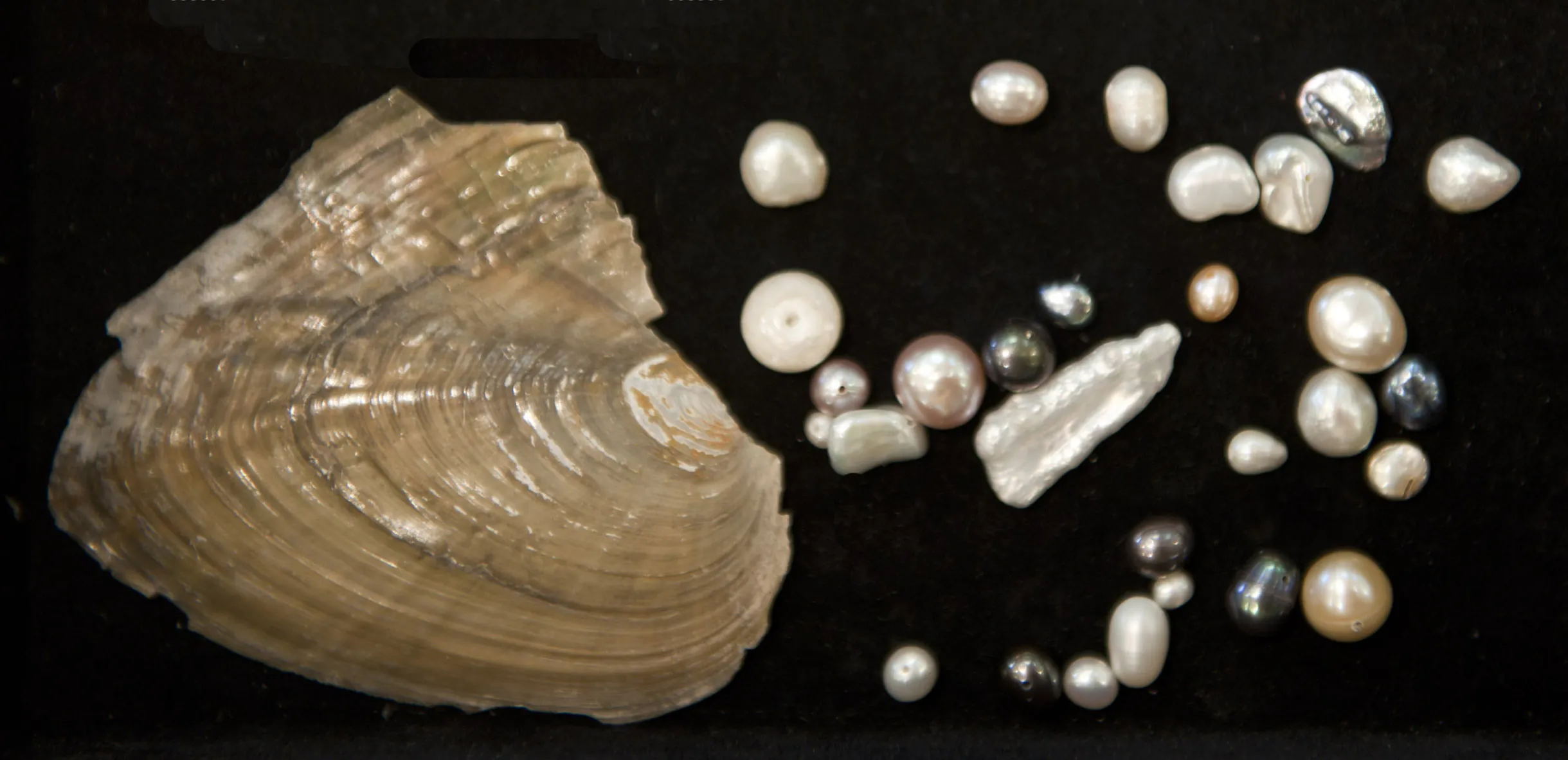
No. Not every black pearl is a Tahitian pearl. Tahitian cultured pearls are the best-known naturally dark pearl type, but the phrase black pearl is much broader than one pearl category. Naturally dark pearls can also come from other mollusks and regions, while many black freshwater and black Akoya pearls have been color-treated after harvest.
The useful question is therefore not simply, “Is this pearl black?” It is: What type of pearl is it, where did its color come from, and has that color been treated?
This distinction matters because two pearls can both look black in a photograph while differing completely in mollusk species, growing environment, treatment history, rarity, typical size, and price.
Black Pearl Types at a Glance
| Pearl type | Can the dark color be natural? | Typical origin or mollusk | What buyers should know |
|---|---|---|---|
| Tahitian cultured pearls | Yes | Pinctada margaritifera, strongly associated with French Polynesia | The classic naturally dark cultured pearl category; many are gray, green, charcoal, silver, or multicolored rather than jet black. |
| Other black-lipped-oyster cultured pearls | Yes | Cook Islands and other Pacific locations using Pinctada margaritifera | They may resemble Tahitian pearls, but geographic origin still matters; they should not automatically be called Tahitian. |
| Sea of Cortez cultured pearls | Yes | Pteria sterna, Gulf of California, Mexico | A different naturally dark saltwater pearl type, often showing gray, brown, purple, green, blue, and strong iridescent effects. |
| Black freshwater cultured pearls | Usually not in the commercial black range | Freshwater mussels, especially Chinese production | Dark gray, black, blue, green, or similar colors should prompt a treatment question; dyeing and irradiation are known methods. |
| Black Akoya cultured pearls | Dark market colors are commonly treated | Akoya pearl oysters, especially Japan, China, and Vietnam | Black, blue-black, green-black, or dark gray Akoya pearls may be dyed, irradiated, or otherwise color-modified. |
| “Black” South Sea pearls | Not a standard natural-color category | Pinctada maxima | South Sea pearls are normally associated with white, silver, and golden color families. A very dark example deserves clear treatment disclosure. |
Why Tahitian Pearls Are So Strongly Associated with “Black Pearls”
Tahitian cultured pearls are grown in the black-lipped pearl oyster, Pinctada margaritifera. This mollusk can naturally produce dark nacre, which is why Tahitian pearls became the pearl type most closely associated with the phrase “black pearl.”
But “black” is an imperfect description. As the GIA notes, Tahitian pearls occur across a broad range of naturally dark colors. Many are greenish gray, silver gray, charcoal, brownish gray, or green, often with blue, purple, pink, bronze, or other overtones. A fine Tahitian pearl can look dramatically different as the lighting angle changes.
If you want a closer look at that color range, see our guide to the natural dark colors of Tahitian pearls. For the broader pearl type—its origin, size, shapes, nacre, and quality factors—read our complete Tahitian pearl guide.
Important: “Naturally Colored” Does Not Mean “Natural Pearl”
This terminology causes a lot of confusion.
A naturally colored cultured pearl is still a cultured pearl. Humans initiated the culturing process, but the pearl developed its displayed color without a post-harvest color treatment. Most Tahitian pearls sold in jewelry today belong to this cultured-pearl category.
A natural pearl, in gemological terminology, formed without human intervention. Natural pearls are a separate and much rarer category.
A color-treated cultured pearl is also a real pearl, but its color was changed or enhanced after harvest—for example through dyeing or irradiation.
An imitation pearl is different again: it is a product made to resemble a pearl rather than a pearl formed inside a mollusk.
So a dyed black freshwater pearl can be a genuine cultured pearl even though its black color is not natural. “Treated” and “fake” are not synonyms.
Other Naturally Dark Black Pearls Do Exist
1. Black-Lipped-Oyster Pearls from Outside French Polynesia
The black-lipped oyster is not limited to French Polynesia. Pinctada margaritifera also occurs in other Pacific regions, and black pearl culture has an established history in places such as the Cook Islands.
These pearls can naturally show the same broad family of dark gray, green, silver, blue, purple, and near-black colors associated with black-lipped-oyster nacre. That does not mean every such pearl should automatically be sold as “Tahitian.”
When provenance matters, the seller should describe the actual origin accurately. “Black-lipped cultured pearl from the Cook Islands,” for example, tells you more than simply borrowing the better-known Tahitian name.
This is a useful reminder that mollusk species and geographic name are related, but they are not interchangeable.
2. Sea of Cortez Pearls from Mexico
Sea of Cortez cultured pearls are one of the most important exceptions to the idea that a naturally dark cultured pearl must be Tahitian.
They are associated with the rainbow-lipped pearl oyster, Pteria sterna, in Mexico's Gulf of California. GIA research on these pearls documents brown, gray, and dark gray bodycolors combined with vivid interference colors. Depending on the individual pearl and lighting, purple, green, blue, bronze, and other iridescent effects may be visible.
Sea of Cortez pearls are therefore genuinely different from Tahitian pearls. They come from a different mollusk and production region, and their color character can also be distinctive. They are much less commonly encountered in ordinary jewelry retail, so buyers may never see one unless they deliberately look for this category.
3. Rare Naturally Dark Pearls from Other Mollusks
Dark natural pearls and unusual cultured pearls can also occur in other Pinctada and Pteria species. Gemological laboratories occasionally examine pearls with gray, brown, purple, blackish, or strongly iridescent colors that do not belong to the mainstream Tahitian category.
For a collector-level pearl, however, appearance alone is not enough to establish species, natural-versus-cultured origin, geographic provenance, or color origin. Those questions can require laboratory examination.
What Are Black Freshwater Pearls?
Freshwater cultured pearls naturally occur in a wide range of attractive colors, including white, cream, pink, peach, lavender, and other warm or pastel variations. But very dark black, blue, green, or gray freshwater pearls should raise a different question: has the color been treated?
GIA specifically advises buyers to ask about treatment when freshwater pearls appear gray or black, strongly blue or green, or unusually deep in tone. Dyeing is one of the most common color treatments used on freshwater pearls, and irradiation is another documented method.
This does not make black freshwater pearls inherently poor products. They can be attractive, durable enough for normal jewelry wear, and much more affordable than fine naturally dark saltwater pearls. The key issue is disclosure.
A listing such as “black dyed freshwater cultured pearl” tells the buyer what the product actually is. Calling the same pearl a “rare natural black pearl” would create a very different—and potentially misleading—impression.
For a deeper explanation of dyeing, irradiation, toning, and other post-harvest processes, see our guide to pearl color enhancement treatments.
What Are Black Akoya Pearls?
Akoya pearls are best known for white to cream bodycolors, bright luster, and relatively round shapes. Dark Akoya pearls certainly exist in the marketplace, but buyers should not assume that a black, blue-black, green-black, or dark gray Akoya pearl formed with that color naturally.
GIA has documented both dyed and irradiated Akoya cultured pearls. Irradiation can darken the freshwater shell-bead nucleus inside an Akoya pearl and change the pearl's face-up appearance, while dyeing can create darker surface colors directly.
There is an important nuance here: naturally occurring blue or gray Akoya pearls can exist, and the Akoya color story is more complicated than “all non-white Akoya are dyed.” But if a pearl is being marketed specifically as a black Akoya, treatment disclosure matters far more than the color name itself.
Are There Naturally Black South Sea Pearls?
In normal trade usage, white and golden South Sea pearls are associated with Pinctada maxima. Their natural color range centers on white, silver, cream, yellow, and golden tones—not the classic dark Tahitian range.
For that reason, “black South Sea pearl” can be a confusing label. Historically, the phrase “black South Sea cultured pearl” has sometimes been used broadly for black-lipped-oyster pearls, including Tahitian-type material. But in modern retail, where “South Sea pearl” usually means Pinctada maxima, a very dark pearl sold under that name deserves clarification.
Ask the seller which mollusk produced the pearl, where it was cultured, and whether its color was treated. Those three answers are far more useful than the word “black.”
Can You Tell a Tahitian Pearl from a Treated Black Pearl by Eye?
Sometimes you can notice useful clues, but visual inspection is not a reliable proof of color origin.
Natural-color Tahitian pearls often show complex color layering: a gray, green, or charcoal bodycolor may carry a separate pink, blue, purple, bronze, or green overtone. The color can shift as the pearl moves under neutral light. Some treated pearls look flatter or more uniform, while others may show obvious color concentrations around drill holes or surface irregularities.
Those are clues—not a laboratory test. Modern treatments can be convincing, and naturally colored pearls can also be very dark or visually uniform.
A practical buying check is:
- Ask for the pearl type. Tahitian, freshwater, Akoya, Sea of Cortez, or another category?
- Ask whether the displayed color is natural or treated. Do not accept “real pearl” as an answer to a color-treatment question.
- Ask for the treatment name when known. Dyed and irradiated are more informative than a vague phrase such as “enhanced.”
- Check the drill hole and surface under neutral light. Uneven color concentration may be a clue, but its absence proves nothing.
- Use an independent laboratory for a high-value or unusually colored pearl. This is especially useful when natural color is a major part of the price.
If your question is broader than color treatment and you are trying to separate genuine pearls from imitation pearls, use our guide on how to tell whether pearls are real or fake.
Does “Naturally Black” Automatically Mean More Valuable?
No. Natural dark color can contribute to rarity and desirability, but it is not a complete quality grade.
A Tahitian pearl with dull luster, heavy surface damage, poor nacre, or weak matching is not automatically more valuable than a beautiful pearl simply because its color is natural. Value still depends on the full combination of size, shape, color, luster, surface quality, nacre quality, and matching.
The same applies to color names. “Peacock,” “aubergine,” “black,” and “blue” can describe attractive appearances, but they should not substitute for judging the pearl itself.
For buyers who specifically want the classic naturally dark saltwater look, browse our Tahitian pearl jewelry after you understand how bodycolor, overtone, and treatment disclosure work.
The Simplest Way to Think About Black Pearls
Instead of treating “black pearl” as one category, divide the market into two groups:
Naturally dark pearls: Tahitian cultured pearls are the best-known example, but black-lipped-oyster pearls from other Pacific origins and Sea of Cortez pearls can also develop naturally dark colors.
Color-treated dark pearls: black freshwater and black Akoya cultured pearls are widely available, and their dark colors may be created through dyeing, irradiation, or other treatment.
That framework immediately prevents the most common misunderstanding. A pearl can be genuinely cultured, genuinely beautiful, and still have treated color. Conversely, a naturally dark pearl does not become Tahitian simply because it looks like one.
“Black” tells you what the pearl looks like. “Tahitian” tells you much more about what the pearl is.
FAQ
Are all naturally black pearls Tahitian?
No. Tahitian pearls are the best-known naturally dark cultured pearls, but Sea of Cortez pearls and black-lipped-oyster pearls from other Pacific origins can also show naturally dark colors. Rare dark pearls from other mollusks also exist.
Are black freshwater pearls real pearls?
They can be genuine cultured freshwater pearls even when their black color is treated. “Dyed” or “irradiated” describes the color treatment; it does not automatically mean the pearl itself is imitation.
Are black Akoya pearls naturally black?
Black and very dark Akoya pearls in the commercial market are commonly color-treated. Naturally blue or gray Akoya pearls can occur, so the safest approach is to ask specifically whether the displayed color is natural or treated.
Are Sea of Cortez pearls Tahitian pearls?
No. Sea of Cortez cultured pearls are associated with Pteria sterna in Mexico's Gulf of California. Tahitian pearls are associated with the black-lipped pearl oyster, Pinctada margaritifera, and especially French Polynesian production.
Can a black pearl from the Cook Islands be called Tahitian?
It may come from the same black-lipped oyster species and show a similar natural dark color range, but geographic origin still matters. When provenance is important, describing it as a Cook Islands black pearl is more precise than automatically calling it Tahitian.
Can I identify a dyed black pearl from the drill hole?
Sometimes dye concentration or an unnatural color boundary around the drill hole can be a useful clue. However, the absence of that clue does not prove natural color. High-value identification is better supported by seller disclosure and, when necessary, laboratory testing.
References
- GIA: Different Pearl Types Explained—Akoya, South Sea, Tahitian & Freshwater Pearls
- GIA: Are strongly and brightly colored pearls naturally colored?
- GIA Pearl Research: color treatments and pearl identification
- GIA Gems & Gemology: Cultured Pearls from the Gulf of California, Mexico
- GIA Gems & Gemology: Irradiated and Dyed Akoya Pearls