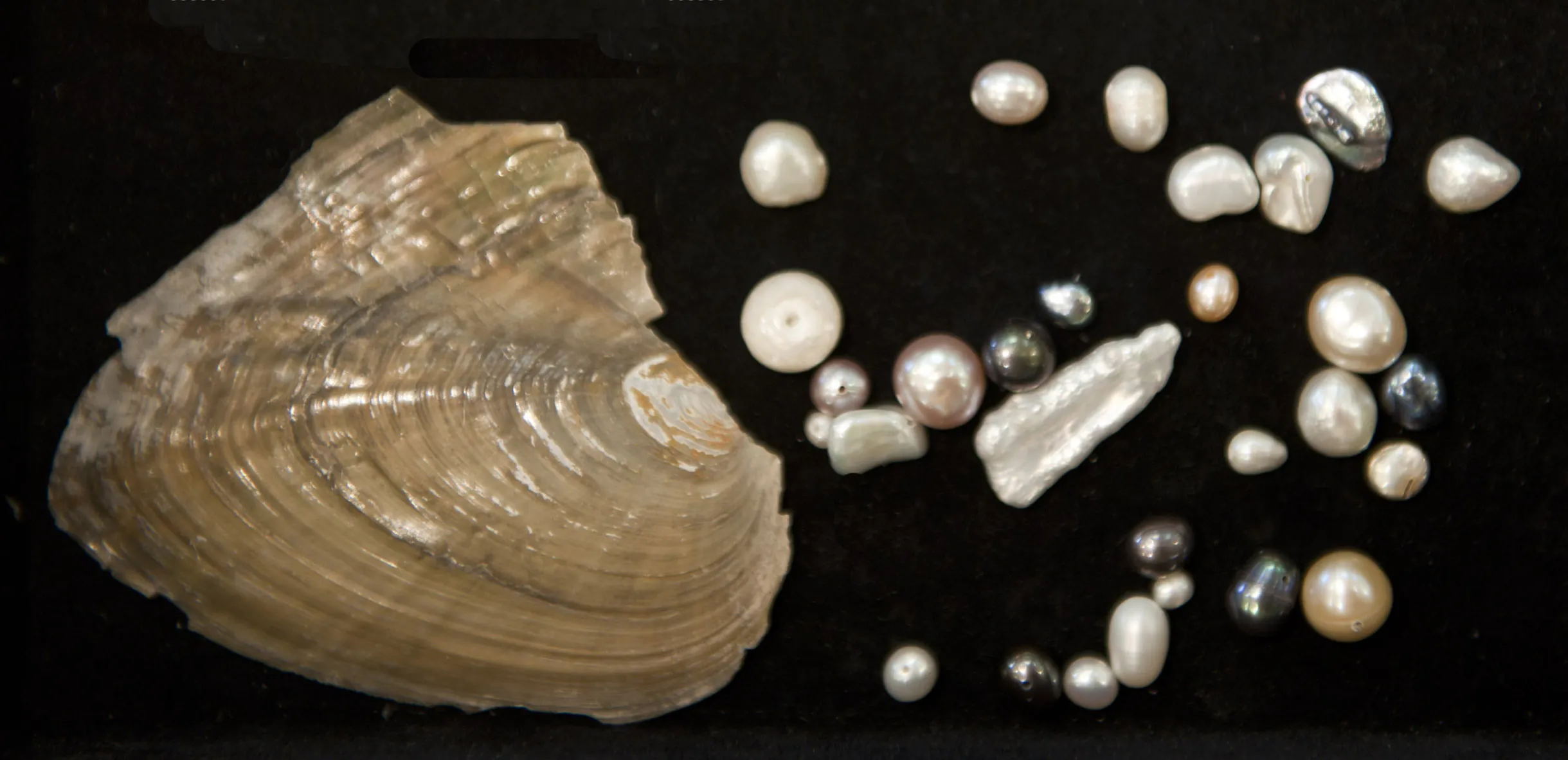
Short answer: Edison pearls are large mainly because they are bead-nucleated freshwater cultured pearls. Instead of starting with mantle tissue alone, the farmer implants a round shell bead that already has substantial diameter. The mussel then forms a pearl sac and deposits nacre around that bead. Suitable freshwater mussels, longer cultivation, and better survival with larger nuclei all help make finished Edison pearls much larger than the freshwater pearls many buyers are used to seeing.
This is an important distinction because the size of an Edison pearl does not come from nacre growth alone. A large finished pearl is the result of the bead nucleus plus the nacre deposited around it. That is the central reason Edison pearls can reach sizes that overlap visually with Tahitian and South Sea pearls.
According to GIA's 2026 pearl market report, large round and near-round freshwater bead-cultured pearls commonly called Edison pearls typically range from about 9 mm to more than 15 mm. Their increasing size range is one of the reasons they have become so prominent in the modern pearl market.
The Main Reason: Edison Pearls Start with a Bead Nucleus
Traditional non-bead-cultured freshwater pearls are formed after pieces of mantle tissue are implanted into a freshwater mussel. There is no large spherical bead inside the developing pearl, so the pearl must build its form through nacre deposition around the developing pearl sac.
Edison pearls follow a different production logic. GIA describes them as near-round to round freshwater bead-cultured pearls. A round bead nucleus is implanted along with pearl-forming tissue. The tissue develops into a pearl sac, and nacre is deposited around the bead.
That bead matters enormously for size. In bead-cultured pearls, the nucleus acts as a physical template. A relatively large bead means the pearl begins its growth process with a much larger internal diameter than a tissue-nucleated freshwater pearl. Nacre then increases the diameter further as cultivation continues.
So when asking why Edison pearls are large, the most useful formula is:
Final pearl diameter = bead nucleus diameter + nacre deposited around the bead.
This also explains why a 14 mm Edison pearl should not be interpreted as 14 mm of nacre. Much of that total diameter may come from the nucleus inside. The exact internal structure and nacre thickness cannot be determined reliably from the outside alone.
For a broader explanation of the category, see our guide to Edison pearls.
Why Can Freshwater Mussels Accept Such Large Nuclei?
Edison pearls are commonly associated with Hyriopsis cumingii freshwater mussels or hybrids involving this species. These are much larger pearl-producing mollusks than the small Akoya oyster most consumers picture when they think of classic round pearls.
The size and physiology of the host matter because a farmer cannot simply insert an arbitrarily large bead into any mollusk. The operation has to be tolerated by the animal, the bead must remain in the pearl sac, and the mussel must survive long enough to coat it with attractive nacre.
This is why "use a bigger bead" is only part of the explanation. A larger nucleus raises the technical difficulty of cultivation. GIA has reported that earlier Chinese attempts using large beads resulted in high mortality, while later improvements in techniques and the use of suitable or hybrid mussels made large bead-cultured freshwater pearls increasingly successful.
Modern Cultivation Techniques Made Large Edison Pearls More Practical
The existence of a large bead nucleus does not guarantee a large marketable pearl. The mussel can reject the bead, die after nucleation, produce an irregular shape, develop a poor surface, or form nacre that lacks attractive luster.
The modern Edison pearl category became possible because cultivation improved enough to manage these risks more successfully. Better host selection, more refined nucleation, improved farming conditions, and more controlled cultivation all increased the ability to produce large freshwater bead-cultured pearls with acceptable shape and surface quality.
This point is easy to miss when looking only at the finished pearl. A 13 or 15 mm round freshwater pearl looks simple after it has been polished and matched into jewelry, but producing it requires the mussel to survive a comparatively demanding operation and then maintain stable pearl growth over an extended period.
Cultivation Time Adds Nacre Around the Large Starting Core
The bead provides the starting size, but time still matters. After the pearl sac forms, the mussel continues depositing nacre around the nucleus. Longer successful cultivation can increase the finished diameter and build a more substantial nacre layer.
GIA documented a Chinese necklace of large freshwater bead-cultured pearls measuring approximately 11.9 to 13.85 mm that had reportedly been cultured for about three and a half to four years. In its 2023 market reporting, GIA also noted that producing Edison pearls above roughly 14 mm takes considerably more time and sharply limits the yield of top-quality pearls.
That leads to a useful buying insight: very large Edison pearls are not simply ordinary Edison pearls left in the water a little longer. As size increases, the farmer is asking more from the mussel for a longer period while still trying to preserve roundness, luster, surface quality, and nacre condition.
Why Not Just Insert an Even Larger Bead?
In theory, a larger bead gives the farmer a larger starting diameter. In practice, there is a biological and economic limit.
A larger bead can make nucleation more stressful. It can increase the chance of mortality or bead rejection, and even a surviving mussel may not produce a pearl with the shape, surface, nacre, and luster required for a high grade.
This is why the supply of fine Edison pearls does not increase smoothly with size. Once you move into especially large diameters, the number of pearls that satisfy several quality requirements at the same time becomes much smaller.
GIA's market observations are especially useful here: pearls over about 14 mm require more cultivation time, and top-grade yield becomes increasingly limited. That is one reason a small change in diameter can produce a much larger change in price at the upper end of the size range.
Is the "One Pearl Gets All the Mussel's Energy" Explanation Accurate?
You may see Edison pearls explained by saying that the mussel grows only one pearl and therefore "puts all its energy into it." That is an easy metaphor, but it is not the most precise explanation.
The more important factors are structural and biological:
- A large bead nucleus creates a large starting diameter.
- The bead provides a round template for nacre deposition.
- The host mussel must be large and healthy enough to tolerate the operation.
- Cultivation must continue long enough to build nacre around the bead.
- Improved farming techniques make survival and acceptable pearl quality more achievable.
Compared with traditional freshwater methods that can produce multiple tissue-nucleated pearls in one mussel, Edison-style bead culture is much more focused on producing a relatively large, round in-body pearl. But "all the nutrition goes to one pearl" should be understood as a simplification, not the biological mechanism that determines size.
How Edison Pearls Compare with Traditional Freshwater Pearls
| Feature | Edison Pearls | Traditional Non-Bead Freshwater Pearls |
|---|---|---|
| Internal starting structure | Round bead nucleus plus pearl-forming tissue | Mantle tissue without a large bead nucleus |
| Main reason large sizes are possible | Large starting bead plus later nacre deposition | Size develops from nacre growth without a large spherical core |
| Shape tendency | Often round or near-round | Wider shape variation is common |
| Common visual impression | Large, bold, often saltwater-like in scale | Usually more traditional freshwater proportions and shapes |
If you want to understand the other side of this comparison, read our guide to freshwater non-bead-cultured pearls.
Why Large Edison Pearls Can Resemble South Sea Pearls
Size is one of the strongest visual signals people use when identifying a pearl at first glance. When an Edison pearl reaches 12, 14, or 15 mm and is also round with strong luster, it can create a visual scale that many buyers associate with South Sea pearls.
But similar size does not make the two categories the same. Edison pearls are freshwater bead-cultured pearls. South Sea pearls are saltwater bead-cultured pearls produced by Pinctada maxima. Their mollusks, environments, typical colors, nacre characteristics, rarity, and market structures differ.
The correct conclusion is not that Edison pearls "become South Sea-like." It is that modern freshwater bead culture can now produce pearl diameters that overlap with traditionally large saltwater categories.
Does a Larger Edison Pearl Mean a Better Edison Pearl?
No. Size is only one quality and value factor.
A very large Edison pearl with dull luster, heavy surface blemishing, obvious shape distortion, or poor matching may be less desirable than a slightly smaller pearl with stronger overall beauty. Large size can increase rarity and price, but it does not cancel the importance of the other factors.
When comparing Edison pearls, look at:
- Luster: Are reflections bright and reasonably sharp?
- Surface: Do blemishes distract from the face-up appearance?
- Shape: Is the pearl truly round, near-round, or intentionally baroque?
- Color: Is the bodycolor attractive and, when relevant, is treatment disclosed?
- Size: Does the diameter suit the jewelry design and budget?
- Matching: For pairs and strands, do the pearls look coherent together?
Our pearl size guide explains how millimeter differences change visual presence, while the pearl shape guide explains why roundness should be judged separately from overall pearl quality.
What This Means When Buying Edison Pearls
The most useful thing to remember is that an Edison pearl's large size is not a mysterious property of freshwater nacre. It is the result of a deliberate cultivation system designed to create a large bead-cultured pearl.
That means you should never judge an Edison pearl by diameter alone. A large nucleus can make a pearl large, but the farmer still has to achieve attractive nacre, surface quality, shape, color, and luster. The largest high-quality pearls are difficult because all of those factors must come together after a more demanding cultivation process.
If you are comparing loose pearls or strands for jewelry production, you can also browse our wholesale pearl selection and compare size together with luster, surface, shape, and matching rather than treating millimeters as the only quality signal.
Final Takeaway
Edison pearls are large primarily because they are bead-nucleated freshwater pearls. The bead gives the developing pearl a relatively large starting diameter, and the mussel then deposits nacre around it. Large freshwater mussels, improved nucleation methods, successful long-term cultivation, and better control of mortality and bead rejection make these large sizes commercially possible.
The key idea is simple: Edison pearl size comes from both the nucleus and the nacre. Bigger pearls are therefore not just the result of "more nacre," and they are not automatically better. At the upper end of the size range, producing a pearl that is simultaneously large, round, lustrous, clean, and well formed becomes increasingly difficult—which is why the finest large Edison pearls remain selective despite the efficiency of modern freshwater pearl farming.
FAQ
What size are Edison pearls usually?
Modern Edison pearls are commonly seen from roughly 9 mm to more than 15 mm. GIA's 2026 market report notes this broad range, although exact commercial size distributions vary by harvest and supplier.
Are Edison pearls large because they grow longer?
Longer cultivation can help increase the final size and nacre layer, but it is not the whole reason. The large bead nucleus gives an Edison pearl a substantial starting diameter before nacre growth is complete.
Are large Edison pearls solid nacre?
No. Edison pearls are generally bead-cultured, so they contain an internal bead nucleus surrounded by nacre. This is different from traditional non-bead-cultured freshwater pearls, which do not contain a large spherical shell bead.
Why are Edison pearls over 14 mm more expensive?
As size increases, cultivation generally takes more time and the yield of pearls that are also round, lustrous, clean, and well formed becomes lower. The price premium therefore reflects both size and increasing production difficulty.
Are Edison pearls the same as South Sea pearls?
No. They can overlap in size, but Edison pearls are freshwater bead-cultured pearls, while South Sea pearls are saltwater pearls produced by Pinctada maxima.