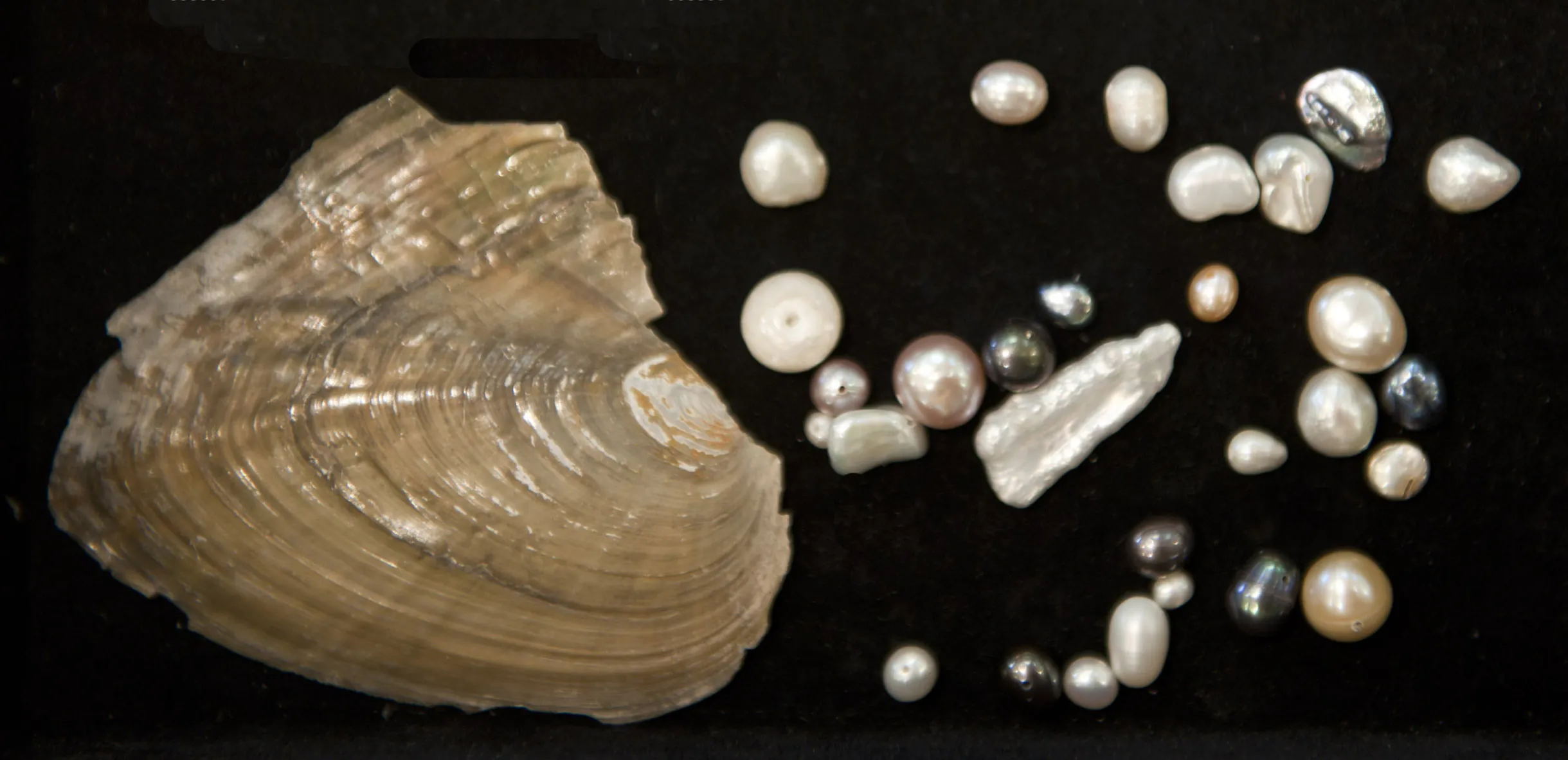
The main difference is geometric: a round pearl stays close to a sphere when viewed from different directions, while a near-round pearl is still largely spherical but shows a slight deviation—such as mild flattening, elongation, or asymmetry—when it is rotated or measured.
That distinction sounds small, and visually it often is. A high-quality near-round pearl can look almost round when seen from the front, especially once it is mounted in jewelry. But the difference matters because true roundness is relatively difficult to produce, so round pearls generally command a premium when the pearl type, size, luster, surface quality, color, nacre, and matching are otherwise comparable.
Roundness is only one part of pearl quality, however. A near-round pearl with bright luster, a clean surface, attractive color, and strong nacre quality can be more beautiful—and sometimes more valuable—than a technically round pearl with dull luster or obvious surface issues. If you want the broader context first, see our Pearl Shape Guide.
Round vs. Near-Round Pearls at a Glance
| Feature | Round Pearl | Near-Round Pearl |
|---|---|---|
| Overall form | Approaches a sphere from multiple viewing angles | Largely spherical, with slight deviation from a true sphere |
| What you may notice | Very little flattening or elongation | Mild flattening, elongation, or asymmetry when rotated |
| Visual effect | Highly uniform and formal | Still classic, but slightly more natural-looking |
| Typical price relationship | Usually higher if all other value factors are comparable | Often more affordable because the shape standard is less strict |
| Best for | Premium matched strands, classic studs, highly symmetrical designs | Everyday jewelry, value-focused strands, designs where tiny shape differences are not visually important |
| Does shape alone determine quality? | No | No |
What Does “Round” Mean in Pearl Classification?
GIA treats round and near-round as separate pearl shape categories. In practical terms, a round pearl should present a consistently spherical outline rather than merely looking circular from one convenient angle.
This is important because a pearl is a three-dimensional object. A slightly flattened pearl can appear perfectly circular in a face-up photograph. An elongated pearl may also look round if the camera is aligned with its shorter axis. That is why a single image is not enough to judge strict roundness with confidence.
When roundness matters, look at the pearl from several directions. For higher-value loose pearls, pairs, or strands, a slow rotation video is much more useful than one front-facing image. Maximum and minimum diameter measurements can also reveal small differences that are difficult to see in a still photo.
For round and near-round pearls, GIA commonly expresses size by diameter in millimeters. But size measurement and shape classification are not the same thing: two pearls can both be sold as 8 mm and still differ visibly in roundness.
What Makes a Pearl Near-Round?
A near-round pearl is not baroque and is not simply an oval pearl under another name. It still belongs to the broadly spherical family. The deviation from roundness is present, but not large enough to change the pearl into a clearly elongated, flattened, drop, button, or irregular shape.
Common near-round characteristics include a very slight oval tendency, a subtly flattened area, an uneven contour that appears only after rotation, or dimensions that differ enough to show the pearl is not a true sphere. From normal wearing distance, these differences may be difficult to notice.
This is why near-round pearls can offer strong value. They preserve most of the visual language people associate with classic round pearls while avoiding the scarcity premium attached to stricter roundness.
Is There a Universal Measurement That Separates Round from Near-Round?
No single percentage should be treated as a universal worldwide rule. Different laboratories, national standards, producers, wholesalers, and retailers may use different classification systems or commercial tolerances.
Some systems quantify shape using the difference between maximum and minimum diameter. CIBJO educational material, for example, summarizes classification systems that use dimensional thresholds for round and near-round pearls. But CIBJO also notes that it does not endorse one industry grading system over all others. A percentage taken from one system should therefore not be presented as if every seller or laboratory uses the same boundary.
For a buyer, the practical rule is simpler: if a seller claims a meaningful premium for “round” rather than “near-round,” ask what standard is being used and what evidence supports the distinction. Multiple views and actual dimensions are more informative than an unexplained label such as “perfect round,” “top round,” or “very round.”
Does Round Mean Higher Quality?
Not by itself. Shape is only one of the major factors used to evaluate pearls. GIA’s seven pearl value factors are size, shape, color, luster, surface quality, nacre quality, and matching for jewelry containing more than one pearl.
That means a pearl can be highly round but still have weak luster, heavy spotting, poor nacre quality, unattractive color, or poor matching. Conversely, a near-round pearl can have exceptional luster and a very clean surface.
If you are comparing two pearls, do not pay attention to roundness before checking the factors that make the pearl visually attractive in the first place. Our Pearl Grading Guide explains how these characteristics should be considered together, while the Pearl Luster Guide focuses specifically on reflection quality and visual brightness.
Why Are Round Pearls Usually More Expensive?
When other factors are equal, round pearls are generally more valuable because true spherical form is comparatively difficult to produce and match. GIA identifies round as the rarest cultured pearl shape under otherwise comparable conditions.
The premium can become especially noticeable in strands. A necklace does not require only one round pearl; it requires many pearls that are simultaneously compatible in shape, size, color, luster, surface quality, and overall appearance. The stricter the matching target, the more pearls must be sorted to assemble a uniform strand.
Near-round pearls loosen one of those constraints. The strand can still appear refined and consistent, but the acceptable shape range is slightly wider. That can make the finished piece significantly more affordable without creating an equally large visual difference.
However, there is no fixed rule such as “near-round pearls should cost 30% less.” The price gap changes with pearl type, size, quality, supply, matching difficulty, and the seller’s grading system. For a broader explanation of how multiple characteristics interact, see our guide to evaluating pearl value.
When Can You Actually See the Difference?
In a loose pearl
The difference is easiest to detect when you can rotate the pearl freely. A near-round pearl may look round from one side and slightly oval or flattened from another.
In stud earrings
The difference may be much harder to see because the pearl is normally viewed from the front. If the visible face is attractive and the pair is well matched, near-round pearls can produce a very similar effect to round pearls.
In a necklace or bracelet
Repeated small differences become more visible. A strict round strand creates a very regular rhythm. A near-round strand may show subtle variations as the pearls turn, although a carefully matched strand can still look highly uniform at normal viewing distance.
In a pendant or ring
Shape visibility depends on the setting. A pendant may rotate and reveal more of the pearl’s profile, while a setting can sometimes conceal a slightly flatter area. For a single pearl design, luster, color, surface, and how the pearl sits in the mounting may matter more than achieving perfect geometry.
Are Near-Round Pearls a Good Value?
Often, yes—especially when your goal is the classic look of round pearls rather than strict geometric perfection.
A good near-round pearl can be a rational choice when the shape difference is subtle, the luster is strong, the surface is clean, and the jewelry design does not constantly expose the pearl from every angle. In these cases, paying substantially more for a stricter round category may not produce a proportionally large visual improvement.
Near-round can be especially attractive for everyday strands, bracelets, larger freshwater pearls, and jewelry where budget is better spent on luster or surface quality. For many buyers, a bright near-round pearl will look more impressive than a duller round pearl at the same price.
On the other hand, strict roundness makes more sense when you want a highly formal matched strand, a premium pair of classic studs, a collector-grade piece, or a design where geometric symmetry is central to the look.
Does Pearl Type Change the Meaning of Round and Near-Round?
The basic distinction applies across cultured pearl types, but the market context changes.
Akoya pearls are strongly associated with classic round strands and crisp symmetry, so small shape differences may receive more attention in premium Akoya jewelry. Tahitian and South Sea pearls are larger on average, which can make tiny irregularities easier to detect; truly round large pearls can therefore command substantial premiums. Freshwater pearls occur in a very wide range of shapes, although modern bead-nucleated freshwater pearls can also be impressively round.
Do not use shape alone to identify pearl type. A round pearl is not automatically Akoya, and a near-round pearl is not automatically freshwater. If you are comparing types as well as shapes, start with the Pearl Buying Guide.
How to Compare Round and Near-Round Pearls When Buying Online
- Check more than one angle. Front-facing images can hide flattening or elongation.
- Ask for a rotation video if strict roundness is a major reason for the price.
- Request dimensions for expensive loose pearls or pairs when the seller provides only one nominal millimeter size.
- Judge luster and surface separately. Do not assume the rounder pearl is automatically the better pearl.
- For strands and pairs, inspect matching. Small differences can become more noticeable when multiple pearls are viewed together.
- Ask what the seller means by “round.” Commercial labels are not useful unless the standard is explained or demonstrated.
For designers and makers buying loose pearls or strands, shape tolerance should be specified before ordering—especially if the final design requires close matching. You can browse the current wholesale pearl selection or request matching requirements based on the intended jewelry design.
Which Should You Choose?
Choose round pearls when maximum symmetry is part of what you are paying for. They make the most sense in premium matched strands, classic jewelry, and designs where tiny variations will be scrutinized.
Choose near-round pearls when you want a largely spherical, traditional appearance but would rather allocate more of your budget to luster, surface quality, size, or color. A carefully selected near-round strand can look extremely close to a round strand in normal wear.
The right question is therefore not simply “Which shape is better?” It is: Will the extra roundness be visible enough in this piece to justify the extra cost?
FAQ
Can near-round pearls look round when worn?
Yes. Mild shape deviations can be difficult to see at normal viewing distance, particularly in stud earrings or well-matched strands. The difference becomes easier to detect when the pearl is rotated or viewed from the side.
Are near-round pearls lower quality than round pearls?
Not necessarily. Near-round describes shape, not total quality. A near-round pearl can have better luster, surface, color, nacre, or matching than a round pearl.
Are round pearls always more expensive?
No. They are generally more valuable only when the other major value factors are comparable. A large, lustrous, clean near-round pearl can cost more than a smaller or lower-quality round pearl.
Is a slightly oval pearl still near-round?
Sometimes, but there is no universal retail boundary. A very slight elongation may still be described as near-round, while a more obvious elongated symmetrical form is better described as oval. Ask to see multiple views rather than relying only on the label.
Can you judge roundness from one photograph?
Not reliably. A three-dimensional pearl can look circular from one angle while showing flattening or elongation from another. Rotation video and multiple dimensions are more useful.
Should I buy round or near-round pearls for a necklace?
If you want maximum uniformity and a formal classic appearance, round is the stronger choice. If you want a similar overall look at a more efficient budget, a well-matched near-round strand can offer excellent value.
Sources & Further Reading
This article uses gemological terminology and value-factor principles from the Gemological Institute of America (GIA) and industry nomenclature references from CIBJO. These sources support the distinction between round and near-round shapes and the principle that pearl value must be assessed across multiple factors rather than shape alone.