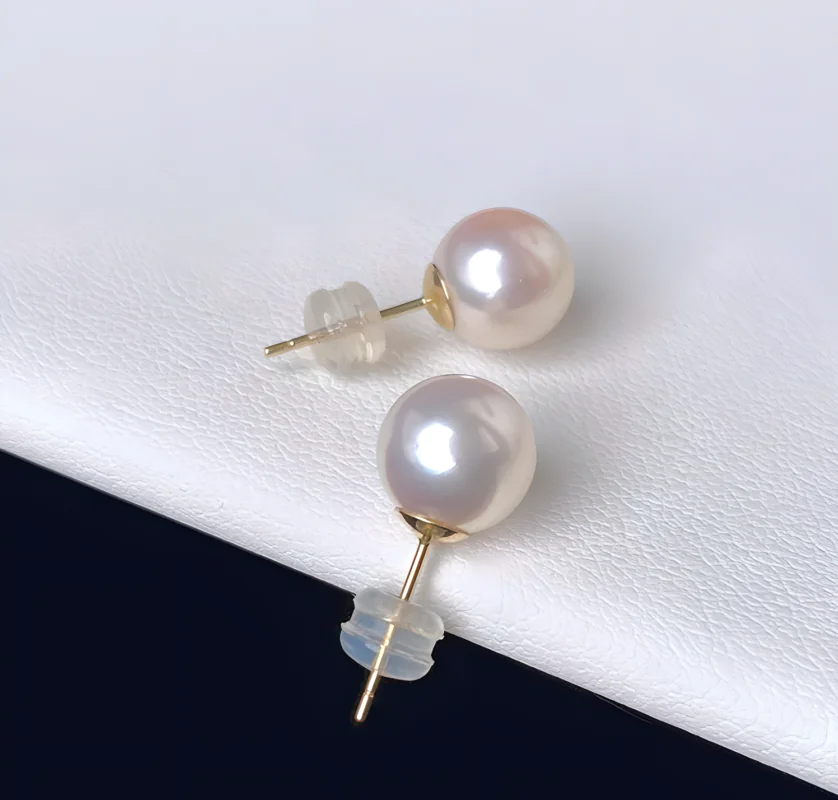
The tooth-rub test is useful as a quick screening clue, but it is not reliable enough to prove that a pearl is real. Many nacreous natural and cultured pearls feel faintly gritty when rubbed very gently against the edge of a tooth, while many common glass or plastic imitations feel smoother. But that difference is not universal, and the test cannot tell you whether a pearl is natural or cultured, what type it is, whether it has been treated, or how valuable it is.
The simplest way to think about the pearl tooth test is this: it can raise or lower suspicion, but it should not close the case.
What Is the Pearl Tooth Test?
The traditional tooth test involves lightly touching or rubbing a pearl against the biting edge of a front tooth and paying attention to the surface sensation.
On many nacreous pearls, the surface produces a fine sandy or slightly rough feeling. Many simple imitation pearls, especially smooth glass or plastic beads with a uniform coating, feel more slippery or glass-like.
That is why the test became popular: it is fast, requires no equipment, and can sometimes separate an obvious imitation from a typical nacreous pearl within seconds.
But the popular version of the advice often goes too far. A gritty sensation does not automatically prove “real pearl,” and a smooth sensation does not automatically prove “fake pearl.”
Why Do Many Real Pearls Feel Gritty?
Most familiar jewelry pearls—such as Akoya, freshwater, Tahitian, and South Sea pearls—have a nacreous surface. Nacre is built from microscopic calcium-carbonate structures combined with organic material. Its surface is not perfectly featureless at the microscopic level.
When that surface moves lightly against tooth enamel, the tiny surface structure can create the faint friction people describe as sandy, powdery, or similar to very fine sandpaper.
This is a real physical clue. The problem is not that the tooth test is imaginary; the problem is that people often treat one clue as if it were a complete gemological identification method.
What Can the Tooth-Rub Test Actually Tell You?
| Question | Can the tooth test answer it? |
|---|---|
| Could this be a typical nacreous pearl rather than a simple smooth imitation? | Sometimes — it can provide a useful clue |
| Is the pearl definitely real? | No |
| Is it natural or cultured? | No |
| Is it freshwater, Akoya, Tahitian, or South Sea? | No |
| Has the pearl been dyed, bleached, coated, or otherwise treated? | No |
| Is it high quality or valuable? | No |
This distinction matters because identifying a real pearl versus an imitation is only the first question. Once a pearl is known to be genuine, there are still separate questions about growth origin, pearl type, treatments, quality, and value.
Why the Tooth Test Is Not Proof of Authenticity
1. Surface feel is subjective
“Slightly gritty” is not a standardized measurement. Someone who has handled many pearls may recognize the sensation quickly, while a first-time buyer may not know whether what they are feeling counts as rough, smooth, or somewhere in between.
The result becomes even less useful when you do not have a known real pearl and a known imitation available for comparison.
2. Imitation pearls are not all made the same way
Some imitations are simple plastic beads. Others use glass cores, shell materials, multilayer coatings, or more sophisticated finishes. GIA has documented high-quality imitation products that can closely resemble cultured pearls in appearance.
That variety is important. A home test that works well against a cheap plastic bead should not automatically be assumed to work equally well against every modern imitation.
3. Surface condition can affect what you feel
Pearls can be polished, worn, scratched, coated, treated, or simply altered by years of use. An old surface and a fresh surface may not feel identical. That makes touch an imperfect basis for an absolute yes-or-no judgment.
4. Not every real pearl is nacreous
This is one of the biggest weaknesses in the usual internet explanation of the tooth test.
GIA distinguishes nacreous pearls from non-nacreous pearls. Conch and Melo pearls, for example, are genuine pearls but have porcelaneous, non-nacreous surfaces rather than the layered nacre structure associated with Akoya, Tahitian, South Sea, and many freshwater pearls.
So the statement “all real pearls feel gritty because all real pearls have nacre” is simply too broad. The tooth test is better understood as a rough screening method for many common nacreous pearls—not as a universal definition of a real pearl.
Can the Tooth Test Distinguish Natural Pearls from Cultured Pearls?
No. Both natural and cultured pearls can be genuine pearls formed inside mollusks, and both may have nacreous surfaces.
A tooth cannot reveal the pearl’s internal growth structure. That is the information needed to determine whether a pearl formed naturally or through a culturing process.
For that question, gemological laboratories use methods such as X-ray radiography. GIA describes microradiography as a key non-destructive way to examine the internal structure of pearls and distinguish natural, bead-cultured, and non-bead-cultured growth.
This is also why a pearl can “pass” the tooth test and still leave the most important identification question unanswered.
Can the Tooth Test Tell You Whether a Pearl Is Valuable?
No. Authenticity and value are separate issues.
A relatively inexpensive cultured freshwater pearl and an exceptional high-luster pearl can both be genuine. The tooth test does not evaluate the qualities that actually drive pearl value, such as size, shape, color, luster, surface quality, nacre quality, matching, rarity, and craftsmanship.
If your question is not merely “Is this real?” but “Is this a good pearl?”, use a quality framework such as our Pearl Grading Guide instead.
Can Rubbing a Pearl on Your Teeth Damage It?
It can if you rub too hard or repeat the test unnecessarily.
GIA describes pearl as a soft gem and warns that its surface can be scratched or abraded. That does not mean one extremely light touch will automatically ruin a pearl, but it does mean aggressive scraping is a poor identification habit—especially on an heirloom, an expensive strand, or a pearl you do not own.
If you choose to try the test on your own low-stakes piece, the goal is only to sense the surface with minimal pressure. Do not bite the pearl, scrape it repeatedly, or treat the test as a durability challenge.
What Should You Check Instead?
For home inspection, the best approach is to combine several non-destructive clues rather than trust one trick.
Look at the surface under magnification
Real cultured pearls often show subtle growth features, small surface variations, or tiny irregularities. An imitation may show a uniform coating, molded appearance, flaking, or a different material beneath a damaged surface.
Inspect the drill holes
Drill holes can reveal useful information. Coated imitations may show chipping, peeling, or a visible boundary between an outer finish and an inner bead. A clean drill hole does not prove authenticity, but obvious coating failure can be a strong warning sign.
Compare the whole strand
Do not judge one bead in isolation. Look at matching, surface character, luster, color variation, and drill-hole appearance across multiple pearls. A pattern of evidence is more useful than one isolated observation.
Read the seller's description carefully
Clear terminology matters. “Cultured pearl” and “imitation pearl” describe fundamentally different products. A trustworthy listing should tell you what the material actually is rather than relying only on words such as “pearl-like,” “shell pearl,” or a brand name.
If you are buying rather than inspecting an inherited piece, our Pearl Buying Guide explains which information is worth checking before purchase.
When Should You Skip Home Tests and Use a Laboratory?
Professional identification makes sense when the answer has real financial or historical importance—for example:
- an antique or inherited pearl strand
- a pearl represented as natural rather than cultured
- a rare conch, Melo, or other unusual pearl
- a high-value loose pearl or important piece of jewelry
- a case where treatment, color origin, or internal structure affects value
In these situations, a home texture test is not enough. Laboratories can combine visual examination with X-ray imaging, spectroscopy, fluorescence, and other methods depending on the identification problem.
A Better Way to Interpret the Tooth Test
Instead of thinking in terms of “gritty = real” and “smooth = fake,” use the result as one clue in a larger decision.
| What you notice | Better interpretation |
|---|---|
| Fine gritty sensation | Consistent with many nacreous pearls, but not proof of authenticity |
| Very smooth, glassy sensation | May increase suspicion of a smooth imitation, but does not prove it is fake |
| Result feels ambiguous | Ignore the test and move to visual inspection or professional identification |
| Pearl may be valuable or unusual | Skip rubbing and use a gemologist or laboratory |
Frequently Asked Questions
Does a gritty tooth test mean a pearl is real?
Not conclusively. A faint gritty sensation is consistent with the surface of many nacreous natural and cultured pearls, but it should be treated as a screening clue rather than proof.
Can a fake pearl pass the tooth test?
A tactile result can be ambiguous because imitation pearls use different cores and coatings. The tooth test is most useful against obvious smooth glass or plastic imitations and becomes less dependable as the imitation becomes more sophisticated.
Can the tooth test tell whether a pearl is natural or cultured?
No. Natural and cultured pearls can both have nacreous surfaces. Determining growth origin generally requires examination of internal structure, often with X-ray radiography.
Are cultured pearls real pearls?
Yes. Cultured pearls are genuine pearls formed inside living mollusks with human assistance. They should not be confused with imitation pearls, which are manufactured to simulate the appearance of pearls.
Is rubbing two pearls together better than using a tooth?
Not necessarily. It relies on the same general idea of surface friction and can also abrade pearl surfaces. For valuable jewelry, careful visual inspection and professional identification are preferable to repeated rubbing.
The Bottom Line
The tooth-rub test is a useful clue, not a reliable final test. A gritty sensation can support the idea that you are handling a typical nacreous pearl rather than a simple smooth imitation, but it cannot prove authenticity, distinguish natural from cultured, identify pearl type, detect treatment, or determine value.
The biggest mistake is asking one home test to answer too many questions. Use surface feel only as part of a broader inspection, and when provenance or value matters, rely on gemological testing rather than your teeth.
Sources
- Gemological Institute of America (GIA), “How GIA Analyzes Pearls from Start to Finish”
- Gemological Institute of America (GIA), FAQ: “How does GIA identify whether pearls are Natural or Cultured?”
- Gemological Institute of America (GIA), “Pearl Care and Cleaning Guide”
- Gems & Gemology, “Majorica Imitation Pearls”
- CIBJO Pearl Commission, Pearl Book