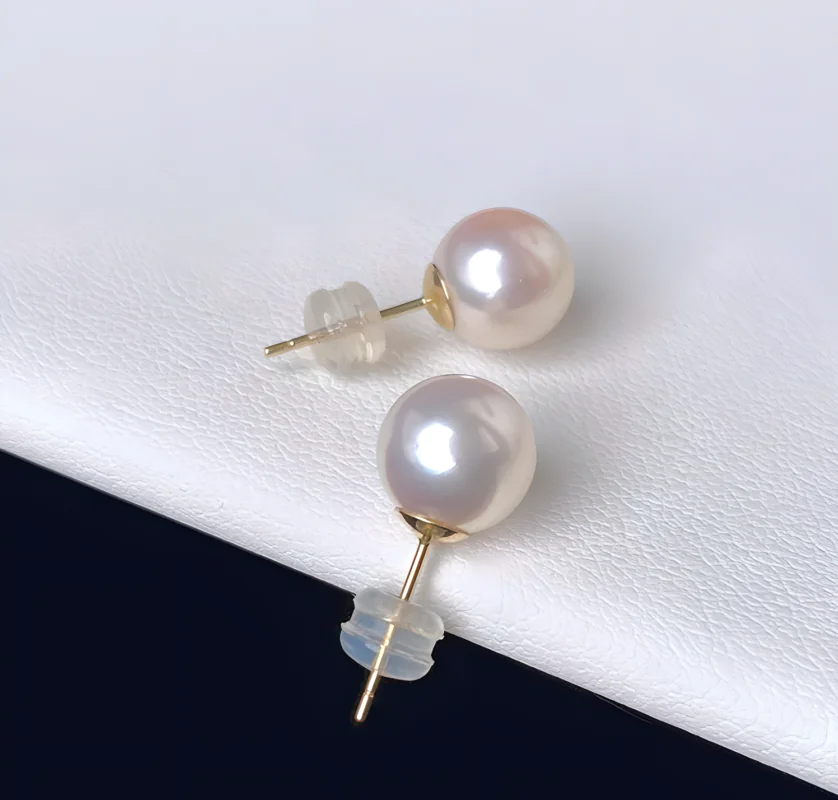
Appearance can sometimes reveal that a “pearl” is an imitation, but it cannot prove every pearl claim. If you can see a pearlescent coating peeling from a different core, an exposed glass or plastic bead, a molded seam, or the same artificial surface defect repeated across a strand, you have meaningful visual evidence. But a pearl that simply looks round, smooth, lustrous, imperfect, white, black, or expensive-looking has not yet proved what it is.
The useful question is not “Does this look real?” in the abstract. It is “What specific evidence is visible, and what conclusion can that evidence actually support?”
That distinction matters because “real pearl” can refer to both natural pearls and cultured pearls. Cultured pearls are genuine pearls formed by mollusks with human assistance. An imitation pearl is a manufactured look-alike. CIBJO’s pearl terminology likewise treats imitation or simulated pearls as a separate category from natural and cultured pearls.
The Short Answer: Appearance Is Better at Finding Red Flags Than Proving Identity
Visual inspection is strongest when it exposes how an imitation was manufactured. It is much weaker when you try to use appearance to infer hidden structure, treatment history, or geographic origin.
| Question | What appearance alone can do | Confidence |
|---|---|---|
| Is there an obvious manufactured coating or non-pearl core? | Peeling film, exposed glass/plastic/shell bead material, molded seams, or coating buildup can be strong evidence of imitation construction. | Often useful |
| Does the pearl have good luster, a clean surface, an attractive shape, or good matching? | These visible qualities can be judged directly, especially in person under controlled light. | Useful for appearance and quality |
| Is it definitely a genuine pearl? | Obvious imitations may be screened out, but a convincing imitation can still look plausible. | Sometimes, not universally |
| Is a genuine pearl natural or cultured? | The exterior may look very similar. Internal growth structure is usually the important evidence. | Not reliable by appearance alone |
| Is the color natural or treated? | Some color concentration or coating may look suspicious, but many treatments cannot be confirmed visually. | Clues only |
| Is it freshwater, Akoya, Tahitian, South Sea, or from a specific country? | Typical appearance can narrow possibilities, but overlap is real. | Suggestive, not definitive |
| What is the pearl worth? | Appearance shows some quality factors, but value also depends on identity, size, rarity, treatment, matching, documentation, and market context. | Not from appearance alone |
The Strongest Visual Evidence Is Usually Construction Evidence
A common mistake is to judge authenticity from beauty: “It glows, so it must be real,” or “It looks too perfect, so it must be fake.” Neither rule is dependable. Fine cultured pearls can be exceptionally round, clean, and lustrous. Good imitations can also be deliberately textured, carefully weighted, and coated to look convincingly pearlescent.
Visual inspection becomes more persuasive when you stop judging style and start looking for physical evidence of manufacture.
Peeling or chipping that exposes a different material
If a thin pearlescent layer is visibly lifting from a glass, plastic, resin, shell, or other bead underneath, that is far more informative than a vague impression that the object looks “plastic.” GIA has documented coated shell imitation pearls in which magnification revealed chipping and peeling around drill holes, exposing the shell bead beneath the artificial surface.
Existing damage can therefore become an inspection window. Do not create new damage by scratching, scraping, cutting, or enlarging a hole. The goal is to read what is already visible, not destroy the object in order to test it.
Repeated molded features or mechanically identical defects
Compare several pearls, not just one. Biological pearls can be matched very closely, especially in fine strands, so uniformity is not automatically suspicious. What matters more is manufacturing repetition: the same seam, the same molded opening, the same coating ridge, or the same artificial surface pattern appearing repeatedly.
A well-matched cultured pearl necklace consists of individual biological gems that were sorted to look harmonious. A manufactured strand may reveal repeated construction features because the beads were made by the same process. That is a more useful distinction than “real pearls are never perfect.”
Artificial-looking film, glitter, bubbles, or resinous surface behavior
Some imitation coatings show an oily, glittery, paint-like, resinous, or film-like appearance under magnification. GIA’s laboratory reports on shell and other imitation pearls describe surface features that looked unlike normal nacre and, in some cases, required further analytical testing to confirm what the material actually was.
This is important for two reasons. First, unusual surface behavior can be a useful red flag. Second, even trained laboratories do not always stop at appearance. If sophisticated imitations can require microscopy, X-radiography, spectroscopy, or other testing, a consumer should be cautious about making absolute claims from one photograph.
Drill Holes Are Useful—but They Are Not a Certificate
If a pearl is drilled, the hole is one of the best places to inspect because it interrupts the outer surface. Use a loupe, macro lens, or clear close-up photograph and look for:
- a thin coating peeling away from a different-colored core;
- paint-like buildup or a separate film around the edge;
- chipping that exposes glass, plastic, resin, or obvious shell-bead material;
- a molded rather than drilled-looking opening;
- the same suspicious construction feature repeated across many pearls.
What you should not do is treat every imperfect drill hole as evidence of a fake. Genuine pearls can be poorly drilled, chipped, worn, dirty, abraded, or damaged during use. Some genuine pearls may also have surface treatments. The relevant question is not “Is the hole rough?” but “Does the hole reveal a clearly separate manufactured layer or core?”
For a broader set of home screening methods, including non-visual clues, see our real vs. fake pearl guide.
Luster Can Be Judged Visually; Authenticity Cannot Be Judged from Luster Alone
Luster is one of the most important visual qualities of a pearl. GIA evaluates pearl luster by the intensity and sharpness of reflected light. High-luster pearls show bright, crisp reflections; lower-luster pearls appear softer, hazier, or chalkier.
That makes luster highly useful for judging appearance and quality. It does not make luster a stand-alone authenticity test.
A genuine pearl can have weak luster because of its original quality, nacre condition, wear, chemical damage, or surface deterioration. An imitation can be coated to create an attractive pearlescent effect. So “deep glow means real” and “flat shine means fake” are best treated as tendencies, not verdicts.
This separation is useful when shopping: first ask what the object is, then evaluate how good it looks. Our pearl grading guide explains how luster, surface, shape, size, color, nacre, and matching work together when judging quality.
Surface Marks and Imperfections Are Evidence of Condition, Not Automatic Proof of Authenticity
Real pearls commonly show surface characteristics such as small pits, wrinkles, ridges, growth lines, flattened areas, or other irregularities. These can support the impression that you are looking at a biological gem.
But the internet shortcut “real pearls have imperfections; fake pearls are flawless” fails in both directions.
- Fine cultured pearls can have very clean surfaces.
- Imitation pearls can be intentionally textured or irregular.
- Damage can make a genuine pearl look artificial.
- A manufactured coating can develop wear marks that resemble natural irregularity.
Surface features are most informative when they are interpreted together with luster, drill-hole behavior, wear, and strand-level variation. If you are trying to distinguish normal growth features from actual damage, our guide to pearl surface and blemishes provides a more focused framework.
Perfect Roundness Does Not Mean Fake
Roundness is one of the most persistent sources of bad pearl advice. A perfectly or nearly round object is easy to manufacture, so roundness can occur in imitation pearls. But round cultured pearls are also real and can be highly desirable.
GIA lists shape as one of the seven pearl value factors and notes that round cultured pearls are relatively difficult to produce. That means an unusually round strand may be expensive precisely because genuinely round pearls had to be selected and matched—not because the strand is artificial.
Likewise, irregularity does not prove authenticity. Baroque shape is common in genuine pearls, but a manufacturer can also make an irregular bead. Shape should answer the question “What form is this pearl?” rather than “Is this pearl real?”
Color Can Raise a Question, but It Rarely Settles the Question
Pearls naturally occur in a wide range of bodycolors and overtones, while cultured pearls can also be dyed, irradiated, coated, bleached, or otherwise processed. A pearl can therefore be genuine and still have treated color.
Visible clues such as concentrated color around drill holes, cracks, pits, or surface damage may suggest dyeing or coating. Unusually uniform or paint-like color may also deserve a closer look. But the absence of these clues does not prove that the color is natural.
This is why “Is it real?” and “Is the color natural?” should be treated as two different questions. For the second question, see our guide to pearl treatments and enhancements.
What Appearance Alone Usually Cannot Prove
Natural pearl vs. cultured pearl
A natural pearl and a cultured pearl can overlap strongly in color, shape, luster, surface, and size. The decisive evidence may be inside the pearl rather than on the surface.
GIA states that it uses digital X-radiography together with visual observation and other testing to determine whether pearls are natural or cultured, and describes microradiography as the most reliable non-destructive method for observing internal pearl structure. This is the clearest example of why an attractive exterior cannot answer every identity question.
Natural color vs. treated color
Some treatments create visible clues. Others may require microscopy, spectroscopy, fluorescence testing, X-ray methods, or a combination of observations. If a rare natural color is an important part of the price, visual confidence is not the same as documentary or laboratory evidence.
Freshwater vs. saltwater in every case
Experienced pearl professionals can often recognize familiar commercial types from combinations of size, shape, color, luster, surface, and market context. But modern freshwater and saltwater cultured pearls overlap enough that appearance should not be treated as a universal diagnostic rule.
Exact mollusk species or geographic origin
A pearl may look consistent with Akoya, Tahitian, South Sea, or freshwater material, but appearance is not a passport. Exact species or geographic origin can require supply-chain documentation, laboratory evidence, or both.
Exact nacre structure or thickness
Severe nacre problems may be visible—for example, a chalky appearance or an obvious nucleus showing through. But a normal photograph does not reveal the complete internal growth structure or provide a precise nacre measurement.
A Better Way to Judge a Pearl Visually: Use an Evidence Hierarchy
Instead of collecting random “real pearl tricks,” rank what you see by how directly it relates to the object’s construction.
Stronger visual evidence
- a separate pearlescent coating visibly peeling from a non-pearl core;
- an exposed glass, plastic, resin, shell bead, or fibrous material beneath the surface;
- a visible molded seam or manufacturing remnant;
- the same artificial coating defect or molded feature repeated across many beads.
Moderate visual evidence
- an unusual glittery, oily, paint-like, or film-like surface;
- suspicious buildup around several drill holes;
- mechanically repetitive surface texture across a strand;
- flat or artificial-looking luster when combined with other manufacturing clues.
Weak evidence when used alone
- perfect roundness;
- visible blemishes;
- a flawless surface;
- strong shine;
- white, pink, black, golden, or another particular color;
- an expensive-looking setting;
- a seller calling the piece “vintage,” “natural,” or “real.”
This hierarchy is more useful than memorizing one trick because it asks how directly the observation connects to material construction. A visible coating peeling off a glass bead is direct evidence. “This pearl looks too perfect” is only an impression.
How to Inspect a Pearl Without Damaging It
- Start with neutral, diffuse light. Strong yellow lighting, colored backgrounds, and direct flash can distort color and luster.
- Rotate the pearl. A single angle can hide coating edges, surface marks, flattening, or unusual reflection behavior.
- Use magnification. A 10× loupe or a good macro photograph is especially useful for drill holes and damaged areas.
- Inspect existing wear. Look where thread, clasps, metal findings, or neighboring beads have rubbed the surface.
- Compare several pearls. Repeated artificial features across a strand can be more revealing than one isolated mark.
- Separate identity from quality. Judge luster, surface, shape, and matching, but do not treat those qualities as proof of origin.
- Stop when the question moves inside the pearl. Do not scratch, burn, cut, dissolve, or aggressively scrape a pearl to force an answer.
If the item is valuable, antique, inherited, or represented as natural, the safest next step is professional gemological examination rather than increasingly destructive home tests. Our broader pearl identification guide explains how visual inspection fits into a more complete identification process.
Can You Tell If a Pearl Is Real from a Photo?
A good photograph can reveal useful red flags: peeling coating, an exposed core, obvious seams, suspicious drill-hole edges, repeated surface patterns, or severe wear. Multiple sharp macro images under neutral light are much more useful than one distant product photo.
But photography also removes evidence. You cannot feel the object, rotate it freely, change the lighting yourself, inspect every drill hole, or see hidden internal structure. Phone processing can sharpen reflections, smooth skin-like texture, alter white balance, and compress small details. Retouching can remove exactly the marks that would have been useful.
So a photograph can support statements such as “this area looks consistent with a coating” or “no obvious imitation construction is visible here.” It usually should not support claims such as “this is definitely a natural pearl” or “this dark color is unquestionably untreated.”
When Is Laboratory Testing Worth It?
Laboratory testing is most useful when the unanswered question materially changes the pearl’s value, rarity, or description. Examples include:
- a pearl being sold as natural rather than cultured;
- a valuable antique or inherited strand with uncertain identity;
- a rare natural-color claim that contributes significantly to price;
- an unusual pearl whose freshwater or saltwater origin matters;
- a treatment dispute;
- a high-value purchase for which independent documentation is appropriate.
GIA’s current pearl-analysis workflow begins with visual and surface examination, then uses methods such as X-radiography and other analytical techniques as needed. The sequence itself is instructive: looking is the beginning of identification, not always the end.
The Bottom Line
You can sometimes tell that a pearl is imitation from appearance alone, especially when its construction is visibly exposed. You usually cannot prove every aspect of a genuine pearl’s identity from the outside.
Prioritize evidence that shows how the object is built: peeling coatings, exposed cores, molded features, repeated manufacturing patterns, and suspicious behavior around drill holes. Treat luster, surface marks, roundness, color, and overall perfection as supporting observations rather than universal tests.
Once the question becomes natural vs. cultured, untreated vs. treated, freshwater vs. saltwater in a difficult case, or exact origin, appearance has reached its limit. At that point, the most accurate answer is not another visual trick—it is better evidence.
FAQ
Can you tell if a pearl is real just by looking at it?
Sometimes. Obvious imitation construction—such as peeling coating over a different core—can be visible. But a convincing imitation may look plausible, so appearance alone cannot always give a definitive answer.
Do real pearls always have imperfections?
No. Genuine cultured pearls can have very clean surfaces, while imitation pearls can be deliberately textured. Imperfections are supporting clues, not proof.
Are perfectly round pearls fake?
No. High-quality cultured pearls can be very round and carefully matched. Roundness describes shape, not authenticity.
Can a drill hole prove that a pearl is real?
A drill hole can reveal strong evidence, especially if a coating is peeling and a different core is exposed. But a clean drill hole does not certify authenticity, and genuine pearls can also have damaged or rough holes.
Can you tell natural pearls from cultured pearls by appearance?
Not reliably. Their exterior appearances can overlap substantially. Professional laboratories use X-radiography and other methods to examine internal growth structures.
When should I get a pearl tested professionally?
Consider independent testing when the item is valuable, antique, represented as natural, unusually colored, or when treatment or origin materially affects the price or description.