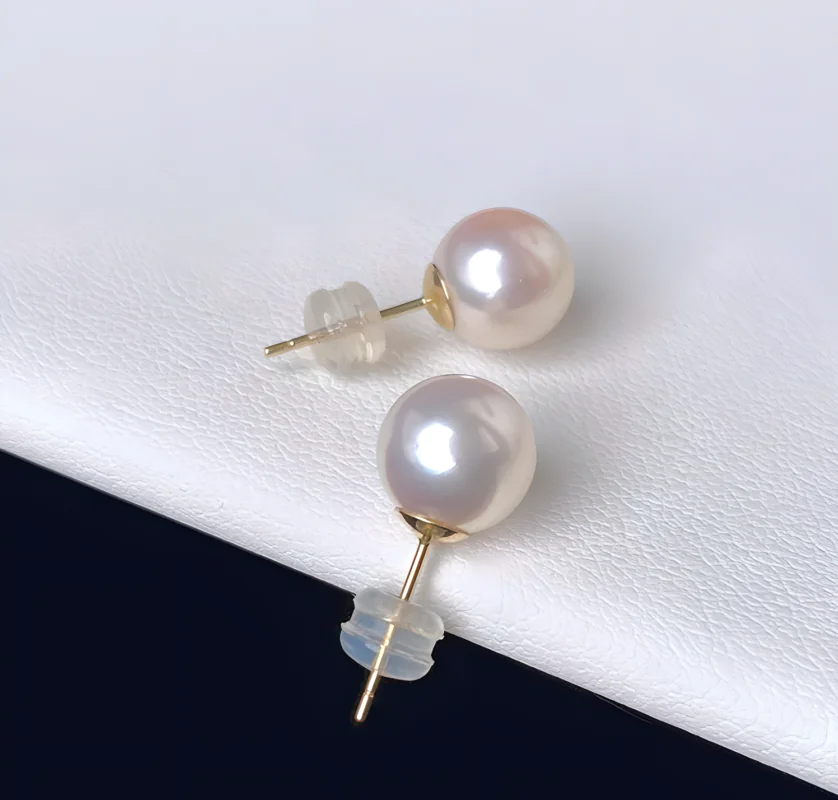
The strongest clues that a pearl may be an imitation usually come from how the object was manufactured, not from whether it looks “too perfect.” Peeling coatings, exposed glass or plastic cores, molded-looking drill holes, repeated artificial textures, and a surface that behaves like a separate film are more meaningful warning signs than roundness, color, or price alone.
No single home observation is conclusive in every case. High-quality imitation pearls can be surprisingly convincing, and genuine cultured pearls can be extremely round, clean, and well matched. The practical goal is therefore to recognize suspicious patterns and know when closer examination is justified.
First: cultured pearls are not imitation pearls
A cultured pearl is a real pearl formed by a mollusk with human assistance. An imitation pearl is a manufactured object designed to resemble a natural or cultured pearl. Its core may be glass, plastic, shell, or another material, often covered with a pearlescent coating.
This distinction matters because “real versus fake” discussions often blur two different questions: whether an object is actually a pearl, and whether a real pearl is natural or cultured. The first question can sometimes be screened visually. The second commonly requires examination of internal structure and may require laboratory X-ray methods.
For the broader distinction between genuine and imitation pearls, see our real vs. fake pearl guide.
The most useful imitation clues at a glance
Think of clues in three levels. Evidence that reveals construction is usually more persuasive than a general impression about how a pearl “should” look.
| Clue | Why it matters | How useful is it? |
|---|---|---|
| Peeling or chipped pearlescent coating | May reveal a separate manufactured surface layer | Strong when a clearly different core is visible |
| Exposed glass-, plastic-, or bead-like core | Shows that the pearly appearance is only a surface treatment | Strong |
| Ragged, coated, pooled, or molded-looking drill hole | Drilling interrupts the surface and may expose construction | Moderate to strong |
| Glittery, paint-like, oily, or film-like surface | May indicate an artificial coating rather than nacre | Moderate |
| Identical artificial marks repeated across a strand | Mechanical repetition can point to molding or coating processes | Moderate |
| Perfect roundness or very uniform matching | Can occur in both fine cultured pearls and manufactured beads | Weak by itself |
| Weight, temperature, or smoothness | Depends heavily on whether the imitation core is plastic, glass, shell, or another material | Weak to moderate |
1. Peeling, flaking, or chipping around the surface
One of the clearest warning signs is a pearlescent layer that behaves like a coating sitting on top of another material. Look especially around drill holes, worn edges, clasp contact points, and places where neighboring beads rub against one another.
Under magnification, an imitation may show a thin skin lifting from the bead, flakes missing from the surface, or a sharply different material beneath the pearly finish. GIA has documented shell-bead imitations with a glittery artificial coating that chipped near drill holes and exposed the white shell core underneath.
The key idea is not simply “damage.” Genuine pearls can also be scratched, abraded, chipped, or worn. The more useful clue is a distinct manufactured layer separating from a different core.
If the concern is whether damage represents genuine nacre deterioration rather than an imitation coating, compare the appearance with our guide to pearl surface cracks and nacre peeling.
2. A visibly different core beneath the pearly finish
If wear or damage exposes material that is clearly different from the outer pearlescent surface, the clue becomes much stronger. The core may look transparent, glassy, plasticky, chalky, shell-like, or simply unlike the surrounding finish.
Many imitation pearls are constructed exactly this way: a bead supplies the shape and weight, while a coating supplies the pearl-like appearance. However, the core material itself can vary widely. A glass imitation may feel substantial, a plastic imitation may be light, and a shell-based imitation can be surprisingly close to a cultured pearl in both appearance and heft.
If you want to compare the common core materials in more detail, see shell, glass, and plastic imitation pearls.
3. Drill holes that reveal coating behavior
Drill holes are especially useful because drilling cuts through the exterior and can expose the relationship between the surface and the interior.
With a 10× loupe, examine the rim rather than trying to see deep inside the bead. Suspicious features can include:
- ragged flakes of coating around the edge;
- a pearly layer bridging or lifting away from the core;
- coating material pooled around the opening;
- a clearly different material visible underneath;
- an opening that appears molded as part of the bead rather than drilled afterward;
- the same unusual drill-hole construction repeated across many beads.
GIA studies of imitation pearls have repeatedly found useful evidence around drill holes, including ragged coating edges, exposed underlying bead material, and unusually formed openings. A drill hole is therefore often more informative than the center of an undamaged surface.
Still, a rough drill hole alone does not prove imitation. Genuine pearls can be drilled poorly, worn by thread, or damaged during restringing.
4. A glittery, oily, paint-like, or overly surface-level shine
Imitation pearl coatings can produce attractive luster, so “shiny” is not the problem. The more suspicious appearance is a finish that seems to sit only on the surface: glitter-like particles, an oily rainbow effect, a plasticky sheen, or a uniform paint-like film.
Real nacre can show complex reflections and orient, but those effects arise from layered biological structure. Under magnification, nacreous pearls may show fine overlapping surface structures rather than a particulate coating. GIA's examination of shell imitations found glittering particles and a lack of the expected overlapping nacre platelets.
This remains a comparative clue, not a verdict. Some genuine pearls have weak or chalky luster, while sophisticated imitation coatings can look deep and convincing in ordinary light.
5. Mechanical repetition across a strand
A single bead can be difficult to judge. A strand gives you more evidence because you can compare many surfaces, drill holes, and wear patterns at once.
Fine cultured pearl strands can be exceptionally well matched, so uniform size and roundness are not enough. Instead, look for repetition that resembles manufacturing: identical dimples, the same artificial-looking texture, the same coating edge around every hole, or blemish-like marks that recur in nearly the same form.
Biological pearls can be sorted to look similar, but their small surface variations usually do not repeat like a molded pattern. The distinction is between careful matching of individual pearls and duplication created by a production process.
6. Seams or molding marks
Some plastic or molded imitation beads can show a faint seam, ridge, or other manufacturing mark. This is particularly suspicious when the line repeats in a consistent location or orientation across several beads.
A visible seam is more useful than general smoothness because it points directly to how the object was formed. However, absence of a seam tells you very little: glass, shell, and higher-quality plastic imitations may have no obvious molding line at all.
7. Weight and temperature that do not fit the expected material
Weight and temperature can support an identification, but they are poor stand-alone tests because imitation pearls are made from different materials.
- Plastic-core imitations are often relatively light and may warm quickly.
- Glass-core imitations can be heavy and cool to the touch, sometimes making them feel more convincing rather than less.
- Shell-core imitations can have weight and thermal behavior that overlap substantially with genuine pearls.
This is why statements such as “fake pearls are always light” or “real pearls are always colder” are too simple. Weight and temperature are most useful only when you already have a reasonable idea of the size and likely construction.
8. A smooth tooth-test result can support suspicion—but grit does not prove authenticity
The familiar tooth test is based on the fine texture of nacre. A genuine nacreous pearl often feels slightly gritty when gently touched to the edge of a front tooth, while many coated imitations feel smooth.
But this test has two important limits. First, it can damage or contaminate jewelry and is unnecessary when magnification is available. Second, manufacturers can create textured imitation surfaces. GIA's study of Majorica imitation pearls specifically noted that a gritty surface can be manufactured, meaning that “gritty = real” is not a safe conclusion.
Use texture as one clue among several, never as the final decision.
9. “Too perfect” is only a reason to inspect more closely
Perfect-looking roundness, clean surfaces, and excellent matching are commonly presented online as signs of fake pearls. That rule is unreliable.
High-quality cultured pearls can be round, smooth, bright, and very closely matched because large numbers of pearls are sorted to assemble fine strands. Conversely, many imitation pearls are deliberately made slightly irregular to appear more natural.
A better question is: Does the perfection come with evidence of manufactured construction? If perfectly matched beads also show identical coating boundaries, repeated molded marks, or the same unnatural drill-hole structure, the combination becomes more meaningful.
10. Product wording can be another clue when buying online
When you cannot inspect the pearls physically, terminology matters. Phrases such as “shell pearl,” “pearl-like,” or branded imitation names can obscure what the object actually is if the seller does not clearly disclose the construction.
The current CIBJO Pearl Book states that pearl imitations or simulants should be clearly described as imitation or simulated pearls. GIA has also documented commercially sold “shell pearls” that were shell beads coated with artificial material and therefore properly classified as imitation pearls.
Before buying, look for a direct answer to a simple question: Was this object formed by a mollusk, or is it a manufactured bead made to look like a pearl? Clear sellers should be able to answer without relying on vague trade language.
Which clues deserve the most weight?
If several signs conflict, prioritize evidence of construction.
- Highest value: exposed non-pearl core, peeling artificial film, obvious seam, or clearly manufactured drill-hole structure.
- Next: glittery or paint-like coating, repeated artificial textures, and mechanical repetition across many beads.
- Supporting only: smooth feel, unusual weight, temperature behavior, uniformity, color, or price.
This approach is more reliable than trying to memorize one trick. The best question is not “Does this pearl pass the tooth test?” but “Do several independent observations point to a manufactured object?”
When common clues are not enough
Some imitation pearls are difficult to separate visually from genuine pearls. GIA reported a 2025 case in which one imitation bead was mixed among thousands of pearls and looked similar to neighboring pearls until closer examination and laboratory testing revealed abnormal features.
Professional testing becomes especially appropriate when the item is valuable, antique, represented as natural, part of an important estate or insurance claim, or simply too ambiguous to judge without damaging it. Laboratory methods may include magnification, X-ray imaging, spectroscopy, and other tests depending on the identification problem.
For a more systematic introduction to what gemologists examine, continue with our pearl identification guide.
The practical rule: look for construction, not stereotypes
Imitation pearls are manufactured objects, so the most revealing clues tend to be manufacturing clues: a coating that separates from its core, a drill hole that exposes layered construction, a molded seam, repeated artificial texture, or a surface finish that behaves like paint rather than nacre.
Roundness, smoothness, weight, temperature, and even the tooth test are much weaker when used alone. Combine observations, compare several pearls whenever possible, and treat home identification as screening rather than certification.
FAQ
What is the clearest sign that a pearl may be an imitation?
A clearly separate pearlescent coating peeling away from a visibly different glass, plastic, or other bead core is one of the strongest practical clues. It directly reveals manufactured construction rather than relying on appearance alone.
Are perfectly round pearls usually fake?
No. High-quality cultured pearls can be very round and closely matched. Roundness is only a weak clue unless it appears together with stronger manufacturing evidence such as repeated molded marks or coating behavior.
Can shell pearls be imitation pearls?
Yes. A shell bead coated with artificial material to imitate a pearl is an imitation pearl even though the core itself comes from shell. The important distinction is whether the object was formed as a pearl by a mollusk or manufactured as a look-alike bead.
Does a gritty tooth test prove a pearl is real?
No. Genuine nacre often feels slightly gritty, but imitation surfaces can also be manufactured with texture. The tooth test should be treated only as a supporting clue, and magnified visual examination is preferable when possible.
Can an imitation pearl look almost identical to a real pearl?
Yes. Good imitation pearls can closely reproduce color, luster, weight, and even surface texture. When construction clues are absent and the identification matters financially, professional gemological testing is the safer next step.
Sources and further reading
- GIA Gems & Gemology: Shell Pearl as a Pearl Imitation
- GIA Gems & Gemology: Majorica Imitation Pearls
- GIA Gems & Gemology: Imitation Seed Pearl with Blue X-Ray Fluorescence
- GIA Gems & Gemology: Applications of X-Ray Radiography and X-Ray Computed Microtomography in Gemology
- CIBJO Pearl Book: Pearl terminology and disclosure standards