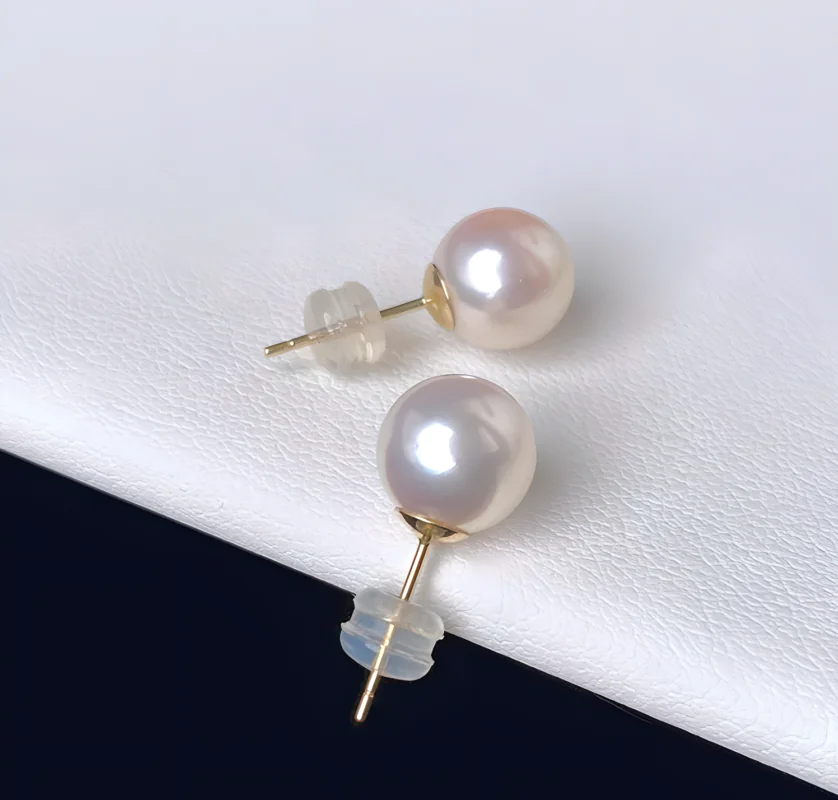
Pearls are durable enough for regular wear, but they are not hard-wearing gemstones in the same sense as sapphire or diamond. Their surface scratches relatively easily, and heat, acids, cosmetics, and repeated abrasion can gradually damage the nacre. At the same time, a sound pearl is not so fragile that it should stay in a jewelry box.
The most useful way to think about pearl durability is this: pearls tolerate normal, thoughtful wear much better than they tolerate friction, chemicals, heat, and repeated impact. A well-made pearl necklace or pair of earrings can remain beautiful for decades, while a pearl ring worn through rough daily activity may show wear much sooner.
That difference becomes clearer once durability is separated into several different properties rather than reduced to one hardness number.
Pearl Durability Is More Than Hardness
When people ask whether pearls are durable, they are usually asking several questions at once:
- Do pearls scratch easily?
- Can they chip or crack?
- Will the nacre wear away?
- Can perfume, sweat, or heat damage them?
- Are they suitable for everyday jewelry?
These are different forms of durability. Gemologists normally distinguish between properties such as hardness, which describes resistance to scratching, and toughness, which describes resistance to breaking or chipping. Stability—how a gem reacts to heat, light, and chemicals—is another part of the picture.
According to the Gemological Institute of America (GIA), pearl is about 2.5 on the Mohs hardness scale and is therefore relatively easy to scratch or abrade. GIA also describes pearl toughness as usually good. In other words, a pearl can be soft without being structurally flimsy.
For more detail on why pearls behave this way, see our guide to the physical and chemical properties of pearls.
1. Pearls Have Low Scratch Resistance
This is the most important durability limitation in ordinary wear. Pearl nacre is much softer than many gemstones, metals, and even some particles of dust or grit that may become trapped between jewelry pieces.
A pearl does not need to suffer one dramatic accident to look worn. Repeated rubbing can gradually create fine scratches, broader abrasion, dull patches, or a less crisp reflection. Because luster depends strongly on the condition of the pearl's surface and underlying nacre, small amounts of wear can eventually become visible.
This is why pearls should not be stored loose against diamond, sapphire, or metal jewelry. It is also why rings and bracelets generally face more abrasion than earrings or pendants: they touch desks, clothing, bags, skin, and other objects far more often.
If you are trying to identify an existing mark, our guide to scratches, abrasion, and wear damage on pearls explains how those patterns differ.
2. Pearls Are Not Automatically Brittle
Low hardness is sometimes mistaken for low toughness. They are not the same thing.
A pearl is a layered biological composite rather than a single mineral crystal. In nacreous pearls, microscopic calcium-carbonate platelets are bound within an organic matrix. That structure gives a sound pearl a useful degree of toughness, which is one reason pearl necklaces and earrings can survive many years of normal wear.
Still, pearls are not impact-proof. A strong blow can chip the surface, open an existing crack, damage nacre around a drill hole, or loosen a pearl from its setting. Older pearls, dehydrated pearls, and pearls with compromised nacre may also be more vulnerable than healthy pearls in good condition.
The practical distinction is simple: do not worry that a pearl will crumble during ordinary wear, but do protect it from hard knocks and repeated rubbing.
3. Nacre Quality Has a Major Effect on Long-Term Durability
For cultured pearls, durability is not determined by pearl type alone. The quality and condition of the nacre matter greatly.
GIA evaluates nacre because its thickness, continuity, and condition can affect appearance and, in some cases, durability. A pearl with thin, damaged, chalky, peeling, or disrupted nacre deserves more caution than a pearl with sound, continuous nacre.
This is especially easy to understand in a bead-cultured pearl. The bead nucleus makes up much of the interior, while the nacre forms the visible outer layer. If that layer is too thin or has already begun to separate, there is less margin for future wear.
However, thicker or better nacre does not make a pearl scratch-proof. A high-quality pearl is still a relatively soft gem. Nacre quality improves one part of the durability equation; it does not eliminate the normal vulnerabilities of pearls.
See our detailed guide on how nacre quality affects pearl durability if you want to inspect this factor more closely.
4. Chemicals and Heat Can Damage Pearls Even Without Scratching Them
A pearl can look physically protected and still be damaged chemically. Nacre is composed largely of calcium carbonate, which is sensitive to acids. GIA also warns that pearls can be affected by cosmetics, hair spray, perfume, perspiration, high heat, and other chemical exposure.
This matters because chemical damage does not always look like a conventional scratch. The surface may gradually become dull, etched, discolored, cracked, or otherwise altered.
Heat is another concern. Excessive heat can dehydrate pearls and may contribute to discoloration, cracking, or splitting. Steam cleaning is therefore inappropriate for pearl jewelry, and ultrasonic cleaning is also generally avoided.
If you want the chemistry behind these warnings, read why pearls are sensitive to acid, perfume, and chemicals.
5. Jewelry Design Changes How Durable a Pearl Feels in Real Life
The same pearl can have very different wear risk depending on where it is used.
| Jewelry type | Typical exposure | Practical durability for frequent wear |
|---|---|---|
| Stud earrings | Low friction and low impact | Very practical |
| Pendants | Usually limited contact with hard surfaces | Very practical |
| Necklaces | Skin, clothing, cosmetics, and strand-to-strand contact | Good with routine care |
| Bracelets | Frequent movement and contact with desks and objects | More exposed to wear |
| Rings | High risk of knocks, rubbing, soap, and hand products | Requires the most care |
This is more useful than asking whether one pearl variety is simply “durable” or “delicate.” If frequent wear is the goal, placement and jewelry design can matter as much as the pearl itself.
For example, a pearl stud can be an easy everyday piece because it rarely strikes hard surfaces. A pearl ring may use an equally good pearl yet accumulate wear faster because hands constantly contact objects.
Are Freshwater Pearls More Durable Than Akoya, Tahitian, or South Sea Pearls?
There is no single ranking that is correct in every case.
Many tissue-nucleated freshwater cultured pearls consist almost entirely of nacre, which means there is no large bead nucleus immediately beneath a thin outer shell. That can be an advantage when thinking about nacre wear. Bead-cultured pearls such as Akoya, Tahitian, and South Sea pearls depend more directly on the quality and condition of the nacre surrounding the nucleus.
But that does not mean every freshwater pearl is automatically more durable than every saltwater pearl. Surface condition, nacre quality, processing, existing damage, jewelry setting, and how the piece is worn all matter. A high-quality bead-cultured pearl with sound nacre can perform very well for decades, while a poorly treated or damaged freshwater pearl can deteriorate much sooner.
For buying decisions, it is better to assess the actual pearl than to rely on a simple species-based durability ranking. Our pearl grading guide explains the quality factors worth evaluating together.
Can Pearls Be Worn Every Day?
Yes—provided “every day” means normal wear rather than every activity.
Pearls are well suited to regular use in earrings, pendants, necklaces, and other relatively protected designs. They are less suited to situations involving repeated impact, heavy perspiration, household chemicals, swimming pools, exercise equipment, showers, or rough manual work.
A useful rule is to separate daily jewelry from 24-hour jewelry. Pearls can be daily jewelry. They should not be treated as something that stays on through every task, shower, workout, and cleaning job.
That distinction avoids both extremes: pearls are neither indestructible nor too delicate to enjoy.
How Long Can Pearls Last?
There is no reliable fixed lifespan for a pearl. Two pieces of the same age can look very different because their wear history, storage conditions, nacre quality, treatments, and jewelry design may be completely different.
Well-cared-for pearls can remain wearable for decades and may be passed between generations. But “can last for generations” should not be read as a guarantee that the surface will remain unchanged. A frequently worn pearl can accumulate fine abrasion and other signs of age even when it remains structurally sound.
It is also important to separate the pearl from the rest of the jewelry. A necklace may need restringing long before the pearls themselves need replacement, while a ring may need prong, cup, adhesive, or mounting inspection even when the pearl is still attractive.
What Kind of Damage Matters Most?
Not every imperfection is a durability problem. Natural pits, wrinkles, ridges, growth marks, and other surface features may simply be part of how a pearl formed.
More concerning signs include:
- active peeling or flaking of nacre;
- open cracks or chips;
- heavy abrasion that has visibly flattened or dulled the surface;
- damage around drill holes;
- areas where a bead nucleus appears to be showing through;
- a loose pearl, damaged mounting, or severely worn string.
For a deeper visual distinction between normal surface character and structural concern, see our guide to pearl surface cracks and nacre peeling.
How to Make Pearls Last Longer
Pearl care is mainly about reducing unnecessary exposure. You do not need elaborate rituals.
- Put pearls on after cosmetics and fragrance. This reduces direct exposure to perfume, hairspray, lotion, and makeup.
- Remove them for rough or wet activities. Exercise, cleaning, swimming, showering, and manual work add impact, sweat, detergents, or other avoidable exposure.
- Wipe them after wear. A very soft, clean cloth helps remove skin oils and surface residue.
- Store them separately. Keep pearls away from harder gemstones, chains, and sharp metal edges that can abrade nacre.
- Inspect the whole piece. Check clasps, settings, drill holes, knots, and string—not only the pearl surface.
- Avoid aggressive cleaning. Steam, ultrasonic cleaning, acids, abrasives, and harsh jewelry cleaners are inappropriate for pearls.
For a complete routine, see our pearl care and maintenance guide.
The Bottom Line
Pearls are soft but reasonably tough. Their main weaknesses are scratching, abrasion, chemical sensitivity, excessive heat, and damage to the nacre. Their real-world durability also depends heavily on nacre quality and the way the pearl is mounted and worn.
So, how durable are pearls? Durable enough to wear and enjoy regularly, but not durable enough to ignore how you wear them. Earrings and pendants can be highly practical for frequent use; necklaces do well with basic care; bracelets and rings demand more attention because they encounter more friction and impact.
If you remember only one idea, make it this: pearls do not need to be babied, but they do need to be protected from avoidable wear.
Frequently Asked Questions
Do pearls scratch easily?
Yes. Pearls are relatively soft, with GIA listing a Mohs hardness of about 2.5–3.0. They can be scratched or abraded by harder gemstones, metal edges, and repeated friction.
Can pearl jewelry last a lifetime?
It can. Sound pearls that are worn and stored carefully can remain attractive for decades. Longevity depends on nacre condition, treatment history, frequency of wear, chemical exposure, storage, and the jewelry construction, so there is no guaranteed lifespan.
Are pearls durable enough for everyday wear?
Many pearl pieces are. Stud earrings, pendants, and necklaces are generally easier to wear frequently because they experience less impact than rings and bracelets. Pearls should still be removed for swimming, exercise, cleaning, showering, and rough work.
Can a scratched pearl be polished back to new?
Not always. If dullness comes from removable residue, gentle cleaning may improve the appearance. If nacre itself has been scratched or abraded away, cleaning cannot replace the lost material. Aggressive polishing can remove even more nacre and should not be treated as a universal repair.
Does thicker nacre make a pearl more durable?
Better nacre thickness and condition can improve durability, especially in bead-cultured pearls, but they do not make a pearl resistant to scratching, chemicals, heat, or impact. Nacre quality is one durability factor rather than a complete guarantee.