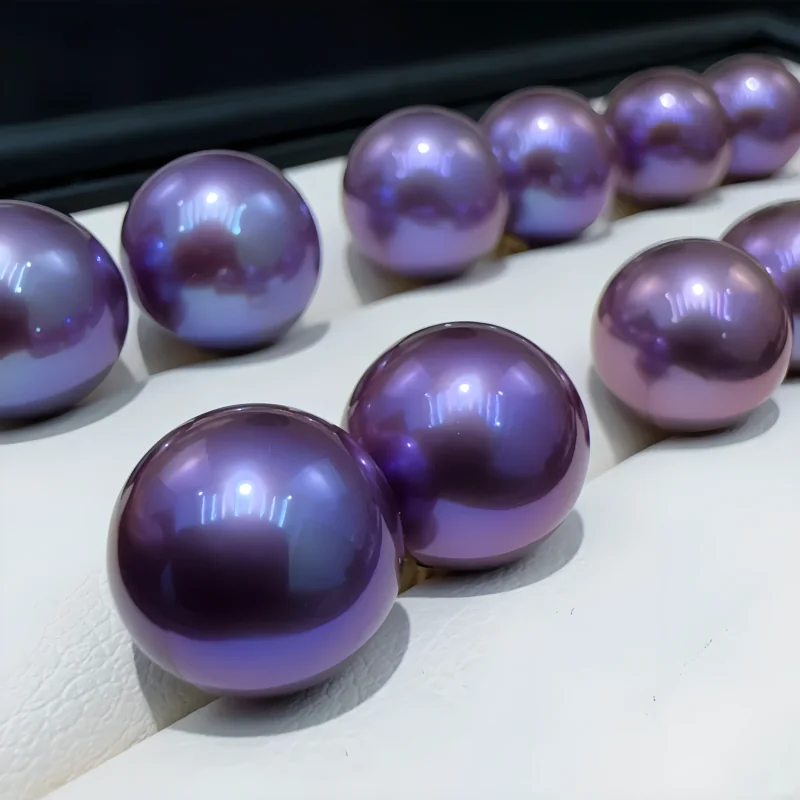
Conch pearls are expensive because the supply of natural material is extremely limited, and the supply of truly fine material is smaller again. A conch pearl may already be an uncommon natural find, but collectors and jewelers usually pay the strongest premiums for a much narrower combination: attractive pink-to-red color, visible flame structure, pleasing symmetry, useful size, a clean surface, and—when more than one pearl is needed—good matching.
That is the key to understanding conch pearl value. Their price is not explained by one feature. It comes from compounding scarcity: first the pearl itself must exist, then several desirable traits must occur together in the same specimen.
Conch pearls are also different from ordinary cultured pearl categories. Although cultured Queen conch pearls have been successfully produced and documented, they have not developed into a routine large-scale supply comparable with Akoya, freshwater, Tahitian, or South Sea cultured pearls. Fine conch pearls in the jewelry trade therefore remain closely associated with scarce natural material.
The Quick Answer: Conch Pearl Prices Are Built on a Scarcity Pyramid
| Scarcity layer | What has to happen | Why it matters to value |
|---|---|---|
| Natural occurrence | A pearl must form inside a Queen conch | The basic supply is already limited |
| Desirable color | The pearl must show an attractive bodycolor, often strong pink to red | Not every natural conch pearl has the colors most demanded by collectors |
| Visible flame structure | The fibrous crystal structure must create a strong, attractive flame-like effect | Prominent flame is one of the signature features of fine conch pearls |
| Shape, surface, and size | The pearl must also have useful proportions, limited distracting surface issues, and sufficient size | Each extra requirement reduces the qualifying pool again |
| Matching | Two or more pearls must look intentionally compatible | Pairs and sets can be much harder to assemble than single stones |
This is why saying “conch pearls are rare” is correct but incomplete. The expensive examples are usually not merely rare pearls. They are rare pearls that also sit inside a much smaller intersection of desirable visual and gemological traits.
1. Most Fine Conch Pearl Supply Still Depends on Natural Finds
Queen conch pearls are non-nacreous pearls produced by the Queen conch, now commonly referred to as Aliger gigas and historically published under names including Strombus gigas and Lobatus gigas. The animal is native to the wider Caribbean region.
The important pricing point is not simply that the pearls are natural. It is that there is no mature, high-volume farming system supplying standardized conch pearls to the market.
GIA documented successful cultured conch pearls and reported that the first documented cultured counterpart appeared through research work in 2009. Later laboratory reports examined cultured specimens as well. So the often-repeated claim that “conch pearls cannot be cultured” is too absolute.
However, documented cultivation is not the same thing as mass commercial availability. GIA later noted that no broad commercial production had reached the market at the time of its follow-up reporting. That distinction matters: a technically culturable pearl can still remain commercially scarce if production is limited, inconsistent, or not available at scale.
For a broader introduction to how these pearls differ from ordinary nacreous varieties, see our guide to Conch Pearls.
2. Finding a Pearl Is Only the First Filter
Commercial articles often quote dramatic occurrence ratios for conch pearls, but exact numbers vary by source, fishery, sample, and what counts as a “gem-quality” pearl. It is safer not to treat one internet statistic as a universal biological rule.
The more useful idea is the filtering process. Even after a natural conch pearl is found, it may be brown, pale, irregular, heavily marked, small, or only weakly flamed. Such a pearl can still be genuine and interesting, but it does not automatically belong to the highest-value tier.
A strong price premium appears when several uncommon features survive the filtering process together. This is similar to the broader logic behind pearl pricing: value rises fastest when multiple desirable characteristics overlap rather than when only one factor improves. Our general guide to why pearl prices vary explains that compounding effect across pearl types.
3. Strong Flame Structure Can Make a Fine Pearl Much More Desirable
One of the most recognizable features of a fine conch pearl is its flame structure—a silky, streaked or flame-like optical pattern created by the pearl's fibrous crystal arrangement.
GIA's classic work on Queen conch pearls described prominent flame structure as highly desirable and noted that pearls in which the effect is not easily visible generally carry lower value than comparable examples with a strong flame. Later GIA reports continued to emphasize the visual appeal of this structure.
The important word is comparable. Flame does not erase every other quality factor. A strongly flamed pearl can still be small, awkwardly shaped, damaged, or less desirable in color. But when strong flame appears together with attractive color and form, it helps push the specimen into a rarer visual category.
4. Deep Pink to Red Colors Attract the Strongest Demand
Conch pearls are not only pink. They can occur in white, beige, brown, yellow, orange, pink, and red tones. But current gemological and trade reporting consistently places saturated pinks and red-pinks among the most desirable colors.
GIA reported in 2023 that deep pink to red conch pearls with strong flame patterns were the most desirable among the rare non-nacreous conch material discussed, while pastel material offered a more accessible alternative for designers and collectors.
This creates another layer of scarcity. The market is not competing equally for every conch pearl that exists. A large part of collector demand concentrates on a smaller color range—especially when that color is combined with strong flame.
5. Symmetry, Size, and Surface Quality Multiply the Rarity
Natural conch pearls commonly occur in oval, semi-baroque, and baroque forms. A visually balanced oval or unusually symmetrical shape can therefore command more attention than a random irregular specimen, especially when the pearl is intended for a ring, pendant, or centered jewelry design.
Size adds another filter. GIA's historical study noted that conch pearls over 10 carats are rare, even though much larger examples have been recorded. Size alone does not determine quality, but a large pearl that also has desirable pink color, good flame, useful shape, and a relatively clean surface is substantially harder to find than a large pearl with only one of those traits.
Surface condition matters for the same reason. Fine conch pearls can have natural irregularities, and a perfectly featureless surface should not be assumed to be normal. What matters is whether surface characteristics distract from the face-up beauty of the pearl, create structural concerns, or interfere with the intended setting.
The high end of the market is therefore governed by combinations: large + attractive color + visible flame + pleasing shape + good surface. Each extra “plus” narrows supply.
6. Matching Two Conch Pearls Can Be Much Harder Than Finding One
A single pearl only has to be attractive on its own. Earrings, paired drops, double-stone rings, or multi-pearl jewelry require something harder: two or more natural pearls that work together.
Matching does not necessarily mean microscopic sameness. But the pearls may need compatible size, outline, depth of color, flame visibility, and overall visual weight. Because natural conch pearl supply is already irregular, every matching requirement makes the search more restrictive.
This is one reason exceptional pairs can carry a premium that is not obvious if you simply compare the carat weights of two loose pearls. The value includes the scarcity of the relationship between the pearls, not only the characteristics of each individual specimen.
7. Collector and Designer Demand Competes for a Very Small Supply
Scarcity only becomes price when someone wants the scarce object. Conch pearls have a visual identity that is difficult to substitute: porcelaneous rather than nacreous, often pink, and sometimes marked by a strong flame-like pattern that is unlike the mirror luster of Akoya pearls or the satin glow of South Sea pearls.
GIA's 2023 reporting described growing international demand for conch pearls in European, U.S., and Asian markets. That matters because the supply side is not expanding in the same standardized way as major cultured pearl categories.
In economic terms, the market is simple: a small and irregular supply is meeting collector and high-jewelry demand for the same narrow set of exceptional traits. The result is a steep premium at the top end.
8. Conservation and Fishery Rules Reinforce the Idea of Finite Supply
Queen conch is not an unlimited raw material. The species has been listed in CITES Appendix II since 1992, which means international trade is controlled under the Convention on International Trade in Endangered Species. In the United States, NOAA Fisheries listed Queen conch as threatened under the Endangered Species Act in 2024 after reviewing population status and threats including overutilization and illegal, unreported, and unregulated fishing.
These conservation facts should be interpreted carefully. A threatened listing does not automatically assign a higher dollar value to an individual pearl. Nor should rarity be used to encourage extraction from protected or illegally sourced animals.
The more defensible conclusion is that Queen conch supply exists within managed fisheries and conservation constraints. That makes the idea of endlessly increasing natural pearl supply unrealistic and makes provenance and legal sourcing increasingly important for serious buyers.
Why There Is No Reliable Universal “Price per Carat” for Conch Pearls
Search results often publish simple price-per-carat ranges. They can be tempting, but they are not a stable grading system.
GIA has specifically noted that non-nacreous pearls are difficult to value with one standardized framework because they are rare and highly individual. Market demand also matters. Two conch pearls with the same weight can differ sharply in color, flame, shape, surface, and desirability.
That means a per-carat figure without photographs, measurements, origin information, laboratory documentation, and quality context can be misleading. The most valuable material often behaves more like a collectible rare gem than a standardized commodity.
For this reason, this article does not give a fixed retail price table. A future appraisal-oriented comparison should evaluate actual specimens rather than imply that every 2-carat or 5-carat conch pearl belongs to one predictable price band.
Are All Conch Pearls Expensive?
No. “Conch pearl” identifies a rare pearl category; it does not guarantee top quality.
A pale, heavily marked, irregular pearl with weak visible flame will not be valued in the same way as an intense pink-red oval with a strong silky flame pattern and an attractive surface. Natural origin creates the scarcity baseline, but individual desirability determines how far above that baseline a particular pearl can move.
This distinction is important because rarity can easily be used as a sales shortcut. A seller may emphasize that conch pearls are rare while giving little information about the actual specimen. Serious evaluation should move from “Is this category rare?” to “What exactly makes this pearl exceptional?”
What Should You Verify Before Paying a Major Premium?
For a high-value conch pearl, the price discussion should begin with identification and documentation rather than marketing adjectives.
- Identity: Is the object actually a pearl rather than a bead fashioned from Queen conch shell?
- Natural or cultured origin: Do not assume “conch pearl” automatically proves natural origin simply from appearance.
- Color: Is the bodycolor attractive and accurately represented under neutral lighting?
- Flame structure: Is the pattern eye-visible, subtle, localized, or mainly visible under magnification?
- Shape and measurements: Are dimensions and weight documented clearly?
- Surface condition: Are there cracks, chips, major pits, or distracting surface features?
- Laboratory report: For a significant purchase, has a recognized gemological laboratory examined the specimen?
That approach is more useful than relying on labels such as “museum quality,” “investment grade,” or “ultra rare.” If you are comparing pearls more generally, our Pearl Buying Guide explains how to separate visible quality from seller language.
The Bottom Line
Conch pearls are expensive because scarcity compounds. The natural supply is limited to begin with, and the market then filters for a much smaller set of pearls with desirable color, flame structure, shape, size, surface quality, and—when needed—matching.
The highest prices are therefore not simply a reward for the word conch. They reflect how difficult it is to find a specimen in which several rare and attractive traits occur together.
The best mental model is a pyramid: many people talk about conch pearl rarity, fewer pearls are attractive enough for fine jewelry, and only a very small fraction combine the traits that serious collectors and high-jewelry designers compete for. That shrinking pool is what turns rarity into value.
Frequently Asked Questions
Why are conch pearls so expensive?
Because natural supply is very limited and fine-quality traits rarely occur together. Strong pink or red color, visible flame structure, pleasing symmetry, useful size, a good surface, and close matching can make an already rare pearl much rarer.
Are all conch pearls expensive?
No. Natural origin creates a rarity baseline, but individual value still depends on the pearl's color, flame structure, shape, size, surface condition, documentation, and market demand.
Why are pink conch pearls more valuable?
Conch pearls occur in several colors, but saturated pink to red material attracts particularly strong collector and jewelry demand. The premium is strongest when attractive color appears together with a strong flame pattern and good overall form.
Does flame structure increase a conch pearl's value?
Usually, yes, when other factors are comparable. A clearly visible, attractive flame structure is one of the signature visual features of fine conch pearls and has long been associated with higher desirability.
Can conch pearls be cultured?
Yes. Cultured Queen conch pearls have been successfully produced and documented. However, they have not developed into a routine mass-market supply, so fine conch pearls in ordinary jewelry trade remain strongly associated with scarce natural material.
Should an expensive conch pearl have a laboratory report?
For a major purchase, independent laboratory identification is highly useful. It can help confirm that the object is a pearl rather than fashioned shell material and may provide important information about natural or cultured origin and other identifying characteristics.
References and Further Reading
- GIA Gems & Gemology — The History and Gemology of Queen Conch “Pearls”
- GIA Gems & Gemology — Nonbead-Cultured Pearls from Strombus gigas
- GIA Gems & Gemology — Natural Conch “Rosebud” Pearls
- GIA Gems & Gemology — Exceptionally Rare Pearls from ECIJA
- CITES — Queen Conch (Strombus gigas), Appendix II
- NOAA Fisheries — Final Rule to List the Queen Conch as Threatened Under the Endangered Species Act