Matching Priorities for Akoya Pearl Necklaces and Earrings
Good Akoya matching is not simply a matter of making every pearl look identical. The real goal is visual harmony: the differences that attract the eye should be controlled first, while minor differences that disappear in the finished piece may be acceptable. For an Akoya necklace, consistency of luster and color across the strand usually has the greatest visual impact, followed by a smooth size-and-shape rhythm. For a pair of earrings, the two pearls are compared much more directly, so size, shape, luster, color, and face-up appearance all need to agree very closely.
Quick answer: the priority changes with the jewelry format
| Matching factor | Akoya necklace | Akoya earrings |
|---|---|---|
| Luster | Very high priority; one dull pearl can interrupt the brightness of the strand | Very high priority; uneven reflections make the pair look mismatched |
| Body color and overtone | Very high priority across the visible strand | Very high priority because the pair frames the face symmetrically |
| Size | Consistency or an intentional graduation matters more than identical measurements | Extremely important; even small visible differences can disturb symmetry |
| Shape | Should create a consistent round or near-round rhythm | Should look alike face-up, not merely measure similarly |
| Surface | Minor marks may be distributed or oriented so they do not dominate the strand | Front-facing surface appearance should be closely matched |
| Drilling / orientation | Important for a straight, orderly strand | Important for how each pearl sits in the finished setting |
This is a practical priority framework, not a replacement for formal pearl grading. GIA treats matching as the uniformity of pearls in a pair, strand, or other multi-pearl item and considers consistency across the same characteristics used to describe individual pearls. What changes from one jewelry format to another is how strongly the eye notices each kind of difference.
First, separate individual pearl quality from matching quality
A beautifully matched strand is not automatically a high-quality strand. Twenty pearls with equally weak luster can be very consistent with one another and still be mediocre pearls. Conversely, a group of individually fine pearls can look less impressive as a finished necklace if their luster, color, shape, or size varies enough to break the visual flow.
That distinction matters when comparing Akoya jewelry. Individual quality asks, “How good is each pearl?” Matching asks, “How well do these pearls work together?” A strong finished piece needs both. If you are still learning how luster, surface, color, shape, and other factors affect value, the guide to evaluating pearl value provides the broader framework, while the Akoya pearl guide focuses on this pearl type specifically.
Why Akoya mismatches can be especially noticeable
Akoya pearls are commonly chosen for a bright, refined, relatively uniform look. Their appeal often depends on strong, crisp reflections, roundness, and restrained white-to-cream color families with varying overtones. Because the intended appearance is orderly, a pearl that is visibly duller, yellower, less round, or larger than its neighbors can stand out quickly.
This does not mean every Akoya pearl in a piece must be a visual clone. Natural cultured pearls inevitably vary. The skill in matching is deciding which variations can disappear into the whole and which ones pull attention away from the design.
Matching priorities for an Akoya pearl necklace
1. Match the luster level before chasing surface perfection
Across a necklace, luster behaves almost like a continuous line of light. If most pearls show bright, sharp reflections but one or two look softer or hazier, those pearls can appear darker or flatter even when their color and size are technically close. That interruption is often more noticeable at normal viewing distance than a tiny surface mark.
For this reason, luster consistency is usually one of the first things to judge in a finished Akoya strand. Do not inspect only one pearl under magnification. Step back and look at the entire necklace under the same light. The strand should have a reasonably even visual brightness from one pearl to the next.
2. Keep body color coherent, then refine the overtone
Two white Akoya pearls can still look different if one leans cooler and silver-white while another looks warmer or creamier. Overtones can add another layer, such as pink or subtle greenish effects. In a strand, a single distinctly warm pearl among cooler pearls may be more distracting than several pearls that differ only slightly in overtone.
A useful practical order is to first control the broad body-color family, then refine overtone consistency. Perfect overtone uniformity is not always necessary, especially when the changes are subtle, but obvious color jumps should not appear accidental.
3. Judge size as a rhythm, not only as a number
Akoya necklaces are often sold within narrow millimeter ranges, and some strands may be intentionally graduated. Therefore, “matched size” does not always mean that every pearl has exactly the same diameter. What matters visually is whether the progression looks smooth.
A strand can tolerate tiny incremental changes that the eye reads as continuous. It is much less forgiving of one isolated pearl that suddenly appears larger or smaller than its neighbors. When evaluating size matching, scan the strand as a sequence rather than comparing only the largest and smallest measurements.
4. Match shape well enough to preserve the silhouette
Roundness is important in classic Akoya strands, but the eye does not judge every pearl independently. It reads the outline of the whole necklace. A slightly off-round pearl may disappear among its neighbors; a visibly elongated or flattened pearl may interrupt the silhouette.
Shape matching therefore works together with size matching. Pearls that measure similarly can still look unequal if one is round and another is noticeably oval.
5. Surface matching is partly about placement
Surface quality still matters, but small natural characteristics do not all have the same visual effect. A minor mark close to a drill hole, between adjacent pearls, or on a less visible side can matter less than a similar mark positioned prominently on the face of the pearl.
For a necklace, the goal is not necessarily to make every pearl equally spotless. It is to avoid obvious clusters of blemishes or a few pearls whose surface condition is clearly worse than the rest. Intelligent orientation can improve the finished appearance without changing the underlying pearl.
6. Drilling and stringing can make good pearls look badly matched
Matching does not end when the pearls are selected. Off-center drill holes, poor orientation, irregular spacing, or uneven stringing can cause an otherwise well-matched strand to look wavy or disorganized. In a classic Akoya necklace, assembly quality should support the matching rather than fight it.
That is why judging a loose group and judging a finished strand are not exactly the same task. The final piece should be evaluated as worn jewelry.
Matching priorities for Akoya pearl earrings
Earrings create a different problem. A necklace may contain several dozen pearls, allowing minor differences to blend into the overall pattern. A pair of earrings contains only two principal pearls. The viewer therefore compares pearl A directly with pearl B.
1. Size and shape must create bilateral balance
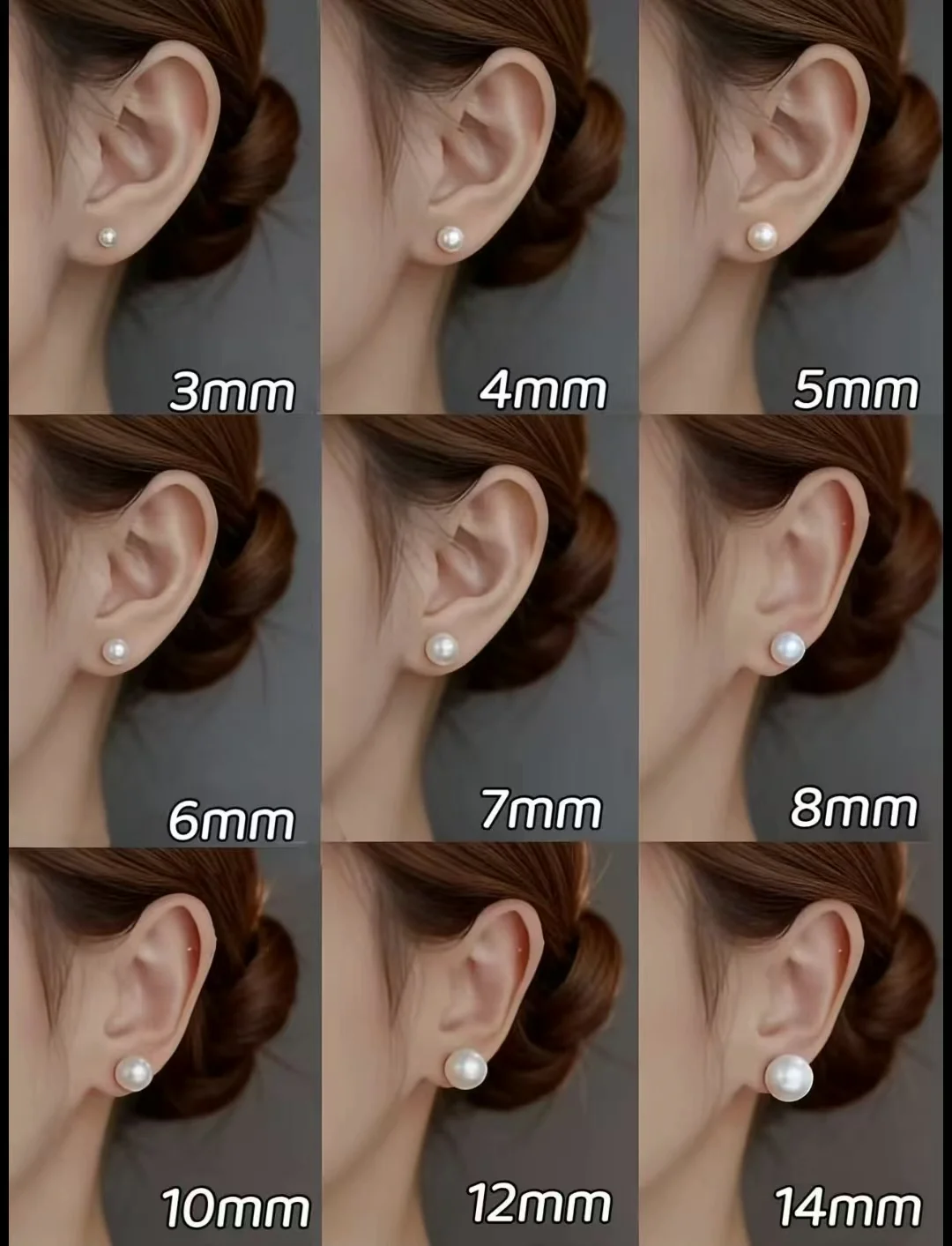
For classic Akoya studs, a good pair should look the same size on the ears. Caliper measurements help, but face-up appearance matters more than a number alone. Two pearls can have similar maximum diameters yet look different if one is more spherical and the other is slightly flattened or off-round.
When checking a pair, place the pearls side by side in the same orientation and then view them from a normal wearing distance. If one immediately feels visually heavier, the pair may not be well matched even if the measurement difference is small.
2. Luster should respond to light in the same way
A pair is especially sensitive to luster mismatch because the earrings occupy symmetrical positions beside the face. If one pearl produces a sharp, bright reflection and the other looks softer, the difference can read as unequal brightness rather than as a subtle quality variation.
This is why two individually attractive pearls do not automatically make a good pair. Their reflections should be similar in intensity and sharpness under the same light.
3. Match body color closely and avoid conflicting overtones
Color differences that might disappear across a long necklace can become obvious in a pair. One pearl should not appear distinctly warmer, grayer, yellower, or pinker than the other unless the design intentionally uses contrast.
Overtone does not always need to be perfectly identical, because it can shift with viewing angle and lighting. Still, the pair should belong to the same visual color family when seen together.
4. Compare the visible surface, not only the total blemish count
Mounted earrings have a face. A small surface characteristic near the back or close to the setting may be far less important than a mark positioned on the most visible front area. For matching purposes, the two earrings should present a similar face-up cleanliness.
This also explains why a merchant or jeweler may rotate a pearl before setting it. Orientation can place the most attractive surface toward the viewer while keeping the pair visually balanced.
5. Setting alignment belongs in the final inspection
With studs, post position and pearl orientation affect how the earrings sit on the ear. With drops, differences in hook length, pearl orientation, or movement can create asymmetry even if the pearls themselves were selected well. The finished pair should therefore be checked as jewelry, not only as two loose pearls.
A practical matching order for buyers
If you are comparing pieces in person or from detailed seller photos, the following order is useful because it starts with the differences most likely to disturb the overall appearance.
- Look at the whole piece first. Before zooming in, ask whether anything immediately looks brighter, duller, warmer, larger, or less round than its neighbors.
- Compare luster under one light source. Reflections should have broadly similar brightness and sharpness.
- Check body color and overtone together. Look for isolated pearls that shift noticeably warmer or cooler.
- Check size and shape as a pattern. For necklaces, look for a smooth rhythm; for earrings, compare the two directly.
- Inspect visible surface characteristics. Pay attention to where marks are located, not just how many exist.
- Inspect drilling, orientation, and assembly. Make sure construction does not introduce an artificial mismatch.
Use the same background and the same lighting for every comparison. Diffuse daylight or neutral indoor lighting is generally more useful than rapidly changing showroom spotlights. Smartphone photos can help document differences, but automatic exposure and white balance can also exaggerate or hide color variation, so they should not be the only basis for a matching judgment.
Sorting order is not the same as visual priority
This distinction is often missed. In practical pearl sorting, a supplier may first divide pearls by measurable attributes such as size and broad shape because that is efficient. The smaller groups can then be refined by color, luster, surface, and other appearance factors. That operational order does not mean size is always the most important visual factor in the finished jewelry.
For example, a necklace made from pearls all within the same size range can still look poorly matched if several pearls have noticeably weaker luster. Conversely, a carefully graduated strand can be beautifully matched even though its pearls are intentionally different sizes. Matching should therefore be judged by the intended design, not by one specification in isolation.
Should an Akoya necklace and Akoya earrings match each other exactly?
No. Matching within the necklace and within the earring pair is usually more demanding than matching the necklace to the earrings as separate pieces. The distance between the ears and neckline gives the eye more tolerance.
If you want a coordinated set, prioritize a similar overall luster level and body-color family first. Then consider overtone, shape, and proportion. The earrings may be the same nominal size as the strand or slightly larger or smaller depending on the intended look; exact diameter equality is not required for harmony.
Buying a coordinated set at the same time can make matching easier because pearl lots vary. However, separately purchased pieces can still work well if their overall brightness, color temperature, and style are compatible. Browse examples in the pearl necklace collection and pearl earring collection to compare how size and design change the visual balance.
What deserves the most budget: better pearls or tighter matching?
Do not pay for perfect matching at the expense of the pearl qualities you actually see and value. A very tightly matched but dull strand will not gain the brightness of a higher-luster strand simply because its pearls are uniform. Likewise, a pair of earrings should not sacrifice obvious luster or serious surface quality just to achieve an extremely small size difference.
For most buyers, the better decision is to establish a minimum acceptable individual quality first, then compare how well the pearls are matched within that quality level. On classic Akoya jewelry, stronger and more consistent luster is usually worth protecting before chasing microscopic uniformity.
If you are buying Akoya jewelry from Margaret Jewelry and matching matters to your order, ask for the piece to be evaluated as a finished item rather than only by the stated pearl grade. This is especially useful for stud pairs and classic strands, where small visual inconsistencies are easier to notice.
FAQ
What is the most important matching factor in an Akoya pearl necklace?
There is no single official priority order for every design, but luster and color consistency usually have the strongest effect on the visual continuity of a classic Akoya strand. Size and shape should then form a smooth, intentional rhythm.
What matters most when matching Akoya pearl earrings?
For a pair of classic studs, size and shape should create strong symmetry, while luster and body color should be very close. Face-up surface appearance and setting alignment also matter because the two pearls are compared directly.
Do all pearls in an Akoya necklace need to be exactly the same size?
No. A strand may contain a narrow size range or an intentional graduation. Good size matching means the transition looks smooth rather than random or interrupted.
Can two Akoya pearls have the same grade but still make a poor earring pair?
Yes. A grade describes quality within a grading system, but two pearls within the same broad grade can still differ visibly in overtone, exact shape, luster character, or face-up appearance. Pair matching requires direct comparison.
Can surface blemishes be acceptable in a well-matched set?
Yes, depending on their number, severity, and position. Small characteristics can be much less noticeable near a drill hole, between pearls, or on the back of a mounted earring than on a prominent face-up area.
The key idea to remember
Akoya matching is the art of controlling the differences the eye notices first. In a necklace, judge the continuity of the whole strand: luster, color, size-and-shape rhythm, surface distribution, and assembly. In earrings, judge the relationship between two pearls: symmetry, reflection, color, face-up cleanliness, and setting. The best matching is not sterile sameness. It is a finished piece in which no unintended difference steals attention from the pearls as a whole.