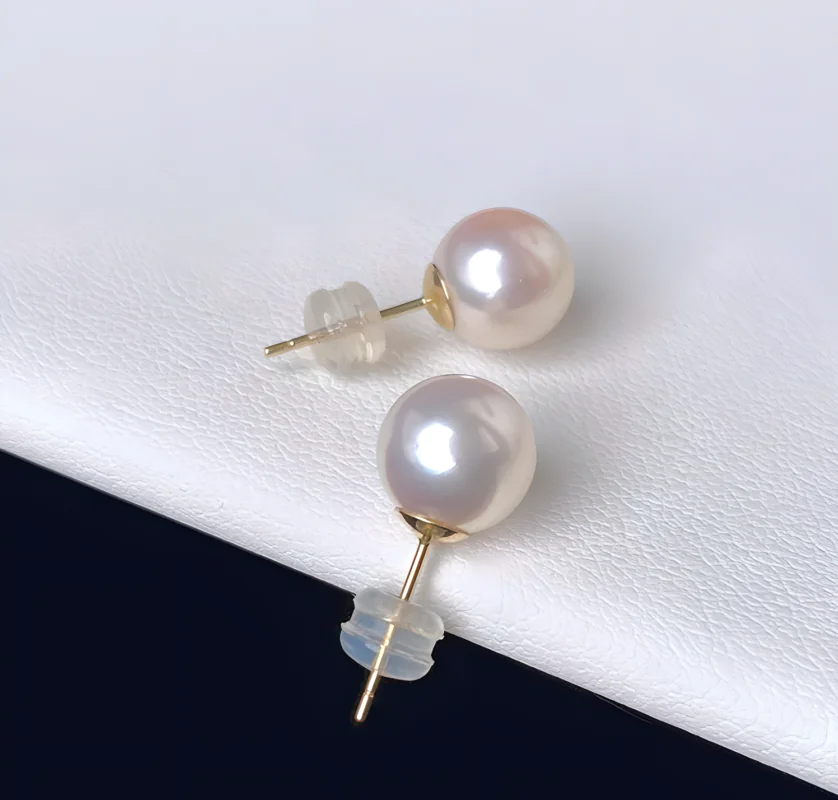
No. A dark-looking drill hole does not by itself prove that a pearl has been dyed. Dye can sometimes concentrate around or inside a drill hole, making that area especially useful during examination. But an ordinary drill hole can also look dark because of shadow, dirt, thread, internal material, drilling texture, or the structure inside the pearl.
The more useful question is not simply, “Is the hole dark?” It is: “Does the hole contain a distinct concentration of the pearl's visible color, and do other parts of the pearl show the same treatment pattern?”
This distinction matters because a single dark opening is a weak observation. A colored ring around the opening, pigment-like streaks inside the hole, matching color trapped in cracks or pits, and unnatural patchiness elsewhere on the pearl form a much stronger pattern.
Quick Answer: What Does a Dark Drill Hole Actually Tell You?
| What you see | Possible explanation | How strongly does it suggest dye? |
|---|---|---|
| The hole simply looks black or dark | Shadow, depth, internal structure, thread, dirt or other material | Weak clue |
| A colored ring around the drill-hole edge | Colorant may have concentrated in accessible material | Useful clue |
| Colored streaks or layers inside the hole | Possible penetration or concentration of treatment-related color | More significant |
| The same color appears in cracks, pits or blemishes | Colorant may have accumulated in surface-reaching features | Stronger combined evidence |
| Dark internal nucleus but little color at the hole edge | Internal structure or another treatment such as irradiation may need consideration | Not evidence of dye by itself |
| No unusual drill-hole color at all | The pearl may be untreated—or the treatment may simply leave little visible evidence | Does not prove natural color |
Why Can a Normal Pearl Drill Hole Look Dark?
A drill hole is a small, recessed space. Even before pearl treatment is considered, its geometry makes it look darker than the surrounding curved surface.
Light reaches the smooth outer nacre directly and reflects back toward your eye. Inside a narrow hole, much less light returns. Under overhead lighting or in a photograph, the result may be an almost black center even when the pearl has never been dyed.
The appearance can become darker still if the hole contains or reveals:
- dark string or thread running through the pearl;
- dirt, skin oils or polishing residue accumulated around the opening;
- rough drill marks that create additional shadow;
- organic-rich or naturally darker internal material;
- a bead nucleus or other internal structure visible through the opening; or
- adhesive, mounting material or jewelry components in a half-drilled pearl.
This is why photographing only the black center of a hole rarely tells you much. The rim, exposed material and surrounding nacre are usually more informative than the darkness at the deepest visible point.
Darkness and Dye Concentration Are Not the Same Thing
This is the most important distinction.
Simple darkness usually lacks a recognizable color pattern. It may look gray, brownish or black primarily because light cannot reach the interior well.
Dye concentration is different. Under magnification, treatment-related color may appear as a colored ring, line, layer, spot or streak that is visibly stronger than the neighboring nacre. The color often resembles the pearl's treated bodycolor rather than looking like a neutral shadow.
For example, a dyed green pearl may show distinctly green material concentrated near the drill hole. A yellow-treated pearl may show deeper yellow or brownish-yellow residue in the opening or nearby cavities. On a dark-colored pearl, the distinction may be harder to see because both shadow and treatment can look nearly black without adequate illumination.
Whenever possible, examine the hole from several angles under bright, neutral light rather than judging one photograph.
What Other Clues Should You Check Before Suspecting Dye?
A treatment conclusion becomes more credible when several independent observations point in the same direction.
1. Look for the same color inside pits, cracks and surface depressions
Surface-reaching features can be particularly revealing. Dye may become concentrated in cracks, pits, wrinkles, cavities or other imperfections, producing small areas that are more intensely colored than the smoother nacre around them.
This is more informative than a dark hole alone because you are seeing a repeated pattern: stronger color in multiple places where treatment material could accumulate.
Do not assume every darker blemish is dye, however. Natural surface structure can also create shadows and color variation. Compare the actual hue rather than simply asking whether an area is darker.
2. Check whether the color forms rings, streaks or layers
Under a loupe or macro lens, treatment-related color may have structure. Instead of an evenly dark opening, you might see a narrow colored band near the hole wall, a streak following a fracture, or a visibly colored layer that contrasts with material deeper inside.
Patterns like these carry more diagnostic value than a hole that merely appears black from one viewing direction.
3. Examine the entire pearl for unnatural patchiness
Some treated pearls show irregular patches in which color becomes unusually concentrated. If a dark drill hole appears together with strong localized patches elsewhere on the pearl, dye treatment deserves more serious consideration.
But natural color is not necessarily perfectly even. Tahitian pearls, naturally colored freshwater pearls and other genuine pearls may show bodycolor variation, overtones and orient. The goal is not to label every uneven pearl as treated, but to identify patterns that look associated with cracks, holes or other pathways into the pearl.
4. Compare multiple pearls in the strand
A necklace gives you more information than one bead.
If one drill hole looks dark while every other pearl appears normal, the observation may simply reflect dirt, drilling or lighting. If ten or twenty pearls repeatedly show similarly colored rings, pigment-like deposits, or matching color concentrations in their blemishes, the pattern becomes more significant.
Repetition is especially useful because it helps separate a treatment process applied to an entire batch from an isolated physical feature on one pearl.
5. Ask whether the color itself is expected for that pearl type
Color context matters.
Freshwater cultured pearls naturally occur in whites and warm color families such as pink, purple, peach and related tones. Very dark black, blue, green or gray freshwater pearls should therefore prompt a treatment question rather than being automatically accepted as natural-color pearls.
That does not mean a dark freshwater pearl must specifically be dyed. Color can be modified in different ways. The observation simply raises the importance of accurate treatment disclosure.
For the broader color question, see our comparison of dyed, irradiated and naturally dark-colored pearls.
A Dark Akoya Drill Hole Can Raise a Different Question
Gray or bluish Akoya pearls are a useful example of why the “dark hole = dye” rule breaks down.
In bead-cultured Akoya pearls, the internal shell bead can sometimes be visibly darker than the nacre around it. Color modification by irradiation can darken a freshwater-shell bead nucleus, and because Akoya nacre can be relatively translucent, that darker nucleus may influence the pearl's visible gray or bluish appearance.
Gemological research has documented treated Akoya pearls with darkened nuclei in more than one visual configuration. Some also showed obvious color concentration near their drill holes, indicating additional dye treatment. Others had darkened nuclei without comparable drill-hole color concentration.
That distinction is important. Seeing something dark inside an Akoya pearl tells you to investigate the pearl's color origin; it does not identify dyeing by itself.
Can a Dyed Pearl Have a Completely Clean-Looking Drill Hole?
Yes.
One of the biggest limitations of home inspection is that not every dye process leaves obvious residue around the hole. Treatment methods vary, pearls may be treated at different stages, and subsequent processing can reduce or obscure visible concentration.
Gemological studies of treated pearls have included samples whose color treatment was difficult to identify visually and required spectroscopy or other laboratory methods.
Therefore, the logic works better in one direction than the other:
- Obvious colored residue can justify suspicion.
- No visible residue cannot prove untreated color.
This is why buyers should not treat the drill hole as a pass/fail test.
Do Not Confuse Dyeing with Imitation Pearls
A genuine cultured pearl can be dyed.
That does not make it a fake pearl. “Real versus imitation” and “natural color versus treated color” are two different identification questions.
When inspecting an imitation pearl, the drill hole may reveal something different: a pearlescent coating peeling or chipping away from a glass, plastic, shell or composite core. That is evidence about construction, not merely color treatment.
Our guide to real and imitation pearl drill holes explains this distinction in more detail.
How Strong Are the Different Clues?
| Observation | Evidence level for dye | How to interpret it |
|---|---|---|
| Dark center of drill hole only | Weak | Too many ordinary causes can produce the same appearance. |
| Colored ring or concentrated bodycolor at hole edge | Moderate | Useful treatment clue, especially under magnification. |
| Colored streaks or layers inside hole | Moderate to strong | May reveal localized penetration or treatment-related material. |
| Matching color in cracks, pits and cavities | Strong supporting evidence | Repeated concentration in accessible features makes treatment more plausible. |
| Unnatural patchiness plus drill-hole concentration | Strong supporting pattern | Multiple independent observations point toward treatment. |
| Dark internal nucleus alone | Not specific to dye | Internal structure or another treatment such as irradiation must be considered. |
| Clean drill hole | No conclusion | Some treated pearls show little obvious visual evidence. |
A Practical Way to Examine the Drill Hole
You do not need destructive testing to perform a useful first inspection.
- Use bright neutral light. Avoid making a judgment from a dim room or strongly colored lighting.
- Use magnification. A 10× loupe or a sharp macro photograph can reveal the rim and interior much more clearly.
- Rotate the pearl. If the darkness disappears or shifts dramatically with the lighting angle, shadow may be playing a major role.
- Inspect the rim separately from the center. Look for colored rings, residue, streaks or visible layers rather than just a black opening.
- Check surface defects. Look for the same hue inside pits, cracks and wrinkles.
- Compare several pearls. Repeated treatment-like features matter more than one isolated dark hole.
- Consider the pearl type and stated color origin. Ask whether the claimed natural color is plausible for that type of pearl.
Avoid scratching the hole, applying solvents, scraping nacre or trying other destructive home tests. They can damage the pearl without giving you a reliable answer.
For a broader visual inspection sequence, see our guide to common visual clues of dyed pearls.
When Should You Stop Guessing and Use Laboratory Testing?
Visual clues are most useful as screening tools. They can tell you that a pearl deserves more investigation, but they cannot always establish the origin of its color.
Laboratory testing becomes more useful when:
- a pearl is expensive specifically because its color is represented as natural;
- you are buying a high-value Tahitian, South Sea, Akoya or natural pearl whose treatment status affects price;
- visual clues conflict with the seller's description;
- the pearl has an unusual or commercially rare color;
- you need documentation for resale, collection, insurance or another significant transaction; or
- the difference between natural and treated color materially changes your buying decision.
Gemological laboratories can combine microscopy with techniques such as spectroscopy, fluorescence analysis, X-ray methods and elemental analysis depending on the type of pearl and suspected treatment.
For an inexpensive fashion strand, laboratory testing may make little economic sense. In that situation, clear seller disclosure is usually more practical: ask whether the color is natural, dyed, irradiated or otherwise treated and keep that description with the purchase record.
The Most Useful Rule: Look for a Pattern, Not One Sign
A dark drill hole is easy to notice, which is why it has become one of the most repeated pearl-identification shortcuts. The problem is that darkness itself is not chemically specific.
A more reliable visual suspicion of dye comes from a pattern:
- the drill hole contains a distinct concentration of the pearl's visible color;
- the same color appears in cracks, pits or surface depressions;
- the pearl shows treatment-like patchiness or unusual saturation;
- multiple pearls show similar features; and
- the claimed natural color is unusual for the pearl type.
Even then, visual evidence should be described as an indication, not an absolute laboratory conclusion.
Frequently Asked Questions
Does a black-looking pearl drill hole mean the pearl was dyed?
No. The inside of a drill hole can look black simply because it is recessed and poorly illuminated. Thread, dirt, internal structure, drilling texture and other material can also make it appear dark. A clearly colored concentration matching the pearl's bodycolor is more informative than darkness alone.
What does dye around a pearl drill hole look like?
It may appear as a distinctly colored ring, spot, streak, layer or residue around the rim or inside the hole. The key feature is color concentration that differs from ordinary neutral shadow.
Can a dyed pearl have a normal-looking drill hole?
Yes. Some color treatments leave little visible evidence, so a clean-looking hole cannot prove that the pearl's color is natural.
If the center of an Akoya pearl looks dark, is it dyed?
Not necessarily. A dark internal bead nucleus can be associated with other color-modification processes such as irradiation, and internal structure can also affect what you see through a drill hole. Dye requires additional evidence.
Are black freshwater pearls usually naturally black?
Very dark black, gray, blue or green freshwater cultured pearls should generally prompt questions about color treatment. Natural freshwater colors are much more commonly found in white and warm pink, purple, peach and related ranges.
Can I prove pearl dyeing at home?
Usually not with certainty. Magnification can reveal useful warning signs, but subtle treatments may require professional gemological testing. Avoid destructive solvent, scraping, burning or abrasion tests.
Is a dyed pearl a fake pearl?
No. A genuine natural or cultured pearl can be color-treated and still remain a real pearl. Dye treatment concerns the origin of the color; imitation concerns whether the object itself is actually a pearl.
The Key Takeaway
A dark drill hole is not a diagnosis. It is merely a place worth inspecting more carefully.
If the opening is dark only in its deepest part, ordinary shadow or internal material may explain what you see. If there is a clearly colored ring or streak around the hole—and the same color is concentrated in cracks, pits or other surface features—the evidence for dye treatment becomes more persuasive.
The safest approach is therefore to rank the clues rather than searching for one magic test: darkness alone is weak evidence; repeated color concentration is stronger evidence; and laboratory testing is the appropriate answer when natural color materially affects value.
References and Further Reading
- GIA, Irradiated and Dyed Akoya Pearls — examples of darkened bead nuclei, drill-hole color concentrations and unnatural patchy coloration in treated Akoya pearls.
- GIA, Update on the Identification of Dye Treatment in Yellow or “Golden” Cultured Pearls — research showing both visible dye indicators and treated pearls with little obvious surface evidence.
- GIA, Detection of Color Treatment and Optical Brightening in Chinese Freshwater “Edison” Pearls — laboratory methods used to distinguish naturally colored and treated freshwater cultured pearls.
- GIA, Fluorescence Spectroscopy for Colored Pearl Treatment Screening — discussion of laboratory screening methods for treated versus naturally colored pearls.
- SSEF, Natural Pearls Dyed Green — documented example of green dye concentration around pearl drill holes confirmed by Raman spectroscopy.
- MJ Pearls, Common Visual Clues of Dyed Pearls: What to Look For — broader guide to drill holes, pits, cracks, patchiness and other visual treatment clues.
- MJ Pearls, Irradiated, Dyed, and Naturally Dark-Colored Pearls: What Is the Difference? — comparison of different causes of dark pearl color.