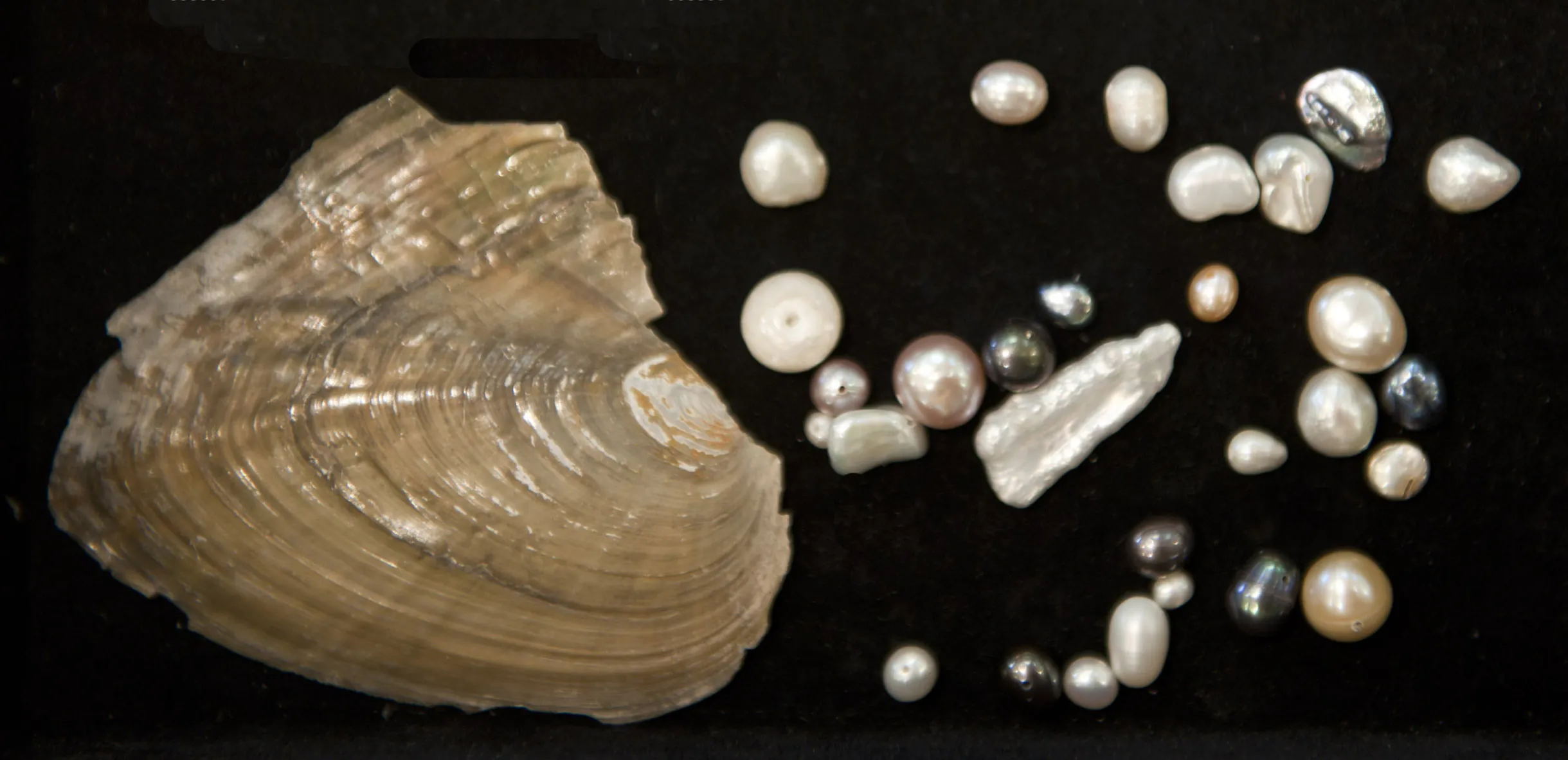
Yes. The vast majority of pearls in today’s jewelry market are cultured pearls. Natural pearls still exist, but they are rare and are more often encountered in antique jewelry, specialist collections, auctions, or pieces sold with gemological documentation.
The important distinction is that cultured does not mean fake. A cultured pearl is formed inside a living mollusk. Human intervention starts the process, but the mollusk builds the pearl. Imitation pearls, by contrast, are manufactured products made to look like pearls.
What does “cultured pearl” actually mean?
A cultured pearl is a real pearl whose formation was intentionally initiated by a pearl farmer. Depending on the cultivation method, a technician may introduce a bead nucleus, a small piece of donor mantle tissue, or both. The mollusk then forms a pearl sac and deposits nacre or other pearl material over time.
This is why the difference between natural and cultured pearls is mainly about how pearl formation begins:
| Type | How formation begins | Formed by a mollusk? | Typical place in today’s market |
|---|---|---|---|
| Natural pearl | Without human intervention | Yes | Rare; often antique or specialist material |
| Cultured pearl | Human intervention initiates pearl growth | Yes | The main source of modern real-pearl jewelry |
| Imitation pearl | Manufactured to simulate a pearl | No | Fashion jewelry and simulated-pearl products |
For a closer look at the biology behind both natural and cultured pearls, see our guide to how pearls form. The key point is that the mollusk—not the inserted bead or tissue—does the biological work of building a cultured pearl.
How dominant are cultured pearls today?
There is no useful reason to invent a precise global percentage, because pearl production, jewelry sales, antique trade, and imitation products are measured differently. The reliable conclusion is simpler: cultured pearls make up the vast majority of real pearls in the modern pearl and jewelry market.
The Gemological Institute of America (GIA) states that the vast majority of pearls in the pearl and jewelry market are cultured, while most natural pearls encountered in the market today are antique. The U.S. Federal Trade Commission likewise notes that natural pearls are very rare, so most pearl jewelry contains cultured or imitation pearls.
In practical buying terms, if you see a newly made strand, pair of earrings, bracelet, ring, or pendant containing genuine pearls, it is reasonable to expect the pearls to be cultured unless the seller specifically identifies them as natural pearls and can support that claim.
Why did cultured pearls become the normal choice?
Natural pearl formation is uncommon and unpredictable. Before modern cultivation, finding enough natural pearls of suitable size, appearance, and matching quality for jewelry required enormous amounts of wild shell and labor. Producing a well-matched strand was especially difficult.
Pearl cultivation changed that supply problem. Farmers could intentionally initiate pearl growth, care for the mollusks, manage growing conditions, and harvest pearls after an appropriate cultivation period. The results are still variable—many cultured pearls never become top-quality gems—but cultivation makes a stable pearl industry possible in a way that random natural formation cannot.
That development also explains why pearls moved from being exceptionally scarce historical gems to something available across a much wider range of prices and styles. If you want to understand the farming process in more detail, our guide to pearl cultivation explains nucleation, growth, care, and harvesting step by step.
Are Akoya, freshwater, Tahitian, and South Sea pearls cultured?
In modern jewelry, the major commercial pearl categories are overwhelmingly associated with cultured production. This includes:
- Akoya cultured pearls, typically grown in saltwater oysters and known for bright luster and classic round strands.
- Freshwater cultured pearls, grown in freshwater mussels and produced through several cultivation methods, including tissue-nucleated and bead-nucleated systems.
- Tahitian cultured pearls, produced by Pinctada margaritifera and valued for naturally dark bodycolors and colorful overtones.
- South Sea cultured pearls, produced by Pinctada maxima and known for their larger sizes and white, silver, or golden color ranges.
Natural pearls can also form in pearl-producing mollusks, so the species name alone does not prove whether an individual pearl is natural or cultured. What matters is whether pearl formation occurred without human intervention.
Does “cultured” mean lower quality?
No. “Cultured” describes origin of formation, not a quality grade.
Two cultured pearls can differ dramatically in luster, surface condition, shape, size, color, nacre quality, and matching. One may be an inexpensive commercial pearl; another may be an exceptional gem. The same word—cultured—can apply to both.
This is one reason buyers should separate two questions:
- What is it? Natural, cultured, or imitation?
- How good is it? What are its actual quality and value factors?
Our pearl classification guide explains the first question, while the pearl buying guide is a better next step when you are comparing quality and deciding what to buy.
Are cultured pearls “real pearls”?
Yes. Cultured pearls are real biological pearls produced by living mollusks. Calling them fake simply because humans initiated the process mixes up cultured with imitation.
An imitation pearl may be made from glass, plastic, shell, or another material and coated to resemble a pearl. It does not grow inside a mollusk. That is a fundamentally different product.
There is another terminology trap worth avoiding: cultured pearls should not be described as “natural pearls.” GIA specifically distinguishes the two terms. A pearl can be genuine and cultured at the same time; “natural” has the narrower meaning of formation without human intervention.
Can you tell a natural pearl from a cultured pearl just by looking?
Usually not with confidence. Shape, surface texture, color, or irregularity alone cannot reliably prove that a pearl is natural. Cultured pearls can be round or baroque, smooth or blemished, and natural pearls can also vary widely.
Gemological laboratories distinguish natural from cultured pearls by examining their internal growth structures, commonly with X-radiographic techniques. That becomes especially important when a seller claims that a pearl is natural and the claim materially affects the price.
For an ordinary modern cultured-pearl purchase, a laboratory report is not necessary for every piece. But for a high-value pearl represented as natural, independent gemological identification can be much more important than visual impressions or seller wording.
What should buyers look for on a product description?
First, do not assume that the word “pearl” automatically means natural pearl. In everyday shopping language, “pearl jewelry” is often used as a broad category. Look for a more specific description of what the product actually contains.
Useful wording includes terms such as cultured freshwater pearls, Akoya cultured pearls, Tahitian cultured pearls, or South Sea cultured pearls. In U.S. consumer guidance, the FTC advises sellers to disclose whether pearls are cultured or imitation rather than leaving buyers to infer it from a pearl-type name alone.
If a product is represented as containing natural pearls, that is a much more unusual claim. For expensive pieces, ask what evidence supports the identification and whether an independent gemological report is available.
The simple way to think about today’s pearl market
For modern pearl jewelry, cultured pearls are the rule rather than the exception. Natural pearls remain important historically and as rare collectible gems, but they are not the normal source of the pearls seen in today’s jewelry stores.
The most useful mental model is:
Natural vs. cultured tells you how the pearl started. Cultured vs. imitation tells you whether the pearl was actually grown by a mollusk. Quality is a separate question again.
Once those three ideas are separated, modern pearl terminology becomes much easier to understand—and “cultured” stops sounding like a compromise. It is simply how most real pearls reach the market today.
Frequently Asked Questions
Are almost all real pearls today cultured?
The vast majority of real pearls in the modern pearl and jewelry market are cultured. Natural pearls are much rarer and are often found in antique, collector, auction, or specialist markets.
Are cultured pearls fake?
No. Cultured pearls are formed inside living mollusks. Human intervention initiates their growth, but the mollusk produces the pearl. Fake or imitation pearls are manufactured to simulate the appearance of pearls.
Are freshwater pearls usually cultured?
Yes. The freshwater pearls sold in modern jewelry are generally cultured pearls. Depending on the production method, they may be tissue-nucleated, bead-nucleated, or produced through other non-bead cultured techniques.
Are natural pearls more valuable than cultured pearls?
Natural pearls can command very high prices because of their rarity, provenance, size, quality, and historical importance. However, value cannot be determined from the word “natural” alone. Individual pearl quality, matching, condition, documentation, and market demand still matter.
How can a laboratory tell whether a pearl is natural or cultured?
Gemological laboratories examine internal growth structures, often using X-radiography or related imaging methods. Those internal structures can provide evidence that is not reliably visible from the pearl’s exterior.