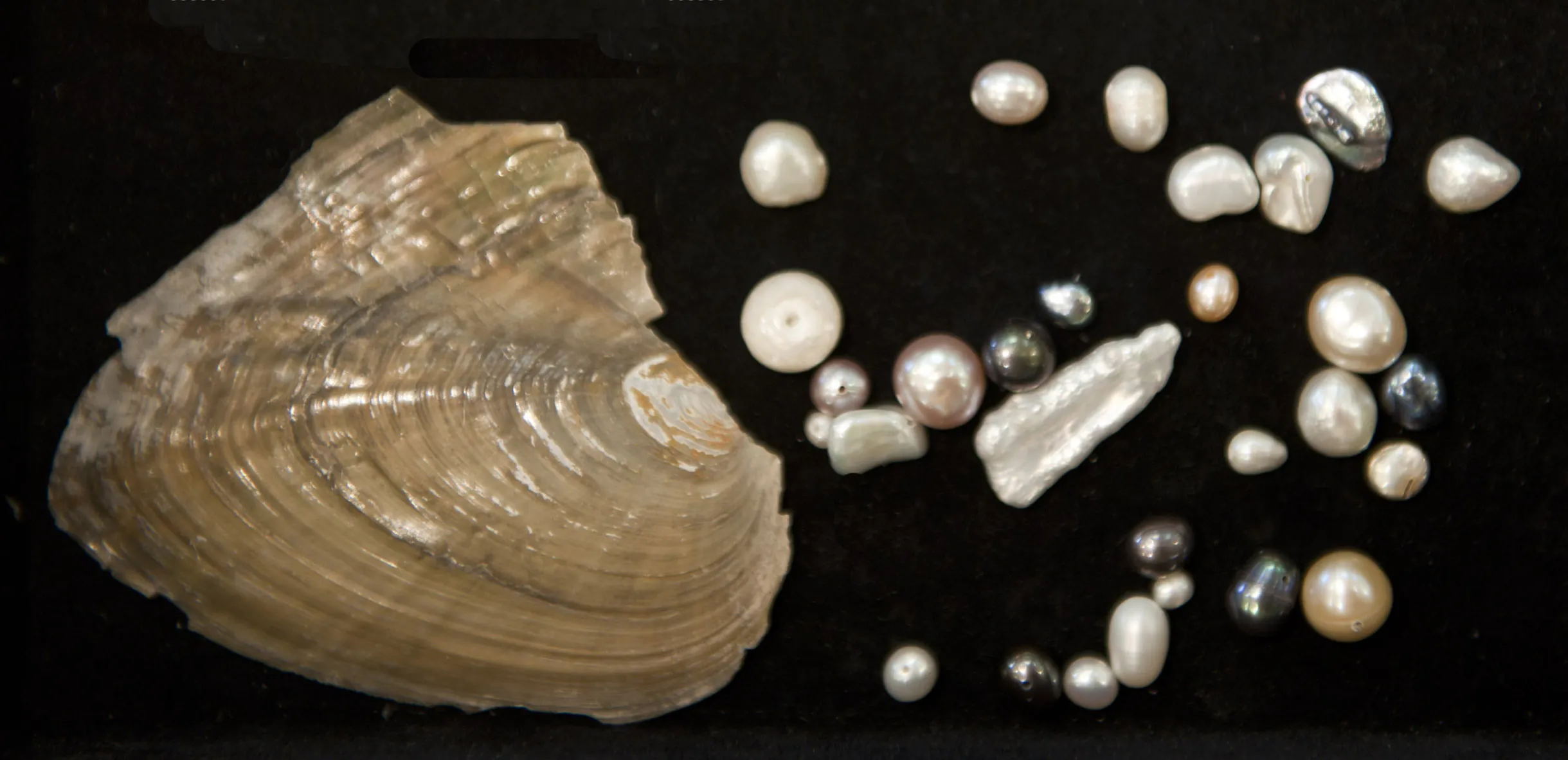
Usually, no. The familiar story says that a grain of sand gets inside an oyster, irritates it, and is gradually coated until it becomes a pearl. That is a useful story for children, but it is not a good biological explanation of how most pearls form.
The crucial event is not simply “something irritating the oyster.” Pearl formation depends on pearl-forming epithelial cells becoming established in the right place and forming a pearl sac. That living sac secretes the mineral and organic material that builds the pearl layer by layer.
There is one important nuance: technical references do not make it impossible for a sand grain or another inorganic particle to be involved in an occasional natural pearl. The better conclusion is therefore not “sand can never be inside a pearl,” but “a grain of sand is not the general mechanism that explains pearl formation.”
Why Is the “Grain of Sand Makes a Pearl” Story Misleading?
The story focuses on the object at the center of a pearl. Biology focuses on the tissue that produces the pearl.
A mollusk's mantle is the tissue responsible for producing shell material. If mantle-derived epithelial cells become displaced into an abnormal internal location, they can proliferate and organize into a closed pearl sac. The inner surface of that sac then secretes calcium-carbonate mineral and organic matrix toward the center.
That is the key step. Without pearl-producing tissue, putting a random particle inside a mollusk does not automatically give you a pearl.
This is also why a more complete explanation of pearl formation talks about mantle tissue, pearl-sac development, and biomineralization rather than treating the central particle as the whole story.
So Can a Grain of Sand Ever Be Involved?
Potentially, yes—but that is different from saying pearls are normally formed from sand.
Some technical references on natural pearl formation list possible organic and inorganic nuclei, including parasites, biological debris, cells, plant material, and sand grains. Other gemological and biological research emphasizes mantle injury, displaced epithelial cells, pearl-sac formation, and the difficulty of identifying the original trigger after a natural pearl has fully developed.
Those views are not as contradictory as they first sound. A foreign particle can be present at the center, but the particle itself is not the pearl-making machinery. The pearl sac is.
So if someone asks, “Can a pearl ever grow around a grain of sand?” the cautious answer is: it is possible in a natural event. If they ask, “Are pearls generally made because sand gets into oysters?” the answer is no—that explanation is much too simple.
What Actually Starts a Natural Pearl?
A natural pearl forms without deliberate human intervention. Exactly what starts an individual natural pearl can vary, and in many finished pearls the original event cannot be reconstructed with certainty.
Possible starting events include injury, intrusion by a small organism, organic material entering or moving through tissue, or another disturbance that results in pearl-forming epithelial cells being positioned where they can create a pearl sac.
Once the sac exists, it behaves like a tiny pearl-producing envelope. Its cells secrete mineral and organic material inward, and successive deposits gradually build the pearl from the center outward.
Gemological X-ray examination of natural pearls shows that their internal structures can be quite varied. Some contain organic-rich centers, voids, concentric growth structures, or evidence suggestive of an organism; many do not preserve a simple, obvious “object in the middle” that explains their entire history.
The Pearl Sac Matters More Than the Irritant
This is the easiest way to replace the sand myth with a more accurate mental model:
- Something causes mantle-derived epithelial cells to be present in an abnormal internal location.
- The cells organize into a pearl sac.
- The pearl sac secretes pearl material inward.
- Repeated deposition builds the pearl layer by layer.
The center can differ from pearl to pearl. The living secreting tissue is the consistent biological idea.
In nacreous pearls, the deposited material develops into nacre: a highly organized composite made mainly from calcium carbonate crystals plus an organic matrix. Its fine layered structure is responsible for much of the luster and optical depth associated with classic pearls.
Do Cultured Pearls Start with Grains of Sand?
No. Modern pearl cultivation does not depend on putting grains of sand into oysters or mussels.
For many bead-nucleated cultured pearls, a technician inserts a small piece of donor mantle tissue together with a smooth bead nucleus. The mantle cells proliferate and form a pearl sac around the bead; that sac then deposits nacre onto the bead.
The bead is usually made from shell material and is deliberately shaped for the cultivation process. It is not simply a convenient substitute for sand. Just as importantly, the bead alone is not enough in the initial operation: the pearl-producing mantle tissue is essential to establishing the sac.
Other cultured pearls can be produced without a large bead. In traditional tissue-nucleated freshwater culture, small pieces of mantle tissue are inserted and pearl sacs develop without a spherical shell bead at the center. Our guide to freshwater non-nucleated pearls explains this process in more detail.
For the broader farming sequence—from grafting and nucleation to growth and harvest—see how pearl cultivation works.
Is the Bead Nucleus the Same Thing as an Irritant?
Calling the cultured-pearl bead an “irritant” can be misleading because it makes modern pearl culture sound like someone simply inserts an annoying object and waits.
In bead-nucleated culture, the nucleus is a deliberately selected physical center around which the pearl can grow. The biological part of the process comes from the grafted mantle tissue and the pearl sac that develops from it.
A useful distinction is:
- Nucleus or center: the material or space around which the pearl develops.
- Pearl sac: the living epithelial tissue that secretes the pearl layers.
- Nacre: the layered biomineral material that forms the familiar lustrous surface of nacreous pearls.
Keeping those three ideas separate makes both natural and cultured pearl formation much easier to understand.
Why Does the Sand Story Keep Getting Repeated?
Because it turns a complicated tissue process into a one-sentence story: foreign object enters, oyster protects itself, pearl appears.
That version is memorable, but it hides several important facts. Not every object inside a mollusk becomes a pearl. Natural pearls do not all have the same type of center. Cultured pearls are deliberately started with biological grafting techniques rather than random irritants. And the pearl-producing sac—not the “annoying object”—does the actual building.
There is also a second oversimplification hidden in the story: people often use “oyster” for every pearl-producing mollusk. Marine pearl oysters are important, but freshwater mussels and several other mollusks can also produce pearls. Pearl structures vary across these groups, so a single sand-grain story cannot explain every pearl category. For a broader overview, see our pearl classification guide.
What Should You Remember Instead?
If you remember only one sentence, use this one:
Pearls are formed by pearl-producing cells organized into a pearl sac, not simply by an oyster coating a grain of sand.
A natural pearl begins without deliberate human intervention, and its original trigger can vary. A cultured pearl begins because a farmer deliberately creates the conditions for pearl-sac formation, often using mantle tissue together with a bead nucleus.
Sand may occasionally be involved as a foreign particle in nature, but it is not the rule, it is not the biological mechanism, and it is not how modern pearl farming works.
Frequently Asked Questions
Do grains of sand make pearls?
Not in the simple way the popular story suggests. A sand grain can potentially be involved as an occasional foreign particle in a natural event, but pearl formation depends on pearl-forming epithelial cells creating a pearl sac that deposits pearl material.
What usually causes a natural pearl to form?
There is no single cause for every natural pearl. Injury, intrusion by small organisms, organic material, or other disturbances may contribute. The crucial biological event is the formation of a pearl sac from pearl-producing epithelial cells.
Do cultured pearls contain sand?
They are not cultured by inserting sand. Many saltwater cultured pearls are grown around a deliberately shaped shell bead inserted together with donor mantle tissue. Some freshwater cultured pearls are produced with mantle tissue and no large bead.
Is a pearl bead nucleus a grain of sand?
No. A bead nucleus is a deliberately prepared, much larger cultivation component, commonly made from shell material. It provides a center for growth, while mantle-derived pearl-sac tissue produces the nacre around it.
Are cultured pearls real if people start the process?
Yes. Cultured pearls are genuine pearls formed inside living mollusks. Human intervention initiates the process, but the pearl itself is produced biologically by the mollusk. Imitation pearls are manufactured materials made to resemble pearls.