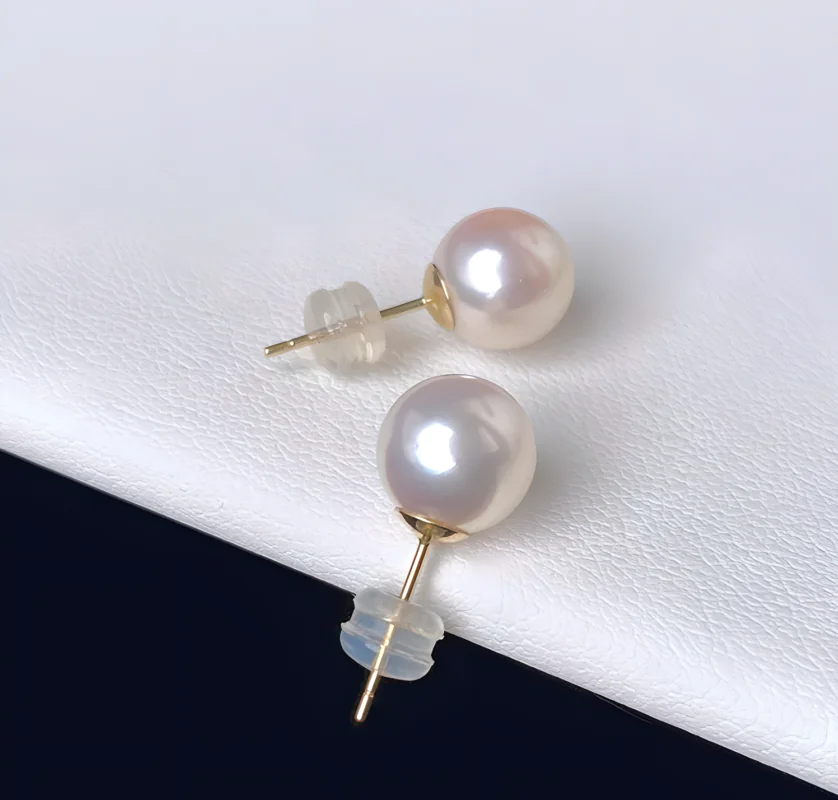
Akoya Pearl Nacre Thickness and Durability Limits
Akoya pearls are famous for bright, sharp luster, but they are also bead-cultured pearls with a comparatively thin layer of nacre over a shell nucleus. That makes nacre thickness an important quality and durability factor. The key point, however, is that there is no single thickness that translates into a guaranteed number of years of wear. For Akoya pearls, thickness, nacre structure, continuity, surface condition, drilling, setting, and care all matter together.
Quick Answer: How Thick Is Akoya Pearl Nacre?
GIA research describes approximately 0.15–0.50 mm as a typical nacre-thickness range for traditional Akoya bead-cultured pearls. More recently, GIA has stated that its minimum thickness parameter for Akoya cultured pearls is at least 0.15 mm. Separately, Japan's Pearl Science Laboratory defines 0.4 mm or more as “thick nacre” for Akoya pearls in its own grading system and uses the same 0.4 mm minimum in its Aurora Hanadama criteria.
These numbers should not be treated as interchangeable. A minimum classification parameter is not the same thing as a premium-quality benchmark, and neither one is a guaranteed durability lifespan.
| Nacre reference point | What it means | What it does not mean |
|---|---|---|
| 0.15 mm | GIA's stated minimum thickness parameter for Akoya cultured pearls | Not a promise of premium quality or a specific number of years of wear |
| About 0.15–0.50 mm | A range GIA has described as typical for traditional commercial Akoya bead-cultured pearls | Not a universal grade scale and not the range of every Akoya pearl |
| 0.4 mm or more | “Thick nacre” under the Pearl Science Laboratory grading system; also an Aurora Hanadama criterion | Not a universal worldwide definition of Hanadama, nor a guarantee of superior luster or lifetime durability |
| Above 1 mm | Possible in unusual Akoya production; GIA documented exceptional hybrid Akoya pearls above this level | Not a normal target for traditional Akoya pearls |
What Nacre Thickness Actually Measures
Akoya pearls are usually produced by inserting a round shell bead together with mantle tissue into an Akoya oyster. The oyster then deposits nacre around that bead. In this context, nacre thickness is the depth of the nacre coating from the surface of the bead nucleus to the outer surface of the pearl. It is not the pearl's total diameter and it should not be confused with the diameter difference between the finished pearl and the implanted bead.
This distinction matters because a pearl can be large mainly because a larger bead was used. A larger finished diameter does not automatically mean a thicker nacre layer. To understand how bead nucleation fits into Akoya pearl formation, see our broader Akoya pearl guide.
Why Akoya Nacre Is Usually Thinner Than South Sea or Tahitian Nacre
Traditional Akoya pearls are generally cultured for a shorter period than many South Sea and Tahitian bead-cultured pearls. GIA notes that Akoya growth periods commonly run around 10–14 months, and that Akoya oysters can form high-quality nacre under relatively cool water conditions. The result is a pearl type known for fine, reflective nacre layers but generally less nacre overgrowth than the larger bead-cultured South Sea and Tahitian categories.
Thin in absolute measurement does not automatically mean poor. Akoya pearls are valued precisely because fine nacre structure can produce exceptionally sharp, mirror-like reflections. The relevant question is not whether Akoya nacre is “thin” compared with another pearl species, but whether the nacre is sufficiently thick, continuous, well formed, and in good condition for that Akoya pearl.
Where Does the 0.15 mm Minimum Come From?
In its current pearl-classification guidance, GIA describes nacre using three related elements: thickness, continuity, and condition. GIA states that the minimum nacre-thickness parameter for Akoya pearls is at least 0.15 mm. GIA also notes that pearls with excessively thin nacre may show a chalky appearance or allow the bead nucleus to become visible under strong lighting.
That 0.15 mm figure is best understood as a lower technical threshold used within GIA's classification framework, not as a shopping target. GIA's own earlier research on small Akoya bead-cultured pearls measured examples from 0.20 to 0.41 mm and described 0.15–0.50 mm as the usual commercially accepted range expected for Akoya bead-cultured pearls.
For readers comparing laboratory reports, this distinction is important: a pearl can clear a minimum parameter without having what another laboratory, dealer, or premium certification program would call “thick nacre.”
Why 0.4 mm Is Often Mentioned for High-Quality Akoya Pearls
The 0.4 mm figure comes from a different context. Japan's Pearl Science Laboratory states that, under its PSL Pearl Grading System, Akoya pearls with nacre of 0.4 mm or more fall into its “thick nacre” category. The laboratory also lists 0.4 mm or more as one of the criteria for its Aurora Hanadama designation.
This makes 0.4 mm a useful reference point, especially when reading Japanese certificates. But it should not be turned into a universal law. “Hanadama” does not have one globally uniform laboratory standard, and nacre thickness is only one part of a high-quality Akoya evaluation. Shape, luster, surface, matching, nacre condition, and the specific certification system still matter.
Nacre Thickness Helps Durability, but It Does Not Set a Precise Lifespan
A thicker nacre layer generally gives more material between the outside world and the bead nucleus. This creates more margin against wear, especially in vulnerable areas such as drill holes. Very thin nacre is more concerning because wear, chipping, or peeling can expose the underlying bead sooner.
What cannot be stated responsibly is a fixed formula such as “0.3 mm lasts 10 years” or “0.5 mm lasts 30 years.” Reliable pearl laboratories do not assign consumer lifespans this way. GIA instead evaluates whether nacre is sufficiently thick and whether its structure and condition present durability concerns. If nacre is considered too thin to sustain normal wear, GIA says this will be disclosed in report comments.
So the practical durability limit is not a single cliff where a pearl is safe on one side and doomed on the other. Risk increases as the nacre becomes thinner or more structurally compromised, but actual service life depends on several interacting factors.
Five Factors That Can Matter as Much as the Thickness Number
1. Nacre continuity
A pearl can have enough measured nacre yet still contain structural interruptions, subsurface cracks, or uneven layering. GIA's expanded nacre scale specifically considers continuity rather than treating thickness as the whole story. A smooth, uninterrupted nacre structure is different from one with visible or subsurface disruption.
2. Nacre condition after harvest
Processing, drilling, setting, wear, and later damage can change the condition of the nacre. A pearl that began with adequate thickness can still develop chips, cracks, abrasion, or peeling if it is damaged. This is one reason nacre condition is evaluated separately from the raw thickness measurement.
3. The drill hole
Drill holes are mechanically vulnerable because they expose the cross-section of the nacre layer and are places where thread, knots, metal findings, or movement can create repeated contact. Chipping around a drill hole can therefore become visible earlier than broad wear across the main face of the pearl.
4. Jewelry type and frequency of wear
An Akoya pendant or pair of earrings usually experiences less rubbing against hard surfaces than a ring or bracelet. A frequently worn strand may also see repeated contact with skin, clothing, perfume, cosmetics, and clasp components. Two pearls with the same nacre thickness can therefore age differently in different jewelry designs.
5. Care and storage
Pearl nacre is softer and more chemically sensitive than many common jewelry materials. Thicker nacre cannot make a pearl immune to scratches, acids, harsh cleaners, or prolonged abrasion. For practical prevention, follow a conservative pearl care routine and store pearls away from harder jewelry that can scratch them.
Can You See Thin Nacre Without Laboratory Equipment?
Sometimes, but visual inspection is only a screening tool. GIA notes that thin nacre can make the bead nucleus more visible and can contribute to a dull or chalky appearance. Under strong lighting, some very thin-nacre Akoya pearls may show a visual “blinking” or uneven light-and-dark effect as the pearl is rotated.
However, a pearl that looks bright is not automatically proven to have a particular nacre thickness. Luster is a separate value factor, and visual appearance depends on nacre structure as well as thickness. Conversely, a laboratory measurement can quantify nacre more reliably than estimating a fraction of a millimeter by eye.
How Laboratories Measure Akoya Nacre Thickness
Because the bead nucleus is hidden, accurate measurement usually requires non-destructive imaging rather than ordinary visual grading. GIA research has used real-time X-ray microradiography to see the bead nucleus and measure the nacre overgrowth. GIA also offers average nacre-thickness measurements as an optional service on certain pearl reports.
The Pearl Science Laboratory likewise states that it uses X-ray measurement for nacre thickness in its grading work. These methods are more meaningful than seller claims such as “very thick nacre” when no measurement method or grading standard is identified.
Why Thickness Alone Does Not Guarantee Better Luster
Nacre thickness and luster are related, but they are not interchangeable. GIA's pearl system evaluates luster and nacre as separate value factors. A sufficient nacre layer supports durability and can help produce attractive optical effects, yet the organization and quality of the nacre layers also influence how light is reflected and interferes within the pearl.
This is why two Akoya pearls with similar measured thickness can still differ noticeably in sharpness, brightness, overtone, and surface appearance. When evaluating overall quality, use nacre as one part of the larger framework rather than allowing a single millimeter figure to override everything else. Our guide to evaluating pearl value explains how nacre fits alongside luster, surface, shape, size, color, and matching.
An Extreme Example: Akoya Pearls With More Than 1 mm of Nacre
A 2025 GIA study provides a useful reminder that “typical” is not the same as “possible.” Researchers examined hybrid Akoya bead-cultured pearls from Vietnam with extraordinarily thick nacre. Four approximately 6 mm pearls measured about 1.62–1.68 mm of nacre, while several 4 mm pearls measured about 1.11–1.46 mm.
Those values were far above the 0.15–0.50 mm range GIA described for traditional Akoya pearls. They demonstrate that biology, oyster strain, environment, and cultivation method can substantially change nacre growth. They should not, however, become a new consumer benchmark: the study described exceptional hybrid material, not the normal structure expected in standard Akoya production.
How to Judge an Akoya Pearl's Durability in Practice
If durability matters, do not ask only, “How many millimeters of nacre does it have?” Use a layered check instead:
- Confirm that the pearl has sufficient nacre for its type. If a laboratory report is available, check whether it flags thin or unacceptable nacre.
- Understand the grading system behind the number. A 0.4 mm threshold from one Japanese laboratory is not the same thing as GIA's minimum classification parameter.
- Inspect luster and bead show-through. Chalkiness, obvious nucleus visibility, or strong blinking deserves caution, even though appearance alone cannot provide an exact measurement.
- Look closely around drill holes. Chips, peeling, cracks, or exposed bead material are more immediate durability concerns than a theoretical thickness discussion.
- Consider how the jewelry will be worn. Earrings and pendants generally face less abrasion than rings and bracelets.
- Evaluate the whole pearl. Nacre thickness, continuity, condition, luster, and surface should agree with one another rather than being reduced to a single number.
For readers who want to understand why pearls respond differently to scratching, chemicals, heat, and wear, see the physical and chemical properties of pearls.
What “Durability Limit” Should Mean for an Akoya Buyer
The most useful way to think about a durability limit is as a risk threshold, not a lifespan calculator. Extremely thin nacre increases the risk that the bead becomes visible or that wear reaches the nucleus sooner. Adequate nacre provides more protection. Thick, well-structured nacre provides a stronger durability margin. But no laboratory thickness number can account in advance for every drill hole, mounting, impact, storage condition, cleaning method, or wear pattern.
For that reason, an Akoya pearl described as 0.4 mm should not be marketed as “guaranteed for life,” just as a pearl near 0.15 mm should not automatically be declared unusable without considering its full laboratory and physical condition. The responsible conclusion is more precise: thickness is important, very thin nacre is a genuine durability concern, and stronger evaluations combine the number with nacre continuity, condition, luster, surface, and intended use.
FAQ
What is a normal nacre thickness for Akoya pearls?
GIA has described approximately 0.15–0.50 mm as the usual commercially accepted range expected for traditional Akoya bead-cultured pearls. Individual pearls can fall outside that range, so it should be treated as a reference rather than a universal grading scale.
Is 0.4 mm of nacre good for an Akoya pearl?
It is a meaningful positive reference. Japan's Pearl Science Laboratory defines 0.4 mm or more as “thick nacre” for Akoya pearls and uses that threshold in its Aurora Hanadama criteria. It is not, however, a universal global grade or a guaranteed lifespan.
How thin is too thin for an Akoya pearl?
GIA currently states a minimum Akoya nacre-thickness parameter of at least 0.15 mm and flags nacre that is too thin to sustain normal wear. In practice, durability should also be judged from continuity, condition, visible damage, and the way the pearl will be worn.
Does thicker nacre always mean a more lustrous Akoya pearl?
No. Sufficient nacre supports good optical performance, but luster also depends on the quality and organization of the nacre layers. GIA evaluates luster and nacre separately for this reason.
Can I measure Akoya nacre thickness at home?
Not accurately. Visual signs can suggest very thin nacre, but reliable measurement of a hidden bead and its nacre coating normally requires laboratory imaging such as X-radiography.
Sources and Further Reading
- GIA: An Overview and Update on the GIA 7 Pearl Value Factors Classification System
- GIA: Very Small Akoya Cultured Pearls
- GIA: Exceptional Nacre Thickness of Hybrid Akoya Bead Cultured Pearls
- GIA: Expanded Nacre Scale for Pearl Classification Reports
- Pearl Science Laboratory: Akoya “Thick Nacre” Definition
- Pearl Science Laboratory: Aurora Hanadama Criteria
What to Remember
Akoya nacre is thin by design compared with many other saltwater bead-cultured pearls, yet high-quality Akoya can still combine fine nacre structure with exceptional luster and good durability. Use 0.15 mm as a minimum technical reference in GIA's framework, 0.4 mm as a meaningful “thick nacre” reference in the Pearl Science Laboratory system, and 0.15–0.50 mm as a commonly cited traditional Akoya range—not as a lifespan formula. The best durability judgment comes from thickness plus continuity, condition, construction, wear pattern, and care.