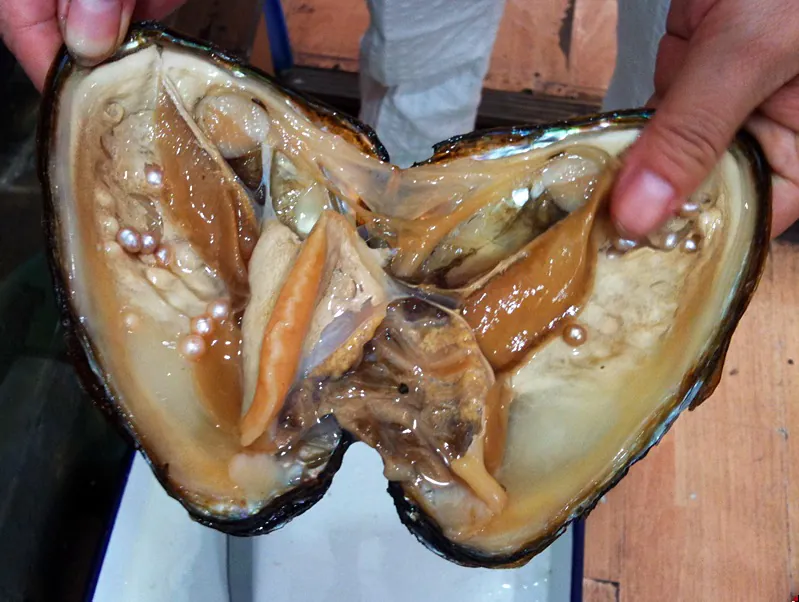
A pearl is not usually ready for a necklace the moment it is removed from a mollusk. After harvest, it still has to be cleaned, inspected, separated into comparable groups, and prepared for its final use. Some pearls also undergo post-harvest treatments that change color or appearance.
The important point is that there is no single universal processing line for every pearl. Akoya, freshwater, Tahitian, and South Sea pearls can follow different routes, and even within one pearl type the order of drilling, treatment, sorting, and grading may vary between farms and processors.
A practical way to think about the workflow is:
Harvest → cleaning → first screening → sorting → optional processing or treatment → drilling if required → final grading → matching → jewelry or wholesale preparation.
Several of those stages can repeat. In practice, pearl processing is often a loop of inspection and re-sorting rather than a perfectly straight conveyor belt.
The post-harvest pearl workflow at a glance
| Stage | Main purpose | Does every pearl need it? |
|---|---|---|
| Removal and cleaning | Remove biological residue and prepare the surface for inspection | Usually |
| Initial screening | Separate obviously damaged or commercially unsuitable pearls | Usually |
| Sorting | Group pearls by size, shape, color, luster, surface, or intended use | Usually, often more than once |
| Optional treatment or enhancement | Modify color, brightness, luster, or other appearance factors | No |
| Drilling or other working | Prepare pearls for strands, earrings, pendants, or settings | Only when the final product requires it |
| Final grading | Evaluate quality after the relevant preparation steps are complete | Normally for commercial sale |
| Matching and lotting | Create pairs, strands, sets, or consistent wholesale parcels | Depends on the destination |
1. Pearls are removed and cleaned after harvest
At harvest, the pearl is removed from the oyster or mussel. A fresh harvest can contain a surprisingly wide range of results: round pearls, baroque pearls, strong and weak luster, clean and marked surfaces, multiple colors, and pearls that are not suitable for normal jewelry use.
The first practical job is cleaning. Newly harvested pearls can carry mucus, tissue residue, salts, or other surface material. Gentle cleaning makes the surface easier to inspect without intentionally changing the pearl into a different color or grade.
This distinction matters because cleaning is not automatically the same thing as treatment. A pearl can be cleaned simply so its existing surface can be seen accurately.
2. The harvest receives a first screening
Before fine grading, the harvest is usually divided into broad groups. Pearls with severe damage, major structural problems, very poor nacre, or shapes that do not fit the intended product may be separated from more usable material.
This is not yet the final grade. It is closer to triage: the processor is reducing a mixed biological harvest into groups that can be compared meaningfully.
That is why a newly harvested batch can look chaotic while the final commercial lot looks very consistent. Much of that consistency is created by sorting rather than by changing the pearls themselves.
3. Pearls are sorted into comparable groups
Sorting can involve several characteristics at once:
- diameter or overall dimensions,
- round, near-round, oval, button, drop, baroque, or other shape families,
- bodycolor and overtone,
- luster,
- surface condition,
- nacre appearance,
- drill status, and
- intended use, such as a loose pearl, pair, strand, or finished jewelry piece.
Sorting is one of the most important parts of post-harvest work because grading only becomes useful when similar pearls are being compared. A 7 mm white Akoya pearl, a 12 mm golden South Sea pearl, and an irregular freshwater baroque pearl should not be judged as though they belong to one uniform category.
For a deeper look at the factors used after sorting, see our pearl grading guide.
4. Some pearls undergo optional post-harvest treatment
This is the stage most likely to cause confusion. Routine preparation and appearance-changing treatment are not the same thing.
CIBJO's Pearl Book separates normal procedures such as cleaning, drilling, polishing, buffing, carving, and cutting from treatments that require more specific disclosure, including bleaching, dyeing, irradiation, coating, luster enhancement, optical brightening, and other chemical or physical alteration.
That does not mean every pearl receives those treatments. It means those methods exist in the trade and should be described accurately when they are used.
GIA research also shows that post-harvest processing is especially relevant to light-colored Akoya and freshwater cultured pearls. Bleaching, luster-enhancement processes such as maeshori, and optical brightening may be used in some production streams. Dyeing and irradiation are additional color-modification methods encountered in the market.
If you want to separate normal finishing from more consequential appearance changes, read our guide to cultured pearl treatments and enhancements.
5. Drilling can happen at different points in the workflow
Many pearls eventually need a full or partial drill hole. The exact timing varies.
A pearl may be drilled after early sorting, after treatment, or only after it has been selected for a specific jewelry use. In some Akoya processing workflows, drilling can occur before certain cleaning or color-related steps. In other businesses, valuable loose pearls are kept undrilled until a buyer or jewelry design determines the ideal orientation.
Drilling is not merely making a hole in the center. The operator may choose the drill direction to:
- preserve the pearl's best visible face,
- hide a small surface mark near the hole,
- keep a pair visually symmetrical, or
- make a strand sit naturally when worn.
Poor drilling can chip the nacre around the hole, place the pearl off-axis, or make later matching more difficult. That is why drilling and matching are often closely connected.
6. Final grading usually happens after the relevant processing is complete
A pearl may be inspected several times before it receives its final commercial grade. The final evaluation generally reflects the pearl as it will actually be sold, not simply how it looked at the moment of harvest.
Typical grading considerations include:
- Luster: the strength, sharpness, and liveliness of reflected light.
- Surface: the quantity, visibility, and severity of blemishes or growth features.
- Shape: how round or intentionally shaped the pearl is.
- Color: bodycolor, overtone, and overall visual appeal, with relevant treatment disclosed.
- Size: diameter or dimensions, considered within the pearl type.
- Nacre: the quality and condition of the nacre appropriate to that pearl category.
- Matching: the harmony between pearls when they will be sold as a pair, set, or strand.
Commercial labels such as AA, AAA, or AAAA are not one universal worldwide grading system. The actual value of a grade depends on the seller's criteria and consistency. This is why the underlying quality factors matter more than the letters alone.
7. Matching turns individual pearls into pairs, strands, and saleable lots
Matching is one of the most labor-intensive parts of the workflow because the goal is no longer to find a good pearl; it is to find several pearls that look right together.
For earrings, two pearls may need to match closely in diameter, bodycolor, overtone, luster, surface quality, and visual weight. For a necklace, dozens of pearls need to transition smoothly across the strand. For wholesale parcels, the goal may instead be to create a lot with a controlled range that a jeweler can work with efficiently.
This is also why sorting happens repeatedly. A group can be re-sorted after drilling, after treatment, or after a stricter matching requirement is introduced.
Designers and makers looking for loose pearls or strands can browse our wholesale pearl selection. For matching, drilling, inspection, or custom production, see our pearl and jewelry services.
Why the workflow differs by pearl type
One of the biggest mistakes is assuming that all cultured pearls receive the same post-harvest treatment.
Akoya pearls
White and light-colored Akoya pearls are well known for post-harvest processing. Depending on the producer and market, this can include cleaning, drilling, bleaching, maeshori or other luster-enhancement steps, toning or related color adjustment, followed by detailed sorting and matching.
That does not make the pearl imitation. It remains a cultured pearl. The key issue is understanding which steps are normal preparation and which treatments materially alter appearance and therefore need appropriate disclosure.
Freshwater pearls
Freshwater harvests can contain a broad natural range of white, cream, pink, peach, purple, and other tones. White or pale pearls may undergo bleaching or optical brightening in some processing streams, while other freshwater pearls may be dyed or irradiated to create colors that are not their original post-harvest appearance.
Because the category is so broad, the safest approach is not to assume that all freshwater pearls are treated or untreated. Ask about the specific lot.
South Sea pearls
High-quality South Sea pearls are often valued for naturally occurring white, silver, cream, and golden colors. At Australian farms, for example, marketable pearls may be cleaned, lightly polished, sorted, and graded without color treatment at the farm stage. However, pearls can still be treated later in the distribution chain, so origin alone does not prove treatment status.
Tahitian pearls
Tahitian cultured pearls naturally occur in dark and strongly colored ranges, including gray, green, peacock, aubergine, and other combinations. Their natural color is a major part of their appeal. Treatments that alter pearl color also exist in the wider market, so unusually uniform or atypical colors should be described carefully rather than assumed to be natural.
Processing is a workflow, not a guarantee of quality
More processing does not automatically produce a better pearl. A weak pearl cannot be turned into a top pearl simply by passing through more steps. Luster, nacre condition, shape, surface, and natural color all begin with what the mollusk produced.
Post-harvest work mainly does three things:
- reveals the pearl clearly enough to inspect,
- groups and prepares pearls for a specific commercial use, and
- in some cases, modifies appearance through disclosed treatment.
That distinction helps explain why two pearls from the same harvest can end up in completely different markets. One may become a matched earring pair, another a strand pearl, another a loose focal pearl, and another may remain unsuitable for normal jewelry production.
What should buyers ask about post-harvest processing?
You do not need the name of every machine or chemical used in a factory. The useful questions are much simpler:
- Is the pearl's color natural or has it been modified?
- Has the pearl been bleached, dyed, irradiated, coated, optically brightened, or otherwise treated?
- Is it drilled, half-drilled, or undrilled?
- What factors were used for the seller's grade?
- For a pair or strand, how tightly were the pearls matched?
These questions tell you much more than asking whether a pearl was simply “processed.” Nearly every commercial pearl goes through some kind of handling after harvest. What matters is what was done, whether it changed the pearl materially, and whether that information is communicated clearly.
FAQ
Are pearls ready to sell immediately after harvest?
Usually not. They normally need at least cleaning, inspection, sorting, and commercial preparation. Pearls intended for pairs, strands, or jewelry require additional matching, drilling, setting, or manufacturing work.
Are all pearls bleached after harvest?
No. Bleaching is common in some pearl categories, especially certain white or light-colored Akoya and freshwater processing streams, but it should not be treated as a universal step for every pearl type or every producer.
Is drilling considered a pearl treatment?
Industry terminology distinguishes routine physical procedures from treatments that materially alter appearance or condition. CIBJO lists drilling among normal procedures for cultured pearls, while methods such as dyeing, irradiation, coating, optical brightening, and luster enhancement require specific treatment disclosure.
Why are pearls sorted more than once?
Because each later decision can create a new matching requirement. Pearls may be broadly sorted after cleaning, regrouped after processing, sorted again by final quality, and then matched into pairs, strands, or wholesale lots.
Does post-harvest processing make a pearl fake?
No. A treated cultured pearl is still a cultured pearl rather than an imitation pearl. Treatment can affect appearance, value, care requirements, and buyer expectations, so the important issue is accurate disclosure.
Sources and further reading
- CIBJO Pearl Book 2024 — terminology and disclosure guidance for normal procedures and pearl treatments.
- GIA Pearl Research — research on pearl identification, color modification, bleaching, maeshori, optical brightening, and other post-harvest processes.
- GIA: Detection of Color Treatment and Optical Brightening in Chinese Freshwater “Edison” Pearls.
- Australian South Sea Pearls: Perfecting the Pearl Farming Process — an example of farm-stage cleaning and grading practices for Australian South Sea pearls.