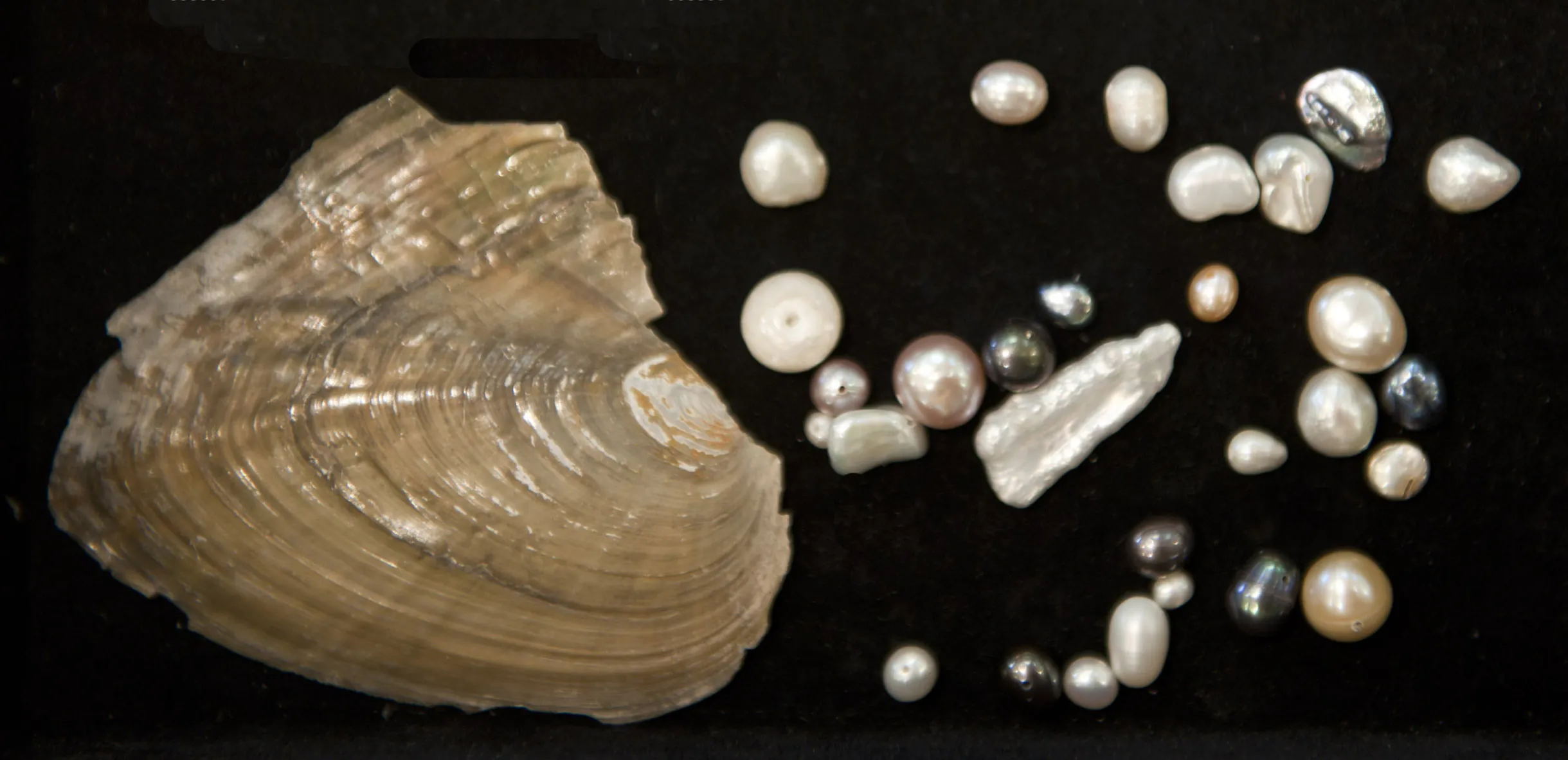
Tahitian pearls are naturally colored saltwater cultured pearls associated with French Polynesia and the black-lipped pearl oyster, Pinctada margaritifera. They are often called “black pearls,” but that description is much narrower than the real color range. Many Tahitian pearls are gray, silver, greenish gray, charcoal, brownish gray, or nearly black, with overtones that can appear green, blue, pink, purple, bronze, or mixed.
The name can also be misleading geographically. A Tahitian pearl does not have to come from the island of Tahiti itself. Much of French Polynesia’s pearl farming takes place across remote atolls and islands, especially in the Tuamotu and Gambier regions. Understanding that distinction makes the category much easier to recognize: “Tahitian” describes a French Polynesian cultured-pearl tradition tied to a particular oyster and a naturally dark color family—not simply any pearl that looks black.
What exactly makes a pearl “Tahitian”?
In casual jewelry language, “Tahitian pearl” is sometimes used as if it were just another name for a dark pearl. In stricter pearl nomenclature, however, origin and producing mollusk both matter.
The World Jewellery Confederation (CIBJO) defines a Tahitian cultured pearl as a naturally colored cultured pearl produced in French Polynesia from Pinctada margaritifera cumingii. In practical buying terms, this gives the name three connected ideas:
- Geography: French Polynesia.
- Mollusk: the black-lipped pearl oyster, Pinctada margaritifera.
- Color character: naturally occurring dark or complex colors rather than a dark appearance created simply by dyeing another pearl type.
This is why a dyed black freshwater pearl is not a Tahitian pearl, even when the surface color looks similar in a photograph. Likewise, a dark pearl produced by another mollusk or in another region should not automatically be identified as Tahitian.
For a broader overview of the pearl type—including size, shape, nacre and matching—see our complete guide to Tahitian black pearls.
Why are they called Tahitian pearls if many are not farmed on Tahiti?
Tahiti is the best-known island in French Polynesia and historically became the commercial name most international buyers associated with the region’s dark cultured pearls. The production geography is much wider.
French Polynesia’s Direction des Ressources Marines reports pearl farming across many islands and atolls. Its 2023 statistics showed that most exploited pearl-farming area was concentrated in the Tuamotu Archipelago, followed by the Gambier Islands, with smaller areas in the Leeward Islands and Tahiti itself. In other words, an authentic Tahitian cultured pearl may have been grown hundreds of kilometers from the island of Tahiti.
This matters because “origin” in pearls is not just a marketing story. It connects the pearl to a farming system, an oyster population, environmental conditions and local production rules. If you want to understand how origin relates to pearl type more generally, our guide on why pearl origin matters explains the distinction between geography, mollusk species and quality.
The black-lipped oyster is the key to the color
The defining mollusk is Pinctada margaritifera, commonly called the black-lipped pearl oyster. Its shell has dark, iridescent mother-of-pearl around the inner edge, and its mantle tissue can produce nacre with the pigments and optical characteristics responsible for the Tahitian pearl family’s naturally dark appearance.
Most round and near-round Tahitian cultured pearls are bead cultured. A technician inserts a bead nucleus together with a small piece of donor mantle tissue. A pearl sac forms around the bead and deposits nacre layer by layer. The biological characteristics of that nacre—and the way light interacts with its layered structure—help create the pearl’s bodycolor, overtone and sometimes orient.
That is a more accurate explanation than saying Tahitian pearls become dark because they “absorb minerals from the lagoon.” Water quality and farming conditions influence oyster health and pearl development, but the oyster and the nacre it secretes are fundamental to the color itself.
Are Tahitian pearls actually black?
Sometimes they can look nearly black, especially under low or directional light, but many are not literally black. Gemological references from GIA describe a range extending from light gray through dark gray and black, with additional bodycolors and secondary hues also possible.
A useful way to read Tahitian color is to separate three different visual features:
- Bodycolor is the dominant overall color of the pearl.
- Overtone is a translucent secondary color seen over the bodycolor.
- Orient is an iridescent, rainbow-like effect that appears on or just below the surface of some pearls.
Two pearls can therefore share a similar gray bodycolor and still look very different. One may carry a cool blue overtone; another may show green with pink or purple flashes. This is one reason Tahitian strands can be difficult to match and why multicolor strands can look intentionally complex rather than inconsistent.
What colors can Tahitian pearls naturally show?
There is no single retail color chart used identically by every pearl seller, so it is more useful to think in color families than in rigid trade-name boxes.
| Color family | What it may look like | Common secondary effects |
|---|---|---|
| Silver / light gray | Cool, metallic-looking gray to medium gray | Blue, green or pink overtone |
| Gray / charcoal | Neutral gray through very dark near-black | Green, blue, purple, bronze or pink flashes |
| Green / greenish gray | Gray with a clear green cast or a more saturated green appearance | Pink, purple, blue or bronze overtone |
| Brown / brownish gray | Warmer dark neutral, sometimes bronze- or taupe-like | Green, rose or purple nuance |
| Lighter or unusual colors | Cream, pale green, yellowish, very light gray or other less typical appearances | Various overtones and orient |
French Polynesia’s marine-resources authority itself describes Tahitian cultured pearls as naturally occurring in a broad palette that includes gray, green, blue, white, cream, cherry and “peacock” appearances. GIA research likewise documents gray-to-black colors as characteristic, with green, pink, purple and mixed secondary hues among the most recognizable.
If you want a deeper breakdown of silver, charcoal, peacock, aubergine, pistachio and other trade color terms, see the natural dark color range of Tahitian pearls.
What does “peacock” mean?
“Peacock” is one of the best-known Tahitian pearl trade color terms, but it should not be treated as a synonym for every green pearl. GIA uses the term for a defined color range involving a green-containing bodycolor with medium-to-strong saturation and medium-to-dark tone, together with a noticeable overtone or orient—often pink, though other hues can occur.
In ordinary retail descriptions, sellers may use “peacock” more loosely. For that reason, photographs taken under neutral lighting and a plain-language description of the bodycolor and overtone are often more useful than a romantic color name by itself.
Does French Polynesian origin automatically mean high quality?
No. Origin tells you what kind of pearl you are dealing with; it does not replace quality evaluation.
Within Tahitian pearls, quality can vary substantially. A pearl may have an attractive rare-looking color but weak luster, heavy surface blemishing or an unsuitable shape for a particular piece of jewelry. Another pearl with a more common gray-green color may be much more beautiful because its luster is sharper and its surface is cleaner.
When comparing Tahitian pearls, judge at least:
- Luster — how bright, sharp and lively the reflections appear.
- Surface — the type, number and visibility of blemishes or growth marks.
- Shape — round, near-round, drop, oval, circled or baroque.
- Size — considered together with the other quality factors, not by itself.
- Color — bodycolor, overtone, saturation and how the pearl looks in different light.
- Matching — especially important for pairs and strands.
For a general framework, use our pearl grading guide rather than assuming that the word “Tahitian” is itself a quality grade.
Can you identify a Tahitian pearl by color alone?
Not reliably. A naturally dark Tahitian pearl may look very distinctive, but color alone is not proof of geographic origin, oyster species or treatment history.
Dark freshwater pearls are widely available, and color treatments can create black, green, blue or peacock-like appearances in other pearl categories. Conversely, genuine Tahitian pearls can be lighter than a shopper expects. A pearl that does not look “black enough” is not automatically suspicious.
For routine jewelry purchases, clear seller disclosure is usually the first thing to check: pearl type, whether the color is represented as natural or treated, size, shape and quality description. For an unusually valuable pearl, a rare color premium, or a purchase where origin and treatment claims materially affect the price, an independent gemological laboratory report can add useful verification.
A practical way to choose Tahitian pearls
If you are choosing Tahitian pearl jewelry rather than studying gemology, the process can be kept simple:
- Confirm the category first. Make sure the seller is actually describing French Polynesian Tahitian cultured pearls rather than using “black pearl” as a general color label.
- Judge luster before chasing a color name. Strong luster usually makes the color look deeper and more dimensional.
- Look at color under neutral light. Dark pearls can shift dramatically under warm indoor lighting, phone processing or a black background.
- Choose the color you genuinely like. Peacock is famous, but silver-gray, green, blue-gray and multicolor Tahitian pearls can be equally compelling depending on the wearer and jewelry design.
- For pairs or strands, check the match. Two individually beautiful pearls may not work as earrings if their bodycolors or overtones pull in opposite directions.
If you want to see how these differences translate into finished pieces, browse our Tahitian pearl jewelry.
What should you remember?
Tahitian pearls are best understood through the connection between place, oyster and color. They belong to the French Polynesian pearl industry, are produced by the black-lipped Pinctada margaritifera, and are famous for naturally dark and complex colors that go far beyond flat black.
The island of Tahiti gives the category its name, but many pearls are cultured elsewhere in French Polynesia, especially across the Tuamotu and Gambier regions. Their color may range from silver and gray to charcoal, green, brown and near-black, with blue, pink, purple, bronze and multicolor overtones. And while origin helps identify the pearl type, it does not tell you whether a particular pearl is high quality: luster, surface, shape, size, color and matching still need to be judged separately.
FAQ
Are Tahitian pearls actually from Tahiti?
They are associated with French Polynesia, but they do not have to be cultured on the island of Tahiti itself. Major pearl-farming areas include islands and atolls in the Tuamotu and Gambier archipelagos.
Are Tahitian pearls naturally black?
They are naturally dark, but many are gray, silver, greenish gray, charcoal, brownish gray or near-black rather than pure black. Overtones can add green, blue, pink, purple or bronze effects.
What oyster produces Tahitian pearls?
Tahitian cultured pearls are produced by the black-lipped pearl oyster, Pinctada margaritifera. Formal CIBJO nomenclature specifies Pinctada margaritifera cumingii for Tahitian cultured pearls from French Polynesia.
Are all black pearls Tahitian pearls?
No. Other pearl types can look black or dark, including treated freshwater and Akoya pearls, and other naturally dark saltwater pearls also exist. “Black” describes appearance; it does not identify origin by itself.
Is peacock the best Tahitian pearl color?
Peacock is one of the most recognized and sought-after trade colors, but there is no single best color for every buyer. Luster, surface, matching and personal preference matter at least as much as the color name.
Sources and further reading
- CIBJO Pearl Book 2024 — industry nomenclature for Tahitian cultured pearls.
- GIA: Non-Bead-Cultured Pearls from Pinctada margaritifera — species, origin and natural color range.
- GIA: Different Pearl Types Explained — overview of Tahitian pearl color, size and culturing.
- GIA: “Peacock” Color Range Comment — explanation of the peacock trade color range.
- French Polynesia Direction des Ressources Marines: La Perle de culture de Tahiti — official overview of Tahitian cultured pearl colors and quality characteristics.
- French Polynesia Direction des Ressources Marines: 2023 Pearl Farming Statistics — distribution of pearl-farming activity across French Polynesia.