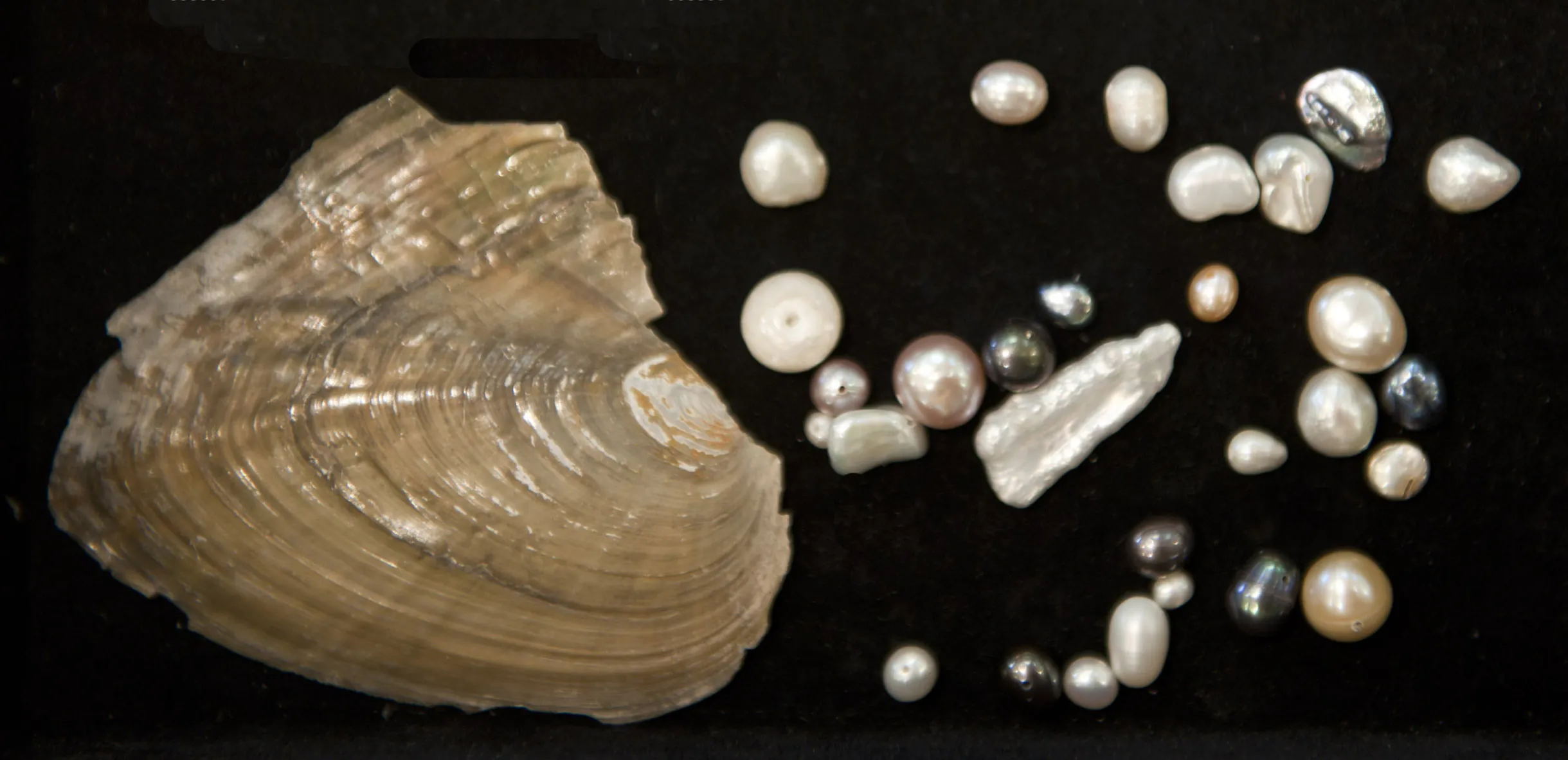
Natural pearls are pearls that form inside a mollusk without deliberate human intervention. No pearl farmer implants a bead, inserts mantle tissue, or otherwise starts the pearl-forming process. The pearl develops spontaneously inside the animal.
That definition is more important than appearance. A natural pearl does not have to be perfectly round, white, large, or flawless, and a pearl that looks irregular is not automatically natural. Likewise, a cultured pearl is still a real pearl—it simply formed after people intentionally initiated the culturing process.
If you want the broader classification first, see our guide to natural, cultured, and imitation pearls.
Natural Pearls vs. “Real Pearls”: These Terms Are Not the Same
One of the most common misunderstandings is to treat natural as another word for real. In gemological terminology, those words answer different questions.
- Natural pearl: formed in a mollusk without human intervention.
- Cultured pearl: formed in a mollusk after human intervention initiates pearl growth.
- Imitation pearl: a manufactured object made to resemble a pearl but not produced as a pearl inside a mollusk.
Both natural and cultured pearls are genuine pearls. GIA specifically cautions that cultured pearls should not be described as “natural pearls,” even though they grow inside living mollusks, because the term natural is reserved for pearls that developed without human intervention.
How Do Natural Pearls Form?
A natural pearl begins when a pearl sac develops inside a mollusk without a person deliberately creating the conditions for it. The mollusk then deposits mineral and organic material as the pearl grows.
You will often see this process explained with the familiar story that a grain of sand enters an oyster and becomes coated with nacre. That is useful as a very rough illustration, but it is too simplistic to treat as a universal explanation. Natural pearl formation can involve biological injury, invading organisms, tissue changes, or other events, and the exact initiating cause is not always preserved or identifiable later.
For nacreous pearls, the visible structure is built from repeated layers containing calcium carbonate and organic material. If you want a deeper explanation of pearl growth itself, our pearl formation guide explains the process in more detail.
How Are Natural Pearls Different from Cultured Pearls?
The most important difference is not whether the pearl grew in nature—it is whether people deliberately initiated its formation.
| Question | Natural Pearl | Cultured Pearl |
|---|---|---|
| Does it form inside a mollusk? | Yes | Yes |
| Is it a genuine pearl? | Yes | Yes |
| Is human intervention used to start pearl formation? | No | Yes |
| Common in the modern jewelry market? | No | Yes |
| Can appearance alone reliably prove the category? | No | No |
| May laboratory X-ray examination be needed? | Yes, especially for valuable or uncertain pearls | Yes, when origin of formation must be confirmed |
Modern cultured pearls may be bead-cultured or non-bead cultured, and some non-bead cultured pearls can have internal structures that make identification more complicated than a simple “bead versus no bead” rule. This is one reason professional pearl identification focuses on internal growth structure rather than surface appearance alone.
Why Are Natural Pearls So Rare Today?
Natural pearl formation is accidental from a commercial point of view. You cannot reliably tell a wild mollusk to form a pearl of a useful size, shape, color, and quality, and then repeat that result across a jewelry collection.
Pearl cultivation changed that. By deliberately initiating pearl formation and caring for mollusks in farms, producers can create genuine pearls in far greater numbers and with much more predictable commercial results. GIA notes that the vast majority of pearls in today’s pearl and jewelry market are cultured, while many natural pearls encountered in trade are antique or pass through specialist markets.
So when a normal jewelry listing simply says “pearls,” you should not assume they are natural pearls. In contemporary retail, cultured pearls are the standard unless the seller clearly states otherwise and can support the claim.
Can You Tell a Natural Pearl Just by Looking at It?
Usually, no—not with enough certainty for a valuable purchase.
Natural pearls are often described as irregular, small, or less uniform, but those are only tendencies. Cultured pearls can also be baroque, off-round, heavily textured, or non-bead cultured. At the same time, some natural pearls can be remarkably attractive and well shaped.
That makes visual shortcuts unreliable. A pearl’s shape, color, surface, luster, or drill hole may provide clues, but none of those features alone proves that it formed naturally.
Gemological laboratories commonly use X-radiography to examine internal structures. GIA describes microradiography as a key non-destructive method for separating natural and cultured pearls, sometimes supplemented by other testing when structures overlap or are difficult to interpret.
For a practical overview of what visual inspection can and cannot tell you, see our pearl identification guide.
What Does a Laboratory Look for Inside a Pearl?
The internal structure records how a pearl grew. A bead-cultured pearl often shows a distinct bead nucleus surrounded by nacre. Natural pearls more commonly show growth structures that developed without an implanted bead or deliberate culturing operation.
However, real identification is more nuanced than diagrams sometimes suggest. Natural pearls can show several different internal growth patterns, while non-bead cultured pearls can sometimes display structures that overlap with natural examples. In difficult cases, laboratories may combine real-time X-radiography, micro-computed tomography, chemical data, fluorescence behavior, species information, and reference samples before reaching a conclusion.
This is why a seller's visual opinion should not be treated as equivalent to a laboratory identification when the natural origin materially affects the price.
Are Natural Pearls Always More Valuable?
No. Natural origin is an important rarity factor, but it is not a complete quality grade.
A pearl's value can also depend on size, shape, luster, surface condition, color, matching, species or pearl type, condition, provenance, and market demand. A poorly formed or damaged natural pearl does not automatically become more desirable than an exceptional cultured pearl simply because it is natural.
For fine natural pearls with attractive appearance, convincing provenance, and reliable laboratory documentation, rarity can create a substantial premium. But “natural” should be read first as a statement about formation, not as a guarantee of beauty, quality, or investment value.
The same principle applies to commercial grading more broadly: identity and quality are separate questions. Our pearl value evaluation guide explains the visual and commercial factors that need to be considered together.
Are All Natural Pearls Nacreous?
No. The classic image of a pearl is a nacreous pearl produced by a pearl oyster or mussel, with the layered optical effects that create familiar pearl luster and orient. But the broader natural-pearl category also includes non-nacreous pearls produced by certain mollusks.
Examples include conch pearls and Melo pearls, which can show distinctive flame-like or porcelaneous appearances rather than the typical nacreous surface of an Akoya-style pearl.
This distinction matters because rules that are useful for nacreous pearls cannot automatically be applied to every natural pearl species.
What Should You Check Before Buying a Natural Pearl?
If the word natural is responsible for a meaningful part of the asking price, documentation matters.
- Ask who identified it as natural. A seller description alone is not the same as independent gemological testing.
- Look for a report from a reputable laboratory. For valuable pearls, the report should address whether the pearl is natural or cultured rather than merely confirming that it is a pearl.
- Read the wording carefully. “Natural pearl” describes formation. It does not automatically confirm high quality, untreated color, species, geographic origin, or market value unless those points are separately tested and stated.
- Consider provenance for antique pieces. Age, documented history, matching, condition, and original mounting can materially affect collector value.
- Be cautious with unusually strong claims based only on appearance. A pearl being irregular, old-looking, or “wild” in appearance is not proof of natural formation.
If you are evaluating paperwork rather than the pearl itself, our pearl grading certificate guide explains how to separate identity information from quality and seller grading.
The Simplest Way to Remember the Difference
Use one question:
Did people deliberately initiate the pearl-forming process?
- If no, the pearl may be natural.
- If yes, it is cultured.
- If it was manufactured outside a mollusk to imitate a pearl, it is an imitation.
That framework is more reliable than trying to classify pearls by roundness, color, surface texture, or price. And when the natural-versus-cultured distinction carries significant financial value, laboratory testing is the appropriate way to confirm it.
FAQ
Are natural pearls real pearls?
Yes. Natural pearls are genuine pearls that form inside mollusks without human intervention.
Are cultured pearls fake?
No. Cultured pearls are also genuine pearls. The difference is that people deliberately initiate the pearl-forming process in a living mollusk.
Are cultured pearls natural pearls?
No. In gemological terminology, natural pearl is reserved for pearls that formed without human intervention. Calling cultured pearls “natural pearls” is misleading.
Are freshwater pearls natural?
Freshwater describes the environment, not whether the pearl is natural or cultured. Natural freshwater pearls exist, but the freshwater pearls commonly sold in modern jewelry are cultured.
Can you identify a natural pearl from its shape?
No. Natural pearls are often irregular, but cultured pearls can also be baroque or off-round. Shape alone cannot reliably establish natural origin.
Do natural pearls need a certificate?
Not every low-value or inherited pearl requires laboratory paperwork, but if a seller is charging a substantial premium because a pearl is claimed to be natural, a report from a reputable gemological laboratory is a sensible form of verification.