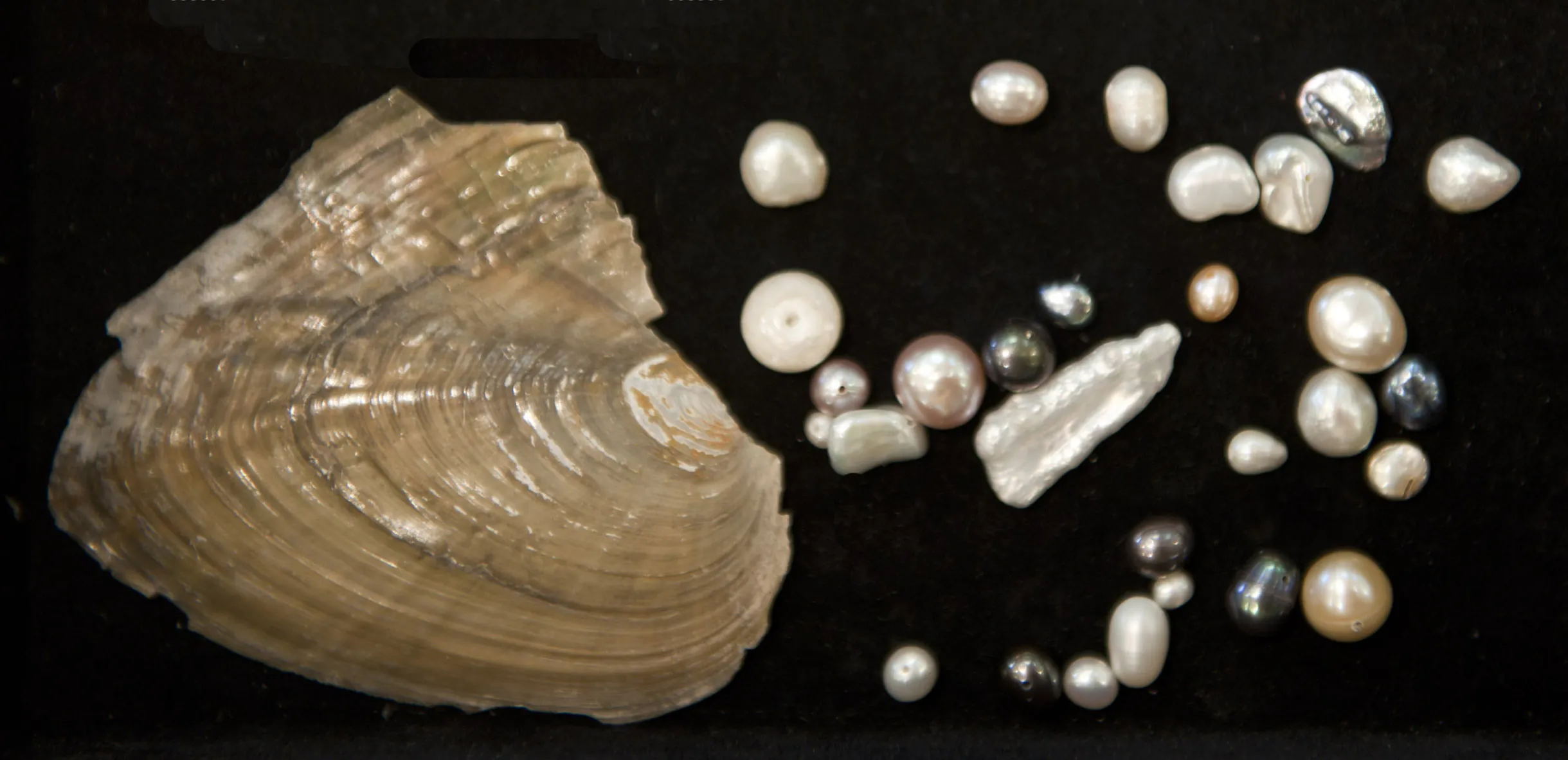
Tahitian pearls are often introduced as “black pearls,” but that nickname is useful only up to a point. A Tahitian pearl may look silver-gray, charcoal, green, blue-green, aubergine, bronze, peacock, or nearly black. Many of the most distinctive examples are beautiful precisely because they are not a flat, uniform black.
The more accurate way to understand Tahitian pearls is this: they are a naturally colored cultured-pearl category from French Polynesia, associated with the black-lipped pearl oyster Pinctada margaritifera. Their visual identity comes from the interaction of bodycolor, overtone, orient, tone, and luster—not from a single color called black.
Why Are Tahitian Pearls Called Black Pearls?
The name makes sense historically and visually. Compared with classic white Akoya or white South Sea pearls, many Tahitian cultured pearls have naturally dark bodycolors. At a distance, a dark gray or greenish-gray pearl may read simply as “black,” especially in low light.
But the official pearl-farming authority of French Polynesia itself notes that Tahitian cultured pearls are only commonly called black pearls. Their natural palette includes colors described as cherry, cream, peacock, green, blue, gray, and white. GIA likewise describes Tahitian pearls as having dark bodycolors and colorful overtones rather than being uniformly black.
So “black pearl” is best treated as a broad commercial nickname. It tells you the pearl belongs to a dark-color family, but it does not describe everything you are actually seeing.
What Makes a Pearl Tahitian?
Color alone does not make a pearl Tahitian. CIBJO's pearl nomenclature defines a Tahitian cultured pearl as a naturally colored cultured pearl produced in French Polynesia from the black-lipped pearl oyster Pinctada margaritifera cumingii.
That means the name connects three things:
- Origin: French Polynesia.
- Mollusk: the black-lipped pearl oyster, Pinctada margaritifera.
- Color character: naturally occurring color produced by the pearl's nacre rather than simply a dark color applied to another pearl type.
A dyed black freshwater pearl can be a genuine cultured pearl, but it is not a Tahitian pearl. A dark cultured pearl from another mollusk or production region should not automatically be called Tahitian either.
For a broader introduction to origin, cultivation, size, shape, and nacre, see our complete guide to Tahitian pearls.
The Better Way to Read Tahitian Pearl Color
Instead of asking only, “Is this pearl black?”, separate what you see into three layers. GIA uses the terms bodycolor, overtone, and orient when describing pearl color.
1. Bodycolor: the dominant overall color
Bodycolor is the main color you perceive before considering secondary flashes. In Tahitian pearls this may be light gray, silver, medium gray, charcoal, greenish gray, brownish gray, deep green, or a very dark near-black tone.
2. Overtone: a translucent secondary color
Overtone appears over the bodycolor. A gray Tahitian pearl may show green, blue, pink, purple, or bronze overtones. A dark green pearl may carry rose or violet effects. Two pearls with similar bodycolors can therefore look dramatically different once their overtones are considered.
3. Orient: an iridescent play of color
Orient is the shifting, rainbow-like effect seen on or just beneath the surface of some pearls. It is not present to the same degree on every pearl, but when visible it can make color feel layered and mobile rather than flat.
This distinction explains why a single photograph can be misleading. A Tahitian pearl that looks almost black in one image may reveal green, blue, or rose when the lighting or viewing angle changes.
What Colors Can Tahitian Pearls Actually Show?
The natural range is broader than one fixed chart, and trade names are not used identically by every seller. It is therefore better to think in color families rather than memorize a long list of romantic names.
| Color family | Typical visual impression | Possible secondary effects |
|---|---|---|
| Silver / light gray | Cool, bright, metallic-looking | Blue, green, pink |
| Gray / charcoal | Neutral gray through near-black | Green, blue, purple, bronze |
| Green / blue-green | Clearly colored rather than simply dark | Rose, violet, blue, bronze |
| Aubergine / purplish tones | Plum, violet, or eggplant-like appearance | Pink, green, blue |
| Peacock-like combinations | Layered green with rose, purple, blue, or other shifting color | Often multicolored rather than one fixed hue |
| Bronze / brown / warm tones | Warmer gray-brown or metallic bronze appearance | Green, rose, gold-like nuances |
If you want a deeper color-by-color explanation—including peacock, aubergine, pistachio, silver, charcoal, and the difference between bodycolor and overtone—read our guide to the natural dark color range of Tahitian pearls.
“Black” Is Not a Quality Grade
A common buying mistake is to assume that the darkest Tahitian pearl must be the best or most valuable. That is not how pearl quality works.
GIA evaluates pearls using seven value factors: size, shape, color, luster, surface quality, nacre quality, and matching for multi-pearl jewelry. Color is important, but it is only one part of the whole.
A very dark pearl with dull luster and heavy surface issues may be less desirable than a lighter silver-green pearl with sharp reflections and a clean surface. Likewise, a famous trade color such as peacock does not automatically compensate for weak luster, poor matching, or unattractive surface condition.
A more useful comparison order is:
- Look at luster first. Does the surface produce bright, sharp reflections or look dull and chalky?
- Check the surface. Are marks minor and unobtrusive, or do they dominate the pearl?
- Judge shape in context. Roundness can command a premium, but drops, circles, and baroque forms can be highly attractive in the right design.
- Then evaluate color. Consider bodycolor, overtone, saturation, and how the pearl changes with light.
- For pairs and strands, check matching. Similar-looking individual pearls do not always form a harmonious set.
For a broader evaluation framework, see our pearl grading guide.
Not Every “Black Pearl” Is a Tahitian Pearl
This is the most important reason not to use “black pearl” and “Tahitian pearl” as exact synonyms.
The jewelry market contains several kinds of dark-looking pearls. Some are naturally dark; others have been color-treated. Dyed freshwater cultured pearls and treated dark Akoya pearls, for example, can be sold in black, blue, green, gray, or peacock-like colors. They may be genuine cultured pearls, but their pearl type and color origin are different from natural-color Tahitian pearls.
Other naturally dark saltwater pearls also exist, so even natural dark color alone does not prove that a pearl is Tahitian. Identity depends on more than appearance.
| If a seller says... | What it actually tells you | What you should still ask |
|---|---|---|
| “Black pearl” | Mainly a color impression or broad market label | What pearl type is it? Is the color natural or treated? |
| “Tahitian pearl” | A specific cultured-pearl category tied to French Polynesia and Pinctada margaritifera | What are the quality factors, size, shape, and color characteristics? |
| “Naturally colored” | The displayed color is represented as having developed naturally | Is there any color treatment or enhancement? Is documentation needed for this purchase? |
If treatment is part of your concern, our guide to common visual clues of dyed pearls explains what can and cannot be inferred from drill holes, surface features, and color concentration.
Why Tahitian Pearls Often Look Different in Photographs
Dark pearls are unusually sensitive to photographic conditions. A change in background, white balance, exposure, or light direction can alter the apparent bodycolor and make an overtone look stronger or weaker than it does in person.
Three situations are especially common:
- Black backgrounds make dark pearls look deeper and more dramatic. They can also make subtle green or blue overtones stand out.
- Warm indoor lighting can shift neutral gray toward brown, bronze, or olive.
- Phone processing can increase saturation and contrast. Peacock or blue-green colors may look more vivid on a screen than under ordinary room light.
If color matters to your purchase, ask for photographs or short video under neutral white light and, ideally, against a neutral gray or white background. For expensive pairs or strands, seeing the exact pearls rather than a generic product image is especially useful.
Should You Look for the Darkest Tahitian Pearl?
Not necessarily. The better question is: what visual effect do you want?
A near-black charcoal pearl can look dramatic and high-contrast. Silver-gray can feel cleaner and more understated. Blue-green often reads cool and contemporary. Peacock combinations can look vivid and complex. Aubergine or bronze may feel warmer and less conventional.
Color preference is also affected by jewelry design. A pearl that looks dark in a loose lot may appear brighter when set beside white diamonds, while warm metal can emphasize bronze or green tones. Matching matters differently too: earrings usually benefit from close color harmony, while a deliberately multicolor necklace can use variation as part of the design.
If you are shopping for a finished piece, browse Tahitian pearl jewelry. Designers or makers comparing loose pearls and strands can instead browse Tahitian pearls for wholesale sourcing.
A Simple Buying Checklist
When a listing describes a pearl as “black” or “Tahitian,” use these questions to get past the label:
- What is the pearl type? Tahitian cultured pearl, freshwater cultured pearl, Akoya, or another category?
- Is the displayed color natural or treated? Do not assume from appearance alone.
- What is the bodycolor? Gray, silver, greenish gray, charcoal, brownish gray, or something else?
- What overtone is visible? Green, blue, rose, purple, bronze, or mixed?
- How strong is the luster? A lively reflection often matters more visually than simply choosing the darkest pearl.
- Are you seeing the exact pearl under neutral light? This matters especially for color-sensitive purchases.
- For pairs or strands, how well do the pearls match? Compare tone, overtone, luster, size, and shape together.
The Main Point: “Black” Is Only the Beginning
Tahitian pearls earned the nickname “black pearls” because naturally dark colors are one of their defining features. But the nickname becomes misleading when it is treated as a complete description.
A Tahitian pearl is better understood as a naturally colored French Polynesian cultured pearl whose appearance may combine silver, gray, charcoal, green, blue, purple, rose, bronze, and other nuances. The exact effect depends on bodycolor, overtone, orient, tone, luster, and viewing conditions.
Once you stop asking only whether a Tahitian pearl is “black,” comparison becomes much more useful. You can ask what kind of dark color it has, how the color moves under light, whether the luster supports it, whether the pearl is naturally colored, and whether the overall quality fits the price.
FAQ
Are Tahitian pearls actually black?
Some Tahitian pearls can appear nearly black, but many are gray, silver, green, charcoal, blue-green, brownish gray, aubergine, or multicolored. “Black pearl” is a broad nickname rather than a precise description of every Tahitian pearl.
Are all black pearls Tahitian pearls?
No. Dark freshwater and Akoya cultured pearls are also sold in the market, often with color treatment, and other naturally dark saltwater pearls exist. A black appearance alone does not identify a pearl as Tahitian.
What gives Tahitian pearls their natural dark colors?
Tahitian cultured pearls are associated with the black-lipped pearl oyster, Pinctada margaritifera. Its nacre can naturally produce dark bodycolors and a wide range of overtones, which is why dye is not required to create the characteristic Tahitian dark-color family.
Is peacock the best Tahitian pearl color?
Peacock is a famous and often desirable trade color, but it is not automatically the best choice or the highest-quality pearl. Luster, surface, shape, size, matching, and personal preference all matter alongside color.
Are darker Tahitian pearls more valuable?
Not automatically. Darkness by itself is not a quality grade. A lighter pearl with excellent luster, a clean surface, attractive color, and good matching can be more desirable than a darker pearl with weaker overall quality.
Can you identify a Tahitian pearl by color alone?
No. Color can be consistent with Tahitian pearls, but it cannot reliably prove geographic origin, mollusk species, or whether a treatment has been applied. Seller disclosure and, for high-value purchases, independent gemological testing provide stronger evidence.
Sources and Further Reading
- GIA: Pearl Quality Factors — bodycolor, overtone, orient, and the seven pearl value factors.
- GIA: Non-Bead-Cultured Pearls from Pinctada margaritifera — documented gray-to-black color range and secondary hues.
- GIA: Different Pearl Types Explained — Tahitian pearl bodycolors, overtones, culturing, and typical size range.
- French Polynesia Direction des Ressources Marines: La Perle de culture de Tahiti — official overview of Tahitian cultured pearl colors and quality characteristics.
- CIBJO Pearl Book — international pearl nomenclature, including the definition of Tahitian cultured pearl.