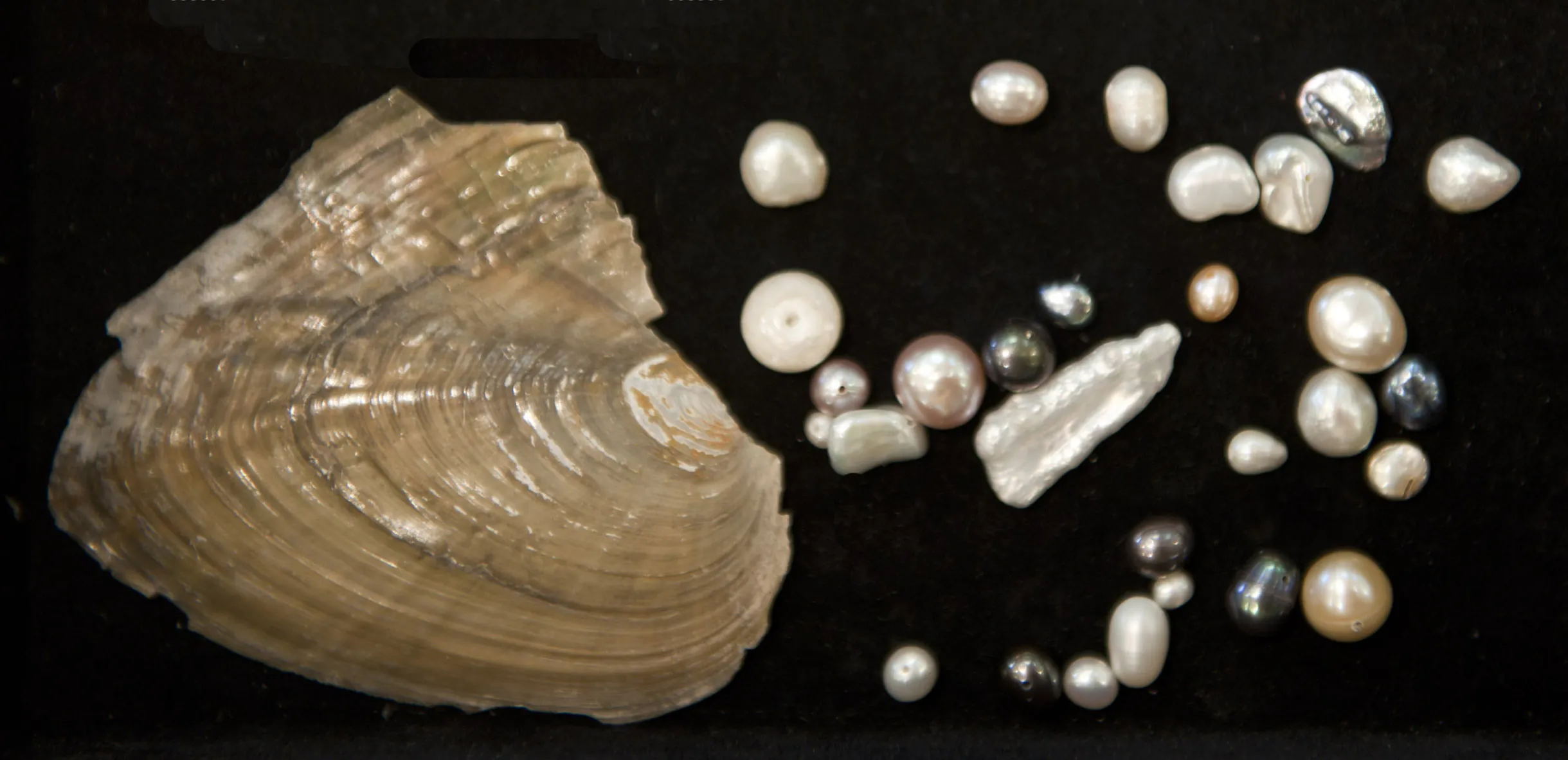
No. Tahitian pearls are famous as “black pearls,” but black is only a shorthand for their naturally dark color family. Many Tahitian pearls are silver-gray, charcoal, green, blue-green, bronze, aubergine, or near-black, often with secondary colors that seem to move across the surface as the pearl turns.
This wide palette is one of the main reasons Tahitian pearls look so different from classic white Akoya pearls. If you are comparing them, it helps to separate three things your eye may be seeing at once: bodycolor, overtone, and orient.
Why Are They Called “Black Pearls” If They Come in So Many Colors?
Tahitian cultured pearls are associated with the black-lipped pearl oyster, Pinctada margaritifera. This mollusk can produce naturally dark nacre, so its pearls became widely known in the trade as black pearls.
But “black” does not mean every pearl has a flat, ink-black surface. The Gemological Institute of America (GIA) notes that although Tahitian cultured pearls are thought of as black, most are shades of gray, while some show colors such as copper, pistachio green, or taupe. Many also display purple, green, turquoise, or pink iridescent effects.
So a better mental model is this: Tahitian pearls belong to a naturally dark and highly variable color family, not a single black color.
For a broader introduction to their origin, cultivation, size, shape, and nacre, see our guide to Tahitian pearls.
What Colors Can Tahitian Pearls Be?
The exact appearance varies from pearl to pearl, but common Tahitian color directions include the following:
| Color direction | What it can look like |
|---|---|
| Silver or light gray | Cool, pale gray with a clean metallic or soft silvery appearance. |
| Charcoal or near-black | Deep gray that can look almost black, especially in low light. |
| Green | From muted olive or pistachio tones to deeper blue-green hues. |
| Peacock | A trade color description generally involving a green bodycolor with strong contrasting overtone or orient, often including pink or purple. |
| Aubergine or purple | Violet, plum, or eggplant-like color effects over a darker base. |
| Blue or blue-green | Steel blue, teal, or cool ocean-like flashes, depending on light and angle. |
| Bronze, brown, or taupe | Warmer earthy colors that can range from subtle brown-gray to metallic bronze. |
These names are useful for describing appearance, but real pearls rarely fit into perfectly separated color boxes. A single pearl can show more than one color impression as it moves.
Bodycolor, Overtone, and Orient: Why One Pearl Can Look Like Several Colors
One reason Tahitian pearl color is confusing is that people often use one word—such as “green” or “black”—for several visual effects at once.
Bodycolor
Bodycolor is the dominant overall color of the pearl. For a Tahitian pearl, this might be gray, silver, greenish gray, brownish gray, or a very dark near-black tone.
Overtone
Overtone is a translucent secondary color that appears over the bodycolor. A dark gray pearl, for example, may carry a green, pink, purple, or blue overtone.
Orient
Orient is a more iridescent play of multiple colors that can appear to shimmer or shift as the viewing angle changes. GIA separates bodycolor, overtone, and orient as distinct components of pearl color, which is especially useful when describing complex Tahitian pearls.
This is why two pearls that are both casually described as “black Tahitian pearls” can look completely different side by side. One may be a neutral charcoal gray, while another may have a dark green body with rose-purple color play.
What Does “Peacock” Mean?
“Peacock” is one of the best-known Tahitian pearl color terms, but it does not simply mean “green.” In 2023, GIA introduced a specific “Peacock” color-range comment for qualifying cultured pearls from Pinctada margaritifera. GIA describes the range as having a green-containing bodycolor with medium-to-strong saturation and medium-to-dark tone, together with a moderate or stronger overtone—usually pink—or orient.
That definition explains why fine peacock pearls can appear green at first glance yet show pink, purple, or other shifting colors when moved under the light.
Why Does the Same Tahitian Pearl Look Different in Different Photos?
Tahitian colors can be unusually sensitive to lighting, background, camera exposure, and viewing angle. A pearl that looks deep green in soft daylight may photograph as dark gray under cooler light. A silver pearl may appear darker against a white background and lighter against black.
When comparing pearls online, do not judge color from one dramatic product photo alone. Look for:
- photos under neutral or daylight-like lighting,
- more than one viewing angle,
- consistent exposure across pearls being compared, and
- clear descriptions of the dominant bodycolor and visible overtone.
This is especially important for matched pairs and strands, where small differences in bodycolor or overtone can become obvious once several pearls are placed together.
Are Green, Blue, or Purple Tahitian Pearls Dyed?
Not necessarily. Tahitian pearls can naturally show green, blue, purple, bronze, and other color effects. A colorful surface is therefore not evidence by itself that a Tahitian pearl has been dyed.
The reverse is also important: appearance alone is not a reliable way to prove that a pearl is untreated. Pearls in the wider market can be dyed, coated, irradiated, or otherwise treated, and some treatments may be difficult to identify visually. If treatment status matters for a high-value purchase, rely on seller disclosure and, when appropriate, laboratory testing rather than color alone.
For more context, see our guide to common cultured pearl treatments and enhancements.
Does a Darker Tahitian Pearl Automatically Mean a Better Pearl?
No. A darker color is not an automatic quality grade.
Pearl value depends on a combination of factors, including luster, surface quality, size, shape, nacre quality, color, and—when pearls are sold as a pair or strand—matching. A vivid peacock pearl may command strong demand, but a bright silver-gray Tahitian pearl with excellent luster can also be highly desirable.
The practical mistake is to reduce the decision to “the blacker, the better.” Instead, judge the whole pearl. Our pearl grading guide explains the broader quality factors, while the pearl buying guide gives a more complete framework for comparing pearls before purchase.
How Should You Choose a Tahitian Pearl Color?
Start with the color you actually enjoy rather than assuming black is the “correct” Tahitian look. Then compare pearls under neutral light and pay attention to how the bodycolor and overtone work together.
As a simple guide:
- Silver and gray tend to look clean, cool, and understated.
- Deep charcoal and near-black create the strongest classic “black pearl” impression.
- Green and peacock emphasize the vivid, iridescent side of Tahitian pearls.
- Aubergine, blue, and bronze can feel more unusual and individual.
- Multicolor strands deliberately celebrate natural variation rather than trying to hide it.
There is no single color that is objectively best for every buyer. The best choice is the one that combines a color you like with strong overall pearl quality and suitable matching for the jewelry design.
The Bottom Line
Tahitian pearls are not only black. “Black pearl” is a convenient trade description for a pearl family known for naturally dark colors, but the real palette is much broader: silver, gray, charcoal, green, peacock, blue-green, aubergine, bronze, taupe, and near-black can all occur.
Once you separate bodycolor from overtone and orient, Tahitian pearl color becomes much easier to understand. Instead of asking only, “How black is it?”, ask: What is the base color, what secondary colors appear, and how does the pearl look as it moves in neutral light?
If you are ready to compare pearl jewelry rather than color terminology alone, you can also browse our current pearl jewelry collection.
Frequently Asked Questions
Are Tahitian pearls naturally black?
Tahitian pearls can naturally develop very dark colors, but many are gray, silver, green, brownish, or near-black rather than flat jet black. Their appearance may also include colorful overtones and orient.
Can Tahitian pearls be green or purple?
Yes. Green, blue-green, aubergine, purple, and other color effects can occur naturally in Tahitian pearls. These colors may appear as part of the bodycolor, as an overtone, or as orient.
Are peacock Tahitian pearls actually black?
Not in the simple sense. Peacock is a trade color range associated with a green-containing bodycolor plus strong overtone or orient, often including pink or purple. It is valued for its layered color rather than for being purely black.
Does a black-looking pearl have to be Tahitian?
No. Other pearl types can appear dark, and some commercial dark colors may be produced through treatment. Color alone is not enough to identify a pearl as Tahitian.
Which Tahitian pearl color is best?
There is no universal best color. Market preferences can favor vivid and unusual combinations, but luster, surface, size, shape, nacre quality, and matching also matter. Personal preference should remain part of the decision.