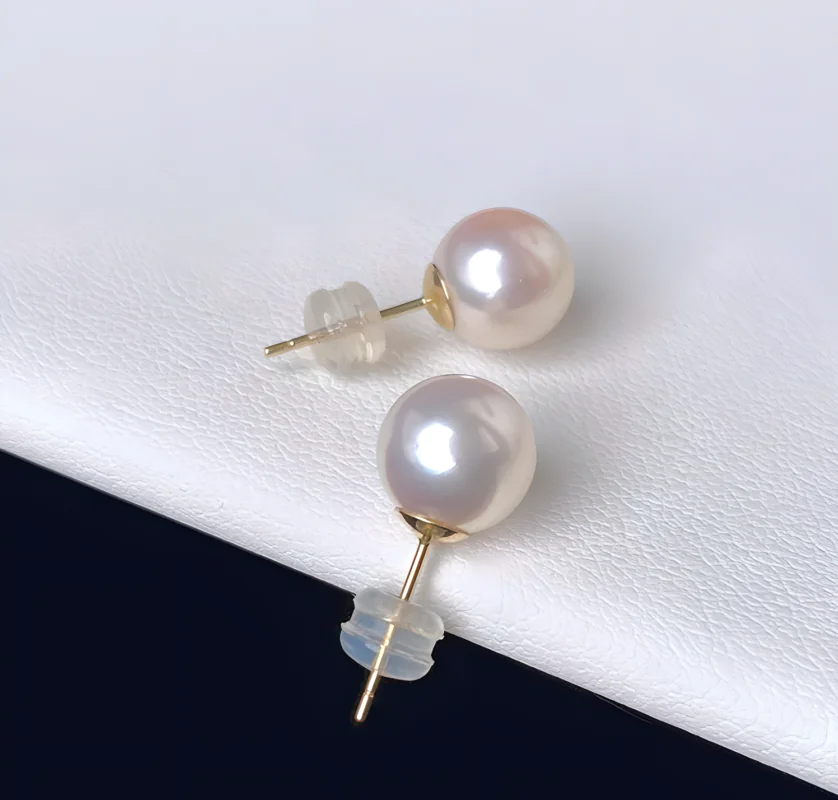
What Is the Difference Between Pink Toning and Natural Pink Overtones in Akoya Pearls?
Pink toning and a natural pink overtone can look similar on an Akoya pearl, but they describe two different things. A natural pink or rose overtone is a secondary hue produced by the pearl’s own nacre and optical characteristics. Pink toning—also called pinking, tinting, or, in Japanese processing terminology, Choshoku—is a post-harvest color adjustment that introduces a very light reddish tint. The important distinction is therefore not simply “pink versus white,” but where the pink appearance comes from.
Quick Answer: Natural Overtone vs. Pink Toning
| Point | Natural Pink Overtone | Pink Toning / Pinking |
|---|---|---|
| What it is | A naturally occurring secondary rose or pink hue over the pearl’s bodycolor | A deliberate post-harvest color adjustment |
| Source of the pink | The pearl’s nacre, pigments, structure, and interaction with light | A light reddish colorant or tint introduced during processing |
| Does the pearl remain cultured? | Yes. “Natural color” does not mean “natural pearl” | Yes. Toning changes color appearance, not whether the pearl is cultured |
| Can you prove the difference by eye? | Usually not with certainty | Usually not with certainty, especially when the toning is subtle |
| Best verification | Clear treatment disclosure or an appropriate laboratory report | Clear treatment disclosure or an appropriate laboratory report |
This distinction matters because a white Akoya pearl can show a rose overtone without having been pink-toned, while a pink-toned pearl may have had some natural rose character before treatment. In other words, the two categories are not always visually opposite. Treatment status and visible color are related, but they are not the same question.
First, Understand Bodycolor and Overtone
GIA separates pearl color into several components. The bodycolor is the dominant overall color of the pearl, while an overtone is an additional translucent hue that appears over the bodycolor. White Akoya pearls can display rose, silver, cream, or mixed secondary effects, and the overtone may become more or less obvious as the viewing angle and lighting change.
This is why a “rose overtone” does not normally mean the pearl has a solid pink bodycolor. A high-luster white Akoya may still read as white from across the room, yet show a soft pink flash or glow when seen close up. If you want the broader context of Akoya color, nacre, and appearance, see our Akoya pearl guide.
GIA’s pearl color guidance also makes an important general point: overtones are legitimate components of pearl color, not separate coatings sitting on top of the pearl. However, a treatment can modify the appearance of that color, which is where confusion begins.
What Is Pink Toning, Pinking, or Choshoku?
In the Japanese Akoya industry, the term Choshoku refers to a light color adjustment performed after bleaching. The Japan Pearl Promotion Society’s 2025 Standard Pearl describes it as adjusting the color tone of bleached Akoya cultured pearls with a reddish dye. CIBJO uses closely related terminology such as tinting or pinking for the light application of a colored dye.
The purpose is not necessarily to turn a white pearl into an obviously pink pearl. Well-executed toning is intended to be subtle. It can make the strand look slightly rosier, warmer, or more consistently matched, especially when many individual pearls must be assembled into one necklace.
This is also different from heavily dyeing a pearl an obviously artificial fashion color. Both involve color treatment, but the visual intent and degree of alteration can be very different. For a broader overview, see pearl color enhancement treatments.
What Does “Natural Pink Overtone” Mean in Akoya Pearls?
A natural pink overtone means the rose effect is attributable to the pearl itself rather than to an added pink color treatment. High-quality Akoya pearls can naturally show pinkish interference or overtone effects over a white bodycolor. GIA specifically recognizes rose or rosé as a common Akoya overtone.
There is one terminology trap worth understanding: “natural color,” “untoned,” and “untreated” are not always identical claims. In Japanese trade terminology, Muchoshoku commonly refers to Akoya pearls that did not receive the final Choshoku color adjustment. The Japan Pearl Promotion Society cautions that such pearls may still have undergone other processing, including Maeshori or bleaching. Calling every Muchoshoku pearl “exactly as harvested” can therefore be inaccurate.
For a buyer, this creates three different questions:
- Was pink toning or Choshoku applied?
- Was any other color-changing treatment applied?
- Was the pearl completely untreated after harvest, including no bleaching or other processing?
A seller may answer “no pinking” to the first question without necessarily answering the other two. When treatment status matters to you, ask for the precise claim rather than relying on a broad phrase such as “natural white.”
Can You Tell a Natural Rose Overtone from Pink Toning by Looking?
Not reliably. Visual examination can provide clues, but subtle pinking is specifically designed to create a natural-looking result. Photography makes the problem harder because white balance, background color, exposure, and reflections can exaggerate or suppress a rose tone.
In practice, buyers sometimes notice that an untreated or untoned overtone appears to “float” over the surface and shift with the light, while a toned strand may look more consistently rosy across many pearls. Concentrated color near a drill hole, crack, or surface feature can also raise suspicion of dye. But these are observations, not proof.
The reverse is equally important: a pearl that shows no obvious dye concentration is not automatically untoned. A delicate treatment may leave no simple visual sign that a consumer can identify at home.
How Can Treatment Status Be Verified?
If the distinction affects price, collectibility, or your buying decision, documentation is more useful than a visual guess. GIA states that its pearl reports can identify treatments and that laboratory testing can separate natural-color from treated-color pearls. Japan’s Pearl Science Laboratory also allows statements such as natural color to be added to certain pearl identification and grading certificates.
That means a practical buying hierarchy is:
- Ask the seller exactly what was done. “Is this strand Choshoku/pink-toned, Muchoshoku, or documented as natural color?” is more useful than “Is it pink?”
- Ask whether the claim appears on the laboratory report. A quality grade alone is not always a treatment declaration.
- For expensive purchases, rely on an appropriate laboratory report when treatment status materially affects value.
This is one reason pearl identification should not be reduced to home tests or appearance alone. See our guide to pearl identification for the broader limits of visual inspection.
Does Hanadama Mean the Akoya Pearls Are Naturally Pink or Un-Toned?
No. Hanadama is not, by itself, a synonym for natural color or no pinking. Hanadama is a quality designation used by Japanese pearl laboratories under their own grading systems. A strand can meet a Hanadama quality standard while still requiring separate information about color treatment.
If natural or untoned color is important, look for a specific color-treatment statement on the certificate rather than assuming it from the word “Hanadama.” The Pearl Science Laboratory, for example, notes that natural-color statements can be added to relevant certificates.
Is a Natural Pink Overtone More Valuable Than Pink Toning?
It can be, but treatment status should not be treated as the only value factor. A matched strand of high-luster Akoya pearls with documented natural color or no color treatment may be scarcer and may attract a premium in parts of the market. Matching many pearls that already have an attractive natural rose effect can be more difficult than adjusting color after harvest.
However, an untoned pearl is not automatically a better pearl. Luster, nacre quality, surface condition, roundness, size, and matching still matter. A dull or thin-nacre pearl does not become high quality merely because it has no pink toning. Conversely, a carefully toned pearl can still have excellent luster, strong nacre, clean surfaces, and beautiful matching.
When comparing two strands, evaluate treatment status as one part of the picture rather than allowing it to replace the usual quality assessment. Our guide to evaluating pearl value explains the main factors that should be considered together.
A Better Way to Read Seller Descriptions
Terms such as “rose,” “pink,” “natural white,” “natural pink,” “pinked,” “toned,” and “untreated” are not always used consistently across sellers. Instead of focusing on the label, translate the description into specific questions.
| If a listing says... | Ask... |
|---|---|
| “Rose overtone” | Is the rose appearance naturally occurring, pink-toned, or not specified? |
| “Natural white” | Does this mean no Choshoku, no color treatment, or no post-harvest treatment at all? |
| “Muchoshoku” | Was final color adjustment omitted, and were Maeshori or bleaching still used? |
| “Hanadama rose” | Does the certificate separately state treatment or natural-color status? |
| “Untreated” | Which treatments are specifically excluded? |
This approach is more accurate than trying to decide from a product photo whether a strand “looks naturally pink.” It also makes seller comparisons much fairer because you are comparing the same treatment definitions.
Why the Difference Matters More in High-End Akoya Pearls
For an everyday pair of earrings, you may simply prefer whichever overtone looks best against your skin. For a high-end matched strand, collector purchase, or certificate-sensitive transaction, treatment history can become more important because it affects rarity, documentation, and how the pearl should be described.
The processing history of Akoya pearls is also more complex than many retail descriptions suggest. Cleaning, Maeshori, bleaching, color adjustment, sorting, drilling, and matching can occur at different stages before the final jewelry is sold. Our pearl processing workflow provides additional context for how post-harvest steps fit together.
FAQ
Are pink-toned Akoya pearls fake?
No. A pink-toned Akoya is still a genuine cultured Akoya pearl. Pinking changes its color appearance; it does not turn the pearl into an imitation. The treatment should simply be described accurately.
Are all rose-overtone Akoya pearls pinked?
No. Akoya pearls can naturally display a rose overtone, but pinking is also widely used to create or adjust a similar appearance. You cannot safely infer treatment status from the words “rose overtone” alone.
Does Muchoshoku mean completely untreated?
Not necessarily. In Japanese Akoya terminology, Muchoshoku generally indicates that the final Choshoku color adjustment was not performed. The pearl may still have undergone other processing such as Maeshori or bleaching.
Can I identify pink toning from a drill hole?
Visible color concentration near a drill hole or crack can be a treatment clue, but its absence does not prove that the pearl is untoned. Subtle treatments may not leave an obvious sign visible to a consumer.
Does a Hanadama certificate prove natural color?
No. Hanadama describes pearl quality under a laboratory’s grading system. Natural-color or no-color-treatment status should be confirmed separately if it matters to your purchase.
Which should I buy: natural pink overtone or pink-toned Akoya?
Choose based on the whole pearl. If rarity and treatment documentation matter, seek a laboratory-supported natural-color or untoned strand. If appearance is the priority, compare luster, nacre, surface, matching, and the way the overtone looks on you rather than rejecting a pearl solely because it was toned.
What to Remember
The simplest distinction is this: a natural pink overtone is a color effect inherent to the pearl, while pink toning is a post-harvest color adjustment. But real-world Akoya terminology is more nuanced than that one sentence suggests. An untoned pearl may still have been bleached or otherwise processed, and a toned pearl may have had some natural rose character before treatment.
For casual buying, judge the pearl by its overall beauty and quality. For high-value or treatment-sensitive purchases, ask exactly what “natural,” “untoned,” or “rose” means and use a laboratory report when the distinction materially affects the transaction.