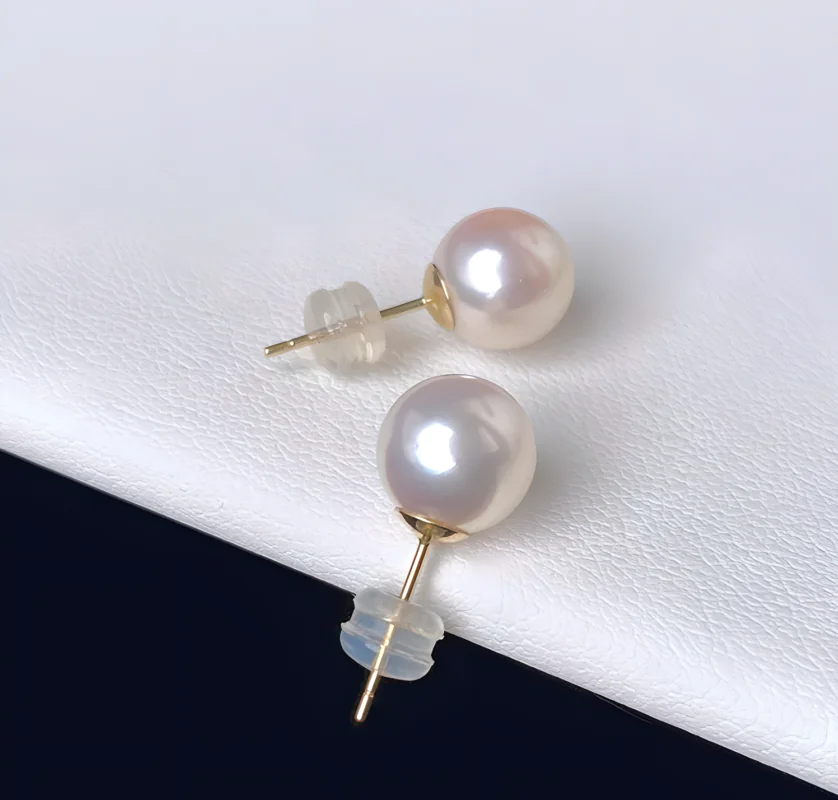
What Is Pearl Nacre Thickness? Why Does It Affect Quality and Durability?
Pearl nacre thickness is the depth of nacre covering the bead nucleus inside a bead-cultured pearl. It matters because nacre is the material you actually see and wear. If the layer is too thin, the underlying bead may become visible, the pearl can look chalky or lifeless, and normal wear may expose or damage the surface more easily. But thickness is only one part of nacre quality: thicker nacre does not automatically mean better luster, a cleaner surface, or a higher-quality pearl.
Quick Answer: What Does Nacre Thickness Tell You?
| Question | Practical answer |
|---|---|
| What is nacre? | The layered material secreted by a mollusk that forms the visible body of a nacreous pearl. |
| What is nacre thickness? | In a bead-cultured pearl, it is the distance from the surface of the bead nucleus to the outer surface of the pearl. |
| Why does it matter? | Adequate nacre helps a bead-cultured pearl remain attractive and durable during normal wear. |
| Does thicker nacre always mean better luster? | No. Thickness matters, but nacre structure, continuity, pearl type, growth conditions, and surface condition also influence appearance. |
| Does nacre thickness apply to every pearl? | Not in the same way. The measurement is primarily relevant to pearls grown around a bead nucleus. |
| Can you measure it by looking at a pearl? | Usually not accurately. Visual clues can suggest thin nacre, but reliable measurement may require gemological examination. |
The distinction in the last two rows is important. Many simplified pearl guides talk about nacre thickness as though every pearl contained a round bead with a coating over it. They do not.
What Is Nacre?
Nacre is the biological material deposited by certain mollusks as a pearl grows. It is built from microscopic layers containing calcium carbonate, mainly in the form of aragonite, together with an organic matrix. Repeated deposition creates the layered structure responsible for much of a nacreous pearl's characteristic appearance.
If you want to understand where those layers come from, our guide to how pearls form explains the process from pearl-sac development through continued nacre deposition.
Nacre should not be confused with a synthetic surface coating. In a genuine nacreous cultured pearl, the mollusk itself produces the nacre during cultivation. The human role is to initiate and manage the cultivation process.
What Exactly Does “Nacre Thickness” Measure?
Imagine cutting a typical bead-cultured pearl through its center. You would see a bead nucleus inside and a layer of nacre surrounding it. Nacre thickness is the depth of that surrounding pearl material.
The layer is not always perfectly uniform. One area of a pearl can have more nacre than another, especially when the pearl is not perfectly round or its growth has been uneven. For that reason, a laboratory may report an average nacre thickness rather than treating the entire pearl as though every point has exactly the same measurement.
This also explains why simply subtracting an assumed bead size from the outside diameter is not a reliable buying method. You normally do not know the exact size, position, or shape of the hidden nucleus, and the nacre may vary around it.
Nacre Thickness Is Mainly a Bead-Cultured Pearl Concept
This is one of the most important distinctions to understand.
Akoya, Tahitian, and South Sea cultured pearls are normally produced using a bead nucleus. In those pearls, asking how much nacre surrounds the bead is meaningful.
By contrast, many traditional tissue-nucleated freshwater cultured pearls develop without a bead nucleus. They can consist essentially of nacreous pearl material throughout, so there is no central bead with a measurable nacre coating around it. Our guide to non-bead cultured freshwater pearls explains this structure in more detail.
However, do not turn that into the rule that “freshwater pearls have no nucleus.” Modern freshwater production also includes bead-nucleated freshwater cultured pearls. For those pearls, nacre thickness around the bead becomes relevant again.
Natural pearls present another situation. Because a natural pearl does not form around a bead deliberately inserted by a pearl farmer, the normal bead-to-surface nacre-thickness measurement used for bead-cultured pearls is not the appropriate way to describe its structure.
Why Does Nacre Thickness Affect Durability?
A bead-cultured pearl is worn from the outside inward. The nacre surface is exposed to contact with skin, fabric, jewelry settings, dust, cosmetics, and occasional abrasion. A sufficiently developed nacre layer gives the pearl more pearl material between everyday wear and the internal bead.
Thin Nacre Leaves Less Margin for Wear
When nacre is excessively thin, relatively little material separates the exterior from the nucleus. Wear, surface damage, or deterioration therefore has less material to progress through before the underlying structure becomes noticeable.
This does not mean a pearl with adequate nacre is indestructible. Pearls remain relatively delicate organic gems and can still be scratched or damaged by poor handling.
Very Thin Nacre Can Allow the Bead to Show Through
With some thin-nacred bead-cultured pearls, the bead beneath the nacre can influence the visible appearance. GIA notes that thin nacre may produce a chalky appearance or allow the bead to become more apparent under strong lighting.
Once the nucleus begins to visually interfere with the pearl's exterior, the problem is no longer only theoretical durability. It can directly reduce beauty and therefore desirability.
Thickness Is Not the Only Structural Issue
A pearl can have substantial nacre yet still contain growth disruptions, cracks, or poorly continuous layers. Modern gemological evaluation therefore looks beyond a simple millimeter measurement. The continuity and condition of the nacre can also influence durability.
This is why the statement “this pearl has thick nacre, so it must be durable” is too simplistic.
How Does Nacre Thickness Affect Luster?
Nacre and luster are closely connected, but not through a simple equation in which every extra fraction of a millimeter produces a brighter pearl.
When nacre is excessively thin, the pearl may look dull, chalky, or visually dominated by the nucleus beneath it. Adequate nacre allows the pearl's layered structure to create the characteristic optical effects associated with fine pearls.
But once adequate nacre is present, the quality and arrangement of those layers matter as well as their total depth. Microscopic structure, growth conditions, pearl species, surface quality, and nacre continuity all influence how light interacts with the pearl.
This is an important reason not to compare pearl types by nacre thickness alone. Fine Akoya pearls are famous for extremely sharp reflections even though their nacre layer is generally thinner than that associated with larger South Sea pearls. A tissue-nucleated freshwater pearl can contain nacre throughout its body yet still display a different style of luster from a top-quality Akoya.
In other words, adequate nacre is important for good luster, but maximum nacre thickness is not the same thing as maximum luster.
Nacre Thickness and Nacre Quality Are Not the Same Thing
Consumers often see the terms used interchangeably, but it is more useful to separate them.
| Factor | What it describes | Why it matters |
|---|---|---|
| Nacre thickness | How much nacre lies over the bead nucleus in a bead-cultured pearl | Helps determine whether there is sufficient pearl material for appearance and normal wear |
| Nacre continuity | How consistently the nacre developed without disruptive structural features | Can affect surface appearance and structural integrity |
| Nacre condition | The present condition of the nacre, including wear, damage, processing, or modification | A thick layer can still be damaged or degraded |
| Luster | The intensity and sharpness of reflected light | Determines much of the pearl's visible liveliness and beauty |
| Surface quality | The type, number, severity, and position of visible surface characteristics | Affects beauty, value, and sometimes durability |
GIA's current approach reflects this broader view. Nacre is one of its seven pearl value factors, and modern evaluation considers more than whether a pearl merely passes a single thin-versus-thick test.
How Thick Should Pearl Nacre Be?
There is no useful single number that should be applied to every cultured pearl. Different pearl types have different structures, sizes, growth systems, and expected nacre characteristics.
In a 2025 GIA overview of its pearl classification system, the following minimum thickness parameters were listed for three major bead-cultured pearl types:
| Pearl type | GIA minimum parameter cited in its 2025 overview | How to interpret it |
|---|---|---|
| Akoya cultured pearl | At least 0.15 mm | A minimum threshold is not the same as a premium-quality designation. |
| Tahitian cultured pearl | At least 0.80 mm | Compare Tahitian pearls with the expectations for Tahitian production, not with Akoya numbers. |
| South Sea cultured pearl | At least 1.50 mm | The larger number reflects a different pearl type and should not be used to claim that every South Sea pearl is automatically better than every Akoya. |
These figures are most useful as type-specific gemological reference points. They should not be turned into a universal shopping scale such as “0.8 mm is good and 1.5 mm is excellent” for every pearl.
For example, applying a South Sea benchmark to an Akoya pearl would make little sense. Likewise, applying any bead-nacre measurement to a traditional non-bead freshwater pearl misunderstands how that pearl formed.
For more context on these major varieties, see our guides to Tahitian pearls and South Sea pearls.
Is Thicker Nacre Always Better?
No. This is probably the most common oversimplification surrounding nacre.
Extremely thin nacre can clearly be a quality problem. But once a pearl has adequate nacre, simply increasing the thickness does not guarantee that all its other characteristics will improve.
A thicker-nacred pearl can still have:
- weak or diffuse luster;
- visible pits, wrinkles, or other surface characteristics;
- uneven or disrupted nacre growth;
- poor shape;
- undesirable color;
- damage from processing or wear; or
- poor matching in a strand or pair.
Conversely, an Akoya pearl does not need the same number of millimeters of nacre as a South Sea pearl to display outstanding luster. Quality has to be judged within the context of the pearl type.
This is why nacre is one factor within a wider evaluation system rather than a substitute for evaluating the entire pearl. Our guide to evaluating pearl value explains how nacre interacts with size, shape, color, luster, surface quality, and matching.
Can You Tell Nacre Thickness Just by Looking at a Pearl?
You can sometimes identify warning signs, but you usually cannot determine an exact nacre thickness in millimeters by eye.
Visual Clues That May Suggest Thin Nacre
Depending on the pearl type and lighting, warning signs can include:
- a dull or chalky overall appearance;
- an underlying bead becoming visible through the nacre;
- uneven areas where the nucleus appears to influence the surface appearance;
- obvious wear revealing a different material underneath; or
- suspiciously thin material visible around a drill hole.
These are clues, not precise measurements. Lighting, surface treatment, color, and pearl type can alter what you see.
A Drill Hole Can Help, but It Does Not Tell the Whole Story
On a drilled bead-cultured pearl, the boundary between the bead and the surrounding nacre may sometimes be visible around the hole. This can give useful information, especially when nacre is obviously very thin.
However, one drill hole shows only a small part of the pearl. Nacre thickness can vary around the nucleus, so a local view should not automatically be treated as the average thickness of the whole pearl.
Laboratory Examination Is More Reliable
For pearls where an exact measurement matters, gemological methods can examine the internal structure without relying only on surface appearance. GIA states that average nacre thickness for bead-cultured pearls can be requested as an optional description on its pearl reports. If nacre is considered too thin to sustain normal wear, GIA says that condition is disclosed in its report comments.
This distinction is useful for buyers: a seller saying “thick nacre” is a description, while a laboratory-reported measurement is an actual measured result.
What Does “Thick Nacre” Mean in a Seller's Description?
Unless the seller provides a measurement or clearly defined grading standard, “thick nacre” should usually be treated as a relative description rather than an exact technical specification.
If nacre thickness is important to your purchase, ask:
- What type of pearl is this? Akoya, Tahitian, South Sea, freshwater, or another variety?
- Is it bead-nucleated? If there is no bead nucleus, the usual nacre-thickness comparison may not apply.
- Is the nacre thickness actually measured? Ask whether the number comes from laboratory examination, production information, a cut sample, or visual estimation.
- Is the figure an average? Nacre may not be equally thick at every point.
- How does the pearl perform visually? Look at luster, surface, color, and overall condition rather than buying from the thickness claim alone.
This approach is especially useful when comparing online listings. Two sellers can both use the phrase “thick nacre” while describing very different pearls.
Does a Longer Cultivation Period Always Produce Better Nacre?
Longer cultivation generally gives a mollusk more time in which to deposit nacre, so cultivation period can influence total nacre thickness. But time alone does not guarantee quality.
Nacre deposition is a biological process. Species, individual mollusk health, water conditions, temperature, growth rate, husbandry, and other factors can influence how the layers form.
That means a pearl should not be judged by statements such as “grown for X months” without looking at the resulting pearl. A longer period may contribute to more nacre, but buyers ultimately care about the nacre that was actually produced: its thickness, structure, continuity, condition, and optical quality.
For a broader look at how farmers influence pearl development, see our guide to pearl cultivation.
Does Thick Nacre Guarantee a Pearl Will Last for Decades?
No. Adequate nacre improves the structural starting point of a bead-cultured pearl, but how the jewelry is made, worn, stored, and cleaned also affects its condition.
Even a well-grown pearl can be damaged by repeated abrasion, hard impacts, aggressive polishing, ultrasonic cleaning, harsh chemicals, or contact with cosmetics and perfume before they have dried.
On necklaces and bracelets, restringing also matters because worn thread can fail long before the pearls themselves do. Rings usually expose pearls to more impact and abrasion than earrings or pendants.
For practical maintenance advice, see our guide on how to care for pearls.
A Practical Way to Evaluate Nacre When Buying Pearls
You do not need to become a laboratory gemologist to use nacre information intelligently. A better buying sequence is:
- Identify the pearl type first. Do not compare nacre numbers before knowing what kind of pearl you are looking at.
- Determine whether it is bead- or non-bead-cultured. This tells you whether nacre thickness over a nucleus is the right concept.
- Check for adequate nacre rather than chasing the largest number. Excessively thin nacre is a concern; beyond that, evaluate the whole pearl.
- Judge luster and surface independently. Thick nacre is not a substitute for bright reflections or an attractive surface.
- Ask how a thickness claim was established. A measured laboratory value carries different meaning from a seller's adjective.
- For expensive pearls, consider documentation. When long-term durability, identification, or value is financially important, a recognized gemological report can provide more reliable information than appearance alone.
The key is to use nacre thickness as one piece of evidence, not as a shortcut for the entire quality judgment.
Source Notes
The quality framework in this article follows the Gemological Institute of America's pearl quality factors, where nacre is included among the seven factors used to evaluate pearls.
GIA's 2025 update on nacre classification explains the expanded emphasis on nacre continuity and notes that cultured pearl types have minimum thickness parameters. GIA's 2025 pearl-classification overview lists minimum parameters of 0.15 mm for Akoya, 0.80 mm for Tahitian, and 1.50 mm for South Sea pearls.
GIA's guidance on pearl reports and nacre thickness also notes that average nacre thickness can be requested for bead-cultured pearls and that excessively thin nacre posing a threat to normal wear is disclosed in report comments.
FAQ
Is thicker nacre always a sign of a better pearl?
No. Very thin nacre can be a quality and durability problem, but greater thickness does not automatically produce better luster, color, shape, or surface quality. Nacre structure, continuity, condition, and the pearl's other quality factors still matter.
How thick should pearl nacre be?
There is no single ideal thickness for every pearl type. GIA's 2025 classification overview cites minimum parameters of at least 0.15 mm for Akoya, 0.80 mm for Tahitian, and 1.50 mm for South Sea pearls. These figures should be interpreted within their respective pearl types rather than used as one universal grading scale.
Can I measure nacre thickness at home?
Not reliably without access to the pearl's internal structure. Visual signs and drill holes may reveal obviously thin nacre, but they do not normally provide an accurate average measurement. Gemological examination is more appropriate when an exact value matters.
Do freshwater pearls have thicker nacre than saltwater pearls?
The comparison is not that simple. Many traditional tissue-nucleated freshwater cultured pearls are non-bead cultured and consist largely of nacreous material, so nacre thickness over a bead does not apply. Other freshwater pearls are bead-nucleated, in which case the thickness of nacre surrounding the nucleus does matter.
Does thick nacre mean a pearl will never peel or wear out?
No. Adequate nacre improves durability, but nacre continuity, existing damage, jewelry construction, abrasion, chemicals, cleaning methods, and long-term care can all affect how well a pearl survives wear.
Is nacre thickness the same as pearl luster?
No. Nacre thickness describes the amount of nacre covering a bead nucleus, while luster describes the intensity and sharpness of reflected light. Thin nacre can harm luster, but thick nacre alone does not guarantee excellent luster.
Final Takeaway
Pearl nacre thickness tells you how much nacre covers the nucleus of a bead-cultured pearl, but it should never be treated as a complete pearl grade. Adequate thickness helps protect the underlying bead, supports attractive optical properties, and improves the pearl's ability to withstand normal wear. Excessively thin nacre can therefore reduce both beauty and durability.
The more useful question is not simply, “Which pearl has the thickest nacre?” It is, “Does this pearl have appropriate nacre for its type, and is that nacre well formed, continuous, attractive, and in good condition?” Once you make that distinction, nacre thickness becomes a genuinely useful quality factor rather than another marketing number.