What Is the Difference Between Mirror-Like, Satin-Like, and Metallic Luster in Pearls?
Mirror-like, satin-like, and metallic luster describe different ways light appears on a pearl’s surface. Mirror-like luster produces bright, crisp reflections; satin-like luster looks softer and more diffused while still appearing luminous; and metallic luster creates an unusually intense, hard-looking reflection that can resemble polished metal. These terms are useful descriptions, but they should not be treated as a universal three-level grading scale.
Quick Answer: How the Three Types of Luster Look
| Luster Description | What You See | Often Associated With | Important Note |
|---|---|---|---|
| Mirror-like | Bright, sharp reflections with clearly defined edges | Fine Akoya pearls and some high-luster freshwater pearls | Usually indicates strong reflection sharpness, but does not describe every quality factor |
| Satin-like | Soft, smooth reflections with a luminous inner glow | South Sea pearls and some Tahitian or freshwater pearls | Soft reflection does not automatically mean low luster |
| Metallic | Extremely bright, hard-looking reflections, sometimes combined with strong color effects | Especially certain freshwater pearls | A descriptive market term rather than a separate universal grading category |
The most important point is that these descriptions concern the character of the reflected light. A satin-like pearl can still have excellent luster for its pearl type, while a pearl described as metallic is not automatically better in every other respect.
What Does Pearl Luster Actually Measure?
Luster is one of the major factors used to judge pearl quality. In practical terms, two things matter especially: how bright the reflected light appears and how sharp the reflection looks. A pearl with strong luster looks lively and luminous, while a low-luster pearl may appear dull, chalky, or visually flat.
This distinction is useful because “shiny” alone is not specific enough. Two pearls can both look bright while producing very different reflections. One may act almost like a tiny curved mirror, while another produces a softer glow with less sharply defined edges.
Luster also should not be judged in isolation. Surface quality, color, shape, nacre quality, size, and matching can all affect how a pearl is perceived and valued. For a broader framework, see our guide to evaluating pearl value.
What Is Mirror-Like Pearl Luster?
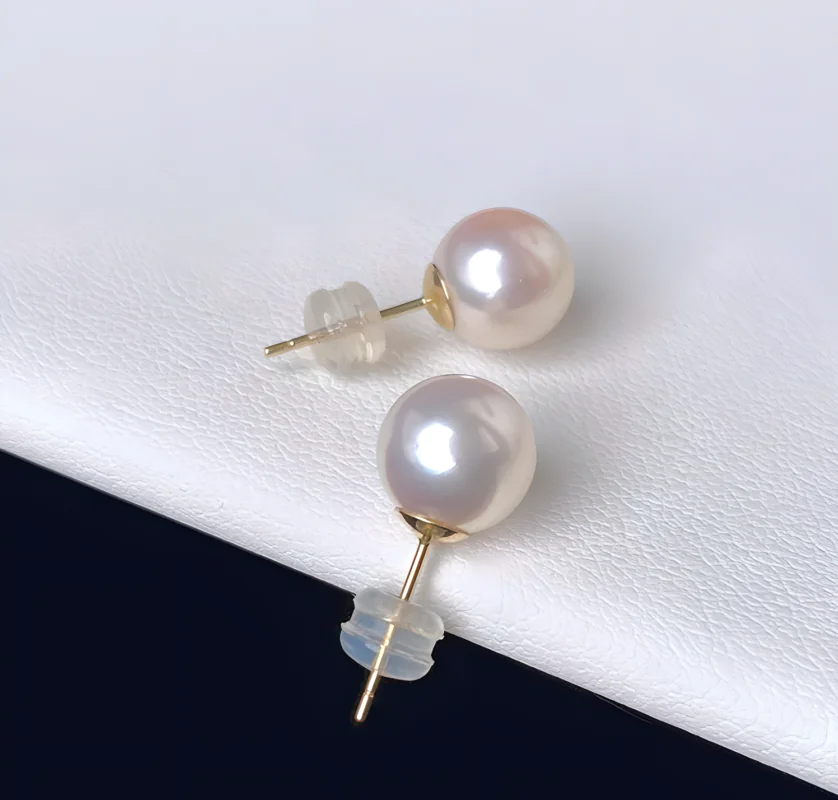
A pearl with mirror-like luster produces reflections with unusually clear boundaries. When you look closely at the pearl under a window, lamp, or other defined light source, the reflected shape may remain recognizable rather than dissolving into a broad patch of light.
The finest examples can show:
- strong brightness
- crisp edges around reflected light
- clear contrast between bright and dark areas
- a glossy, highly reflective surface appearance
High-quality Akoya pearls are particularly well known for this type of luster. Their appearance is one reason shoppers sometimes describe fine Akoya pearls as looking almost glassy or mirror-finished.
However, mirror-like luster is not exclusive to Akoya pearls. Some freshwater pearls can also produce exceptionally sharp reflections.
Mirror-like does not mean flawless
A useful distinction is that luster and surface quality are separate characteristics. A pearl can have extremely sharp reflections while still showing small pits, wrinkles, growth marks, or other surface features. Conversely, a pearl with a relatively clean surface can still have only moderate luster.
When comparing pearls, do not allow strong shine to make you overlook the rest of the surface.
What Is Satin-Like Pearl Luster?
Satin-like luster has a softer visual character. Instead of producing very crisp, mirror-style reflections, light seems to spread more gently across the pearl. The edges of reflected objects are less sharply defined, while the pearl may retain a rich, smooth glow.
This effect is commonly associated with fine South Sea pearls. Their luster is often admired precisely because it can look deep, luxurious, and softly luminous rather than hard and glassy.
This is where pearl terminology can confuse buyers: satin-like does not mean dull.
A dull pearl has weak, indistinct light return and tends to look flat. A high-quality satin-luster pearl can be bright and visually alive, but the reflection has a softer transition and less mirror-like definition.
Think of the difference as two types of light:
- Mirror-like: crisp, bright, high-contrast reflection.
- Satin-like: softer reflection with a smooth luminous effect.
Neither description should automatically be translated into “better” or “worse” without considering the pearl type being examined.
What Is Metallic Pearl Luster?
“Metallic” is used in the pearl trade for pearls whose reflections appear exceptionally intense and hard, sometimes approaching the visual impact of polished metal. The surface may seem to flash strongly under light rather than simply glow.
The term is particularly associated with certain freshwater cultured pearls. Some high-luster freshwater pearls combine strong reflection with pronounced bodycolor, overtone, or iridescent effects, creating an appearance that sellers and buyers describe as metallic.
Metallic luster can overlap with mirror-like luster. There is no clean optical boundary where a pearl suddenly stops being “mirror-like” and becomes “metallic.” In ordinary market language, “metallic” often emphasizes the intensity and visual punch of the shine, while “mirror-like” emphasizes the sharpness and clarity of the reflection.
This is one reason buyers should be cautious when comparing seller terminology. “Metallic,” “super metallic,” “mirror,” and similar descriptions are not interchangeable with a universally standardized laboratory grade.
Readers interested in modern bead-cultured freshwater pearl structures can also continue with our guide to nucleated freshwater pearls.
Mirror-Like vs Satin-Like vs Metallic: The Practical Difference
| Characteristic | Mirror-Like | Satin-Like | Metallic |
|---|---|---|---|
| Reflection edge | Very sharp | Softer and more diffused | Often sharp, sometimes extremely strong |
| Brightness | High to very high | Can also be high, but appears softer | Usually visually intense |
| Overall impression | Crisp and glossy | Smooth and luminous | Bold, hard-shining, reflective |
| Typical pearl association | Akoya | South Sea | Some freshwater pearls |
| Is it an official universal grade? | No | No | No |
Why Can Two High-Luster Pearls Look So Different?
Pearls are not manufactured reflective spheres with identical surfaces. Different pearl types develop under different biological conditions and have different nacre structures, colors, sizes, and surface characteristics. These factors influence how light returns to the eye.
As a result, evaluating luster should not become a contest to see which pearl behaves most like a literal mirror.
A fine Akoya pearl may be admired for extremely crisp reflection. A fine South Sea pearl may be admired for a broad, satiny glow. A striking freshwater pearl may show an unusually metallic appearance. All three can be desirable within the context of their own pearl types.
This is why professional pearl evaluation generally makes more sense when comparing similar pearls with similar pearls rather than judging every variety against one visual standard.
How to Compare Pearl Luster in Person
You do not need specialized laboratory equipment to make a useful visual comparison. A consistent viewing method can reveal a great deal.
1. Use the same lighting
Place the pearls next to each other under the same neutral light. Bright indirect daylight can work well. Avoid comparing one pearl under strong jewelry-store spotlights with another under weak room lighting.
2. Look at the edge of a reflection
Instead of asking only “Which pearl is brighter?”, look at the boundary around a reflected window, lamp, or other object.
Is the edge crisp and recognizable? Or is it soft and hazy? This immediately helps distinguish mirror-like from satin-like behavior.
3. Rotate the pearl
A pearl should not be judged from one favorable angle. Slowly rotate it and observe whether the luster remains attractive across the visible surface. Surface irregularities and uneven areas can become more obvious as the pearl moves.
4. Compare within the same pearl type first
When evaluating quality, compare Akoya with Akoya, South Sea with South Sea, and similar freshwater pearls with one another whenever possible. This provides a more meaningful reference point than expecting every pearl variety to show identical reflection characteristics.
5. Be cautious with photographs
Pearl luster is particularly sensitive to lighting, camera exposure, sharpening, and contrast. A photograph can make reflections appear stronger or cleaner than they look in person. For purchasing decisions, multiple photos, video, or direct inspection usually provides better information than one highly lit product image.
Is Metallic Luster Better Than Mirror-Like or Satin-Like Luster?
Not automatically.
“Metallic” describes a visual effect, not a complete pearl grade. A metallic pearl may have exceptional luster but noticeable surface marks, an irregular shape, poor matching, or a color that does not suit a particular piece of jewelry.
Likewise, a satin-like South Sea pearl should not be downgraded simply because its reflection is softer than that of an Akoya pearl. The expected luster character varies among pearl types.
When other factors are comparable, stronger luster generally contributes positively to pearl quality. But the correct question is usually not:
“Which luster word sounds highest?”
It is:
“How strong and attractive is this pearl’s luster for the type of pearl I am evaluating?”
Do Not Confuse Luster With Overtone or Orient
Luster describes the strength and sharpness of reflected light. Color effects are related but different.
An overtone is a translucent secondary color visible over the pearl’s main bodycolor. Orient refers to iridescent color effects that can appear to move across or beneath the surface.
A pearl can therefore have strong luster without dramatic orient, or pronounced color effects without having the sharpest possible reflection.
This distinction becomes particularly important with colorful freshwater and Tahitian pearls, where strong green, pink, purple, bronze, or multicolor effects can make the pearl look visually intense even before reflection sharpness is considered.
What Should You Remember When Reading Pearl Luster Descriptions?
Use terms such as mirror-like, satin-like, and metallic as visual descriptions rather than assuming they form a fixed grading ladder.
- Mirror-like emphasizes crisp, clearly defined reflections.
- Satin-like emphasizes softer reflections and a smooth luminous glow.
- Metallic emphasizes unusually intense, hard-looking shine and can overlap with mirror-like reflection.
Most importantly, judge the actual pearl rather than the adjective attached to it. Compare brightness, reflection sharpness, surface quality, color, shape, and matching together, preferably against other pearls of the same type.
FAQ
Is satin luster lower quality than mirror-like luster?
No. Satin-like describes a softer reflection style and is characteristic of some highly valued pearls, especially South Sea pearls. A pearl can have strong, high-quality luster without producing an Akoya-style mirror reflection.
Can freshwater pearls have mirror-like or metallic luster?
Yes. Freshwater pearls show a wide range of luster. Some high-quality examples produce very sharp reflections, and certain pearls are described in the market as having metallic or metallic-like luster.
Is metallic an official pearl luster grade?
Not as a universal grading category. It is primarily a descriptive term for a particular visual appearance. Formal pearl evaluation systems typically judge factors such as the intensity and sharpness of reflections rather than assigning every pearl to mirror, satin, or metallic categories.
Does strong metallic luster prove that a pearl has been treated?
No. A metallic-looking reflection by itself does not establish whether a pearl has been treated. Both natural optical characteristics and treatments can affect a pearl's appearance, so treatment status should be evaluated separately rather than inferred from luster alone.
Which pearl type normally has the sharpest mirror-like luster?
Fine Akoya pearls are particularly famous for bright, crisp, mirror-like reflections. However, individual quality varies, and exceptionally reflective freshwater pearls can also show a sharp or metallic appearance.
Final Takeaway
Mirror-like, satin-like, and metallic pearls are not simply three grades of the same shine. They describe different optical personalities. Mirror-like luster is crisp, satin-like luster is softer and luminous, and metallic luster is unusually intense and reflective. Understanding that distinction makes it much easier to compare pearls fairly—and prevents attractive market terminology from replacing an actual quality evaluation.