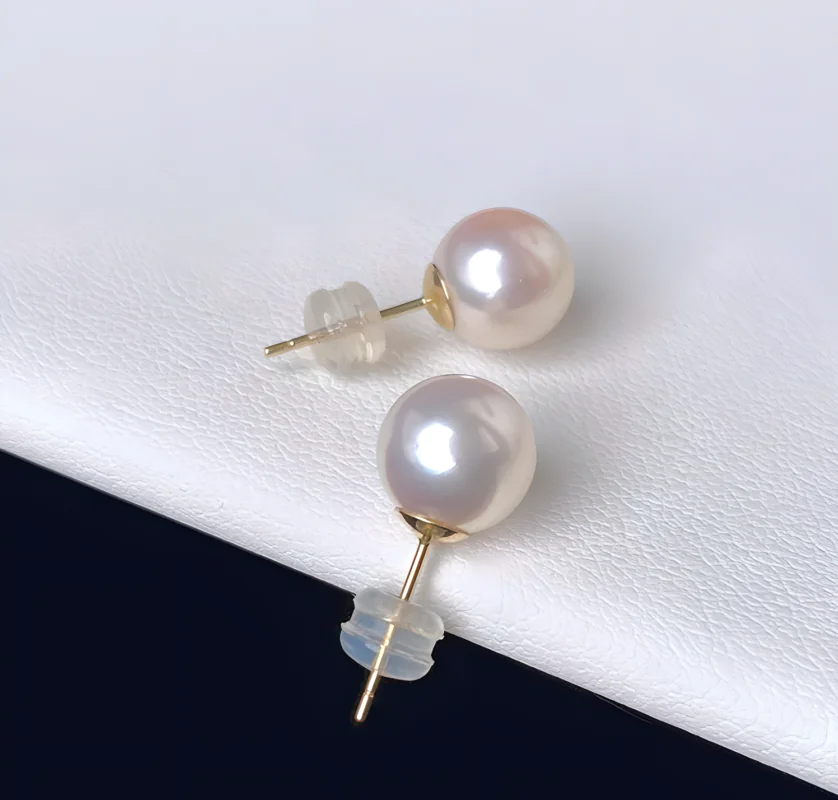
Short answer: no. Appearance can sometimes make a natural-pearl claim look more or less plausible, but it cannot reliably prove that a pearl formed naturally. Natural and cultured pearls can overlap in shape, color, luster, surface, and even internal-looking clues visible at a drill hole. When the distinction matters, gemological laboratories examine the pearl’s internal growth structure, usually with X-ray radiography.
This is an important distinction because natural, cultured, and imitation do not mean the same thing. A natural pearl forms in a mollusk without deliberate human initiation. A cultured pearl also forms in a living mollusk, but people intentionally start the pearl-forming process. An imitation pearl is a manufactured look-alike.
So the question “Is this pearl natural?” is not the same as “Is this pearl real?” A cultured pearl is still a real pearl. If your first concern is whether an object is genuine pearl material or an imitation, start with our guide to how to tell if pearls are real or fake. Natural-versus-cultured identification is a more difficult question.
Why Appearance Alone Cannot Confirm a Natural Pearl
The outside of a pearl records only part of its history. A natural pearl may be round or baroque, clean or blemished, bright or softly lustrous. Cultured pearls can show the same range. Modern pearl cultivation also produces both bead-nucleated and non-bead-cultured pearls, which means the simple idea that “cultured pearls have a bead inside and natural pearls do not” is incomplete.
GIA explains that it uses digital X-radiography together with visual observation and other analytical methods to determine whether pearls are natural or cultured. The reason is straightforward: the most useful evidence is often inside the pearl, where growth structures can be examined without cutting it open.
That makes exterior appearance useful for screening, but weak as proof.
What Visual Clues Can Suggest—and What They Cannot Prove
Several clues are repeatedly used in online pearl guides. Some are worth noticing, but each has important limits.
| Clue | What it may suggest | Why it is not proof |
|---|---|---|
| Irregular shape | A pearl may have formed without strong control over shape. | Many cultured pearls are deliberately sold in baroque, oval, drop, button, and other irregular shapes. |
| Perfect roundness | A highly uniform modern strand is consistent with careful culturing and sorting. | Natural pearls can be round, and historic natural-pearl jewelry was also carefully matched. |
| Surface blemishes | They show real growth or wear history. | Both natural and cultured pearls can have pits, rings, wrinkles, spots, or clean surfaces. |
| Deep luster or orient | Good nacre quality and attractive optical behavior. | Fine cultured pearls can have exceptional luster; beauty does not identify formation origin. |
| Visible line near a drill hole | In some bead-cultured pearls, it may reveal the boundary between a bead nucleus and surrounding nacre. | The boundary may be hidden, and non-bead-cultured pearls do not contain the same kind of bead nucleus. |
| Gritty “tooth test” feel | It may help distinguish some nacreous pearls from smooth imitations. | Natural and cultured pearls both can have nacre, so the test does not separate those two origins. |
The pattern is consistent: most visible features describe the pearl’s appearance or construction, not whether human intervention initiated its formation.
Shape Is One of the Most Misused Clues
Natural pearls are often described as irregular, while cultured pearls are described as round. There is some practical logic behind the generalization, but it becomes misleading when treated as a rule.
Culturing methods can produce round pearls, but they also produce intentionally marketable baroque and semi-baroque pearls. Freshwater cultured pearls, in particular, occur in a broad range of shapes. Natural pearls can also be round enough to be used in fine jewelry, and historically valuable natural strands were assembled by painstakingly matching many separate pearls.
So shape can help you ask better questions. It cannot answer the origin question by itself. If you want to understand what round, baroque, oval, button, drop, and other forms actually mean, see our pearl shape guide.
Luster and Surface Quality Tell You More About Quality Than Origin
A common sales myth is that natural pearls have a uniquely deep glow that cultured pearls cannot reproduce. In practice, luster depends on how light interacts with the pearl’s surface and nacre structure, and excellent cultured pearls can show sharp reflections, strong brightness, and complex overtones.
The same problem applies to blemishes. A natural pearl is not required to be rough or imperfect, and a cultured pearl is not required to be smooth. Surface condition can help you judge quality and wear, but it is a poor standalone test of natural origin.
For buying decisions, it is more useful to treat luster and surface as quality factors and judge them on their own terms. Our pearl grading guide explains how luster, surface, shape, size, color, nacre, and matching work together.
Drill Holes Can Reveal a Bead Nucleus—but Only Sometimes
A drilled bead-cultured pearl may occasionally reveal a visible boundary between its shell bead nucleus and the surrounding nacre. Under magnification, that can be a useful clue. But the absence of such a line does not establish that the pearl is natural.
There are two reasons.
First, a bead boundary may simply be difficult to see from the drill hole. The viewing angle, nacre thickness, drilling position, wear, dirt, setting, and the pearl’s internal structure can all limit what is visible.
Second, not every cultured pearl contains a large round bead nucleus. Many freshwater cultured pearls are grown by tissue nucleation and are commonly described as non-bead cultured. These pearls may consist largely of nacre and therefore defeat the simple “look for a bead” rule.
Non-Bead Cultured Pearls Are the Main Reason Simple Rules Fail
If every cultured pearl contained an obvious spherical bead, natural-versus-cultured identification would be much easier. But non-bead cultured pearls can develop internal structures that are far more complicated.
GIA research describes non-bead cultured pearls with irregular linear structures, voids, organic-rich features, and other internal patterns. Natural pearls can also show more varied internal structures than the familiar “onion-ring” diagram suggests. Some cases fall close enough together that a laboratory may need additional imaging, information about the mollusk, surface or age characteristics, or trace-element chemistry before reaching a conclusion.
This is the key nuance missing from many consumer guides: even the internal structure is interpreted, not reduced to one universal visual rule.
What Laboratories Actually Look for Inside a Pearl
Gemological laboratories commonly begin with visual and microscopic observation, then use non-destructive X-ray techniques to examine growth structures inside the pearl.
Natural pearls
Natural pearls may show concentric growth arcs, tight or minimal growth structures, organic-rich centers, or other patterns associated with natural formation. The exact appearance varies with the mollusk and the way the pearl developed.
Bead-cultured pearls
Bead-cultured pearls often show a relatively clear boundary between a shell bead nucleus and the nacre grown around it. X-radiography can reveal that demarcation much more reliably than looking through a drill hole.
Non-bead-cultured pearls
These may show central voids, linear features, irregular organic structures, or combinations that require experienced interpretation. They are one reason a claim such as “no bead is visible, therefore it must be natural” is unsafe.
When ordinary X-radiography does not show enough detail, higher-resolution methods such as X-ray computed microtomography (micro-CT) can provide three-dimensional information about internal structures. GIA notes that difficult or borderline cases may require this deeper level of examination.
Can an Experienced Jeweler or Pearl Dealer Tell by Looking?
Experience can improve judgment. Someone who handles large numbers of pearls may recognize combinations of size, shape, drilling style, wear, matching, age, setting, and market context that make a claim look plausible or suspicious.
But informed suspicion is not the same as identification.
A dealer may reasonably say, “This looks consistent with an older natural-pearl necklace,” or, “This strand looks much more like modern cultured material.” What appearance alone should not support is an absolute statement such as, “This is definitely natural.”
That distinction matters most when the word natural changes the price dramatically.
Provenance Helps, but It Does Not Replace Gemological Testing
For antique or inherited jewelry, provenance can be valuable context. Old invoices, family records, auction catalogs, photographs, maker marks, and the documented history of a piece may strengthen the case for a natural-pearl origin.
However, age alone does not prove that pearls are natural. Cultured pearls have been commercially important for more than a century, and older jewelry may have been restrung, repaired, or altered. A historical story and a laboratory conclusion answer different questions.
If the pearl’s identity affects insurance, resale, auction value, or a major purchase, independent testing is usually more useful than trying to infer everything from appearance.
When Is Laboratory Testing Worth It?
Not every pearl needs a laboratory report. For an ordinary modern cultured-pearl purchase with transparent seller disclosure, testing may add little practical value. But testing becomes much more important when the unanswered question materially changes what the pearl is worth or how it should be described.
Consider professional identification when:
- a seller is charging a substantial premium because the pearl is claimed to be natural;
- you are evaluating an antique or inherited pearl with uncertain history;
- a strand or loose pearl may be important for auction, insurance, estate, or resale purposes;
- the distinction between natural and cultured materially affects a transaction;
- treatment, freshwater-versus-saltwater environment, or mollusk origin also matters;
- visual clues conflict with the seller’s description.
GIA’s Pearl Identification Report, for example, can state whether submitted pearls are natural or cultured and may also report information such as environment, mollusk when determinable, and detectable treatments. For a broader discussion of what documentation can and cannot establish, see our pearl grading certificate guide.
A Practical Rule for Buyers: Do Not Pay a Natural-Pearl Premium for a Visual Guess
If you are looking at ordinary modern pearl jewelry, the most likely commercial category is cultured pearl, and that is not a negative. Cultured Akoya, Tahitian, South Sea, and freshwater pearls can all be genuine, high-quality pearls.
If a pearl is specifically represented as natural, however, the burden of evidence should rise with the price and rarity of the claim.
A useful decision framework is:
- First ask what claim is being made. “Real,” “natural,” “cultured,” “untreated,” and “saltwater” are different claims.
- Use appearance to look for contradictions or red flags. Shape, drill holes, matching, surface, and wear can provide context.
- Do not convert a clue into proof. A baroque shape, gritty feel, old mounting, or hidden bead boundary does not establish natural formation.
- Ask for documentation when natural origin affects the price.
- Use laboratory testing when the financial or historical stakes justify it.
This evidence-first approach is also useful when judging pearls from photos. Our guide to what appearance alone can and cannot tell you about a pearl explains how to separate visible evidence from assumptions.
The Bottom Line
You can sometimes look at a pearl and decide that a natural origin seems unlikely. You cannot reliably look at the exterior and prove that the pearl is natural.
Shape, luster, surface marks, matching, drill holes, age, and provenance are all pieces of evidence, but none is universally diagnostic. The most important distinction between a natural and a cultured pearl lies in how the pearl began to form, and the evidence for that history is often internal.
That is why serious natural-versus-cultured identification relies on X-radiography and, when necessary, additional laboratory methods. If “natural” is an important part of the price, rarity, or story of the pearl, treat appearance as the beginning of the investigation—not the conclusion.
FAQ
Can a natural pearl be perfectly round?
Yes. Natural pearls can be round, although many are off-round or irregular. Perfect roundness does not prove that a pearl is cultured, just as irregular shape does not prove that it is natural.
Can a cultured pearl have no visible bead nucleus?
Yes. Many cultured pearls, especially many freshwater cultured pearls, are non-bead cultured. Their growth may be initiated with mantle tissue rather than a large spherical bead, so “I cannot see a bead” is not proof of natural origin.
Can the tooth test tell whether a pearl is natural?
No. The tooth test may sometimes help distinguish nacreous pearls from smooth imitations, but both natural and cultured pearls can have nacre. It does not reliably separate natural pearls from cultured pearls.
Can a drill hole prove that a pearl is cultured?
Sometimes a drill hole reveals a boundary between a bead nucleus and nacre, which can strongly suggest bead-cultured construction. But the boundary may not be visible, and non-bead cultured pearls may not contain that kind of bead at all.
What test is used to identify natural pearls?
X-ray radiography is a central non-destructive method used by gemological laboratories to examine internal growth structures and separate natural, bead-cultured, and non-bead-cultured pearls. Difficult cases may require additional imaging or analytical methods.
Sources and Further Reading
- GIA: How does GIA identify whether pearls are natural or cultured?
- GIA: How GIA Analyzes Pearls from Start to Finish
- GIA Gems & Gemology: Applications of X-Ray Radiography and X-Ray Computed Microtomography in Gemology
- GIA Gems & Gemology: Internal Structures of Known Pinctada maxima Natural Pearls
- GIA: Pearl Reports & Services