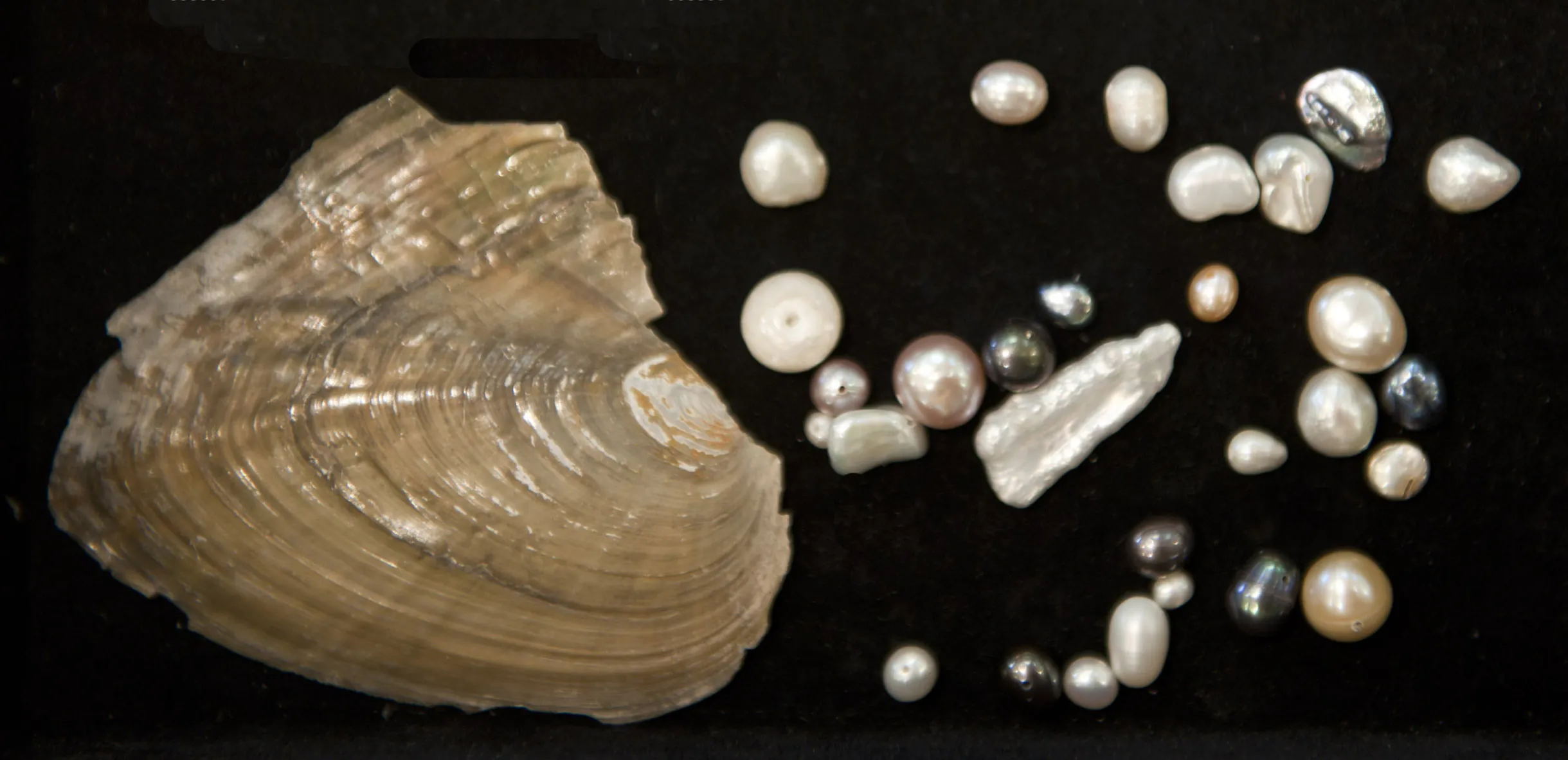
Usually, no. In modern pearl trade terminology, the pearls most buyers encounter as Keshi pearls are Keshi cultured pearls: non-beaded pearls connected to a pearl-culturing operation. They may form accidentally and they may contain no conventional bead nucleus, but that does not automatically make them natural pearls.
The key distinction is human intervention. A natural pearl develops without human intervention. A cultured pearl develops because human activity initiated or materially influenced the pearl-forming process. The absence of a bead is therefore not enough to move a pearl from the cultured category into the natural category.
There is one important terminology nuance. CIBJO notes that Keshi is an old Japanese trade term that has been used for both small saltwater natural pearls and non-beaded cultured pearls. For that reason, CIBJO recommends qualifying the word as “Keshi natural pearl” or “Keshi cultured pearl” when the distinction matters.
Keshi vs. natural pearl: the difference at a glance
| Question | Natural pearl | Keshi cultured pearl | Typical bead-cultured pearl |
|---|---|---|---|
| Human intervention involved in pearl formation? | No | Yes, directly or indirectly through the culturing process | Yes |
| Solid bead nucleus at harvest? | Usually no manufactured bead | No conventional solid bead | Usually yes in saltwater pearl culture |
| Can it form accidentally? | Yes | Yes | The pearl is intentionally cultured, although the final result is biologically variable |
| Is it an imitation? | No | No | No |
| Best buyer-facing description | Natural pearl | Keshi cultured pearl / non-beaded cultured pearl | Cultured pearl |
If you want the broader classification framework beyond Keshi, see our guide to how pearls are classified.
Why does a beadless Keshi pearl still count as cultured?
This is where most of the confusion begins. Many people learn a simplified rule:
bead inside = cultured, no bead = natural.
That rule is too simple.
Cultured pearls do not all need a solid bead nucleus. GIA explicitly distinguishes bead-nucleated, tissue-nucleated, and other non-bead cultured pearls. What matters is not simply what sits in the center of the finished pearl, but how the pearl-forming process was initiated.
A Keshi cultured pearl may develop when a pearl-culturing operation creates conditions for a pearl sac to form, but the intended bead is rejected, separated from the grafted tissue, or otherwise does not remain at the center of the finished pearl. Nacre can continue to accumulate without that bead.
So a Keshi can be beadless and still be cultured. Beadless and natural are not synonyms.
How can Keshi pearls form during cultivation?
CIBJO describes Keshi cultured pearls as non-beaded cultured pearls that can arise through human-influenced processes in marine pearl oysters. Depending on the case, the pearl sac may develop after handling-related mantle injury, from part of the inserted mantle tissue, or from graft tissue that remains active after a bead is rejected.
The exact biological path can vary, which is why it is better to think of Keshi as a cultivation-related formation category rather than as a single one-step accident.
For a fuller explanation of formation, shape, luster, and value, read our complete Keshi pearl guide.
Why are Keshi pearls so often described as “natural”?
The description sounds plausible for several reasons.
First, Keshi cultured pearls usually do not have the standard round shell bead found inside many saltwater cultured pearls. That makes their internal structure feel closer to what buyers imagine a natural pearl should be.
Second, many Keshi pearls are not the farmer's intended main product. They can appear as an unexpected by-product of cultivation, so sellers sometimes describe them as a “natural accident.” That phrase may describe the unpredictability of the result, but it should not be confused with the technical category natural pearl.
Third, Keshi pearls often have organic, irregular outlines. Their free-form appearance can look less controlled than a round bead-cultured pearl, which encourages another mistaken assumption: if the shape looks spontaneous, the pearl must be natural.
None of those features changes the core classification rule. A pearl can look organic, grow without a bead, and form unexpectedly while still belonging to the cultured category.
“Real pearl” and “natural pearl” are not the same question
For consumers, two different questions are often mixed together:
- Is this a genuine pearl rather than an imitation?
- Is this pearl natural rather than cultured?
A Keshi cultured pearl is a genuine pearl produced by a pearl-forming mollusk. It is not a plastic, glass, or coated imitation bead. But in careful gemological terminology, that does not make it a natural pearl.
If your concern is whether a pearl is genuine or imitation rather than natural or cultured, see how to tell if pearls are real or fake.
What do pearl standards actually say about Keshi?
The terminology is more nuanced than many retail descriptions suggest.
CIBJO's 2024 Pearl Book defines Keshi as an old Japanese trade name that historically can refer to a small saltwater natural pearl or a non-beaded cultured pearl. It then separately defines a Keshi cultured pearl as a non-beaded cultured pearl formed through human intervention in marine pearl oysters and associated with the culturing process.
CIBJO also warns that using the word Keshi by itself can be ambiguous and recommends qualifying it with natural or cultured when appropriate.
The Japan Pearl Standard is even more direct for modern seawater production: seawater pearls without bead nuclei that form as by-products of cultured-pearl production should be described as Keshi, and the word cultured should be added to make the origin clear.
That is why the most precise modern product wording is usually Akoya Keshi cultured pearl, South Sea Keshi cultured pearl, or Tahitian Keshi cultured pearl rather than simply “natural Keshi.”
Can a natural pearl ever be called Keshi?
Historically, yes. This is the small but important exception behind much of the terminology debate.
CIBJO records Keshi as an old trade name that has been used for small saltwater natural pearls as well as non-beaded cultured pearls. So it would be too absolute to claim that the word itself has never been connected with natural pearls.
But that historical usage is not a good reason to market an ordinary modern farm-produced Keshi cultured pearl as a natural pearl. If a seller intends the word natural in the gemological sense, the pearl should actually meet the natural-pearl definition: it formed without human intervention.
Does “100% nacre” mean a Keshi is natural?
No. A pearl can be non-beaded and nacre-rich without being natural.
This is another common shortcut in product descriptions. Because a typical Keshi cultured pearl does not contain a conventional shell bead, sellers often emphasize that it is made predominantly or essentially of nacre. That can be an important structural feature, but it tells you about the pearl's construction—not automatically about whether humans were involved in its formation.
In other words:
“No bead” describes structure. “Natural” describes origin.
Those are different questions.
What about “freshwater Keshi pearls”?
You will see the phrase freshwater Keshi in the market, but terminology is inconsistent. CIBJO's modern Keshi cultured-pearl definition is centered on marine pearl oysters, while freshwater cultivation already produces large numbers of non-beaded cultured pearls as normal products rather than accidental saltwater by-products.
For that reason, a freshwater pearl is often better described by how it was actually cultured instead of relying on the Keshi label alone. Our guide to freshwater non-nucleated pearls explains that category in more detail.
How should you read a Keshi pearl product listing?
If a seller simply writes “Keshi pearl,” the name by itself may not tell you everything you need to know. A useful product description should make the formation category clearer.
For an ordinary jewelry purchase, look for wording such as Keshi cultured pearl, the pearl-oyster type when relevant, size, color, luster, surface condition, and whether any treatment has been disclosed.
If a seller is charging a substantial premium because a pearl is claimed to be natural, the evidence standard should be much higher. Natural origin can materially affect rarity and price, so it should not rest on the fact that the pearl is irregular or lacks a visible bead.
Can you tell a natural pearl from a Keshi cultured pearl by eye?
Not reliably in every case.
External appearance can provide clues, but natural pearls and non-bead cultured pearls can overlap in shape and appearance. Gemological laboratories use methods such as X-radiography, and in more difficult cases may use three-dimensional imaging such as micro-CT, to examine internal growth structures.
That matters most when the natural-versus-cultured distinction has a major effect on price, provenance, insurance, or resale. For routine Keshi jewelry, a laboratory report may not be necessary. For a high-value pearl sold specifically as natural, independent identification can be much more important.
Final answer: are Keshi pearls natural pearls?
Most modern Keshi pearls in the jewelry market should be understood as cultured pearls, not natural pearls. Their lack of a conventional bead nucleus does not change that classification when they formed as part of, or because of, a pearl-culturing process.
The historical word Keshi is broader than that simple answer, which is why precise wording matters. When origin matters, avoid relying on “Keshi” alone. Look for Keshi cultured pearl or, in the uncommon case of a genuinely natural pearl, an explicitly supported natural-pearl identification.
The simplest rule to remember is: beadless does not mean natural; human intervention is the key distinction.
Frequently Asked Questions
Are Keshi pearls cultured pearls?
In modern commercial usage, most Keshi pearls are best described as Keshi cultured pearls. They are non-beaded pearls associated with the pearl-culturing process.
Are Keshi pearls genuine pearls?
Yes. Keshi cultured pearls are genuine biological pearls produced by mollusks, not imitation pearl beads. However, “genuine” should not be confused with the technical category “natural pearl.”
If a Keshi pearl has no bead nucleus, why is it cultured?
Because natural-versus-cultured classification depends on human intervention in the pearl-forming process, not merely on whether a solid bead remains inside the finished pearl.
Can sellers describe Keshi pearls as natural?
Only when the pearl truly qualifies as natural. CIBJO notes that the old word “Keshi” has historical natural-pearl usage, but it recommends qualifying the term because modern Keshi cultured pearls are also common.
Do I need a laboratory report for a Keshi pearl?
Usually not for ordinary Keshi jewelry. A report becomes more useful when a pearl is unusually valuable or when the seller's natural-origin claim materially affects the price.
References
- CIBJO Pearl Book 2024 — definitions of “Keshi” and “Keshi cultured pearl.”
- GIA: What is the difference between natural and cultured pearls? — natural pearls form without human intervention; cultured pearls result from human intervention.
- GIA: What does it mean when cultured pearls are also called “natural”? — clarification that cultured pearls should not be described as natural pearls.
- Pearl Standard of Japan 2020 — terminology guidance for seawater Keshi cultured pearls.
- GIA: How GIA Analyzes Pearls from Start to Finish — laboratory methods used to distinguish natural, bead-cultured, and non-bead cultured pearls.